The wastewater treatment process removes solids, oil, organic load, chemicals, nutrients, and pathogens from used water before discharge, reuse, or further treatment. In an industrial ETP, STP, or CETP, the process does not end with clear water. Every stage also creates sludge, and that sludge must be thickened, dewatered, dried, stored, transported, or disposed of correctly.
For plant teams, the real question is not only “Is the treated water within limits?” It is also “What are we doing with the sludge generated every day?”
Quick answer: what happens in wastewater treatment?
A typical wastewater treatment plant works in two connected lines:
| Line | What it handles | Main purpose |
|---|---|---|
| Water line | Liquid wastewater | Remove suspended solids, organic matter, oil, chemicals, nutrients, and pathogens |
| Sludge line | Solids separated from wastewater | Reduce sludge volume, improve handling, reduce disposal burden, and prepare for drying or approved disposal |
In simple terms, wastewater treatment separates water from contamination. Sludge management handles the concentrated contamination left behind.
For a broader plant-level explanation, also read this guide on a wastewater treatment plant.
Main stages of the wastewater treatment process
Most ETP and STP systems use a staged process. The exact design depends on wastewater source, flow rate, pollutant load, BOD, COD, TSS, oil and grease, pH, nutrients, salinity, and discharge or reuse requirements.
| Stage | Main equipment or process | What it removes | Sludge impact |
|---|---|---|---|
| Preliminary treatment | Bar screen, coarse screen, fine screen, grit chamber, oil trap | Large solids, plastics, rags, grit, sand, floating oil | Screenings and grit need separate handling |
| Equalization and pH correction | Equalization tank, mixer, dosing system | Flow and load variation, pH instability | Helps avoid shock load to downstream treatment |
| Primary treatment | Primary clarifier, settling tank, coagulation-flocculation where needed | Settleable solids, suspended solids, some oil and grease | Produces primary sludge |
| Secondary treatment | Aeration tank, activated sludge, MBBR, SBR, MBR, secondary clarifier | Biodegradable organic matter, BOD, part of COD | Produces biological or secondary sludge |
| Tertiary treatment | Sand filter, carbon filter, UF, RO, nutrient removal, polishing systems | Fine solids, colour, nutrients, dissolved contaminants depending on system | May generate backwash sludge or chemical sludge |
| Disinfection | Chlorination, UV, ozone, or suitable system | Pathogens and microbial risk | Usually low sludge generation |
| Sludge treatment | Thickener, filter press, screw press, centrifuge, dryer | Water from sludge cake | Reduces volume and improves disposal handling |
For a focused breakdown of the four major stages, refer to the 4 stages of wastewater treatment process.
Preliminary treatment: removing large solids before damage happens
Preliminary treatment protects pumps, pipes, valves, aeration systems, clarifiers, and downstream equipment.
Common equipment includes:
- Bar screens for rags, plastics, wrappers, and coarse solids
- Fine screens for smaller suspended debris
- Grit chambers for sand, grit, stones, and heavy inorganic particles
- Oil and grease traps or skimmers for floating oil and grease
This stage looks simple, but poor screening can create repeated pump choking, bad odour, sludge contamination, and maintenance downtime.
If your plant faces frequent choking at the inlet, review screen opening size, cleaning frequency, hydraulic loading, and actual wastewater composition. You can also connect this topic with bar screens in wastewater treatment.
Equalization and pH correction
Industrial wastewater rarely comes at a constant flow and constant pollutant load. A textile, chemical, pharma, food, dye, paper, or metal-processing plant may discharge different wastewater streams at different times of the day.
The equalization tank helps:
- Balance flow variation
- Reduce shock loading
- Mix different wastewater streams
- Stabilize pH before biological or chemical treatment
- Improve downstream treatment consistency
In many ETPs, equalization is where problems begin. If mixing is poor or pH control is unstable, the biological system may suffer, chemical dosing may increase, and sludge quality may become inconsistent.
Primary treatment: settling the heavier load
Primary treatment separates settleable solids from wastewater before biological treatment.
Common systems include:
- Primary clarifier
- Settling tank
- Chemical coagulation and flocculation system, where required
- Oil and grease removal system
- Sludge collection mechanism
Primary sludge usually contains heavier suspended solids, organic matter, oil, grease, and process-specific residues. In industrial plants, primary sludge quality can change significantly depending on production batches, raw materials, cleaning cycles, and chemical dosing.
Read more about sludge differences in primary sludge vs secondary sludge.
Secondary treatment: biological treatment of organic load
Secondary treatment uses microorganisms to break down biodegradable organic matter. This is where BOD reduction normally happens.
Common biological treatment systems include:
| System | Where it is commonly used | Practical note |
|---|---|---|
| Activated sludge process | STP, ETP, municipal plants | Needs aeration control, MLSS balance, return sludge control, and operator attention |
| MBBR | Industrial and municipal plants | Biofilm media supports microbial growth and can handle load variation better in many cases |
| SBR | Batch-operated STP/ETP systems | Useful where sequencing, aeration, settling, and decanting are controlled in one tank |
| MBR | Higher-quality treated water applications | Combines biological treatment with membrane separation |
| Anaerobic treatment | High-strength organic wastewater | Produces biogas in suitable conditions but needs careful control |
The biological stage produces secondary sludge. This sludge is generally lighter and more biological in nature compared with primary sludge. It can be difficult to dewater if microbial health, polymer dosing, solids loading, or sludge age is not controlled.
For operational issues in biological systems, read the activated sludge troubleshooting guide.
Secondary clarification and return sludge control
After biological treatment, the mixed liquor moves to a secondary clarifier. The clarifier separates treated water from biological solids.
The settled biological sludge is usually split into:
- Return activated sludge, sent back to maintain the biological population
- Waste activated sludge, removed from the system for sludge handling
If return sludge control is poor, the plant may face floating sludge, high TSS in outlet, odour, bulking, foaming, or unstable treatment performance.
Plant teams should track:
- MLSS
- SVI
- sludge blanket level
- return sludge flow
- waste sludge rate
- dissolved oxygen
- pH
- nutrient balance
- settling behaviour
Tertiary treatment: polishing treated water
Tertiary treatment improves treated water quality after primary and secondary treatment. It is used when the plant needs better removal of suspended solids, colour, nutrients, dissolved contaminants, or when reuse and ZLD integration are planned.
Common tertiary systems include:
- Pressure sand filter
- Activated carbon filter
- Multi-grade filter
- Ultrafiltration
- Reverse osmosis
- Nutrient removal systems
- Chemical polishing
- Advanced oxidation, where required
For industrial plants moving toward water reuse, tertiary treatment often becomes critical. But it also creates backwash water, reject streams, and additional solids that must be included in the sludge and waste management plan.
For reuse-focused plants, see the zero liquid discharge guide.
Disinfection before discharge or reuse
Disinfection reduces pathogen risk before discharge, reuse, gardening, flushing, cooling tower makeup, or other permitted applications.
Common disinfection methods include:
- Chlorination
- UV disinfection
- Ozonation
- Suitable chemical disinfection systems
The correct method depends on water quality, turbidity, reuse application, local requirements, operating cost, safety, and maintenance capability.
Disinfection does not solve poor upstream treatment. If suspended solids or organic load remain high, disinfection becomes less reliable and more expensive.
Where sludge is generated in wastewater treatment
Sludge is not a side issue. It is a direct output of treatment.
| Source | Type of sludge or waste | Handling challenge |
|---|---|---|
| Screening | Plastics, rags, coarse solids | Manual handling, odour, disposal |
| Grit chamber | Sand, grit, heavy particles | Abrasion, storage, landfill burden |
| Primary clarifier | Primary sludge | High moisture, odour, organic content |
| Biological treatment | Waste activated sludge | Difficult dewatering if poorly conditioned |
| Chemical treatment | Chemical sludge | Variable composition, higher inorganic content |
| Tertiary filtration | Backwash sludge | Intermittent generation |
| RO/ZLD pre-treatment | Concentrated reject or solids | Needs process-specific handling |
For deeper sludge-side understanding, read wastewater treatment sludge.
Sludge thickening, dewatering, and drying
Sludge treatment usually follows a step-by-step path. Each step removes water in a different way.
| Step | What it does | Typical output |
|---|---|---|
| Thickening | Concentrates dilute sludge | Thickened sludge |
| Conditioning | Uses polymer, lime, or chemicals where required | Better dewatering behaviour |
| Dewatering | Removes free water mechanically | Sludge cake |
| Drying | Removes additional moisture thermally or through drying systems | Drier, lighter sludge |
| Disposal or reuse route | Sends solids to approved route | TSDF, landfill, co-processing, incineration, composting, fuel, bricks, or other approved use depending on composition |
Dewatering and drying are not the same. Dewatering removes free water using mechanical force. Drying removes more moisture using heat, air movement, solar exposure, or indirect thermal contact.
For comparison, read sludge dewatering techniques and the sludge dewatering machine guide.
Dewatering vs sludge drying
| Point | Dewatering | Sludge drying |
|---|---|---|
| Main purpose | Remove free water mechanically | Reduce additional moisture after dewatering |
| Common equipment | Filter press, belt press, screw press, centrifuge | Paddle dryer, disc dryer, belt dryer, solar dryer, thermal dryer |
| Output | Wet sludge cake | Drier sludge with lower volume and better handling |
| Best for | First-stage volume reduction | Further volume reduction and disposal-cost control |
| Limitation | Cake still contains high moisture | Needs heat source, vapour handling, safety review, and correct sizing |
For dryer selection, see sludge drying methods and systems and the thermal sludge drying system guide.
When should an ETP or STP consider sludge drying?
Sludge drying should be evaluated when wet sludge creates cost, space, odour, transport, or disposal problems.
| Situation | Drying fit |
|---|---|
| Wet sludge disposal cost is high | Strong fit for evaluation |
| Sludge transport distance is high | Strong fit because weight and volume matter |
| Sludge storage area is limited | Strong fit |
| Sludge is difficult to handle manually | Strong fit |
| Plant generates consistent sludge volume daily | Stronger fit for continuous dryer evaluation |
| Sludge composition changes heavily every day | Needs trials and careful process review |
| Sludge contains hazardous chemicals | Needs EHS, regulatory, and disposal-route review before dryer selection |
| Final moisture target is unknown | Not ready for dryer RFQ |
| No data on feed moisture, cake solids, or daily sludge quantity | Data collection needed first |
A dryer should not be selected only by plant capacity or motor HP. It should be selected from sludge properties, feed moisture, final moisture target, operating hours, heating medium, vapour handling, MOC, pollution-control requirement, and disposal route.
How a paddle dryer fits after wastewater treatment
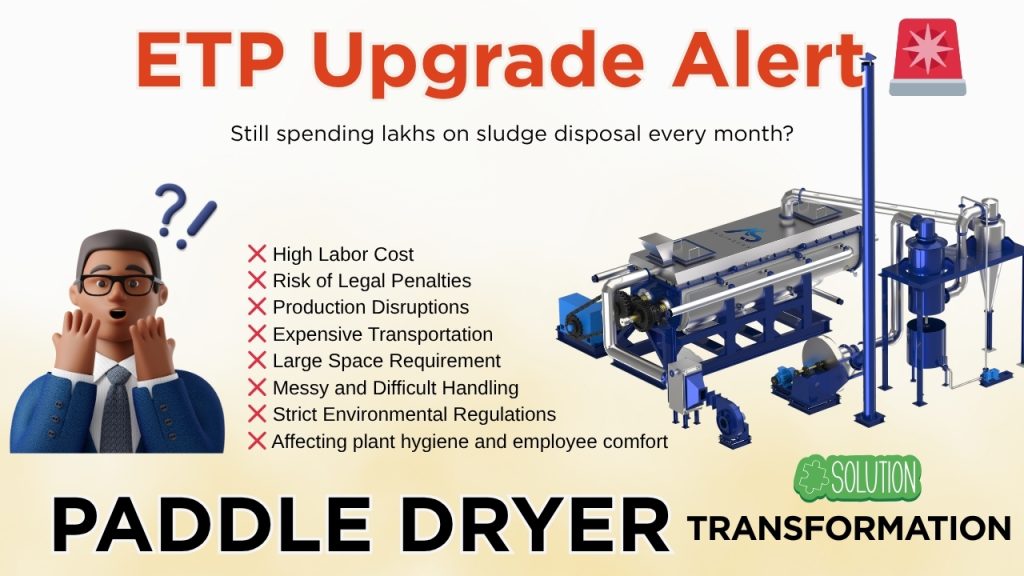
In many ETP and STP plants, a sludge dryer is installed after dewatering. A dewatering machine produces sludge cake, and the dryer further reduces moisture to improve handling and reduce disposal burden.
A paddle dryer is suitable for many sludge applications because it uses indirect heat transfer. Heat is transferred through hollow shafts, heated surfaces, and jacketed construction. The paddles mix and move the sludge while heat evaporates moisture.
For sludge drying, practical design review should include:
- Feed sludge type: ETP, STP, CETP, biological, chemical, paper, pharma, textile, dye, food, or oil sludge
- Feed moisture and final moisture target
- Sludge cake consistency: sticky, pasty, fibrous, granular, oily, abrasive, or corrosive
- Daily sludge quantity
- Operating hours per day
- Heating medium: steam, thermic fluid, hot water, or other source
- Vapour and odour handling
- Condensation or scrubbing requirement
- Dust and fines handling
- Material of construction
- Discharge handling, storage, bagging, or truck loading
- Disposal or reuse route
For conductive drying, read sludge treatment with conductive paddle dryers and the sludge paddle dryer selection guide.
Why sludge drying affects the economics of wastewater treatment
Many plants focus on aeration, chemical dosing, filters, and treated water quality, but ignore sludge cost until it becomes a recurring expense.
Wet sludge can increase:
- Transport cost
- Storage area requirement
- Labour requirement
- Odour complaints
- Handling difficulty
- Disposal frequency
- Dependence on outside disposal agencies
- Hygiene and housekeeping burden
Drying does not remove the need for proper disposal approval. But it can reduce moisture, reduce volume, improve handling, and make downstream disposal planning easier when the sludge composition and legal route are properly reviewed.
For disposal planning, read the industrial sludge disposal guide.
Common mistakes in wastewater treatment process planning
Treating sludge as an afterthought
A wastewater treatment plant should be designed with both water and sludge lines in mind. If sludge handling is weak, the plant may meet treated water targets but still suffer from daily disposal problems.
Selecting equipment from capacity alone
Two plants with the same flow rate can generate very different sludge. Textile, pharma, chemical, food, paper, dairy, and metal-treatment sludge behave differently. Selection must consider actual sludge characteristics.
Ignoring upstream variation
Production changes, cleaning cycles, chemical dosing, and batch discharge can change wastewater quality. Equalization and monitoring are essential.
Confusing dewatering with drying
A filter press or centrifuge reduces sludge moisture, but the cake may still remain heavy. Drying is a separate step and needs thermal, vapour, odour, and safety review.
Not defining final sludge destination
Before choosing a dryer, the plant should know whether dried sludge will go to TSDF, landfill, co-processing, incineration, composting, bricks, fuel use, or another approved route. The disposal route affects moisture target and system design.
RFQ checklist for wastewater sludge dryer selection
Before asking for a sludge dryer proposal, prepare these inputs:
| RFQ input | Why it matters |
|---|---|
| Sludge source | ETP, STP, CETP, biological, chemical, mixed, oil, paper, textile, pharma, food |
| Feed quantity | kg/hr or tons/day |
| Operating hours | Batch or continuous duty |
| Feed moisture | Starting moisture percentage |
| Final moisture target | Required dryness or handling target |
| Sludge cake behaviour | Sticky, pasty, granular, fibrous, abrasive, corrosive, oily |
| Current dewatering equipment | Filter press, screw press, belt press, centrifuge, drying bed |
| Heating medium available | Steam, thermic fluid, hot water, waste heat, electricity, fuel |
| Vapour handling need | Condenser, scrubber, bag filter, cyclone, chimney, odour control |
| MOC expectation | CS, SS304, SS316, duplex, alloy, or other requirement |
| Disposal route | TSDF, co-processing, landfill, incineration, reuse, composting, bricks |
| Site constraints | Space, height, power, foundation, access, maintenance clearance |
| Automation need | Manual, semi-automatic, fully automatic, PLC, data logging |
Incomplete RFQ data leads to wrong sizing, wrong heating surface, unstable drying, high operating cost, or poor sludge discharge behaviour.
Practical AS Engineers note
When we review a wastewater sludge drying requirement, we do not start with the dryer model alone. We first look at the sludge source, feed moisture, final moisture target, daily quantity, dewatering method, heating medium, vapour handling, MOC, and disposal route.
For ETP and STP teams, this avoids one of the most common mistakes: selecting a dryer before understanding the actual sludge.
Conclusion
The wastewater treatment process is not only a water-cleaning process. It is also a sludge-generation process. Screening, primary treatment, biological treatment, tertiary polishing, and disinfection are important, but sludge thickening, dewatering, drying, storage, and disposal decide the long-term operating burden of the plant.
For industrial ETP, STP, and CETP projects, review both the treated water line and the sludge line together. If sludge disposal cost, handling, odour, transport, or storage has become a recurring issue, evaluate dewatering and drying with proper sludge data.
To review a sludge drying requirement, share feed moisture, final moisture target, sludge quantity, sludge type, current dewatering method, heating medium, vapour handling need, and disposal route with the AS Engineers team.
FAQs
What are the main stages of the wastewater treatment process?
The main stages are preliminary treatment, equalization, primary treatment, secondary biological treatment, tertiary polishing, disinfection, and sludge handling. Industrial plants may also include oil removal, pH correction, chemical dosing, filtration, membrane treatment, or ZLD integration depending on wastewater quality and reuse goals.
What is the difference between primary, secondary, and tertiary treatment?
Primary treatment removes settleable solids and some suspended matter. Secondary treatment uses biological processes to reduce organic load such as BOD. Tertiary treatment polishes the treated water through filtration, nutrient removal, carbon filtration, membrane systems, or other advanced treatment steps.
Where is sludge generated in wastewater treatment?
Sludge is generated from primary clarifiers, secondary biological treatment, chemical treatment, tertiary filtration backwash, and other separation systems. Screening and grit removal also generate solid waste that must be handled separately.
Is sludge dewatering the same as sludge drying?
No. Dewatering removes free water mechanically using a filter press, belt press, screw press, or centrifuge. Sludge drying removes more moisture after dewatering using thermal, solar, or indirect drying systems. Drying is usually considered when plants need further volume reduction and better sludge handling.
What data is required before selecting a sludge dryer?
The main inputs are sludge type, feed quantity, feed moisture, final moisture target, operating hours, sludge behaviour, heating medium, vapour handling need, material of construction, site constraints, and final disposal route. Without these inputs, dryer selection can become inaccurate.