Sludge drying methods are used to reduce moisture from dewatered sludge so the sludge becomes lighter, easier to handle, and more suitable for disposal, reuse, fuel recovery, or further treatment. The best sludge drying method depends on sludge type, feed moisture, required final moisture, land availability, energy source, odour control, vapour handling, and local disposal rules.
In many plants, sludge drying is not only a machine decision. It is a system decision. The dryer, feed system, heating system, vapour handling, pollution control equipment, discharge arrangement, safety controls, and maintenance access must work together.
This guide explains practical sludge drying methods, where each method fits, and how plant teams can select a sludge drying system with fewer surprises after installation.
What Sludge Drying Means
Sludge drying is the controlled removal of water from sludge after thickening and mechanical dewatering. It is normally used after equipment such as a filter press, screw press, belt press, decanter centrifuge, or plate and frame press.
The purpose is to reduce moisture so the sludge becomes:
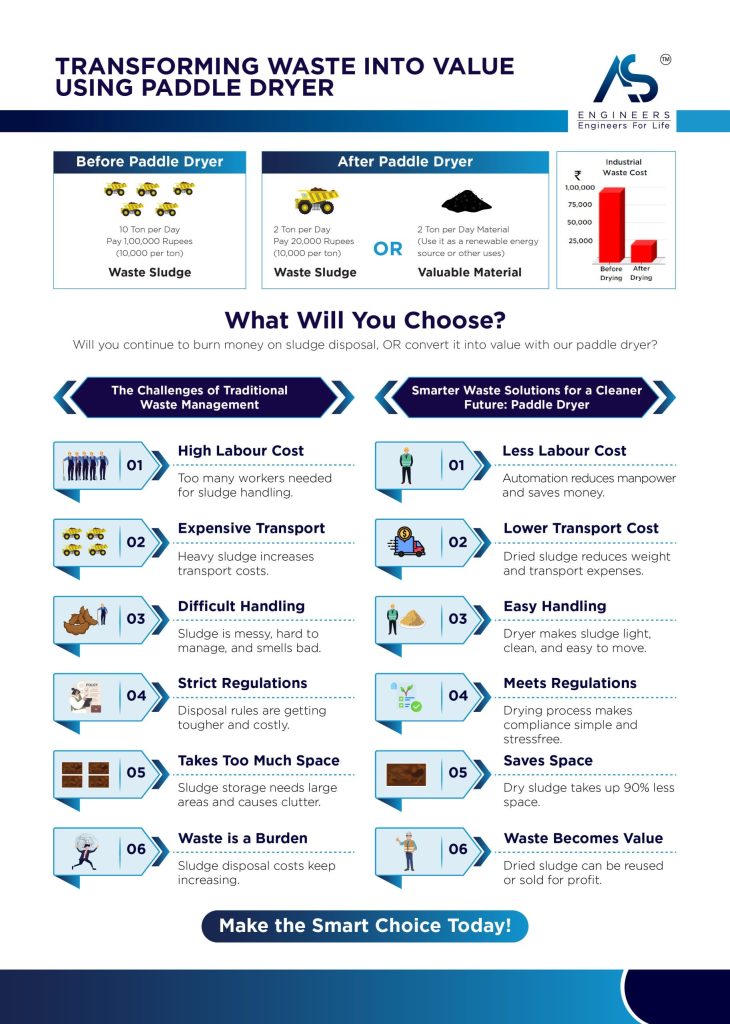
- Lower in weight and volume
- Easier to store and transport
- Less messy during handling
- More stable for disposal or reuse
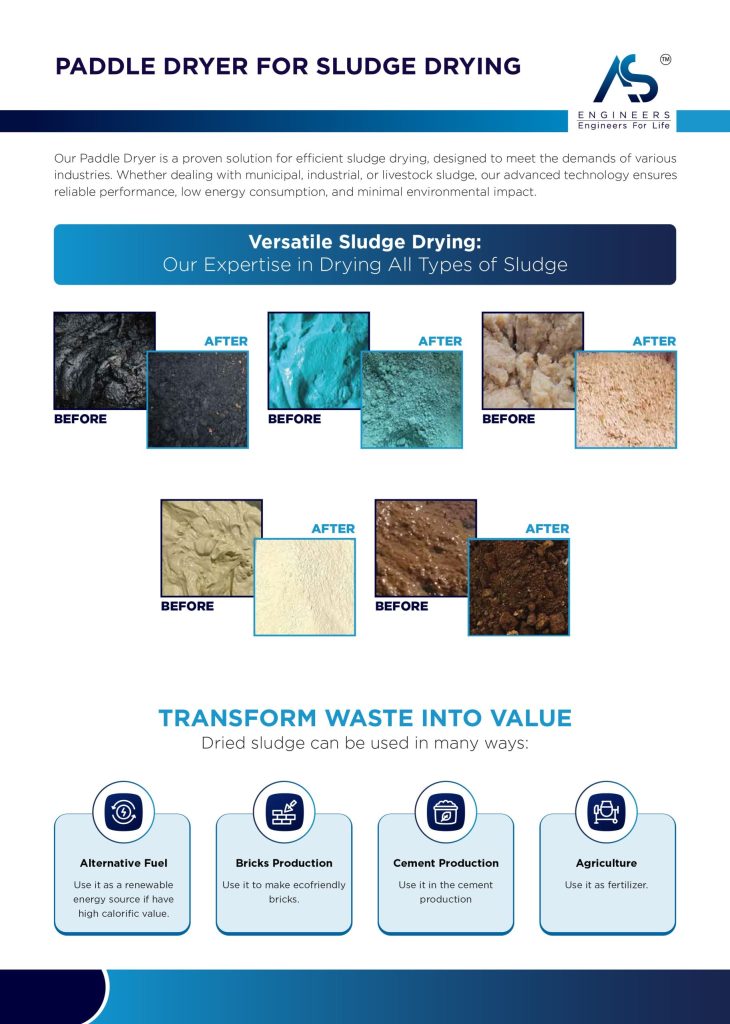
- Better suited for thermal treatment, co-processing, brick production, cement use, or controlled landfill disposal, where legally permitted
For a deeper treatment-chain explanation, read our guide on what sludge is and how it moves through the treatment process.
Where Sludge Drying Fits in the Treatment Chain
A practical sludge drying system usually follows this sequence:
| Stage | Purpose | Common Equipment |
|---|---|---|
| Sludge collection | Collect sludge from ETP, STP, CETP, process plant, clarifier, or biological treatment | Sludge pit, sump, holding tank |
| Thickening | Increase solids before dewatering | Gravity thickener, mechanical thickener |
| Dewatering | Remove free water mechanically | Filter press, screw press, belt press, centrifuge |
| Drying | Remove remaining moisture by natural, solar, or thermal method | Drying bed, solar dryer, paddle dryer, rotary dryer, disc dryer |
| Vapour and odour handling | Manage evaporated moisture, fines, odour, and process vapour | Cyclone, scrubber, bag filter, condenser, ID fan |
| Dried sludge handling | Move, cool, store, bag, truck, or send for reuse/disposal | Screw conveyor, bagging system, silo, truck disposal system |
Drying should not be selected before checking the dewatering stage. A poorly dewatered sludge cake can increase drying load, fuel cost, residence time, and handling problems.
For pre-drying equipment selection, see sludge dewatering techniques and belt filter press vs screw press dewatering.
Main Sludge Drying Methods
Sludge drying methods can be grouped into five practical categories.
| Sludge Drying Method | Best Fit | Main Advantage | Main Limitation |
|---|---|---|---|
| Drying beds | Small plants, low urgency, available land | Simple and low energy | Weather, land, odour, and long drying time |
| Solar drying | Municipal sludge, low-to-medium volume, sunny climate, land availability | Lower external energy demand | Weather dependency and large footprint |
| Direct thermal drying | High throughput applications where hot gas contact is acceptable | Fast moisture evaporation | Higher off-gas volume and stronger emission-control requirement |
| Indirect thermal drying | Sticky, paste-like, industrial, ETP, STP, and controlled drying duties | Heating medium does not directly contact sludge | Requires proper feed, vapour, and discharge design |
| Hybrid systems | Plants needing staged drying or waste heat use | Better energy integration | More complex design and control |
The correct choice is not “one dryer is best for all sludge.” The correct choice is the method that matches sludge behaviour, site constraints, moisture target, and disposal or reuse route.
Drying Beds
Drying beds use natural drainage and evaporation. Sludge is spread over a prepared bed, and water is removed through drainage and atmospheric drying.
Drying beds may fit where:
- Sludge volume is low
- Land is available
- Drying time is not urgent
- Odour risk is manageable
- Weather conditions support open drying
- The sludge is not highly hazardous or difficult to expose
Drying beds may not fit where the plant has limited land, high monsoon impact, odour complaints, hazardous sludge, or strict handling requirements.
For a dedicated explanation, read our sludge drying bed guide.
Solar Sludge Drying
Solar sludge drying uses solar heat, greenhouse-type structures, ventilation, and sometimes sludge turning systems. It is more controlled than open drying beds, but it still depends heavily on climate, land, and drying time.
Solar drying can work well where:
- The sludge is suitable for slower drying
- Land is available
- Climate supports evaporation
- Energy cost reduction is the main priority
- Final moisture target is not extremely aggressive
- Odour and vector control can be managed
Solar drying becomes difficult when the plant needs compact layout, fast drying, year-round consistency, or enclosed handling.
For a direct comparison, see solar drying for wastewater sludge and paddle dryer vs solar bed area requirement.
Direct Thermal Sludge Drying
In direct thermal drying, hot gas comes into direct contact with sludge. Heat transfer is fast because the hot air or flue gas directly carries moisture away from the material.
Direct thermal drying may fit:
- High throughput applications
- Non-sticky or better-conditioned sludge
- Plants with strong off-gas treatment
- Applications where direct contact with hot gas is acceptable
- Sites with enough space and utilities for exhaust treatment
The concern is off-gas load. Direct systems can generate larger air volumes, which may increase the size and importance of odour control, dust capture, and emission treatment.
Indirect Thermal Sludge Drying
Indirect thermal drying separates the heating medium from the sludge. Heat passes through a surface such as a jacket, hollow shaft, disc, paddle, or heated wall. The sludge does not directly mix with flame or hot gas.
Indirect sludge drying is useful when the plant needs:
- Enclosed drying
- Lower off-gas volume
- Better odour containment
- Controlled heat transfer
- Handling of sticky or paste-like sludge
- Better suitability for industrial ETP sludge
- More controlled vapour and fines management
This is where paddle dryers are commonly considered.
Paddle Dryer for Sludge Drying
A paddle dryer is an indirect sludge dryer. In an AS Engineers paddle dryer, heat is transferred through the jacket and hollow shafts. Wedge-shaped paddles agitate the sludge, break down lumps, expose wet surfaces, and move material through the dryer.
The system can be designed around:
- Feed moisture and final moisture target
- Steam, thermic fluid, hot water, or other heating arrangement
- Standard, dual zone, or vacuum dryer configuration
- Carbon steel, SS304, SS316, duplex steel, or other MOC based on sludge chemistry
- Cyclone, scrubber, bag filter, condenser, or chimney arrangement based on vapour and fines
- Screw conveyor, bagging system, silo, bucket elevator, or truck loading
A paddle dryer is not only the dryer body. A complete system may include fuel resource, heating system, feeding system, paddle dryer, scavenging system, pollution control system, solvent or vapour management, and product handling system.
For more specific selection guidance, read how to choose a sludge paddle dryer and the paddle dryer configuration guide.
Sludge Drying Method Selection Table
| Selection Factor | Drying Bed | Solar Dryer | Direct Thermal Dryer | Indirect Paddle Dryer |
|---|---|---|---|---|
| Land requirement | High | High | Medium | Low to medium |
| Weather dependency | High | Medium to high | Low | Low |
| Drying speed | Slow | Slow to medium | Fast | Medium to fast |
| Odour containment | Low | Medium | Depends on exhaust system | Better due to enclosed design |
| Sticky sludge handling | Limited | Limited | Depends on design | Strong fit |
| Industrial ETP sludge fit | Limited | Conditional | Conditional | Strong fit when designed properly |
| Off-gas volume | Low but uncontrolled | Medium | Higher | Lower |
| Automation potential | Low | Medium | High | High |
| Capital cost | Lower | Medium | Medium to high | Medium to high |
| Best use case | Small, simple sludge loads | Land-rich municipal sites | High evaporation duty | Controlled industrial and municipal sludge drying |
Practical Best Practices for Sludge Drying
Start With Sludge Characterization
Before selecting a sludge drying system, test the sludge. Do not rely only on the plant name or industry category.
Check:
- Feed moisture
- Solids percentage
- Organic and inorganic fraction
- Chlorides, sulphates, oil, grease, solvents, or chemicals
- pH and corrosive behaviour
- Stickiness and cake behaviour
- Bulk density
- Abrasiveness
- Odour potential
- Final disposal or reuse requirement
When I review a sludge dryer requirement, I first ask what happens to the sludge after drying. A dryer selected for landfill reduction may not be the same as a dryer selected for cement co-processing, fertilizer use, boiler fuel, or internal reuse.
Do Not Skip Dewatering Quality
Mechanical dewatering removes free water more economically than thermal drying. If the dewatering stage is weak, the dryer has to remove more water, which increases energy demand and operating cost.
Before dryer selection, review:
- Existing dewatering equipment
- Cake moisture variation
- Polymer dosing
- Filter cloth condition
- Press cycle time
- Sludge feed consistency
- Daily sludge generation
- Peak and average load
If the plant is still deciding the dewatering route, review how to choose the right sludge dewatering equipment.
Define the Final Moisture Target
“Dry sludge” is not a technical specification. A plant should define the target clearly.
Examples:
- Dry enough for easier truck transport
- Dry enough for safer storage
- Dry enough for landfill cost reduction
- Dry enough for cement plant acceptance
- Dry enough for fuel use
- Dry enough for bagging
- Dry enough to reduce odour and leachate risk
Final moisture should be selected based on end use, not only on the maximum dryer capability.
Match Heating Medium With Site Utilities
Common heating options include:
- Steam
- Thermic fluid
- Hot water
- Natural gas
- Wood
- Coal
- LDO
- Electricity
- Briquette or other site-specific fuel
AS Engineers’ sludge drying reference basis uses 80% initial moisture to 20% final moisture for fuel comparison. On that basis, published benchmark equivalents include:
| Fuel Basis | Sludge Drying Yield |
|---|---|
| 1 kg wood | 5 kg sludge |
| 1 kg coal | 8.25 kg sludge |
| 1 Nm³ gas | 22.5 kg sludge |
| 1 kg LDO | 21 kg sludge |
These are benchmark values, not a universal operating guarantee. Real fuel consumption depends on sludge moisture, sludge chemistry, dryer insulation, heat losses, operating practice, and final moisture target.
Design Vapour, Fines, and Odour Handling Early
Many sludge drying problems happen because the dryer is selected first and the vapour handling system is treated as an afterthought.
A complete system may need:
- ID fan
- Cyclone separator
- Scrubber
- Bag filter
- Condenser
- Chimney
- Heat tracing
- Condensate handling
- Odour-control arrangement
- Safe access for cleaning and maintenance
Industrial sludge can produce vapour, odour, fine particles, and condensate that need process-specific review. For hazardous or solvent-bearing sludge, use SME review before finalizing the dryer and exhaust system.
Plan Dried Sludge Discharge and Storage
A dryer can work well and still create site problems if dried sludge handling is weak.
Decide:
- Will dried sludge be discharged hot or cooled?
- Will it be conveyed, bagged, stored in silo, or loaded into truck?
- Is the dried material powdery, granular, sticky, or lumpy?
- Does it absorb moisture again?
- Does it create dust?
- Is operator exposure controlled?
- Is there enough access for cleaning?
AS Engineers paddle dryer systems can be connected with screw conveyors, bagging systems, silos, bucket elevators, or truck disposal systems depending on material and site layout.
Use Pilot Trials for Difficult Sludge
Pilot trials are especially useful for:
- Sticky sludge
- Chemical sludge
- Sludge with oil or solvent
- Variable ETP sludge
- Sludge intended for reuse
- First-time drying projects
- Plants with strict final moisture targets
A pilot trial helps verify feed behaviour, drying curve, lump formation, vapour behaviour, discharge quality, and realistic operating assumptions.
AS Engineers offers a 50 kg/hr paddle dryer pilot trial machine for demonstrations at its works or client site on a minimal paid basis, with the fee waived upon order placement as per AS Engineers’ published material.
Common Mistakes in Sludge Drying Projects
| Mistake | Why It Creates Problems | Better Approach |
|---|---|---|
| Asking only for dryer capacity | Capacity depends on moisture load, not only sludge tonnage | Share feed moisture, final moisture, daily load, and operating hours |
| Ignoring sludge variability | ETP sludge changes with production, chemicals, and season | Test multiple samples, not one ideal sample |
| Selecting on price only | Low-cost drying can become high-cost operation | Compare fuel, maintenance, downtime, service, and disposal route |
| Treating exhaust as minor | Vapour, odour, and fines can become compliance and nuisance issues | Design cyclone, scrubber, bag filter, condenser, and ID fan early |
| No pilot testing for difficult sludge | Real sludge may foam, stick, lump, cake, or smell | Run trial for high-risk material |
| No discharge planning | Dried sludge may be dusty, hot, or difficult to convey | Plan conveyor, bagging, silo, cooling, or truck loading |
| Assuming reuse is automatic | Reuse depends on composition and local approval | Test dried sludge and confirm buyer/authority requirement |
RFQ Checklist for Sludge Drying System
Before asking for a sludge dryer quotation, prepare these inputs:
- Sludge source: STP, ETP, CETP, biological, chemical, paper, textile, pharma, food, oil, paint, refinery, or mixed sludge
- Daily sludge quantity in kg/day or ton/day
- Operating hours per day
- Feed moisture percentage
- Required final moisture percentage
- Current dewatering equipment
- Sludge cake form: paste, cake, slurry, granule, powder, sticky mass
- Bulk density
- pH and corrosive components
- Chloride, solvent, oil, grease, or hazardous content
- Available heating medium
- Fuel preference and site utility cost
- Required MOC
- Vapour, odour, and emission-control requirement
- Dried sludge end use or disposal route
- Space available
- Automation expectation
- Site location and installation constraints
- Need for pilot trial
- Need for AMC, spare parts, or retrofitment support
For industrial ETP applications, also read industrial sludge disposal guide and ETP sludge challenges and treatment solutions.
When Indirect Paddle Drying Is a Strong Fit
An indirect paddle dryer is usually a strong fit when the plant has:
- Sticky or paste-like sludge
- Limited land for solar beds or drying beds
- Need for enclosed drying
- Need for lower off-gas volume
- Industrial ETP sludge
- STP sludge with regular generation
- Requirement for controlled final moisture
- Need for integration with pollution-control equipment
- Requirement for continuous or semi-continuous drying
- Need for compact installation compared with open drying systems
It may not be the first option when sludge volume is very low, land is freely available, drying time is not important, and the sludge is safe for open drying under local rules.
Best Practice for EHS and Compliance
Sludge drying improves handling, but it does not automatically make sludge safe for every reuse route. Dried sludge can still contain heavy metals, salts, pathogens, organics, or hazardous compounds depending on the original wastewater and treatment process.
Before disposal or reuse, confirm:
- Dried sludge lab analysis
- Local pollution-control requirement
- TSDF or landfill acceptance condition
- Co-processing acceptance criteria
- Cement or brick plant requirement
- Agricultural use restrictions, if considered
- Storage and transport requirements
- Worker exposure and dust control measures
For hazardous sludge or solvent-bearing sludge, avoid generic assumptions. Use plant-specific review and approval from the responsible EHS and regulatory team.
Conclusion
Sludge drying methods should be selected from the plant’s real operating conditions, not from a generic equipment list. Drying beds and solar drying can work where land, climate, and drying time are favourable. Direct thermal drying can suit high evaporation duties where off-gas treatment is properly designed. Indirect paddle drying is often a practical choice for ETP, STP, and industrial sludge where enclosed operation, controlled heat transfer, sticky sludge handling, lower off-gas volume, and compact layout matter.
If you are selecting a sludge drying system, share feed moisture, final moisture target, sludge type, daily quantity, heating medium, site layout, vapour handling requirement, and final disposal or reuse plan. The AS Engineers team can review the duty condition and suggest a sludge dryer configuration based on actual plant requirements.
FAQs
What is the best sludge drying method?
The best sludge drying method depends on sludge type, moisture level, land availability, drying time, energy source, odour control, and final disposal or reuse route. Drying beds and solar drying may suit land-rich, slower applications. Indirect paddle dryers are better suited where plants need enclosed, controlled, and compact sludge drying.
Is sludge drying the same as sludge dewatering?
No. Sludge dewatering removes free water mechanically using equipment such as a filter press, belt press, screw press, or centrifuge. Sludge drying removes additional moisture after dewatering, usually by natural evaporation, solar heat, or thermal energy.
When should a plant choose an indirect paddle dryer?
A plant should consider an indirect paddle dryer when sludge is sticky, paste-like, high-moisture, or difficult to expose in open drying. It is also useful where the plant needs controlled final moisture, enclosed operation, compact layout, vapour handling, and integration with pollution-control equipment.
Can dried sludge be reused?
Dried sludge may be used as alternative fuel, cement plant input, fertilizer, brick-making input, or other resource-recovery material only when its composition and local rules permit it. Lab testing and buyer or authority acceptance are required before treating dried sludge as a reusable product.
What details are needed for a sludge dryer quotation?
A useful RFQ should include sludge source, daily quantity, feed moisture, final moisture target, current dewatering method, sludge behaviour, heating medium, MOC requirement, vapour handling requirement, available space, operating hours, and final disposal or reuse plan.