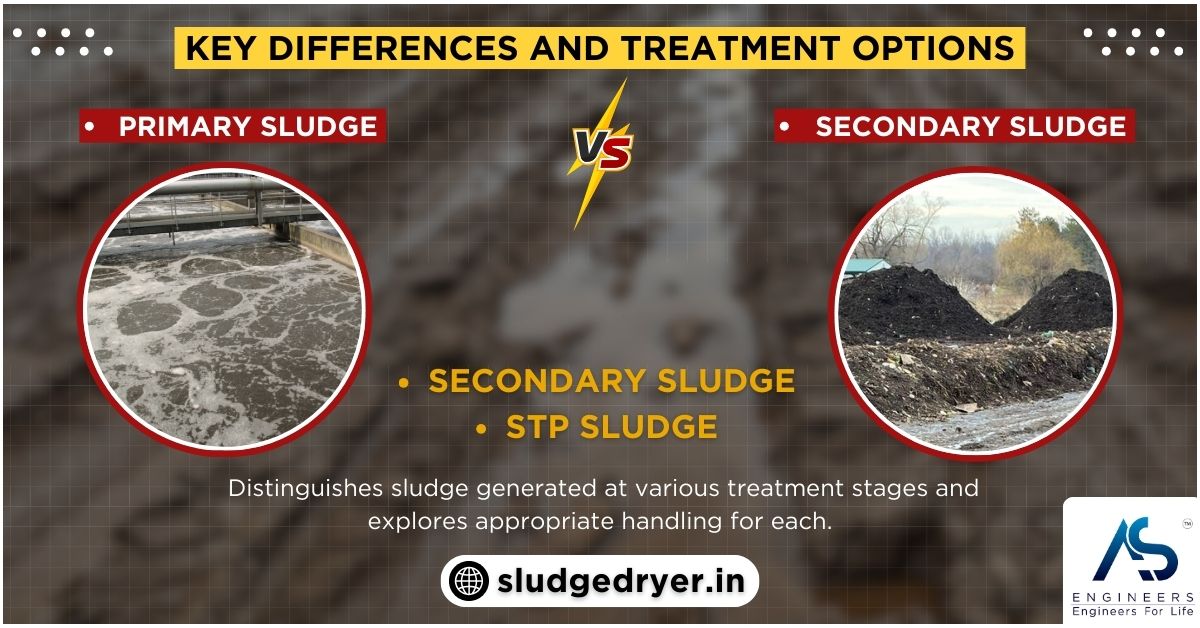
Primary sludge and secondary sludge are not the same waste stream. Primary sludge comes from the primary clarifier, where heavier settleable solids separate from wastewater. Secondary sludge comes from biological treatment, where microorganisms consume dissolved organic matter and create waste activated sludge. This difference affects thickening, polymer dosing, dewatering, drying, odor control, disposal cost, and final sludge handling.
For plant teams, the important question is not only “what is the difference?” The practical question is: how should each sludge type be treated before disposal, reuse, or thermal drying?
Primary sludge vs secondary sludge in simple terms
Primary sludge is the raw settled sludge removed early in wastewater treatment. It usually contains heavier suspended solids, grit-like settled matter, fats, oils, grease, food residues, and organic solids.
Secondary sludge is biological sludge generated after aeration or biological treatment. In activated sludge systems, it is often called waste activated sludge, or WAS. It contains microbial biomass, fine suspended solids, extracellular material, and water that is more difficult to release.
For a broader base understanding, first read this guide on what sludge is and how it forms. If your plant team is reviewing the full treatment sequence, this wastewater treatment process guide will also help connect sludge generation with each treatment stage.
Quick comparison table
| Point | Primary sludge | Secondary sludge |
|---|---|---|
| Generated from | Primary clarifier or sedimentation tank | Biological treatment and secondary clarifier |
| Main formation method | Physical settling of heavier solids | Microbial growth and biomass separation |
| Common content | Settleable solids, FOG, organic matter, grit-like particles | Microbial biomass, fine solids, biological floc, bound water |
| Texture | Denser, heavier, more settleable | Lighter, finer, often more gelatinous |
| Dewatering behavior | Usually easier than secondary sludge | Usually harder due to fine particles and bound water |
| Odor risk | Can turn septic quickly if not handled | Can create odor if biological sludge is stored poorly |
| Typical treatment | Thickening, digestion, dewatering, drying | Thickening, conditioning, digestion, dewatering, drying |
| Best handled as | Separate or blended stream depending on plant design | Often needs careful polymer and thickening control |
| Drying consideration | Can be dried after suitable dewatering | Usually needs good conditioning and dewatering before drying |
What is primary sludge?
Primary sludge is the settled material removed in the primary clarifier or sedimentation tank. The wastewater flow slows down, heavier solids settle at the bottom, and scum or floating matter may be removed from the top.
Primary sludge commonly includes:
- Settleable suspended solids
- Fats, oils, and grease
- Food or organic residues in municipal and industrial wastewater
- Inert particles and heavier suspended matter
- High moisture content, even when it appears thick
Primary sludge often looks easier to handle because it settles well. But it can also become septic quickly when stored too long, especially when the sludge contains high organic matter. In food, dairy, chemical, pharma, and municipal plants, this can lead to odor, hygiene, and disposal problems if the sludge line is not designed properly.
What is secondary sludge?
Secondary sludge forms during biological wastewater treatment. In activated sludge systems, microorganisms consume organic pollution in the aeration tank. Some biomass is recycled back to the process, and the excess biomass is removed as waste activated sludge.
Secondary sludge commonly includes:
- Bacteria and microbial biomass
- Biological floc
- Fine suspended solids
- Extracellular polymeric substances
- Water held inside and around the biological solids
This is why secondary sludge is often harder to thicken and dewater. It may not release water easily, even when mechanical dewatering equipment is installed. Before selecting a press, centrifuge, screw press, or sludge dryer, the plant should understand the actual sludge behavior through testing.
For biological treatment context, see this page on activated sludge and this troubleshooting guide for activated sludge system issues.
Why the difference matters in real plant operation
The difference between primary sludge and secondary sludge affects the entire sludge handling chain.
If the sludge type is misunderstood, the plant may select the wrong polymer, wrong thickener, wrong dewatering machine, wrong dryer size, or wrong disposal strategy. In many plants, the problem is not the dryer alone. The issue starts earlier in the line, at clarification, biological treatment, sludge storage, thickening, or dewatering.
Primary sludge usually needs fast handling
Primary sludge can be rich in raw organic matter. If it stays in a pit or tank for too long, it may create odor and handling problems. It can also increase load on downstream sludge treatment equipment.
Typical priorities for primary sludge:
- Avoid long uncontrolled storage
- Control odor and septic conditions
- Use proper thickening where required
- Select suitable digestion or stabilization
- Dewater before transport or drying
- Check for grit, FOG, and inorganic loading
Secondary sludge usually needs better conditioning
Secondary sludge contains biological solids and fine particles. It can hold water strongly and behave differently from primary sludge during mechanical dewatering.
Typical priorities for secondary sludge:
- Maintain stable biological treatment
- Avoid poor settling and excess solids washout
- Use proper polymer selection and dosing
- Check sludge volume index and settleability
- Use thickening before dewatering where required
- Do not assume the same dewatering behavior as primary sludge
For plants comparing equipment, this guide on how to choose sludge dewatering equipment is a useful next step.
Mixed sludge: when primary and secondary sludge are combined
Many STPs combine primary sludge and secondary sludge before digestion, dewatering, or drying. This is called mixed sludge.
Mixed sludge may improve handling in some plants because primary sludge can add heavier solids while secondary sludge contributes biological solids. But mixed sludge is not automatically easier to process. The final behavior depends on:
- Ratio of primary to secondary sludge
- Organic content
- Volatile solids
- FOG content
- Polymer response
- pH and alkalinity
- Biological sludge age
- Presence of industrial contaminants
- Existing thickening and dewatering equipment
When I review a sludge drying requirement, I do not treat “STP sludge” as one fixed material. I ask whether the feed is primary sludge, secondary sludge, digested sludge, mixed sludge, ETP sludge, or dewatered sludge cake. This small clarification can change the dewatering and drying recommendation.
For more STP-specific context, see STP sludge and sewage treatment guide.
Treatment route for primary and secondary sludge
Most plants should not send raw liquid sludge directly to final disposal or drying without reviewing the full sludge treatment chain.
A practical route is:
| Step | Purpose | Primary sludge note | Secondary sludge note |
|---|---|---|---|
| Collection | Capture sludge from clarifier or biological system | Remove settled sludge before septic conditions develop | Waste excess biomass to maintain process stability |
| Thickening | Reduce free water before dewatering | Gravity thickening may work well in many cases | May need mechanical thickening or careful conditioning |
| Stabilization | Reduce odor, biological activity, and pathogen risk | Anaerobic digestion can be suitable where organic load supports it | Aerobic or anaerobic digestion may be used depending on plant design |
| Conditioning | Improve dewatering response | Polymer depends on solids and FOG | Polymer selection is more sensitive due to fine biomass |
| Dewatering | Convert sludge to cake | Often easier than WAS | Often more difficult due to bound water |
| Drying | Reduce final moisture and volume | Useful after dewatering when disposal or reuse requires lower moisture | Useful after proper conditioning and dewatering |
| Disposal or reuse | Final route | Depends on composition and local rules | Depends on stability, contaminants, and approved end use |
For thickening comparison, refer to sludge thickener fundamentals. For dewatering methods, see sludge dewatering techniques.
Dewatering behavior: why secondary sludge is usually harder
Primary sludge contains larger settleable solids. These solids generally separate from water more easily than biological sludge.
Secondary sludge contains finer microbial solids. Water is trapped in biological flocs and cell-bound structures. Because of this, secondary sludge may require:
- Better polymer testing
- Longer flocculation time
- More controlled feed consistency
- Correct sludge age control
- Good thickening before dewatering
- Careful machine selection
If secondary sludge is poorly conditioned, the dewatering machine may show low cake dryness, high filtrate solids, blinding, poor throughput, or high polymer consumption.
For mechanical dewatering decisions, this plate and frame sludge press guide can help teams understand when a filter press makes sense and when drying is needed after pressing.
Where sludge drying fits
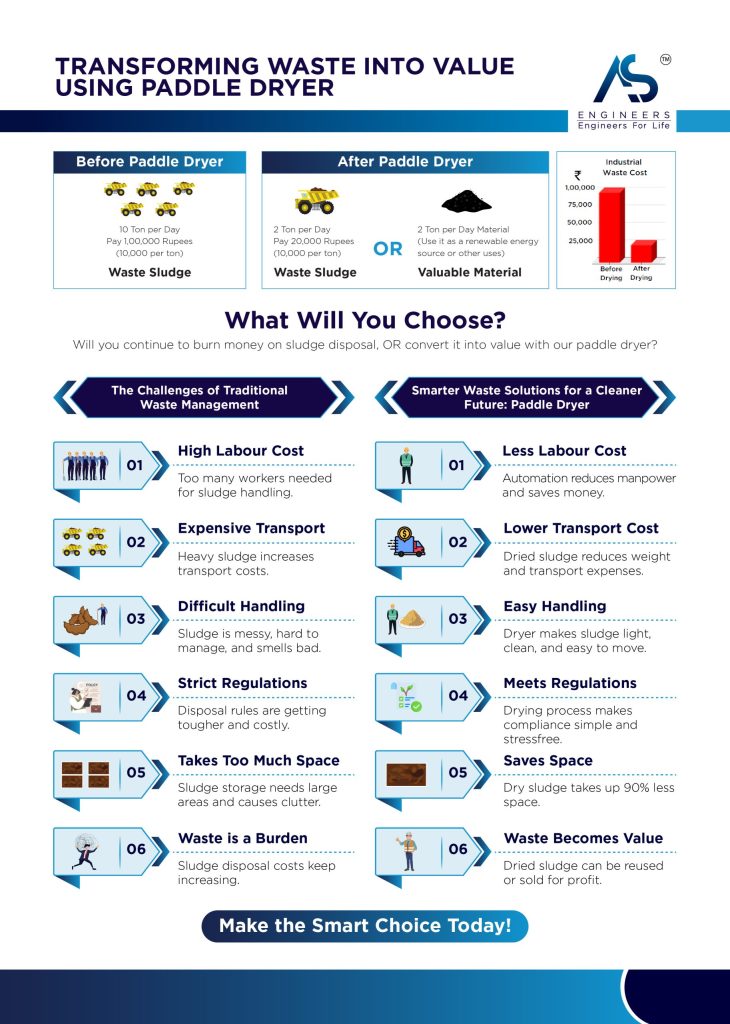
Sludge drying is usually considered after thickening and dewatering. A dryer is not a replacement for the biological treatment process or for basic sludge separation. It is used when the plant needs lower final moisture, lower transport load, better handling, reduced storage burden, or a more controlled final material.
For sludge drying, the feed should be clearly defined:
- Primary sludge cake
- Secondary sludge cake
- Mixed sludge cake
- Digested sludge cake
- ETP sludge cake
- STP sludge cake
- High-moisture sludge from screw press, belt press, centrifuge, or filter press
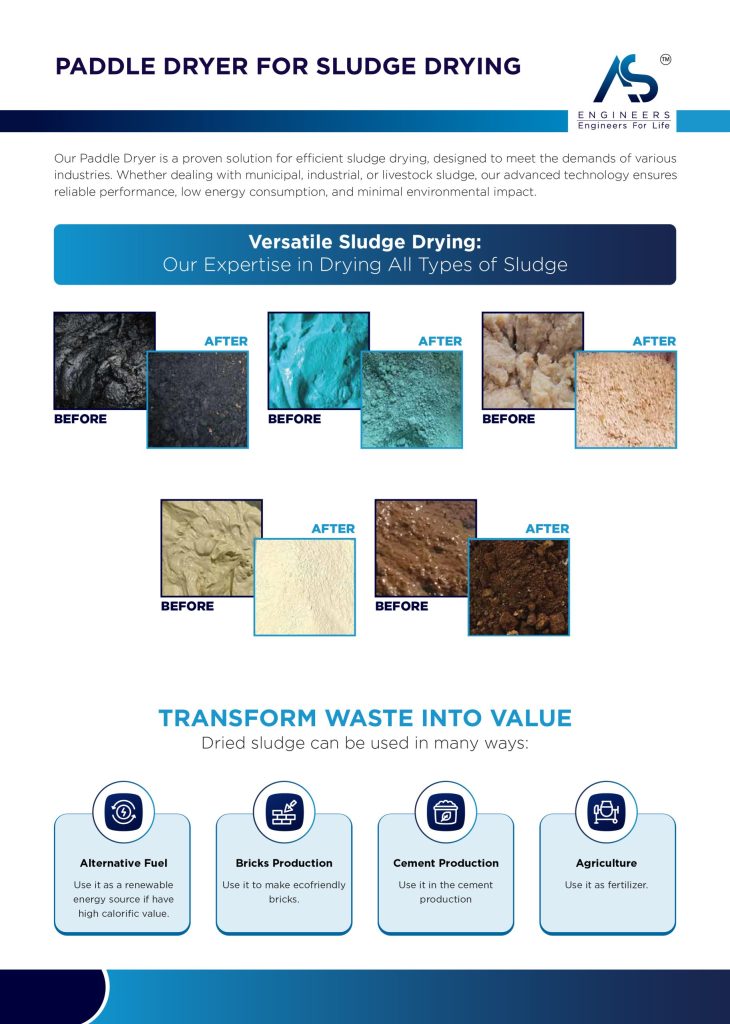
AS Engineers works with paddle dryer / sludge dryer systems where indirect heat transfer through hollow shafts and jacketed surfaces helps dry wet sludge cake in a controlled thermal process. The AS Engineers sludge drying system can be supported with feeding, heating, vapour handling, cyclone, scrubber, ID fan, screw conveyor, and product handling equipment depending on the site requirement. AS Engineers’ catalog identifies paddle dryer / sludge dryer, centrifugal blower, pollution control equipment, and turnkey solutions as part of the product ecosystem.
For dryer selection, see the sludge dryer guide and this page on thermal sludge drying systems.
Primary sludge vs secondary sludge for paddle dryer selection
A paddle dryer can be useful for both primary and secondary sludge streams, but the feed behavior changes the design discussion.
| Selection factor | Primary sludge impact | Secondary sludge impact |
|---|---|---|
| Feed consistency | May be denser after settling | May be softer, finer, and harder to dewater |
| Moisture release | Usually easier after dewatering | Often needs better conditioning before drying |
| Odor risk | High if stored too long | High if biological sludge becomes septic |
| Stickiness | Depends on organics, FOG, and industry | Can be sticky due to biological solids |
| Dryer load | Depends on feed moisture and kg/hr | Often affected by final cake moisture from dewatering |
| Vapour handling | Needed for evaporated water and odour control | Needed for evaporated water and biological odor risk |
| Material of construction | Based on pH, salts, chemicals, corrosion | Based on pH, biological solids, chemicals, corrosion |
| Pre-testing | Recommended | Strongly recommended |
A dryer quotation should not be based only on “sludge quantity per day.” The correct RFQ must include feed moisture, final moisture target, sludge source, dewatering method, hourly feed rate, operating hours, material behavior, heating medium, MOC expectation, and vapour handling requirement.
When to keep sludge streams separate
Separate handling may be useful when:
- Primary sludge has high FOG or high organic load
- Secondary sludge has poor dewatering behavior
- The plant wants separate digestion or biogas optimization
- Industrial contamination differs by stream
- Different polymers are required
- One stream causes odor or foaming problems
- One stream needs a different disposal route
When to blend primary and secondary sludge
Blending may be useful when:
- Mixed sludge gives more stable feed consistency
- One stream improves the other’s dewatering behavior
- Existing plant design already supports mixed digestion
- The final sludge cake is handled by one dewatering line
- Drying system feed needs uniform operation
The decision should be based on jar testing, sludge characterization, dewatering trials, and site operating data.
Common mistakes to avoid
Treating all STP sludge as the same material
STP sludge can include primary sludge, secondary sludge, digested sludge, mixed sludge, tertiary sludge, or dewatered sludge cake. A plant should not use one generic assumption for all streams.
Selecting dewatering equipment before testing sludge behavior
Secondary sludge especially can behave differently from plant to plant. Polymer response, cake dryness, filtrate quality, and throughput should be checked before final equipment selection.
Sending very wet sludge directly to thermal drying
Thermal drying very wet sludge can increase fuel consumption. In many cases, thickening and dewatering before drying improves the overall economics.
Ignoring vapour and odor handling
Drying evaporates moisture. The vapour path, fines separation, condenser or scrubber requirement, and ID fan arrangement should be reviewed during design.
Asking for a dryer price without RFQ data
A price request without moisture, feed rate, final moisture target, sludge type, MOC, heating medium, and operating hours leads to poor comparison between vendors.
RFQ checklist for primary or secondary sludge drying
Before asking for a sludge dryer quotation, share these details:
| RFQ input | Why it matters |
|---|---|
| Sludge source | Primary, secondary, mixed, ETP, STP, digested, or industrial sludge |
| Feed form | Liquid sludge, thickened sludge, filter press cake, centrifuge cake, screw press cake |
| Feed moisture | Controls evaporation load |
| Final moisture target | Defines drying duty |
| Daily quantity | Helps estimate operating capacity |
| Operating hours | Converts daily load to hourly feed |
| Existing dewatering method | Affects cake consistency |
| Sludge analysis | pH, chlorides, salts, organics, ash, metals, hazardous characteristics |
| Stickiness and odor | Affects dryer internals and vapour handling |
| Heating medium | Steam, thermic fluid, hot water, or other site source |
| Available fuel | Natural gas, LDO, coal, biomass, electricity, or site-specific option |
| MOC preference | CS, SS304, SS316, duplex, or other alloy requirement |
| Pollution control requirement | Cyclone, scrubber, bag filter, condenser, ID fan, chimney |
| Product handling | Screw conveyor, bagging, silo, truck loading, or disposal route |
For complete sludge treatment planning, read sludge treatment plant and top sludge treatment methods.
Practical selection guidance
Choose a primary-sludge-focused route when the plant mainly removes heavy settleable solids in primary clarification and the sludge has strong organic loading, FOG, or septic odor risk.
Choose a secondary-sludge-focused route when most solids are biological biomass from activated sludge, MBBR, SBR, trickling filter, or other biological systems.
Choose a mixed-sludge route when the plant already combines streams and needs one integrated thickening, dewatering, digestion, and drying strategy.
Choose thermal drying when dewatering alone does not reduce moisture enough for transport, storage, disposal, co-processing, or controlled final handling. For AS Engineers equipment context, see sludge dryer manufacturer and paddle dryer for wastewater treatment.
FAQs
What is the main difference between primary sludge and secondary sludge?
Primary sludge is formed by physical settling in the primary clarifier. Secondary sludge is formed during biological treatment when microorganisms consume organic matter and generate excess biomass.
Is secondary sludge the same as waste activated sludge?
In activated sludge plants, secondary sludge is commonly handled as waste activated sludge. However, secondary sludge can also come from other biological treatment systems, depending on the plant design.
Which sludge is easier to dewater?
Primary sludge is usually easier to dewater because it contains larger, heavier, more settleable solids. Secondary sludge is usually harder to dewater because it contains fine biological solids and bound water.
Can primary and secondary sludge be mixed before drying?
Yes, many plants mix both streams before digestion, dewatering, or drying. But the blend ratio, polymer response, moisture, odor, and final cake behavior should be checked before final dryer selection.
Does a sludge dryer replace dewatering equipment?
No. In most plants, a sludge dryer works after thickening and dewatering. Dewatering removes part of the water mechanically, while drying reduces additional moisture thermally.
Conclusion
Primary sludge and secondary sludge come from different stages of wastewater treatment, and they behave differently during thickening, dewatering, digestion, drying, and disposal. Primary sludge is usually denser and easier to dewater, but it can create odor and septic handling problems. Secondary sludge is biological, finer, and often more difficult to dewater, so conditioning and process control become more important.
For a reliable sludge treatment plan, do not select equipment only by sludge quantity. First define the sludge source, moisture, solids behavior, treatment stage, dewatering result, final moisture target, and disposal or reuse route.
If your plant is reviewing primary sludge, secondary sludge, mixed STP sludge, or ETP sludge for drying, share the feed moisture, final moisture target, daily quantity, operating hours, sludge analysis, heating medium, and vapour handling requirement. The AS Engineers team can review the application and suggest a sludge drying configuration based on actual site conditions.