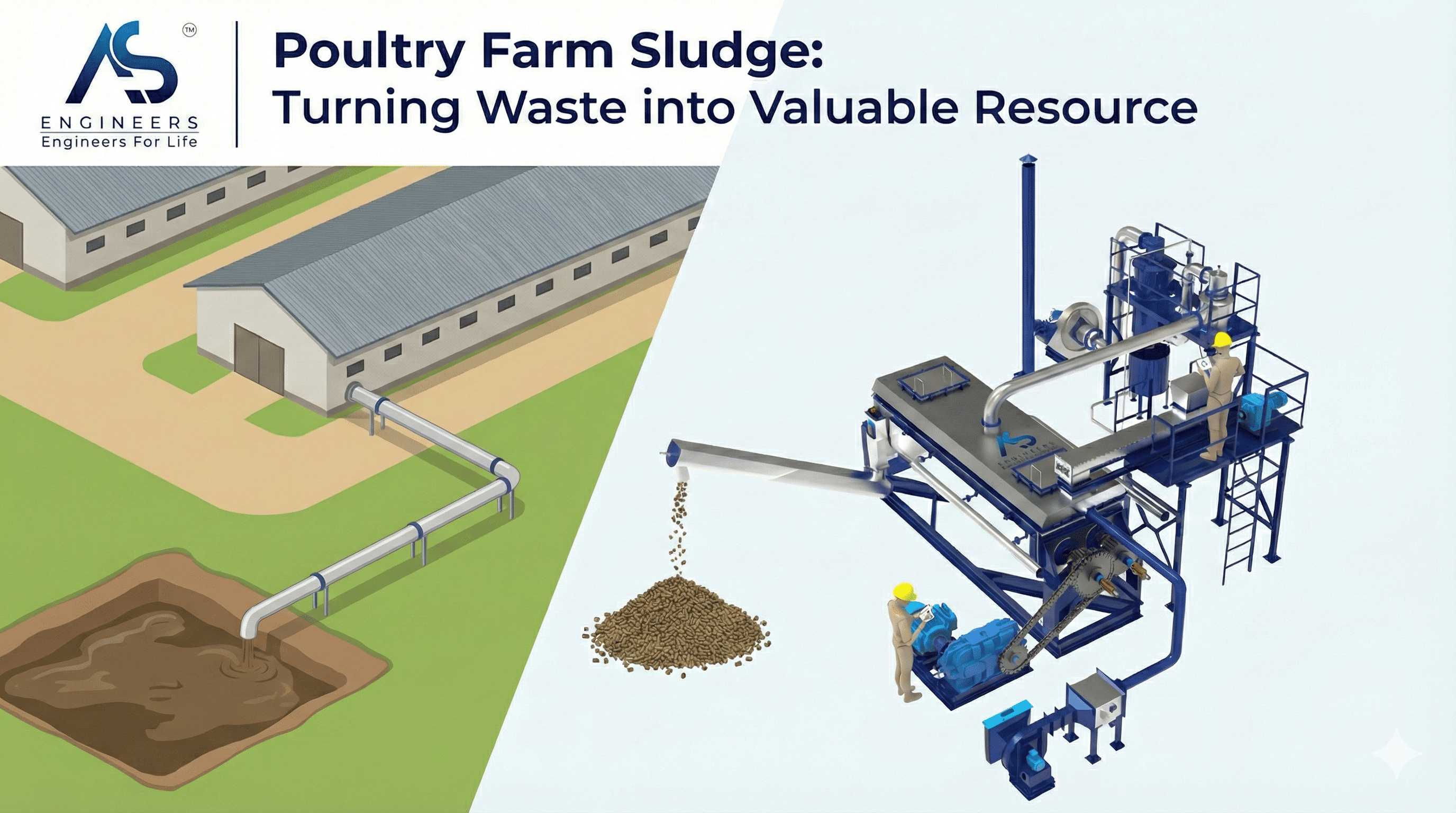
Poultry farm sludge is a wet organic waste stream generated from poultry manure, litter, spilled feed, feathers, shed cleaning water and related farm operations. For small farms, it may be handled through composting or manure sale. For medium and large poultry operations, uncontrolled storage becomes a serious odour, transport, space, hygiene and pollution issue.
A sludge dryer or paddle dryer can help when the waste is too wet, heavy, sticky or difficult to handle in its raw form. The goal is not only disposal. The goal is controlled moisture reduction, easier handling, lower storage burden, safer downstream use and better waste-to-resource planning.
What Is Poultry Farm Sludge?
Poultry farm sludge is not only chicken manure. In real farm conditions, it can include:
- Poultry droppings or manure
- Poultry litter mixed with rice husk, sawdust, wood shavings or bedding material
- Spilled feed
- Feathers
- Wash water from shed cleaning
- Fine organic solids from collection pits or drains
- Slurry from cage systems or cleaning operations
The exact composition depends on whether the farm is a broiler farm, layer farm, hatchery, breeder farm or poultry processing unit.
For dryer selection, this matters. A dryer that works for semi-solid poultry manure may not work the same way for watery wash sludge, feather-rich waste, hatchery debris or mixed waste with stones, plastics and dead birds.
Why Poultry Farm Sludge Becomes a Problem
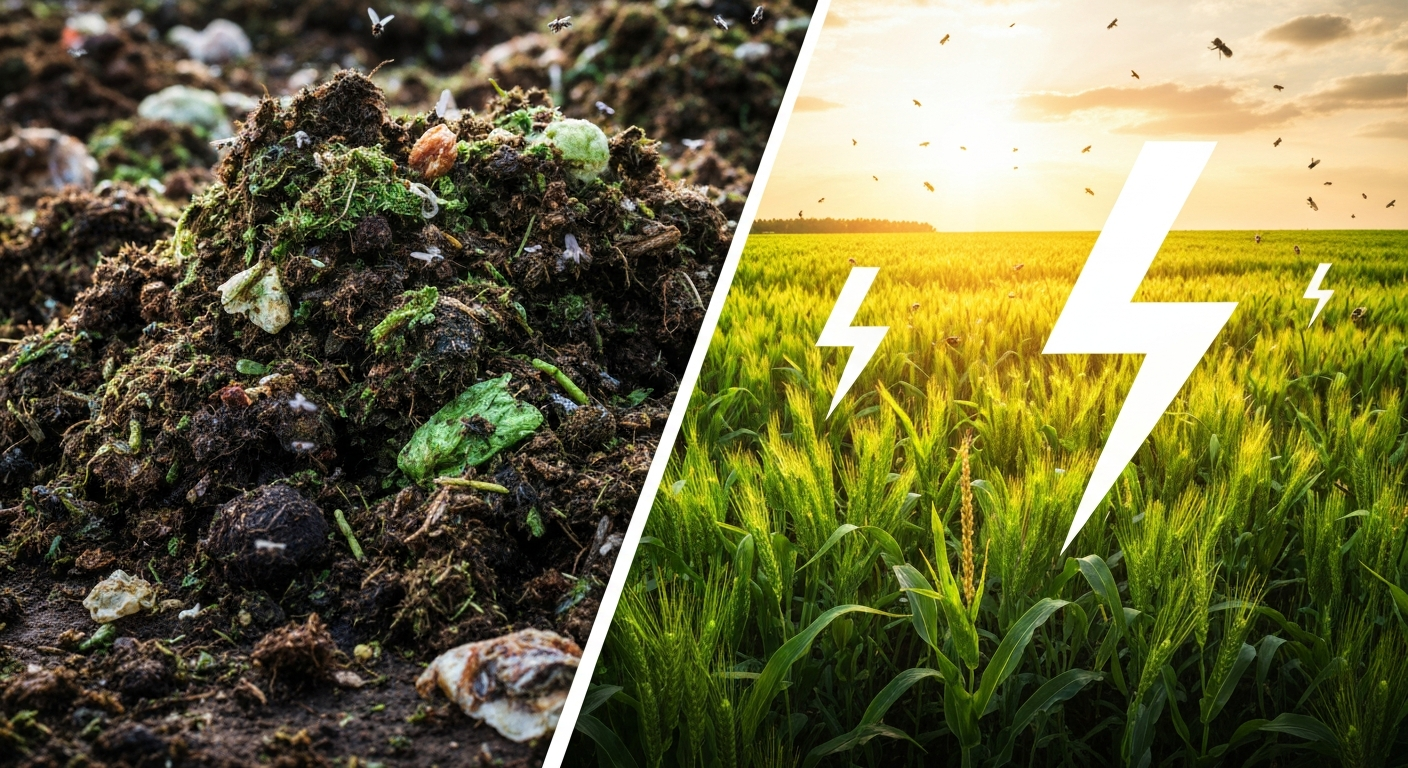
Fresh poultry sludge usually has high moisture, strong odour and high organic loading. When it is stored in open piles or wet pits, it can create handling and environmental problems.
The common site-level problems are:
| Problem | What happens on site |
|---|---|
| High moisture | Sludge becomes heavy, sticky and expensive to move |
| Odour | Ammonia and sulphur-type odours can affect workers and nearby communities |
| Flies and rodents | Wet organic waste attracts pests if not managed quickly |
| Runoff risk | Rainwater can carry nutrients and solids into soil or water bodies |
| Storage pressure | Wet sludge needs more covered space |
| Disposal uncertainty | Farmers may accept dry manure, but wet sludge is harder to sell or reuse |
| Inconsistent quality | Mixed bedding, manure, feed and wash water create variable drying behaviour |
The CPCB poultry farm guidelines identify odour from NH3 and H2S, feed mill dust, manure/litter, dead birds, hatchery waste, wastewater from cleaning operations, flies and rodents as key environmental issues in poultry farms.
Poultry Farm Sludge vs Poultry Litter vs Poultry Manure
These terms are often used loosely, but they are not the same from a drying and disposal point of view.
| Material | Typical source | Dryer relevance |
|---|---|---|
| Poultry manure | Droppings from layer or cage systems | Can be dried if collected separately and screened |
| Poultry litter | Manure mixed with bedding such as rice husk, sawdust or wood shavings | Can be suitable if particle size and foreign material are controlled |
| Poultry sludge | Wet or semi-solid mixture of manure, wash water, litter fines and organic solids | Needs moisture and flowability testing before dryer sizing |
| Hatchery waste | Eggshells, unhatched eggs, embryos and hatchery residues | Usually needs separate handling, rendering or composting route |
| Dead birds | Mortality waste | Should not be mixed casually with dryer feed; follow approved disposal methods |
| Processing waste | Blood, feathers, offal and wash solids | Requires separate process study and may need rendering or special treatment |
A practical poultry waste system should first separate waste streams. Mixing everything into one wet pile increases odour, disease risk, dryer feed inconsistency and downstream reuse uncertainty.
Where Drying Fits in Poultry Waste Management
Drying is usually not the first step. It works best after basic waste segregation and moisture control.
A practical poultry sludge handling route is:
- Separate manure/litter from dead birds and hatchery waste.
- Remove plastic, stones, metal pieces, sacks and oversize bedding.
- Reduce free water through drainage, screening, settling, screw press or other dewatering method if required.
- Feed semi-solid sludge or manure cake into the dryer.
- Use controlled indirect heat to reduce moisture.
- Collect vapour and fine particles through suitable cyclone, scrubber, condenser or bag filter arrangement.
- Store dried product in a covered area.
- Test final dried output before fertilizer, fuel, compost blending or land application.
This approach is safer than sending raw mixed poultry waste directly to open land, open pits or uncontrolled drying beds.
Main Treatment and Disposal Options for Poultry Farm Sludge
| Option | Best suited for | Limitation |
|---|---|---|
| Composting | Small to medium manure/litter streams with correct carbon balance | Needs space, turning, odour control and moisture control |
| Biogas | Wet organic manure slurry where AD economics and expertise are available | Poultry manure can be high in nitrogen, which may create ammonia inhibition risk |
| Land application | Treated and tested manure or compost | Must match crop nutrient needs and local rules |
| Open drying or solar drying | Low-volume farms with available land and weather support | Slow, weather-dependent, odour-prone and space-intensive |
| Mechanical drying | Larger farms, integrators, poultry clusters and processors needing controlled output | Needs capital investment, feed testing and proper vapour handling |
| Rendering | Hatchery and processing by-products such as offal, feathers and some organic residues | Not the same as sludge drying, requires separate system |
| Incineration or approved disposal | Mortality waste and unsuitable organic waste | Needs compliance-controlled design and approval |
EPA’s poultry manure anaerobic digestion guidance notes that AD can provide renewable energy and greenhouse gas benefits, but also highlights poultry-specific barriers such as high nitrogen and ammonia inhibition.
Why Drying Poultry Sludge Helps
Drying reduces the water in sludge. That single change improves the whole handling chain.
Key benefits:
- Lower transport weight
- Lower storage volume
- Easier bagging or covered storage
- Less free water and seepage risk
- Reduced odour generation compared with wet storage
- Better handling for compost blending or fertilizer processing
- More stable material for controlled downstream use
- Better route for poultry clusters that generate regular waste volumes
The important point is this: drying does not automatically make poultry sludge legally usable as fertilizer or fuel. The dried product still needs checking for moisture, nutrients, pathogens, heavy metals, antibiotic residues where relevant, and local approval depending on end use.
Paddle Dryer for Poultry Farm Sludge
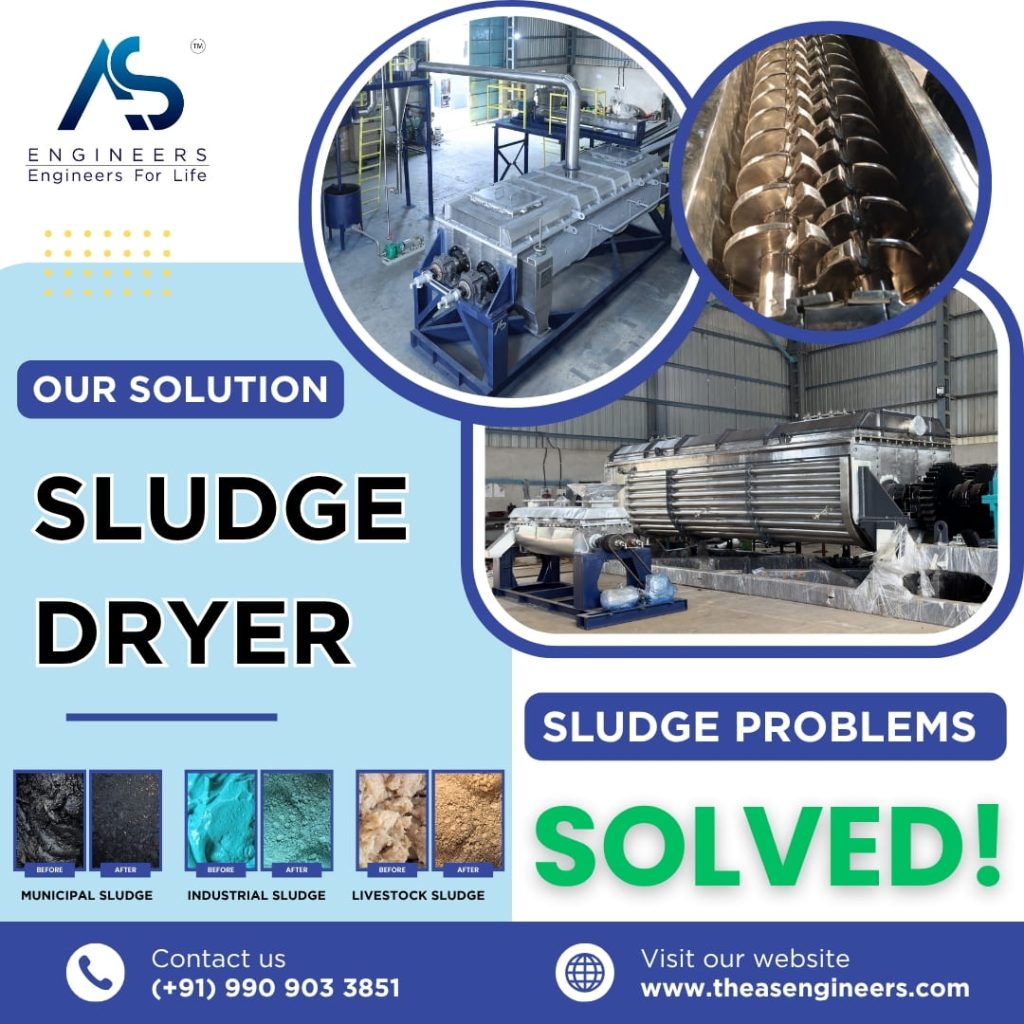
A paddle dryer is an indirect heat dryer. Heat is transferred through hollow shafts, paddles and the jacket instead of direct flame contact with the sludge. AS Engineers’ paddle dryer design uses hollow shafts and jacket heating, dual counter-rotating shafts, wedge-shaped paddles, plug-flow movement and enclosed processing for controlled sludge drying.
For poultry sludge, this design is useful because the material is often sticky, wet and organic. The rotating paddles keep the material moving, break lumps, expose wet surfaces to heated contact areas and help discharge a more manageable dried output.
Why Indirect Drying Matters for Poultry Sludge
In direct hot-air drying, large air volumes contact the waste directly. This may increase odour, dust and off-gas treatment requirements. In indirect drying, the heating medium does not directly mix with the sludge.
For poultry sludge, indirect drying can help with:
| Requirement | Why it matters |
|---|---|
| Odour control | Enclosed drying helps route vapours to treatment equipment |
| Sticky feed handling | Agitation and heated surfaces help manage sticky material |
| Lower air volume | Smaller off-gas stream can reduce downstream treatment load |
| Uniform moisture reduction | Continuous mixing improves heat contact |
| Site hygiene | Enclosed system is cleaner than open drying beds |
| Product handling | Dried output can be conveyed, bagged or stored more easily |
AS Engineers’ process flow includes feeding, heating, paddle dryer, scavenging, pollution control, solvent/vapour management and product handling systems, with options such as screw feeder, sludge pump, steam boiler, thermic fluid, hot water generator, cyclone, scrubber, bag filter, condenser, chimney, screw conveyor and bagging system.
Fit and No-Fit Guide
A paddle dryer is not automatically right for every poultry waste stream. The decision depends on moisture, daily quantity, contamination, reuse target, available fuel and local disposal route.
| Feed condition | Fit for paddle dryer? | Notes |
|---|---|---|
| Dewatered poultry manure sludge | Good fit | Best when feed is screened and moisture is measurable |
| Layer manure from cage system | Possible fit | Depends on collection method, moisture and foreign matter |
| Broiler litter with bedding | Conditional | Needs particle-size review and removal of oversize material |
| Wet cleaning sludge | Conditional | Usually needs settling, screening or dewatering before drying |
| Hatchery shells and residues | Not direct fit | Separate treatment or rendering/composting route may be better |
| Dead birds or carcasses | Not fit as normal dryer feed | Must follow approved mortality disposal route |
| Mixed waste with plastic, stones or metal | Not fit until cleaned | Causes feed, screw, shaft and discharge problems |
| High-feather processing waste | Needs separate study | Feathers behave differently and may require rendering route |
Poultry Sludge Drying Process Flow
A practical poultry sludge dryer system can be configured like this:
| Stage | What happens | Key design question |
|---|---|---|
| Waste collection | Manure, litter or sludge is collected from shed or pit | Is the waste segregated or mixed? |
| Pre-screening | Plastics, stones, metal and oversize bedding are removed | What is the maximum particle size? |
| Dewatering | Free water is reduced if feed is too slurry-like | What is inlet moisture? |
| Feeding | Screw feeder, belt conveyor or sludge pump feeds dryer | Is the feed pumpable, sticky or crumbly? |
| Indirect drying | Hollow shafts, jacket and paddles transfer heat | What final moisture is needed? |
| Vapour handling | Vapour, odour and fines are routed to equipment | Is cyclone, scrubber, bag filter or condenser needed? |
| Discharge | Dried material exits for cooling, conveying or bagging | Will output be bagged, bulk stored or sent to composting? |
| Testing | Dried product is checked before reuse | What fertilizer/fuel/land-use standard applies? |
Important Design Inputs Before Asking for Quotation
Before asking for a poultry sludge dryer quotation, do not send only “capacity required.” A dryer cannot be selected correctly without feed data.
Share these inputs:
| RFQ input | Why AS Engineers needs it |
|---|---|
| Poultry type | Broiler, layer, breeder, hatchery or processing unit waste behaves differently |
| Bird count or daily waste quantity | Helps estimate daily load |
| Waste source | Manure, litter, wash sludge, cage manure or mixed stream |
| Inlet moisture | Main basis for heat load and dryer size |
| Final moisture target | Depends on composting, fertilizer, fuel or storage plan |
| Feed form | Slurry, cake, paste, crumbly litter or fibrous mix |
| Bedding material | Rice husk, sawdust, wood shavings and other bedding affect drying |
| Foreign matter | Plastic, stones, metal and sacks must be removed |
| Bulk density | Impacts feed and discharge equipment |
| Available heating medium | Steam, thermic fluid, hot water, gas, wood, coal, LDO, briquette or electricity |
| Vapour treatment need | Odour, dust and moisture handling need process-specific design |
| MOC requirement | Contact parts may need CS, SS304, SS316 or other material based on corrosion risk |
| Operation hours | Continuous or batch operating logic changes equipment sizing |
| End-use plan | Fertilizer, compost blending, fuel, disposal or sale route affects final moisture |
For AS Engineers’ sludge dryer selection, also check the detailed guide on how to choose a sludge paddle dryer.
Storage and Compliance Considerations in India
Poultry farms should not treat drying as a replacement for compliance. Drying is one treatment step. Storage, runoff prevention, odour control, dead bird disposal, cleaning wastewater management and consent requirements still need to be handled as per applicable rules.
The CPCB poultry guidelines state that poultry manure should be protected from runoff and unwanted pests, proper storage facilities should be provided, and manure/litter storage should be designed with suitable base protection and cover to prevent air emissions, odour and precipitation entry.
For regulatory mechanism, CPCB guidelines state that poultry farms handling above 25,000 birds at a single location need CTE/CTO under the Water Act and Air Act from the State Pollution Control Board or Pollution Control Committee, and poultry farms handling above 5,000 birds at a single location are also to obtain CTE/CTO from 01.01.2023 as per the cited NGT direction.
Always verify current requirements with the relevant State Pollution Control Board before project execution.
Paddle Dryer vs Other Poultry Sludge Drying Methods
| Method | Strength | Weakness |
|---|---|---|
| Open drying bed | Low initial cost | Needs land, time, weather support and odour control |
| Solar drying | Lower energy input | Seasonal and slower, especially in humid/rainy conditions |
| Rotary dryer | Handles some granular manure streams | Higher hot-air volume and dust/odour control requirement may arise |
| Belt dryer | Useful for some dewatered sludge cakes | Sticky feed and feed distribution may become issues |
| Paddle dryer | Enclosed, indirect heat, compact, good for sticky sludge | Needs proper feed preparation and engineering design |
For a wider comparison, refer to sludge drying methods and systems and advanced sludge drying technologies.
Common Mistakes Poultry Farms Should Avoid
- Mixing dead birds, hatchery waste, manure, plastics and wash sludge into one dryer feed.
- Assuming wet sludge can directly become fertilizer without testing.
- Selecting dryer size only by tons per day, without moisture and final use.
- Ignoring odour and vapour treatment.
- Using open storage where runoff can enter drains or soil.
- Underestimating foreign material in litter.
- Ignoring fuel availability and steam/thermic fluid infrastructure.
- Not planning dried product storage before installing the dryer.
- Asking for lowest dryer price instead of lifecycle operating fit.
- Skipping pilot testing for difficult or variable poultry sludge.
Where AS Engineers Fits
AS Engineers manufactures paddle dryer and sludge dryer systems for industrial sludge drying applications. The company’s official catalog lists paddle dryer/sludge dryer, centrifugal blower, pollution control equipment and turnkey solutions, with ISO 9001:2015 certification and 25+ years in fluid mechanics and drying solutions.
For poultry sludge projects, AS Engineers can review the feed condition, heating medium, vapour handling, final moisture target, MOC requirement, site layout and downstream product handling before recommending a dryer configuration.
Relevant pages:
- Sludge dryer manufacturer by AS Engineers
- Paddle dryer manufacturer in India
- Paddle dryer for agriculture and fertilizer industries
- Livestock sludge management
RFQ Checklist for Poultry Farm Sludge Dryer
Use this checklist before contacting AS Engineers:
| Detail | Fill before enquiry |
|---|---|
| Farm type | Broiler / layer / breeder / hatchery / poultry processing |
| Bird count | Total birds at single location |
| Waste type | Manure / litter / wash sludge / mixed |
| Daily wet quantity | kg/day or ton/day |
| Inlet moisture | Lab value preferred |
| Final moisture target | Storage / compost / fertilizer / fuel / disposal |
| Bedding material | Rice husk / sawdust / wood shavings / other |
| Foreign matter risk | Plastic / stones / metal / sacks / feathers |
| Available utilities | Steam / thermic fluid / hot water / fuel / power |
| Operating hours | Batch / continuous / shifts per day |
| Vapour treatment | Cyclone / scrubber / bag filter / condenser / chimney |
| Site space | Indoor/outdoor, dryer room, storage area |
| End-use testing | Nutrient, pathogen, heavy metal or other lab reports |
| Local permission | SPCB/consultant confirmation where applicable |
FAQs
Can poultry farm sludge be dried in a paddle dryer?
Yes, poultry farm sludge can be dried in a paddle dryer when the feed is properly segregated, screened and evaluated for moisture, stickiness, bedding content and foreign matter. Mixed waste with carcasses, plastics, stones or large hatchery residues should not be fed directly.
Is dried poultry sludge safe to use as fertilizer?
It may be usable only after proper treatment and testing. The final dried product should be checked for nutrients, pathogens, heavy metals and any site-specific contaminants. Land application should follow crop nutrient requirements and local regulatory guidance.
Is a paddle dryer better than solar drying for poultry sludge?
For larger or continuous poultry waste loads, a paddle dryer gives better control over moisture reduction, space usage, odour containment and weather independence. Solar drying can be useful for smaller volumes but is slower and depends heavily on climate and land availability.
What should not be mixed with poultry sludge dryer feed?
Dead birds, large feathers, hatchery debris, plastics, stones, metal pieces, sacks, ropes and oversize bedding should be removed or handled separately. These materials can affect hygiene, feeding, shaft operation, discharge and product quality.
What details are required to select a poultry sludge dryer?
Share daily wet quantity, inlet moisture, final moisture target, waste source, bedding type, feed form, available fuel or heating medium, required MOC, vapour treatment requirement, operating hours and final use of dried output.
Conclusion
Poultry farm sludge becomes difficult when it is wet, mixed, odorous and stored without control. The right solution is not simply “buy a dryer.” The right approach is segregation, moisture testing, foreign material removal, controlled drying, vapour handling, safe storage and final product testing.
A paddle dryer is a strong option for poultry manure sludge, litter-based sludge and high-moisture organic waste where controlled drying, compact layout and enclosed handling are important. For the best result, send AS Engineers the actual feed details, moisture data, final moisture target and end-use plan before asking for equipment sizing.