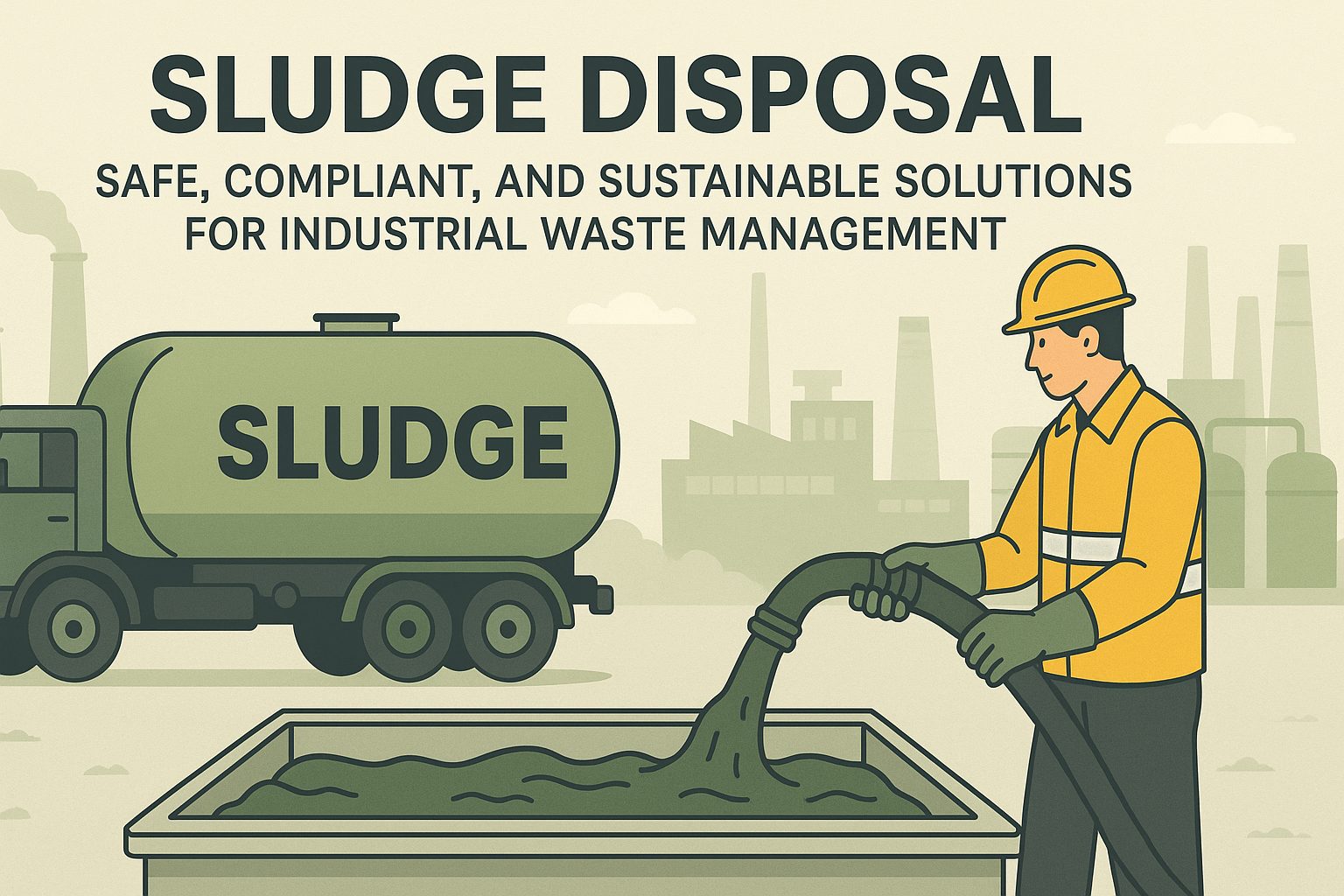
Industrial sludge disposal is the controlled process of testing, classifying, reducing moisture, storing, transporting, and sending ETP, CETP, STP, or ZLD sludge to a suitable disposal, treatment, reuse, co-processing, incineration, or landfill route.
For industrial plants, the safest sludge disposal plan does not start with the cheapest vendor. It starts with sludge testing, moisture reduction, hazard classification, vendor authorization, and a clear final route.
If the sludge is wet, sticky, hazardous, high in salts, oily, organic, or difficult to handle, disposal cost and compliance risk can rise quickly. That is why many plants first evaluate sludge dewatering techniques and thermal sludge drying systems before final disposal.
What is industrial sludge disposal?
Industrial sludge disposal is the planned handling and final removal of semi-solid waste generated from industrial wastewater treatment, effluent treatment, process filtration, neutralization, precipitation, biological treatment, oil-water separation, or ZLD systems.
Industrial sludge may come from:
- Effluent Treatment Plants, ETPs
- Sewage Treatment Plants, STPs
- Common Effluent Treatment Plants, CETPs
- Zero Liquid Discharge, ZLD systems
- Chemical precipitation units
- Filter press or screw press systems
- API, pharma, textile, dye, paper, food, refinery, metal, paint, pigment, and chemical plants
Not all sludge is the same. A food-processing biological sludge, textile ETP sludge, refinery oily sludge, pharma sludge, and ZLD salt cake may need very different disposal routes.
Before choosing the final disposal method, the plant should understand what sludge is, how it was generated, what it contains, and how much water is being transported along with the actual solids.
The right sludge disposal sequence
In my view, many disposal problems start because the plant jumps directly from “sludge generated” to “find disposal vendor.” That misses the most important steps.
Use this sequence before finalizing any industrial sludge disposal route.
| Step | Plant-side question | Output |
|---|---|---|
| Source identification | Which process or treatment stage generated the sludge? | Sludge source map |
| Sampling and testing | What is the moisture, pH, ash, salts, metals, organics, oil, solvent, or calorific value? | Lab report |
| Classification | Is it hazardous, non-hazardous, organic, oily, high-salt, or reusable after treatment? | Disposal category |
| Moisture reduction | Can thickening, dewatering, or drying reduce transport weight and handling difficulty? | Lower-moisture sludge |
| Storage planning | Can the sludge be stored without leakage, odour, leachate, or unsafe mixing? | Safe storage method |
| Vendor route selection | Is the final route TSDF, co-processing, incineration, landfill, composting, reuse, or further treatment? | Approved route |
| Documentation | Are manifests, weighbridge slips, disposal certificates, and authorization records maintained? | Audit trail |
| Periodic review | Has sludge quantity, composition, or vendor acceptance changed? | Updated plan |
Common industrial sludge disposal methods
The best method depends on sludge composition, moisture content, local authorization, vendor acceptance, and final environmental risk. Do not select a method only by price per ton.
| Disposal method | Best-fit sludge condition | Key caution | Where drying helps |
|---|---|---|---|
| TSDF or secure landfill | Hazardous sludge, mixed chemical sludge, high-risk residue | Requires approved facility and documentation | Reduces wet weight and improves handling |
| Co-processing in cement kiln | Sludge with suitable calorific value and acceptable chemistry | Chloride, sulphur, ash, metals, and moisture must be checked | Improves feed consistency and fuel value |
| Incineration | Organic, oily, solvent-bearing, or hazardous sludge where destruction is required | Air pollution control and ash handling matter | Helps reduce moisture before thermal destruction |
| Land application or composting | Treated biological sludge with safe composition | Pathogens, metals, odour, and local rules must be checked | May help convert sludge into a more stable material |
| Brick, cement, or construction material use | Certain tested mineral or inorganic sludge | Needs technical, environmental, and product-quality validation | Helps create a dry, controlled feed form |
| ZLD residue disposal | Salt-rich filter cake, crystallizer residue, or mixed ETP residue | High TDS and mixed chemistry may limit reuse | Drying may reduce moisture but not salt load |
| Recovery or reuse | Sludge containing recoverable material or useful calorific value | Only viable after testing and process validation | Helps convert wet waste into manageable dry material |
For a broader comparison of disposal routes, connect this article with sludge treatment and disposal methods and land application vs incineration for sludge disposal.
Why moisture reduction matters before sludge disposal
Wet sludge is expensive to transport because the plant pays to move water along with solids. It also creates handling, storage, odour, leakage, leachate, and hygiene problems.
Before final disposal, the plant should check whether the sludge can be reduced through:
| Stage | Purpose | Typical equipment |
|---|---|---|
| Thickening | Increase solids before dewatering | Gravity thickener, mechanical thickener |
| Mechanical dewatering | Remove free water | Filter press, screw press, centrifuge, belt press |
| Thermal drying | Remove additional bound moisture and improve handling | Paddle dryer, disc dryer, belt dryer, thin film dryer |
| Stabilization | Reduce odour, biological activity, or chemical risk | Lime stabilization, conditioning, controlled treatment |
| Final handling | Improve dispatch and storage | Screw conveyor, bagging, silo, truck loading |
Dewatering and drying are not the same. Dewatering removes water mechanically. Drying uses heat to remove more moisture after mechanical dewatering.
A plant should usually dewater sludge before thermal drying. Sending very dilute sludge directly to a dryer can increase energy load and reduce system efficiency.
For plants comparing drying technologies, use this with sludge drying methods and best practices and sludge dryer selection guidance.
How sludge drying supports disposal planning
Sludge drying can support disposal by converting wet, sticky, heavy sludge into a drier and more manageable form. It does not automatically make sludge non-hazardous, compliant, or reusable. The final route still depends on testing and approval.
A sludge dryer can help when the plant faces:
- High recurring disposal tonnage
- Wet sludge transport cost
- Odour and hygiene issues in storage
- TSDF or co-processing vendor moisture limits
- Difficult manual sludge handling
- Limited sludge storage space
- ZLD or CETP residue handling difficulty
- Frequent wet sludge dispatch delays
AS Engineers’ paddle dryer system is designed around indirect heat transfer, where heat is transferred through hollow shafts and jacketed surfaces. In suitable applications, the system can include feeding, heating, scavenging, pollution control, solvent or vapour handling, and dried product handling.
For process layout details, refer to the paddle dryer configuration guide and conductive paddle dryer guide.
Disposal route by sludge type
| Sludge type | Common issue | Disposal planning direction |
|---|---|---|
| Chemical ETP sludge | Metals, salts, organics, variable pH | Test first, classify, then evaluate TSDF, co-processing, stabilization, or drying |
| Textile and dye sludge | Colour, salts, chemicals, possible metals | Dewater, test, dry if disposal cost or handling is high |
| Pharma/API sludge | Active residues, solvents, high COD, biological risk | Needs careful classification and approved disposal route |
| Refinery or petroleum sludge | Oil, hydrocarbons, odour, possible flammability | Evaluate oil recovery, stabilization, drying, incineration, or approved disposal |
| Paint and pigment sludge | Solvents, metals, binders, high solids | Avoid unsafe mixing; test for hazardous characteristics |
| Food and beverage sludge | Organic load, odour, biological activity | Dewatering, stabilization, composting, drying, or energy route may be evaluated |
| Paper sludge | Fibre, ash, moisture, organics | Dewater and evaluate fuel, brick, compost, or approved disposal routes |
| STP or sewage sludge | Pathogens, odour, moisture, nutrients | Stabilization, drying, composting, land application, or approved disposal depending on quality |
| ZLD sludge or salt cake | High salts, mixed chemistry | Disposal route depends strongly on composition and local authorization |
For related sludge categories, connect this article with hazardous sludge, chemical sludge treatment and reuse, petroleum sludge treatment and disposal, and ZLD sludge handling.
Compliance checklist before disposal
This section is not legal advice. Final compliance should be verified with the applicable SPCB, PCC, CPCB guidance, authorized TSDF, co-processing facility, or environmental consultant.
For India, industrial sludge disposal planning should normally check:
- Waste classification under applicable hazardous and other waste rules
- Consent and authorization conditions
- Sludge testing and analysis reports
- Whether the selected disposal facility is authorized
- Transporter authorization, where applicable
- Manifest system and dispatch records
- Weighbridge slips and disposal certificates
- Storage area safety, leachate control, and labelling
- Emergency response for leakage, odour, fire, or unsafe mixing
- Annual returns and recordkeeping requirements, where applicable
For deeper India-focused support content, connect this guide with CPCB guidelines for hazardous waste disposal and TSDF site standards.
When sludge drying is a good fit
Sludge drying becomes worth evaluating when disposal is a recurring operating cost, not a one-time waste clearance problem.
It is usually worth checking a dryer when:
- Sludge quantity is high enough to justify equipment evaluation
- The plant pays disposal or transport cost by wet weight
- Sludge is difficult to store, shovel, pump, or dispatch
- Disposal vendors ask for lower moisture
- The plant wants to reduce truck movements
- Odour, hygiene, or storage space is a recurring issue
- The sludge has possible co-processing, fuel, brick, cement, or fertilizer potential after testing
- ZLD or ETP residues are creating regular handling problems
Drying may not be the first step when:
- Sludge is still too dilute and needs thickening or dewatering first
- Sludge quantity is very low or irregular
- Lab reports are not available
- Sludge contains unknown reactive, toxic, flammable, or solvent-bearing components
- Vapour handling and pollution control requirements are not defined
- The final disposal partner has not confirmed acceptance criteria
RFQ checklist for sludge dryer or disposal-route evaluation
Before asking for a sludge dryer recommendation, prepare the following data.
| RFQ input | Why it matters |
|---|---|
| Industry and process source | Sludge chemistry depends on the process |
| Sludge generation quantity | Dryer sizing depends on daily and hourly load |
| Current moisture or solids percentage | Determines water removal load |
| Final moisture target | Depends on disposal or reuse route |
| Existing dewatering equipment | Filter press, screw press, centrifuge, or other pre-treatment affects dryer load |
| Sludge form | Paste, cake, slurry, sticky mass, granules, powder |
| Lab analysis | pH, ash, TDS, COD, BOD, metals, oil, VOCs, calorific value, chlorides, sulphur |
| Hazard classification | Impacts design, handling, vendor route, and safety review |
| Heating medium | Steam, thermic fluid, hot water, or site fuel options |
| Vapour and odour handling | Needed for condenser, scrubber, cyclone, bag filter, or ID fan planning |
| Material of construction | Depends on corrosion, abrasion, temperature, and chemistry |
| Operating hours | Batch or continuous duty impacts sizing |
| Space and layout | Feeding, dryer, discharge, dust control, and truck loading need layout planning |
| Final disposal route | TSDF, co-processing, incineration, reuse, landfill, or other route |
This checklist also helps purchase teams compare vendor quotations more accurately. A lower equipment price is not useful if the dryer is selected without moisture load, sludge behaviour, vapour handling, or disposal-route data.
Common mistakes in industrial sludge disposal
Avoid these mistakes before finalizing a disposal contract or dryer system.
| Mistake | Why it creates risk |
|---|---|
| Choosing disposal route without lab testing | Sludge may be misclassified |
| Mixing multiple sludge streams | Composition becomes harder to control |
| Paying for wet-weight disposal without checking drying | Transport and disposal cost may stay unnecessarily high |
| Assuming dried sludge can always be sold | Reuse depends on chemistry and approval |
| Ignoring vapour, odour, and fines | Dryer system may need proper pollution-control equipment |
| Buying a dryer based only on TPD | Moisture load, heat duty, feed behaviour, and final route matter |
| Treating compliance as only paperwork | Storage, transport, manifest, vendor authorization, and final disposal proof matter |
| Using unauthorized disposal vendors | Creates regulatory, environmental, and reputational risk |
Practical selection logic
For most industrial plants, the better decision path is:
- Test the sludge.
- Classify the sludge.
- Reduce free moisture through dewatering.
- Check whether thermal drying improves disposal economics or vendor acceptance.
- Confirm the final route with an authorized disposal, co-processing, incineration, reuse, or landfill partner.
- Size the dryer only after knowing feed quantity, inlet moisture, final moisture, and sludge behaviour.
This approach is more reliable than asking, “What is the cheapest way to dispose sludge?”
Conclusion
Industrial sludge disposal should be planned as a technical and compliance-linked process, not only as a waste-removal activity. The correct route depends on sludge source, test results, moisture, hazardous characteristics, storage safety, vendor authorization, and the final disposal or reuse option.
Where wet sludge is increasing transport cost, storage problems, odour, hygiene issues, or vendor rejection risk, sludge dewatering and sludge drying should be evaluated before final disposal.
For paddle dryer or sludge dryer selection, share your sludge source, daily quantity, inlet moisture, final moisture target, lab report, heating medium, disposal route, and site layout. The AS Engineers team can review the drying requirement and suggest a suitable configuration based on actual process conditions.
Author: Karan Dargode, AS Engineers
Karan Dargode is part of the AS Engineers team and writes practical technical content on sludge dryers, paddle dryers, industrial drying, plant-side reliability, and equipment selection for industrial buyers.
FAQs
What is industrial sludge disposal?
Industrial sludge disposal is the controlled process of testing, classifying, storing, transporting, treating, drying, and sending industrial sludge to an approved route such as TSDF, co-processing, incineration, landfill, composting, land application, or reuse.
Which sludge disposal method is best for industrial plants?
There is no single best method for all plants. The right method depends on sludge chemistry, moisture, hazardous classification, calorific value, vendor acceptance criteria, local authorization, and whether the sludge can be reused, co-processed, incinerated, or landfilled.
Does sludge drying reduce disposal cost?
Sludge drying can reduce wet weight, improve handling, reduce storage volume, and support disposal-route acceptance. Actual cost reduction depends on sludge quantity, inlet moisture, final moisture, fuel cost, dryer efficiency, and the disposal fee structure.
Is all industrial sludge hazardous?
No. Industrial sludge is not automatically hazardous, but it must be tested and classified. Chemical sludge, oily sludge, pigment sludge, refinery sludge, pharma sludge, or ZLD residue may need stricter handling depending on composition.
What data is needed to size a sludge dryer?
Key inputs include sludge source, wet quantity, inlet moisture, final moisture target, operating hours, lab analysis, sludge behaviour, heating medium, vapour handling needs, MOC requirement, site layout, and final disposal or reuse route.