Sludge dewatering techniques help ETP, STP, CETP, and industrial wastewater plants reduce sludge volume before storage, transport, drying, reuse, or disposal. The right method depends on sludge type, solids content, oil and grease, polymer response, space, operating hours, disposal route, and whether the plant needs only a press cake or further thermal drying.
In practical plant operation, dewatering is not the final answer for every sludge. It is usually one important stage in the sludge handling chain. Many plants first thicken the sludge, then mechanically dewater it, and then use a sludge dryer selection guide when the cake still contains too much moisture for economical disposal, storage, co-processing, or handling.
What Is Sludge Dewatering?
Sludge dewatering is the process of removing water from sludge so that the material becomes more concentrated, less liquid, and easier to handle. It can be done through gravity, drainage, mechanical pressure, centrifugal force, chemical conditioning, or a combination of these methods.
A simple way to understand it:
| Stage | Main Purpose | Typical Output |
|---|---|---|
| Thickening | Increase solids before dewatering | Concentrated sludge |
| Dewatering | Remove free water and form cake | Wet or semi-solid sludge cake |
| Drying | Remove remaining bound moisture | Drier sludge for storage, transport, reuse, or disposal |
Dewatering is mainly about reducing free water. Thermal drying goes further by reducing the moisture that mechanical equipment normally cannot remove economically. This is why plants evaluating sludge disposal cost should not look at dewatering equipment alone. They should evaluate the full chain from sludge generation to final disposal.
Why Dewatering Matters in ETP and STP Plants
Wet sludge creates problems in almost every plant department. Operations teams struggle with handling. Maintenance teams deal with pumps, belts, press cleaning, and downtime. Purchase teams face transport and disposal costs. EHS teams must manage storage, odour, leachate risk, and disposal documentation.
Good dewatering helps plants:
- reduce sludge volume before transport,
- make sludge easier to lift, convey, bag, or store,
- reduce free liquid before final handling,
- improve downstream dryer performance,
- reduce load on drying beds or thermal dryers,
- improve consistency before disposal or reuse evaluation,
- reduce housekeeping problems around sludge pits.
For industrial sludge, the selection is more sensitive because textile, chemical, pharma, dye, food, paper, metal, and ZLD sludge can behave very differently. Two sludges with the same moisture percentage may not dewater the same way because particle size, salts, oils, organics, polymers, and compressibility change the result.
Main Sludge Dewatering Techniques
Gravity Thickening
Gravity thickening is often used before mechanical dewatering. It allows solids to settle and concentrate before the sludge enters a press, centrifuge, or dryer feed system.
This method is suitable when the plant has enough tank volume and the sludge settles reasonably well. It is not enough when the plant needs a stackable cake or major moisture reduction.
Best fit:
- municipal sludge,
- biological sludge,
- primary sludge,
- plants with space for settling tanks,
- pre-treatment before screw press, belt press, or filter press.
Watch-outs:
- poor settling sludge may need conditioning,
- odour control may be needed,
- thickener underflow consistency must remain pumpable,
- downstream equipment must be sized for actual underflow solids.
For deeper comparison, link this page to the gravity vs mechanical sludge thickener comparison.
Sludge Drying Beds
Sludge drying beds use drainage and evaporation to remove water. They are simple and low-energy, but they need land area, labour, weather support, and proper leachate control.
Best fit:
- small STPs,
- low-budget sites,
- non-urgent sludge drying,
- locations with suitable climate and land availability.
Not ideal when:
- the plant has high sludge volume,
- land is limited,
- sludge handling must be enclosed,
- monsoon or humidity affects drying time,
- odour and hygiene control are critical,
- quick and predictable moisture reduction is required.
A drying bed can work well for small or low-volume sites, but for industrial ETP sludge, high-volume STP sludge, or plants with strict disposal schedules, mechanical dewatering and thermal drying are usually more predictable. Add a contextual link to the sludge drying bed guide here.
Belt Filter Press
A belt filter press dewaters sludge by passing conditioned sludge between moving porous belts and applying gradually increasing pressure through rollers. It is a common option for continuous sludge dewatering.
Best fit:
- municipal sludge,
- biological sludge,
- paper sludge,
- medium to large plants,
- applications where continuous operation is preferred.
Advantages:
- continuous process,
- relatively simple mechanical layout,
- easier visual inspection,
- suitable for many sludge types after proper conditioning.
Watch-outs:
- belt washing water is required,
- belts need cleaning and replacement,
- oily or sticky sludge can blind the belt,
- polymer dosing and mixing are important,
- odour and open handling may require enclosure or ventilation.
Use this method when the plant can manage belt washing, operator attention, and regular cleaning. If the site is comparing belt press with screw press, add a link to belt filter press vs screw press dewatering.
Screw Press
A screw press uses a slowly rotating screw inside a screen or multi-disc assembly. As sludge moves forward, pressure increases and water drains out through the screen.
Best fit:
- biological sludge,
- STP sludge,
- plants wanting low-speed operation,
- applications where lower noise and simpler operation matter,
- sites where continuous dewatering is needed.
Advantages:
- low-speed mechanical action,
- compact layout,
- continuous discharge,
- generally simpler operation than high-speed centrifuge systems,
- useful where operator attention is limited.
Watch-outs:
- screen clogging can occur,
- sludge conditioning still matters,
- output cake dryness depends heavily on sludge behaviour,
- fibrous, sticky, oily, or abrasive sludge must be tested.
Screw press selection should not be based only on capacity. Ask for feed solids, expected cake moisture, polymer consumption, wash water need, and actual sludge trial data.
Plate-and-Frame Filter Press
A plate-and-frame filter press dewaters sludge in batches by pumping conditioned sludge into chambers between filter plates. Pressure forces water through filter cloth while solids remain inside as cake.
Best fit:
- chemical sludge,
- metal hydroxide sludge,
- industrial ETP sludge,
- lower-flow batch operation,
- applications needing a firmer cake than many continuous systems.
Advantages:
- can produce a firm cake for many industrial sludges,
- good for batch plants,
- suitable for some difficult chemical sludge types,
- easier cake collection in defined batches.
Watch-outs:
- batch operation needs cycle management,
- filter cloth cleaning is important,
- sticky cake may increase manual handling,
- cycle time affects daily capacity,
- feed pump and conditioning must be selected correctly.
Use this when the plant can manage batch operation and wants more cake formation control. Add a contextual link to the plate and frame sludge press guide.
Centrifuge Dewatering
A centrifuge uses high-speed rotation to separate solids and liquid by density. It is compact and continuous, but it needs careful mechanical maintenance and power consideration.
Best fit:
- large municipal plants,
- high-flow sludge streams,
- sites with limited floor area,
- plants with trained maintenance support.
Advantages:
- compact footprint for high throughput,
- enclosed operation,
- continuous processing,
- adjustable operation for changing sludge.
Watch-outs:
- high-speed rotating equipment needs proper maintenance,
- vibration monitoring is important,
- abrasive solids can increase wear,
- power consumption and polymer use must be reviewed,
- poor feed consistency can affect cake and centrate quality.
A centrifuge is not automatically the best answer for every plant. It should be selected when flow, sludge character, operator skill, maintenance capability, and lifecycle cost justify it.
Chemical Conditioning
Many dewatering systems need sludge conditioning before separation. Polymer, lime, ferric salts, or other conditioners can help particles flocculate and release water more effectively.
For ETP/STP buyers, the important question is not “which chemical is best?” The right question is:
Can the sludge form stable floc under real plant conditions without excessive chemical cost, filtrate turbidity, or cake handling problems?
Before final equipment selection, ask for:
- jar test results,
- polymer type and dose range,
- mixing requirement,
- filtrate or centrate clarity,
- cake release behaviour,
- effect of pH, oil, salts, or process changes.
Conditioning is often where dewatering performance succeeds or fails. A good machine with poor conditioning can give poor cake. A smaller machine with correct conditioning can sometimes run more consistently.
Thermal Drying After Dewatering
Mechanical dewatering reduces free water, but many plants still need further moisture reduction. Thermal drying is used after dewatering when the sludge cake is still too wet for economical storage, transport, reuse, co-processing, or approved disposal.
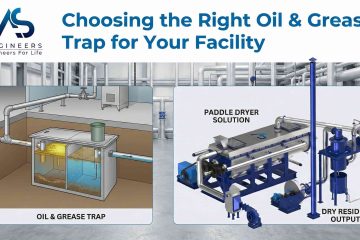
This is where an enclosed paddle sludge dryer can become useful. In a paddle dryer, heat is transferred indirectly through hollow shafts, paddles, and jacketed surfaces while the sludge is mixed and moved through the equipment. AS Engineers’ approved paddle dryer configuration includes feed handling, heating system, paddle dryer, scavenging system, pollution-control equipment, solvent or vapour management, and product handling as part of the overall process flow.
A paddle sludge dryer is most relevant when:
- mechanical dewatering cake is still costly to transport,
- storage space is limited,
- sludge must become easier to bag or handle,
- the plant wants enclosed drying,
- final moisture target is lower than mechanical dewatering can normally achieve,
- drying trial is needed before final sizing.
Do not finalize a dryer only from wet sludge quantity. Share feed moisture, cake moisture after dewatering, desired outlet moisture, sludge type, daily operating hours, heating medium, MOC requirement, vapour handling, disposal route, and site layout.
For the next stage, connect readers to the thermal sludge drying system guide and the how to choose a sludge paddle dryer guide.
Dewatering Technique Comparison
| Technique | Best Use | Strength | Limitation |
|---|---|---|---|
| Gravity thickening | Pre-concentration before dewatering | Simple, low energy | Not enough for final cake |
| Drying bed | Small plants, low-cost drying | Simple and low-energy | Needs land, weather, labour |
| Belt filter press | Continuous municipal or biological sludge | Visual operation, proven method | Belt washing and cleaning needed |
| Screw press | STP/biological sludge, compact operation | Low-speed continuous operation | Screen clogging and conditioning sensitivity |
| Plate-and-frame press | Industrial ETP sludge | Firm cake for many sludges | Batch cycle, cloth cleaning |
| Centrifuge | High-flow plants, compact footprint | Enclosed and high throughput | Power, vibration, maintenance |
| Thermal paddle drying | After mechanical dewatering | Further moisture reduction and easier handling | Needs heat source, vapour handling, sizing trial |
How to Select the Right Sludge Dewatering Technique
Start with the sludge, not the machine.
A practical selection sequence:
- Identify sludge source: primary, secondary, biological, chemical, mixed, oily, paper, textile, pharma, dye, metal hydroxide, ZLD, or STP sludge.
- Measure feed solids and moisture.
- Check whether the sludge settles, floats, foams, blinds screens, or forms stable floc.
- Run conditioning tests.
- Compare required cake dryness with disposal or drying requirement.
- Confirm operating hours and peak sludge generation.
- Check land, power, wash water, polymer, odour control, and operator skill.
- Evaluate downstream drying, storage, bagging, truck loading, or disposal route.
- Run a sludge trial before locking the equipment size.
- Ask vendors for cake moisture expectation, not only machine capacity.
If the plant is buying dewatering equipment first and a dryer later, keep the dryer supplier involved early. A few percentage points of extra moisture in press cake can increase the evaporation load on the dryer and change heating, vapour handling, and operating cost.
Common Dewatering Problems and What They Usually Indicate
| Problem | Likely Cause | What to Check |
|---|---|---|
| Wet cake | Low solids, wrong polymer, high feed rate | Feed solids, polymer, pressure, residence time |
| Cloudy filtrate or centrate | Poor floc formation | Polymer type, mixing, pH, sludge variation |
| Belt blinding | Oil, grease, sticky solids, poor washing | Belt wash system, sludge character, pre-screening |
| Screw press clogging | Fibrous or sticky sludge | Screen gap, wash cycle, feed consistency |
| Filter press long cycle | Low feed solids or poor cake formation | Feed pump pressure, cloth condition, conditioning |
| Centrifuge vibration | Imbalance, feed variation, wear | Feed control, bowl condition, vibration trend |
| Dryer overload after press | Cake too wet or inconsistent | Actual cake moisture, press operation, dryer sizing basis |
When I review a sludge handling issue, I do not look only at the final equipment. I check the full chain: sludge source, thickening, conditioning, dewatering, cake discharge, conveying, drying, vapour handling, storage, and final disposal route. Many problems blamed on the dryer or press actually start from inconsistent feed sludge.
RFQ Checklist for Sludge Dewatering and Drying Projects
Before asking for a technical quote, prepare these inputs:
| RFQ Input | Why It Matters |
|---|---|
| Sludge source | Determines sludge behaviour and risk |
| Feed quantity per day | Helps size equipment capacity |
| Operating hours | Changes hourly load |
| Feed moisture or solids | Base input for dewatering and dryer sizing |
| Expected cake moisture after dewatering | Critical for downstream drying load |
| Final moisture target | Determines whether drying is needed |
| Sludge composition | Affects MOC, odour, vapour, handling |
| Oil/grease/salt/chemical content | Affects dewatering and corrosion |
| Polymer or chemical conditioning data | Impacts cake quality and operating cost |
| Disposal or reuse route | Determines final moisture and compliance requirement |
| Available utilities | Power, steam, thermic fluid, fuel, water, air |
| Space and layout | Affects equipment arrangement |
| Pollution-control requirement | Important for vapour, fines, odour, and exhaust |
| Preferred automation level | Impacts operation and manpower |
| Trial requirement | Reduces sizing and performance risk |
For plants dealing with ETP sludge challenges, connect this section to ETP sludge disposal and treatment solutions.
Where AS Engineers Fits in the Sludge Handling Chain
AS Engineers focuses on sludge drying and industrial thermal process equipment. For plants that already have thickening or mechanical dewatering, the key question is whether the remaining press cake moisture is still creating high disposal, storage, transport, or handling problems.
AS Engineers can review the drying-stage requirement when you share:
- sludge type,
- dewatered cake moisture,
- required final moisture,
- daily sludge quantity,
- heating medium availability,
- site layout,
- MOC requirement,
- vapour and fines handling requirement,
- final storage or disposal plan.
For difficult sludge, a trial is safer than assumption-based sizing. If the sludge is sticky, oily, corrosive, salt-heavy, abrasive, or chemically variable, do not approve final drying equipment only from a generic moisture percentage.
FAQs
What is the difference between sludge thickening and sludge dewatering?
Sludge thickening increases solids concentration before dewatering. Sludge dewatering removes more water and produces a cake or semi-solid material that is easier to handle. Thickening is usually an upstream step, while dewatering is closer to final handling or drying.
Which sludge dewatering technique is best for ETP sludge?
There is no universal best technique. Chemical ETP sludge may suit plate-and-frame filter presses, some biological sludge may suit screw press or belt press, and high-flow plants may consider centrifuges. Final selection should be based on sludge trial, feed solids, polymer response, required cake moisture, operating hours, and disposal route.
Is dewatering enough, or do I still need a sludge dryer?
Dewatering may be enough if the cake is acceptable for transport, storage, or approved disposal. A sludge dryer becomes useful when the dewatered cake is still too wet, bulky, odorous, difficult to handle, or costly to transport.
Why does sludge dewatering performance change even with the same machine?
Performance changes because sludge composition changes. pH, oil, grease, salts, biological activity, polymer response, particle size, feed solids, and flow variation can all affect cake dryness and filtrate quality.
What data should I send for sludge dryer selection after dewatering?
Send sludge type, quantity per day, operating hours, cake moisture after dewatering, final moisture target, sludge composition, heating medium, MOC expectation, vapour handling need, available space, and final disposal or reuse route.
Conclusion
Sludge dewatering techniques should be selected as part of the complete sludge handling chain, not as isolated equipment decisions. Gravity thickening, drying beds, belt presses, screw presses, plate-and-frame presses, centrifuges, and thermal drying each have a role, but the right choice depends on actual sludge behaviour, disposal route, operating conditions, and final moisture target.
For ETP, STP, CETP, chemical, textile, pharma, food, paper, and ZLD sludge, the safest approach is to test the sludge, confirm dewatering output, and then size the downstream sludge dryer based on real cake moisture rather than assumptions.
If your plant is struggling with wet sludge handling, high transport load, limited storage, or inconsistent cake moisture, share your sludge details with AS Engineers. The team can review whether a paddle sludge dryer is suitable after your dewatering stage and what data is needed for a reliable technical proposal.