Agrochemical waste drying equipment is used to reduce moisture from wet waste streams such as ETP sludge, pesticide residue sludge, filter cake, slurry, paste and solvent-bearing wet solids. The goal is not only “drying.” The real goal is controlled handling, lower wet weight, safer storage, easier transport and better preparation for the approved disposal, co-processing or resource-recovery route.
For agrochemical plants, equipment selection must be more careful than ordinary sludge drying. The waste may contain pesticide residues, salts, solvents, active ingredients, acids, alkalis, odour, toxic constituents or combustible dust risk. That is why the dryer should be selected from actual waste data, not only from kg/hr capacity.
If your plant is still comparing drying routes, also read this guide on methods to reduce hazardous waste weight before finalising the dryer layout.
What is agrochemical waste drying equipment?
Agrochemical waste drying equipment is an industrial drying system designed to remove moisture from waste generated during pesticide, herbicide, fungicide, insecticide, fertilizer, chemical intermediate or agrochemical formulation processes.
Common waste streams include:
| Waste stream | Typical form | Drying selection concern |
|---|---|---|
| ETP sludge from agrochemical effluent treatment | Wet sludge or dewatered cake | Moisture, toxicity, stickiness, disposal route |
| Pesticide residue sludge | Sticky sludge or paste | Hazardous residue, vapour control, operator exposure |
| Filter press cake | Cake or semi-solid mass | Cake breaking, feeding, final moisture |
| Slurry or high-moisture residue | Pumpable slurry | Feed control, evaporation load, pre-dewatering |
| Salt-rich ZLD sludge | Crystalline or sticky cake | Corrosion, scaling, MOC selection |
| Solvent-bearing wet solids | Paste, cake or residue | Enclosed drying, vapour handling, condenser/scrubber need |
| Off-spec or date-expired pesticide waste | Product/residue | Usually needs regulatory review before any drying route |
For basic sludge classification and handling context, link this page with hazardous sludge and chemical sludge treatment and reuse.

Why agrochemical plants dry waste before disposal or utilisation
Wet agrochemical sludge is expensive and difficult to manage because moisture adds weight, increases transport load, occupies storage space and makes handling messy. Drying helps convert a wet waste stream into a more controlled material stream.
Drying can help with:
- Reducing free moisture before authorised disposal.
- Improving handling through screw conveyors, bags, drums or bulk transport.
- Reducing dripping and leakage risk during internal transfer.
- Preparing waste for TSDF, co-processing or approved utilisation where permitted.
- Reducing storage area pressure inside the plant.
- Creating a more stable output for downstream handling.
Drying does not automatically make hazardous waste non-hazardous. The classification and disposal route still depend on waste composition, lab analysis and authorisation conditions. For regulatory-facing content, connect this section with CPCB guidelines for hazardous waste disposal and TSDF site standards.
Why paddle dryer technology fits many agrochemical waste streams
A paddle dryer is an indirect heat dryer. Heat is transferred through hollow shafts, paddles and a jacketed body. The material is agitated while it moves through the dryer, so sticky sludge, paste and filter cake get continuous contact with heated surfaces.
This matters in agrochemical waste because many waste streams are not free-flowing powders. They may be sticky, pasty, lumpy or corrosive. A dryer selected only for powder drying may fail when the feed becomes tacky or forms deposits.
A paddle dryer is usually considered when the plant needs:
- Indirect heating instead of direct flame contact.
- Enclosed drying for odour, vapour or dust control.
- Continuous operation for regular ETP sludge generation.
- Better mixing of wet cake, paste or sludge.
- Lower off-gas volume compared with many direct hot-air systems.
- Integration with cyclone, scrubber, condenser or bag filter.
- Custom material of construction based on corrosion and chemical exposure.
For deeper equipment configuration, use the supporting guide on how to choose a sludge paddle dryer and the page on thermal sludge drying systems.
Dryer selection should start from waste data, not motor HP
When I review an agrochemical waste drying requirement, I do not start with dryer size alone. I first look at the waste source, moisture, active ingredients, solvent presence, salts, pH, stickiness, temperature sensitivity, disposal route and vapour handling requirement.
The wrong selection usually happens when the buyer gives only “tons per day” and asks for a price. That is not enough for agrochemical sludge.
Use this selection checklist before sending an RFQ:
| RFQ input | Why it matters |
|---|---|
| Waste source | Pesticide formulation, synthesis, ETP, scrubber, ZLD or container washing waste behaves differently |
| Initial moisture | Decides evaporation load and heating demand |
| Final moisture target | Must match disposal or handling requirement |
| Daily/hourly throughput | Decides dryer size and residence time |
| Physical form | Slurry, paste, sludge, cake, granule or powder needs different feeding design |
| Stickiness and tacky phase | Affects paddle design, shaft torque and cleaning risk |
| pH and corrosive salts | Affects MOC such as CS, SS304, SS316, duplex or alloy selection |
| Solvent or VOC presence | Decides enclosed system, condenser, scrubber and safety review |
| Active ingredient residue | Affects EHS review, dust/vapour control and disposal route |
| Temperature sensitivity | Decides steam, thermic fluid, hot water or vacuum drying approach |
| Vapour treatment requirement | Decides cyclone, scrubber, condenser, ID fan and stack design |
| Downstream route | TSDF, co-processing, authorised utilisation or internal handling route changes final moisture target |
For feed preparation, connect the page with sludge dewatering machine guide, sludge press machine and sludge transfer pumps.
Paddle dryer system layout for agrochemical waste
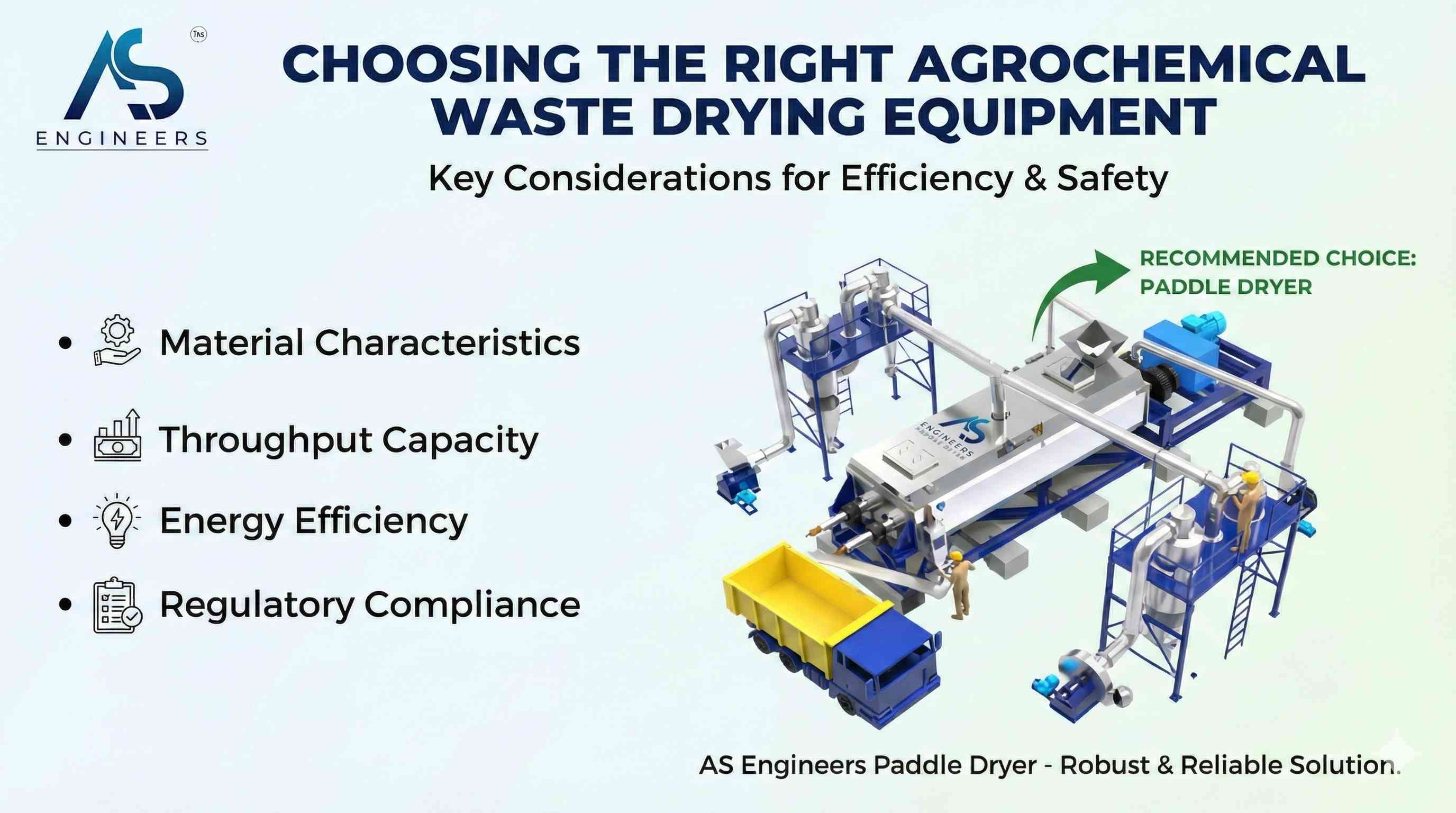
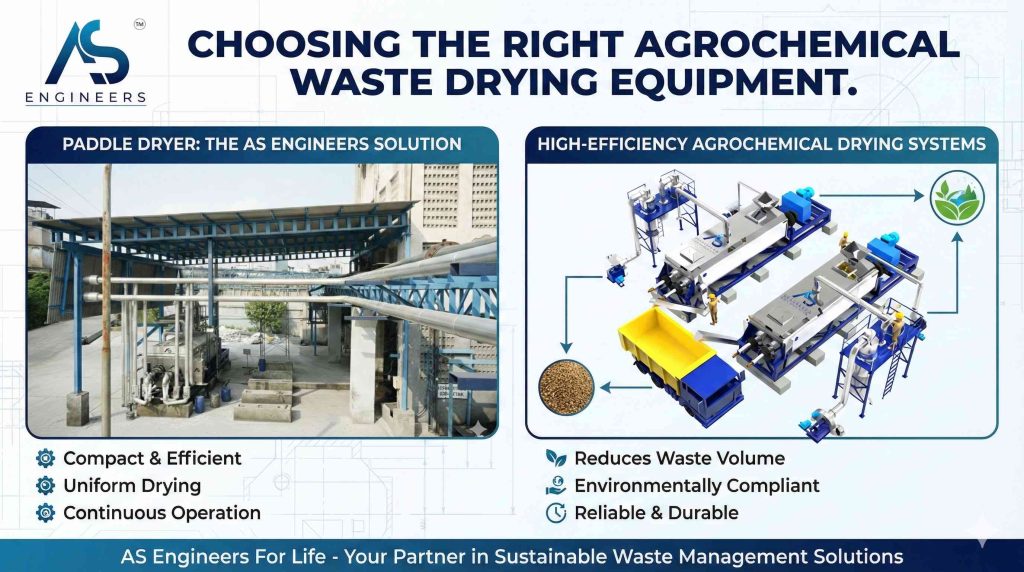
A complete agrochemical waste drying system is more than one dryer body. The supporting systems decide whether the plant gets stable operation.
A practical layout may include:
- Feed collection and dewatering
Wet sludge is collected from ETP, scrubber, process residue handling or ZLD sections. If moisture is very high, mechanical dewatering should be reviewed before thermal drying. - Feeding system
Depending on material behaviour, the system may use a screw feeder, belt conveyor, sludge pump, feed hopper or wet material silo. - Paddle dryer
The dryer uses indirect heating through hollow shafts and jacketed surfaces. Paddles agitate the material, break lumps and expose fresh surface area for evaporation. - Vapour and fines handling
Evaporated moisture, solvent vapour or entrained fines must be routed through suitable equipment such as cyclone, scrubber, condenser, bag filter or chimney, based on waste composition and statutory requirements. - Product discharge and handling
Dried output may move through a screw conveyor, bagging system, silo, bucket elevator or truck loading arrangement. - Control and safety layer
Temperature, feed rate, motor load, vapour flow, pressure condition, interlocks and emergency stop logic should be reviewed based on the site’s EHS requirement.
For broader plant-side sludge handling, support this page with industrial sludge disposal guide and ETP sludge challenges and disposal solutions.
Paddle dryer vs other drying options for agrochemical waste
| Dryer or method | Suitable when | Limitation for agrochemical waste |
|---|---|---|
| Paddle dryer | Sticky sludge, paste, filter cake, solvent-bearing wet solids, enclosed drying requirement | Needs correct feed data, MOC, vapour control and safety review |
| Solar drying bed | Low-risk sludge, large land, predictable climate | Usually weak fit for hazardous, odorous or residue-heavy agrochemical waste |
| Tray dryer | Small batch, controlled product drying | Labour-intensive and not ideal for continuous sludge load |
| Rotary dryer | Granular or free-flowing material | High off-gas volume and dust/vapour handling may be difficult |
| Belt dryer | Dewatered cake with controlled spreadability | Feed must be suitable for belt distribution; enclosed safety design still needed |
| ATFD | Concentrated liquid or ZLD stream | Not a direct replacement for all dewatered sludge/filter cake applications |
For comparison-based linking, use paddle dryer vs solar bed and belt vs thin film sludge dryer comparison where relevant.
Safety and compliance points buyers should not ignore
Agrochemical waste drying can involve toxic, corrosive, flammable, dusty or solvent-bearing materials. Dryer selection should therefore include plant EHS, process, maintenance and disposal teams from the beginning.
Important checks include:
- Waste classification and lab analysis before deciding the route.
- SPCB/PCC authorisation conditions for storage, transport, disposal or utilisation.
- Compatibility of the dryer MOC with acids, alkalis, chlorides, salts and pesticide residues.
- Vapour treatment requirement for solvents, odour and fine carryover.
- Dust control if the dried output becomes fine or combustible.
- Non-reactive storage and safe transfer arrangement for dried output.
- Operator PPE, training, interlocks and emergency procedures.
- Valid downstream route through authorised facility, actual user, co-processing or TSDF as applicable.
Do not present drying as a shortcut for compliance. Drying is a waste conditioning step. The final legal route must be verified with the plant’s authorisation and competent regulatory consultant.
Common mistakes while buying agrochemical sludge drying equipment
| Mistake | What can go wrong |
|---|---|
| Asking for dryer price without waste data | Wrong size, wrong MOC, wrong vapour system |
| Ignoring solvent content | Unsafe vapour handling or wrong condenser/scrubber design |
| Treating all ETP sludge as same | Agrochemical sludge may vary heavily by product campaign |
| Skipping pilot or lab trial for sticky waste | Material may build up, lump, foam or degrade |
| Selecting only by tons/day | Moisture load, residence time and heat load may be missed |
| Ignoring discharge handling | Dried output may bridge, dust, cake or create storage problems |
| Assuming drying guarantees disposal approval | Approval depends on hazardous waste rules and authorised route |
| Not planning spares and cleaning access | Downtime increases after installation |
Where AS Engineers can support
AS Engineers supports industrial sludge and waste drying applications with paddle dryer and sludge dryer systems. For agrochemical waste, the practical selection scope may include feed review, dryer configuration, heating medium selection, MOC discussion, vapour handling concept, pollution control support equipment and product handling layout.
AS Engineers paddle dryer systems can be configured around steam, thermic fluid or other suitable heating arrangements depending on the process requirement. Material options may include carbon steel, SS304, SS316, duplex steel or other alloy steels based on the duty condition.
A pilot trial is recommended when the waste is sticky, solvent-bearing, heat-sensitive, corrosive or highly variable from batch to batch. Trial data helps check drying behaviour, feed handling, output condition and possible operating issues before final sizing.
For a stronger commercial path, link this article with the AS Engineers ecosystem page on paddle dryer in chemical industry and the product page for sludge dryer manufacturer.
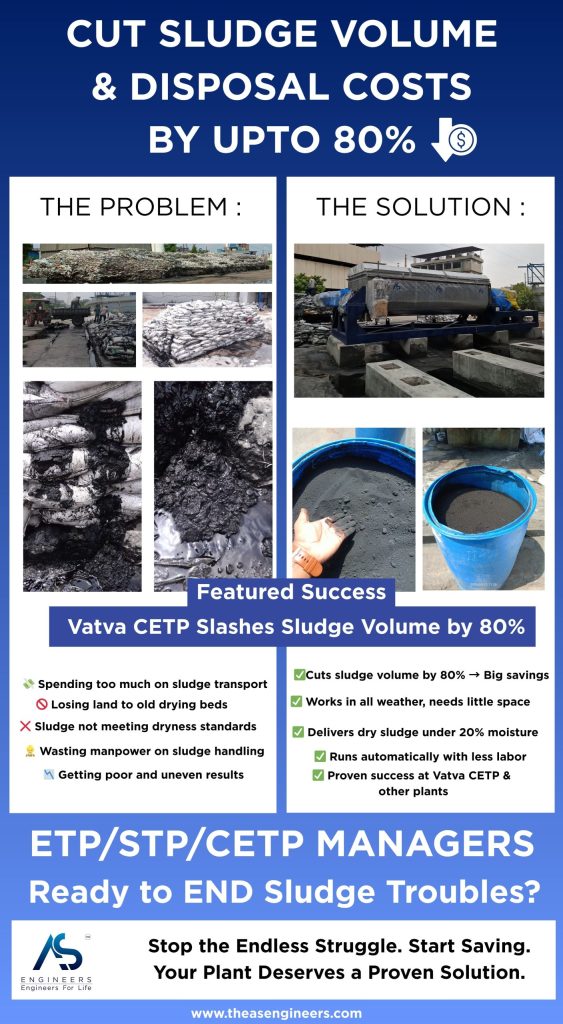

RFQ checklist for agrochemical waste drying equipment
Before requesting a quotation, share these details:
- Industry and product category, such as pesticide, herbicide, fungicide, insecticide, intermediate or fertilizer.
- Waste source, such as ETP sludge, filter press cake, scrubber sludge, ZLD sludge, spent residue or slurry.
- Initial moisture percentage.
- Desired final moisture percentage or disposal route requirement.
- Quantity per hour/day.
- Working hours per day.
- Material temperature sensitivity.
- pH, chloride, salt, solvent and active ingredient information.
- MSDS or lab analysis where available.
- Bulk density and particle size if known.
- Existing dewatering machine details.
- Heating source available at site, such as steam, thermic fluid, hot water, gas, coal, wood, LDO or electricity.
- Required vapour treatment, such as condenser, scrubber, cyclone, bag filter or chimney.
- Space available for dryer and auxiliaries.
- Expected discharge mode, such as bagging, screw conveyor, silo or truck disposal.
- Any statutory, EHS or internal safety requirement.
FAQs
Can agrochemical ETP sludge be dried in a paddle dryer?
Yes, many agrochemical ETP sludge and filter cake streams can be reviewed for paddle drying, especially when the material is wet, sticky, paste-like or difficult to handle. Final suitability depends on moisture, chemical composition, solvent content, corrosiveness, stickiness, temperature sensitivity and disposal route.
Is drying the same as hazardous waste treatment approval?
No. Drying reduces moisture and improves handling, but it does not automatically change the legal classification of waste. Agrochemical plants should verify the authorised storage, transport, utilisation, co-processing or TSDF route with their SPCB/PCC authorisation and regulatory consultant.
Which heating medium is better for agrochemical waste drying?
Steam, thermic fluid, hot water or other heating sources may be used depending on required temperature, site utilities, solvent risk, temperature sensitivity and operating cost. For heat-sensitive or solvent-bearing waste, the heating and vapour-control design should be reviewed carefully before final selection.
What if the agrochemical waste contains solvents?
Solvent-bearing waste needs enclosed drying, vapour collection and suitable downstream handling such as condenser, scrubber or other approved vapour treatment. Do not select a standard open drying method for solvent-bearing sludge without EHS and process safety review.
What details are required to size agrochemical waste drying equipment?
At minimum, share waste source, quantity, initial moisture, final moisture target, physical form, chemical composition, pH, solvent content, active residue risk, bulk density, available heating medium, operating hours, site layout and final disposal or utilisation route.
Conclusion
Agrochemical waste drying equipment should be selected as a complete waste-conditioning system, not as a standalone machine. For pesticide residue sludge, ETP sludge, filter cake, slurry, paste and solvent-bearing wet solids, the most important questions are feed behaviour, moisture load, MOC, vapour handling, safety controls and final authorised route.
A paddle dryer can be a strong fit when the plant needs indirect heat transfer, enclosed operation, continuous drying, sticky material handling and integration with cyclone, scrubber, condenser or product handling systems. Before final selection, share the complete RFQ data and, for difficult waste, consider a pilot trial to reduce sizing and handling risk.