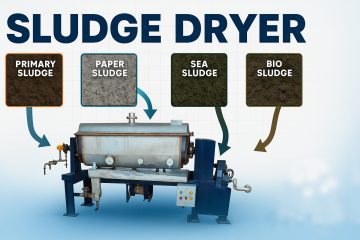
ZLD sludge is the concentrated wet cake, slurry, salt residue, or solid waste left after a Zero Liquid Discharge system recovers reusable water from industrial wastewater. It may come from ETP sludge, RO reject, MEE concentrate, evaporator residue, ATFD discharge, crystallizer salt, or filter press cake.
For plant teams, the real challenge is not only achieving “zero liquid discharge.” The remaining sludge still needs correct characterization, dewatering, drying, storage, movement, and disposal.
A good ZLD sludge plan reduces avoidable handling problems, supports safer waste management, and helps the plant choose the right equipment before committing to a dryer, ATFD, paddle dryer, filter press, or disposal route.
What is ZLD sludge?
ZLD sludge is the final concentrated residue generated after a Zero Liquid Discharge system separates reusable water from wastewater. In industrial plants, it usually contains a mix of salts, suspended solids, chemical treatment residue, organics, process contaminants, and moisture.
In simple terms:
ZLD removes liquid discharge, but it does not remove waste responsibility. It converts the liquid waste burden into a solid, semi-solid, slurry, or salt-handling problem.
This is why ZLD sludge should not be treated as a small by-product. It affects plant space, labour, odour, handling, drying load, disposal cost, and compliance documentation.
For a full system-level understanding, also read this Zero Liquid Discharge guide.
Where is sludge generated in a ZLD plant?
ZLD sludge can form at multiple points, not only at the final dryer.
| ZLD Stage | Common Output | Sludge or Residue Concern |
|---|---|---|
| Primary treatment | Settled solids, chemical sludge | High moisture, heavy handling |
| Biological treatment | Bio-sludge | Variable organic content and odour |
| Clarifier or thickener | Thickened sludge | Still needs dewatering |
| Filter press or centrifuge | Wet cake | Reduced water, but often still heavy |
| RO system | Reject stream | High TDS, scaling tendency |
| MEE or evaporator | Concentrate, slurry, residue | High solids and salt load |
| ATFD or crystallizer | Dry or semi-dry solids, salts | Classification and disposal needed |
| Sludge dryer | Dried cake, granules, powder, or lumps | Needs safe cooling, conveying, bagging, disposal |
The correct treatment route depends on sludge source, moisture, salt load, organics, pH, hazardous constituents, stickiness, abrasiveness, and final disposal rules.
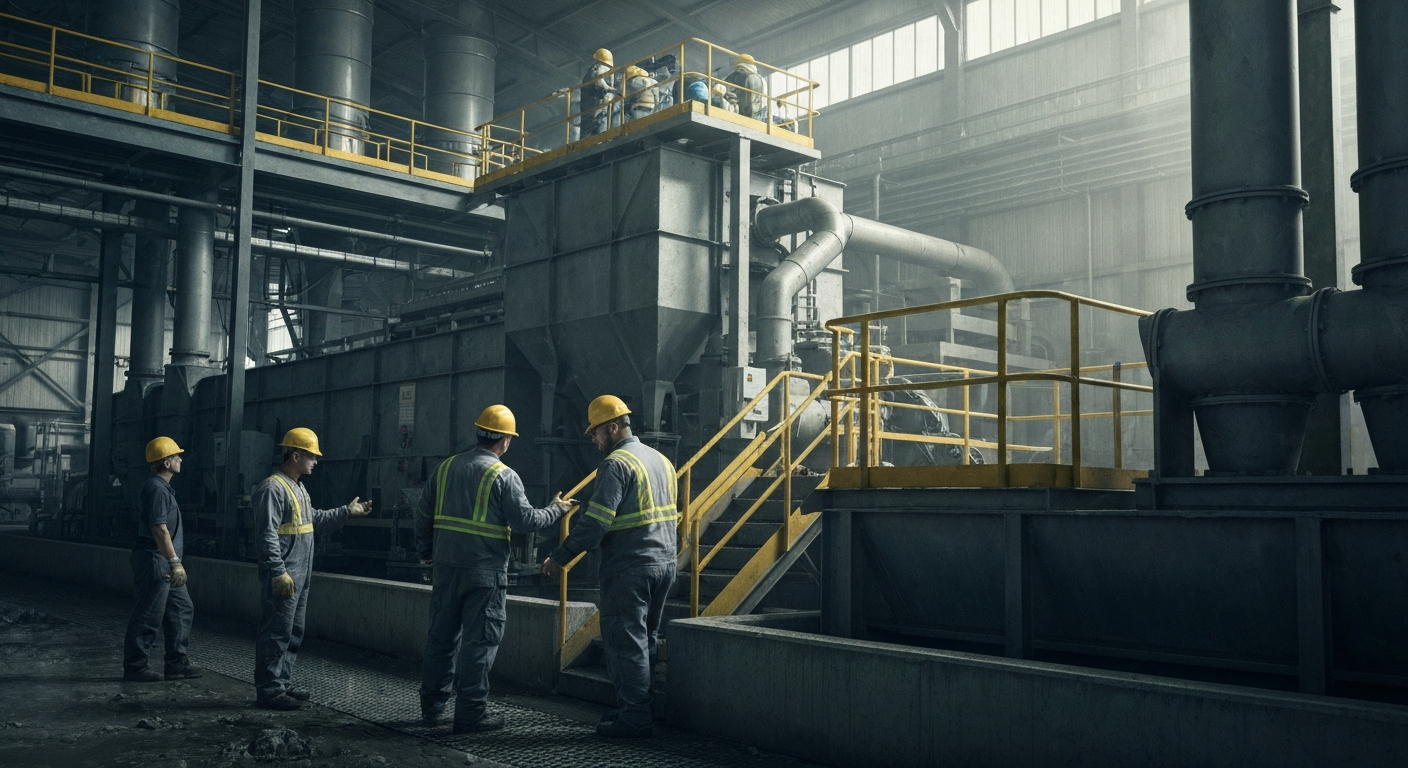
Why ZLD sludge is different from normal ETP sludge
Normal ETP sludge is already difficult to manage, but ZLD sludge can be more complex because the ZLD process concentrates what was previously diluted in wastewater.
| Factor | Normal ETP Sludge | ZLD Sludge |
|---|---|---|
| Water recovery objective | Partial | Maximum practical water recovery |
| Salt concentration | Often lower | Often higher, especially after RO/MEE |
| Handling behaviour | Wet cake or slurry | Wet cake, sticky paste, crystalline salt, slurry, or mixed residue |
| Equipment stress | Moderate to high | Can be high due to salts, scaling, corrosion, and abrasion |
| Disposal sensitivity | Requires classification | Requires stricter review in many industrial cases |
| Dryer selection | Moisture-driven | Moisture, salts, MOC, vapour, and disposal-driven |
This is why ZLD sludge dryer selection should not be done only from tonnage. The team must check inlet moisture, final moisture target, feed behaviour, MOC, heating medium, vapour handling, and final disposal route.
Common problems in ZLD sludge handling
ZLD sludge creates problems when the plant treats it as a simple “solid waste” after water recovery.
Common site problems include:
- Wet cake sticking inside hoppers, conveyors, and dryer feed points
- High transport cost due to excess moisture
- Large storage area requirement
- Odour or hygiene issues where sludge remains wet for long periods
- High salt or chemical load affecting equipment MOC
- Scaling and buildup inside downstream equipment
- Difficult bagging because final material is not dry or free-flowing
- Unclear disposal route due to incomplete waste classification
- Overloading of dryer because dewatering was not optimized first
For plant-side troubleshooting, this related guide on top challenges for ZLD plants is useful.
ZLD sludge treatment flow
A practical ZLD sludge treatment plan normally follows this order.
| Step | Purpose | Key Decision |
|---|---|---|
| Characterization | Understand composition and risk | Lab analysis, TDS, salts, organics, heavy metals, pH, moisture |
| Thickening | Reduce free water before dewatering | Gravity thickener, clarifier, sludge thickener |
| Mechanical dewatering | Reduce moisture before thermal drying | Filter press, screw press, belt press, centrifuge |
| Thermal drying | Reduce moisture further for handling or disposal | Paddle dryer, ATFD, solar drying, hot air dryer |
| Vapour/off-gas handling | Manage evaporated moisture and fumes | Condenser, scrubber, cyclone, bag filter, ID fan |
| Product handling | Move dried material safely | Screw conveyor, bagging, silo, truck loading |
| Disposal or reuse review | Decide final route | TSDF, co-processing, reuse, landfill, or authorized disposal |
Mechanical dewatering should usually come before thermal drying. Dryers should not be used to evaporate water that could have been removed more economically through proper dewatering.
For more on this step, see sludge dewatering techniques and sludge dewatering machine guide.
Role of a paddle dryer in ZLD sludge drying
A paddle dryer is useful when ZLD sludge is already dewatered but still too wet, sticky, heavy, or difficult to dispose of economically.
In an indirect paddle dryer, heat is transferred through hollow shafts and the jacket. Wedge-shaped paddles continuously mix and break the sludge cake while helping expose fresh surface area for evaporation. AS Engineers’ approved product data supports paddle dryer features such as indirect heating through steam or thermal oil, handling of slurries, pastes, cakes, granules, and powders, operation under atmospheric, vacuum, or pressurized conditions, and MOC options such as CS, SS304, SS316, Duplex Steel, and other alloys as per requirement.
For ZLD sludge, the paddle dryer is generally considered after filter press, centrifuge, or screw press dewatering, especially where the plant needs:
- Lower final moisture for transport or disposal
- Better handling than sticky wet cake
- More compact footprint than open drying beds
- Enclosed operation compared with open drying
- Controlled vapour handling
- Continuous drying for higher-volume industrial sludge
- A dryer that can handle paste-like feed behaviour
You can also compare this with sludge treatment using conductive paddle dryers and the paddle dryer configuration guide.
When a paddle dryer makes sense for ZLD sludge
A paddle dryer can be a practical option when:
| Site Condition | Why Paddle Dryer Helps |
|---|---|
| Filter press cake is still heavy | Thermal drying reduces remaining moisture |
| Sludge is sticky or pasty | Paddle agitation helps mixing and movement |
| Plant has limited space | Enclosed continuous drying can reduce open drying area |
| Disposal cost is moisture-sensitive | Lower moisture can reduce weight-based disposal burden |
| Vapour handling is required | Dryer can be connected with condenser, scrubber, cyclone, bag filter, or ID fan system |
| Continuous operation is needed | Suitable for process-linked sludge generation |
| Material requires controlled heating | Indirect heating avoids direct flame contact with sludge |
AS Engineers’ catalogue includes an illustrative sludge drying example where 10 ton/day wet sludge becomes 2 ton/day dried sludge, changing the disposal cost example from ₹1,00,000/day to ₹20,000/day at the same stated disposal rate. This should be treated as an example, not a universal guarantee. Actual results depend on inlet moisture, final moisture target, composition, plant operation, disposal rate, and system design.
When a paddle dryer should not be the first step
A paddle dryer is not always the first or only answer.
It may not be the right first step when:
- Sludge is still a thin slurry with very high free water
- Mechanical dewatering has not been optimized
- Feed composition is unknown
- Sludge contains constituents requiring special safety review
- Vapour treatment route is not defined
- MOC is selected only by budget, not by corrosion/abrasion risk
- Final disposal route is not confirmed
- Plant expects guaranteed dryness without material testing
In many ZLD projects, the better sequence is:
Characterization → thickening → mechanical dewatering → thermal drying → safe storage/disposal
For system-level drying comparison, see this thermal sludge drying system guide.
ZLD sludge drying methods compared
| Method | Best Fit | Limitation |
|---|---|---|
| Filter press | First-stage moisture reduction | Cake may still be wet and heavy |
| Screw press | Continuous dewatering for suitable sludge | Not suitable for every sludge behaviour |
| Centrifuge | Higher-speed dewatering | Power, wear, and sludge chemistry matter |
| Solar drying bed | Low-cost drying where land and time are available | Slow, weather-dependent, large space |
| ATFD | Concentrated liquid, slurry, and some high-solids evaporation duties | Feed behaviour and scaling risk need careful review |
| Paddle dryer | Dewatered cake, paste, sludge, sticky solids | Needs correct feed moisture, heating medium, MOC, vapour route |
| Direct hot-air dryer | Some granular or less sticky materials | Higher off-gas handling burden in many sludge cases |
For plants comparing open drying and mechanical drying, this paddle dryer vs solar bed guide can support selection.
Is ZLD sludge hazardous waste?
Not always, but it must be verified.
ZLD sludge or residue may be non-hazardous, hazardous, reusable, co-processable, or TSDF-bound depending on the industry, source wastewater, chemical treatment, salts, metals, organics, and applicable rules.
For Indian industrial plants, classification should be based on actual analysis and regulatory applicability. Official Indian hazardous waste guidance focuses on safe storage, treatment, and disposal of hazardous waste in an environmentally sound manner, and CPCB publishes technical guidelines and SOPs for multiple hazardous waste categories.
A regulatory committee document also notes that evaporation/MEE residue and salts from wastewater treatment can require proper handling and disposal under hazardous waste rules depending on the waste category and process context.
So the safer rule is:
Do not decide ZLD sludge disposal route by appearance. Decide it by lab analysis, process source, regulatory classification, and approved disposal/reuse route.
For more compliance-focused reading, use this CPCB hazardous waste disposal guide and TSDF site standards guide.

What data is required before selecting a ZLD sludge dryer?
Dryer selection should start with duty data, not only capacity.
| RFQ Input | Why It Matters |
|---|---|
| Source of sludge | ETP, RO reject, MEE residue, ATFD discharge, mixed sludge |
| Wet quantity | Daily and hourly load |
| Inlet moisture | Determines evaporation load |
| Final moisture target | Affects dryer size and residence time |
| Feed behaviour | Sticky, pasty, granular, crystalline, abrasive, corrosive |
| Bulk density | Affects feeding, conveying, and sizing |
| pH and chemical composition | MOC and safety review |
| Salt/TDS load | Scaling, corrosion, disposal classification |
| Heating medium | Steam, thermic fluid, hot water, electricity, or available fuel system |
| Vapour route | Condenser, scrubber, cyclone, bag filter, ID fan, chimney |
| Pollution control requirement | Dust, fumes, odour, solvent, or vapour load |
| Site layout | Space, height, access, foundation, maintenance clearance |
| Disposal route | TSDF, co-processing, reuse, landfill, or authorized handler |
| Automation requirement | Manual, semi-automatic, or continuous operation |
| Trial requirement | Pilot test before final selection |
AS Engineers offers pilot trials for paddle dryer applications with a 50 kg/hr pilot trial machine, available at AS Engineers’ works or at the client site on a paid basis, with the fee waived upon order placement as stated in approved company material.
Practical selection logic I use for ZLD sludge
When I review a ZLD sludge drying requirement, I do not start with dryer size alone. I first ask these questions:
- Is this sludge coming from primary ETP, RO reject, MEE, ATFD, or mixed residue?
- What is the present moisture after dewatering?
- Is the material sticky, scaling, corrosive, abrasive, or salt-heavy?
- What final condition is actually needed: lower moisture, powder, granules, lumps, or baggable solid?
- What will happen to the vapour?
- What is the final disposal or reuse route?
- Is there enough sample data for safe MOC and heating selection?
This avoids one common mistake: buying a dryer based on tonnage and then discovering that feed behaviour, vapour load, or MOC was the real issue.
Common mistakes in ZLD sludge management
| Mistake | Practical Risk |
|---|---|
| Treating all ZLD sludge as the same | Wrong dryer, wrong MOC, wrong disposal route |
| Skipping lab characterization | Compliance and safety risk |
| Sending thin slurry directly to dryer | High energy use and oversized equipment |
| Ignoring feed stickiness | Hopper choking and poor discharge |
| Ignoring vapour treatment | Odour, condensate, and emission handling issues |
| Selecting MOC by lowest cost | Corrosion or premature wear |
| Expecting fixed dryness without trials | Unrealistic performance expectation |
| Not planning product handling | Dryer works, but dried material becomes a handling problem |
| Not checking TSDF or reuse route early | Dried material still has no approved destination |
AS Engineers support for ZLD sludge drying
AS Engineers works in paddle dryers, sludge dryers, centrifugal blowers, and pollution control equipment. The approved AS Engineers catalogue describes the company’s product ecosystem as Paddle Dryer / Sludge Dryer, Centrifugal Blower, Pollution Control Equipment, and Turnkey Solutions, with ISO 9001:2015 certification stated in company material.
For ZLD sludge drying, we can review the application based on:
- Wet sludge quantity
- Inlet and target moisture
- Source of sludge
- Sludge composition and behaviour
- Heating medium availability
- MOC requirement
- Vapour and off-gas handling
- Product discharge and bagging needs
- Site layout and maintenance access
- Existing ZLD, MEE, ATFD, filter press, or ETP equipment
AS Engineers’ paddle dryer system can be integrated with feeding, heating, scavenging, pollution control, solvent/vapour management, and product handling systems as per the approved process flow in company documents.

FAQs
What is ZLD sludge?
ZLD sludge is the solid, semi-solid, wet cake, slurry, salt residue, or concentrated waste left after a Zero Liquid Discharge system recovers reusable water from industrial wastewater. It may come from ETP treatment, RO reject, MEE, ATFD, crystallizer, filter press, or final dryer discharge.
How is ZLD sludge treated?
ZLD sludge is usually treated through characterization, thickening, mechanical dewatering, thermal drying, vapour handling, safe storage, and final disposal or reuse evaluation. The exact method depends on moisture, salts, chemical composition, stickiness, hazardous classification, and disposal route.
Can a paddle dryer dry ZLD sludge?
Yes, a paddle dryer can dry many types of dewatered ZLD sludge, filter press cake, paste-like sludge, and salt-bearing residues when the feed behaviour, moisture, heating medium, MOC, vapour route, and final disposal requirement are suitable. Material testing is strongly recommended for difficult sludge.
Is ZLD sludge hazardous?
ZLD sludge is not automatically hazardous in every case. It must be classified based on source industry, process chemistry, lab analysis, and applicable hazardous waste rules. MEE residue, salts, and chemical sludge from industrial wastewater may require careful regulatory review before disposal.
What information is needed for a ZLD sludge dryer quotation?
Share sludge source, wet quantity per day, inlet moisture, target moisture, lab report, pH, TDS/salt load, sludge behaviour, heating medium, MOC preference, vapour handling requirement, site layout, automation requirement, and final disposal or reuse route.
Conclusion
ZLD sludge is the final responsibility left after water recovery. A ZLD plant may reduce liquid discharge, but the remaining sludge, salts, wet cake, and residues still need proper treatment, drying, handling, classification, and disposal.
For many industrial plants, the strongest approach is not “dryer first.” It is:
Characterize the sludge → dewater it properly → select the right dryer → manage vapour safely → plan final disposal or reuse.
A paddle dryer can be a strong option for ZLD sludge when the material is dewatered, sticky, heavy, space-consuming, or difficult to transport in wet form. But final selection must be based on real sludge data, heating medium, MOC, vapour route, and disposal requirement.
For a ZLD sludge drying review, share your sludge source, quantity, moisture, lab report, current dewatering method, heating medium, and expected final condition. The AS Engineers team can review the requirement and suggest a suitable drying configuration based on actual operating conditions.