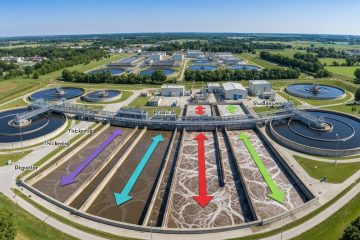
The 4 stages of wastewater treatment process are preliminary treatment, primary treatment, secondary treatment, and tertiary treatment. Together, these stages remove large debris, settleable solids, dissolved organic load, fine impurities, nutrients, and pathogens before treated water is discharged or reused.
For industrial plants, sewage treatment plants, and effluent treatment plants, one more point is equally important: every stage also affects the type, quantity, and moisture level of sludge generated inside the plant.
Quick answer: What are the 4 stages of wastewater treatment?
| Stage | Main purpose | Common equipment | What it removes | Sludge impact |
|---|---|---|---|---|
| Preliminary treatment | Protect downstream equipment | Bar screen, grit chamber, oil and grease trap | Rags, plastics, grit, sand, floating matter | Screenings and grit are removed separately |
| Primary treatment | Settle heavy solids | Primary clarifier, settling tank | Settleable solids, scum, some suspended solids | Primary sludge is formed |
| Secondary treatment | Biologically reduce organic load | Aeration tank, MBBR, SBR, ASP, secondary clarifier | BOD, biodegradable organics, biological solids | Waste activated sludge is generated |
| Tertiary treatment | Final polishing and reuse/discharge preparation | Sand filter, carbon filter, UF/RO, UV, chlorination, nutrient removal | Fine solids, nutrients, pathogens, dissolved contaminants | May generate filter backwash, reject stream, or chemical sludge |
In simple words, the wastewater treatment line handles the liquid stream. The sludge treatment line handles the solids removed from that liquid stream.
Why wastewater needs multiple treatment stages
Wastewater is not one single pollutant. It contains floating debris, suspended solids, organic matter, oil and grease, nutrients, dissolved chemicals, biological contaminants, and sometimes industrial compounds. One treatment method cannot remove all these contaminants properly.
That is why wastewater treatment plants use step-by-step separation, biological treatment, and polishing. Official wastewater treatment references commonly describe treatment in preliminary, primary, secondary, and sometimes tertiary stages before discharge or reuse.
For an industrial plant, this stage-wise approach also protects equipment. Screening prevents pump choking. Grit removal reduces abrasion. Primary treatment reduces solids load. Secondary treatment reduces biological oxygen demand. Tertiary treatment prepares water for stricter discharge or reuse targets.
Stage 1: Preliminary treatment
Preliminary treatment is the first protection stage in a wastewater treatment plant. Its job is not deep purification. Its job is to remove materials that can damage pumps, block pipelines, disturb clarifiers, or overload later stages.
Common preliminary treatment units include:
- Bar screens
- Coarse screens
- Fine screens
- Grit chambers
- Oil and grease traps
- Equalization tanks in many industrial ETPs
Large plastics, rags, wrappers, stones, sand, grit, and floating oil should be removed as early as possible. For industrial plants, this stage becomes more important when wastewater contains fibrous material, packaging waste, floor wash solids, process residue, or oil and grease.
For a detailed related explanation, read the guide on bar screens in wastewater treatment.
Stage 2: Primary treatment
Primary treatment uses gravity to separate settleable solids from wastewater. In this stage, wastewater usually enters a primary clarifier or settling tank. Heavier solids settle at the bottom, while lighter scum, oil, and grease float to the top.
The settled material is called primary sludge. This sludge is usually wetter, heavier, and more organic compared with some downstream sludge streams. If primary sludge is not removed and handled properly, it can create odour, volume, pumping, and disposal problems.
Primary treatment helps reduce the load on secondary biological treatment. It also makes the next stage more stable because the aeration system does not have to deal with unnecessary settleable solids.
Stage 3: Secondary biological treatment
Secondary treatment removes dissolved and colloidal organic matter using microorganisms. This is the biological heart of many STP and ETP systems.
Common secondary treatment processes include:
- Activated sludge process
- MBBR
- SBR
- MBR
- Trickling filter
- Anaerobic treatment for selected high-strength wastewater
In biological treatment, microorganisms consume organic pollutants and convert them into biomass, carbon dioxide, water, and other byproducts depending on the process. EPA wastewater references describe extended aeration as a modification of the activated sludge process that biologically removes biodegradable organic waste under aerobic conditions.
After biological treatment, the mixed liquor usually enters a secondary clarifier. Here, biological solids settle. Some sludge is returned to maintain the biomass level, and excess sludge is removed as waste activated sludge.
For related troubleshooting, read activated sludge system troubleshooting.
Stage 4: Tertiary and advanced treatment
Tertiary treatment is the final polishing stage. It is used when treated water needs better quality for discharge, reuse, process recovery, gardening, cooling tower makeup, boiler pretreatment support, or stricter site requirements.
Common tertiary treatment methods include:
- Pressure sand filter
- Activated carbon filter
- Micron filtration
- Ultrafiltration
- Reverse osmosis
- UV disinfection
- Chlorination
- Ozonation
- Nutrient removal
- Chemical precipitation
Tertiary treatment should not be selected randomly. It depends on the final water quality target, discharge route, reuse application, COD/BOD/TSS level, nutrients, salts, pathogens, and industrial contaminants.
WHO wastewater reuse guidance also emphasizes risk assessment, risk management, health-based targets, and monitoring when treated wastewater or excreta are reused.
Where sludge is generated in the wastewater treatment process
Many people explain wastewater treatment only from the water side. In real plant operation, sludge management is often the bigger cost and handling problem.
Sludge can be generated from:
| Plant area | Sludge type | Practical concern |
|---|---|---|
| Primary clarifier | Primary sludge | High moisture, odour, organic load |
| Biological treatment | Waste activated sludge | Bulky, biological, requires stabilization/dewatering |
| Chemical treatment | Chemical sludge | Depends on coagulant, pH correction, metals, salts |
| Tertiary filtration | Filter backwash solids | Lower volume but still needs management |
| ETP pretreatment | Oil, grease, grit, screenings | Must be handled separately |
This is why the wastewater treatment process should not stop at “treated water is clear.” The plant team should also ask: what sludge is generated, how wet is it, how much is produced per day, how will it be dewatered, and whether thermal drying is needed after dewatering.
For deeper sludge-side planning, read the wastewater treatment sludge guide.
Dewatering vs drying: not the same step
Dewatering and drying are often confused, but they are different operations.
| Step | What it does | Typical output |
|---|---|---|
| Thickening | Increases solids concentration before further treatment | Thickened sludge |
| Dewatering | Removes free water mechanically | Sludge cake |
| Drying | Removes additional moisture thermally | Drier, lighter sludge or granules, depending on material behaviour |
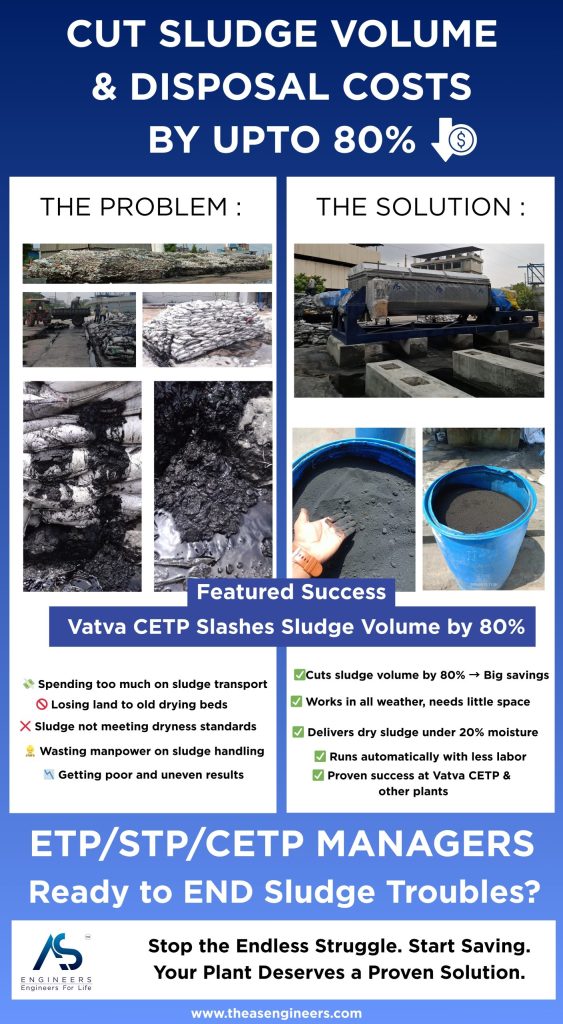
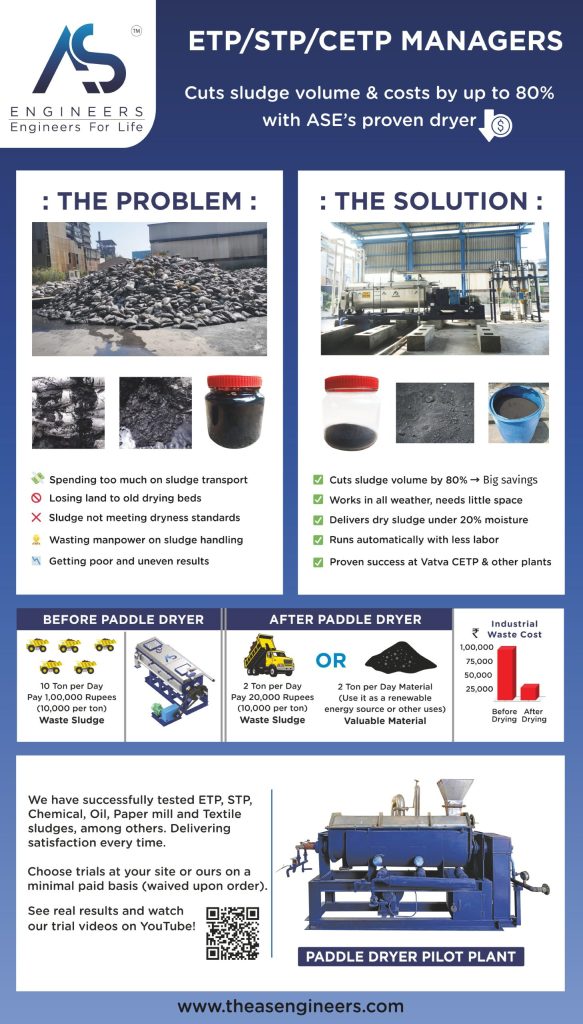
Dewatering normally comes before drying. A sludge dryer is usually considered when mechanically dewatered sludge is still too wet, heavy, sticky, difficult to store, expensive to transport, or unsuitable for the intended disposal or reuse route.
For dewatering options, see sludge dewatering techniques. For drying methods, see sludge drying methods and systems.
When a sludge dryer becomes relevant after wastewater treatment
A sludge dryer is not required in every wastewater treatment plant. It becomes relevant when sludge handling, disposal cost, storage space, odour, transportation weight, or downstream use becomes a serious operational issue.
A thermal sludge dryer may be worth evaluating when:
- Dewatered sludge cake is still too wet for economical handling.
- Sludge disposal cost is increasing because of moisture and weight.
- The plant has limited sludge storage space.
- The sludge is sticky, smelly, or difficult to transport.
- The end-use route requires lower moisture.
- The plant wants to evaluate reuse, co-processing, or volume reduction.
- The sludge source and composition are stable enough for dryer selection.
AS Engineers’ paddle dryer system is designed for sludge drying applications and uses indirect heat transfer through hollow shafts and jacket heating. The official AS Engineers catalogue also lists configuration elements such as feeding system, heating system, paddle dryer, scavenging system, pollution control equipment, solvent management, and product handling system.
Fit and no-fit guidance for industrial plants
| Situation | Dryer fit? | Reason |
|---|---|---|
| Dewatered sludge is still costly to transport | Strong fit | Drying can reduce moisture and handling burden |
| Sludge quantity is too small and disposal is already economical | Maybe not | Dryer investment may not be justified |
| Sludge composition changes daily | Needs trial | Dryer behaviour depends on feed consistency |
| Hazardous or chemical sludge with unknown composition | Verify first | Lab testing and EHS review are required |
| Sludge has free water and poor dewatering | Fix dewatering first | Dryer should not be used as a substitute for basic dewatering |
| Plant wants reusable or co-processing-ready dried solids | Possible fit | Final use depends on composition and regulatory acceptance |
| No vapour, odour, or pollution-control plan exists | Not ready | Dryer system needs proper vapour and exhaust handling |
Common mistakes in wastewater and sludge treatment planning
Treating water quality and sludge handling as separate problems
A plant may achieve acceptable treated water quality but still struggle with sludge storage, tank cleaning, wet cake transport, and disposal cost. Sludge handling should be planned along with the main ETP or STP process.
Selecting equipment only by capacity
Capacity matters, but it is not enough. For sludge drying, selection depends on feed moisture, final moisture target, sludge behaviour, stickiness, pH, salts, oil and grease, MOC, heating medium, vapour handling, and discharge method.
Ignoring seasonal and production variation
Industrial wastewater can change with batch production, raw material changes, cleaning cycles, monsoon dilution, and process shutdowns. This can affect sludge quantity and dryer performance.
Assuming tertiary treatment removes every problem
Tertiary treatment polishes water, but it does not eliminate the need to manage sludge, reject streams, backwash, or chemical residues.
Not testing sludge before drying
Pilot testing is useful when the sludge is sticky, variable, chemical-heavy, heat-sensitive, or intended for reuse. AS Engineers’ source material mentions a 50 kg/hr paddle dryer pilot trial machine for demonstrations and feasibility assessment.
RFQ checklist for wastewater sludge drying
Before asking for a sludge dryer quotation, prepare these inputs:
| RFQ input | Why it matters |
|---|---|
| Sludge source | ETP, STP, CETP, chemical, pharma, food, textile, paper, refinery, etc. |
| Wet sludge quantity per day | Helps estimate duty and operating hours |
| Inlet moisture or solids percentage | Critical for heat load and sizing |
| Final moisture target | Defines drying requirement |
| Sludge form | Slurry, paste, cake, sticky mass, granules |
| Current dewatering method | Filter press, centrifuge, screw press, belt press, drying bed |
| Chemical composition | Corrosion, scaling, odour, safety, and MOC impact |
| Heating medium available | Steam, thermic fluid, hot water, other site utilities |
| Vapour handling need | Water vapour, odour, solvent, scrubbing, condensation |
| Disposal or reuse plan | Landfill, TSDF, co-processing, fuel, compost, brick, cement, other approved route |
| Space and layout | Feeding, discharge, maintenance access, utilities |
| Operation pattern | Batch, continuous, shifts per day, seasonal load |
For ETP-specific sludge issues, read ETP sludge treatment and disposal challenges.
Practical process flow for industrial plants
A practical wastewater and sludge handling sequence usually looks like this:
- Screen and remove grit from incoming wastewater.
- Equalize the wastewater flow and pollutant load where needed.
- Use primary treatment to remove settleable solids.
- Use biological or chemical treatment based on wastewater characteristics.
- Clarify the treated water.
- Add tertiary treatment if discharge or reuse needs polishing.
- Collect primary, secondary, and chemical sludge separately where practical.
- Thicken and dewater sludge.
- Test whether thermal drying is required.
- Select drying, vapour handling, and final product handling based on actual sludge data.
For the full plant-side topic, read the wastewater treatment plant guide.
Frequently Asked Questions
What are the 4 stages of wastewater treatment process?
The 4 stages are preliminary treatment, primary treatment, secondary treatment, and tertiary treatment. Preliminary treatment removes debris and grit. Primary treatment settles solids. Secondary treatment uses biological processes to reduce organic load. Tertiary treatment polishes treated water for discharge or reuse.
Is preliminary treatment the same as primary treatment?
No. Preliminary treatment removes large debris, grit, and floating matter to protect equipment. Primary treatment uses settling tanks or clarifiers to remove suspended solids and produce primary sludge.
Which stage produces the most sludge?
Sludge can come from primary clarifiers, biological treatment, chemical treatment, and tertiary filtration. The highest sludge load depends on the plant design and wastewater characteristics. Primary and secondary treatment are usually major sludge-generation points.
Does tertiary treatment remove the need for sludge treatment?
No. Tertiary treatment improves treated water quality, but sludge generated in earlier stages still needs thickening, stabilization, dewatering, drying, disposal, or approved reuse.
When should an ETP or STP consider a sludge dryer?
A sludge dryer should be considered when dewatered sludge is still too wet, heavy, sticky, costly to transport, difficult to store, or unsuitable for the intended disposal or reuse route. Final selection should be based on sludge testing, moisture target, heating medium, MOC, vapour handling, and site conditions.
Conclusion
The 4 stages of wastewater treatment process are simple to understand, but real plant performance depends on how well each stage is connected to sludge handling. Preliminary treatment protects the plant, primary treatment removes settleable solids, secondary treatment reduces organic load, and tertiary treatment polishes the water.
For industrial ETP and STP teams, the next question is not only “Is the water treated?” It is also “What happens to the sludge?”
If your plant is facing wet sludge storage, high disposal cost, difficult handling, odour, or transport issues after dewatering, share your sludge source, daily quantity, inlet moisture, final moisture target, heating medium, and disposal route with AS Engineers. The team can review whether paddle dryer-based sludge drying is technically suitable for your site conditions.