Reducing hazardous waste weight means cutting avoidable mass before disposal without dilution, unsafe mixing, or bypassing legal handling. For industrial ETP sludge, the practical methods are source reduction, segregation, chemical/process control, dewatering, thermal drying, approved recycling or co-processing, and authorised TSDF disposal planning.
For wet hazardous sludge, most of the removable weight is often water. A dryer can reduce moisture and improve handling, but it does not automatically remove the hazardous classification. That depends on the sludge composition, test reports, and applicable CPCB/SPCB requirements.
Quick answer: best methods to reduce hazardous waste weight
The most practical methods to reduce hazardous waste weight are:
- Reduce waste at the source before it enters the ETP.
- Keep hazardous and non-hazardous streams separate.
- Avoid mixing incompatible or unnecessary materials into sludge.
- Improve chemical dosing and process control.
- Use mechanical dewatering before thermal drying.
- Use sludge drying when moisture is the main weight contributor.
- Check approved reuse, co-processing, or recovery routes.
- Send final waste only through authorised disposal channels.
The main mistake is treating “weight reduction” as only a disposal activity. Real reduction starts inside the process, before sludge is generated.
Why hazardous waste weight increases in industrial plants
Hazardous waste weight usually increases because the plant is carrying unnecessary water, excess chemicals, mixed waste streams, contaminated packing material, off-spec batches, filter media, or poor housekeeping into the final disposal stream.
In ETP sludge, the weight may come from:
| Weight contributor | Why it matters | Control method |
|---|---|---|
| Free water | Increases transport and disposal weight | Thickening, filter press, centrifuge, screw press |
| Bound moisture | Remains after basic dewatering | Thermal sludge drying |
| Excess chemical dosing | Adds solids to sludge | Jar testing, dosing optimization |
| Mixed waste streams | Turns more material into regulated waste | Stream segregation |
| Contaminated packaging | Adds unnecessary weight | Separate clean packing from contaminated packing |
| Poor sludge storage | Adds rainwater or dilution water | Covered storage and controlled transfer |
| Inconsistent feed | Makes drying and disposal planning difficult | Batch testing and feed characterization |
When I review hazardous sludge handling, I first ask a simple question: how much of the disposal weight is actual hazardous solid, and how much is removable moisture or avoidable contamination?
Start with source reduction, not end-stage disposal
Source reduction means preventing waste before it becomes sludge. This is the strongest method because it reduces both treatment load and final disposal weight.
Practical steps include:
- Improve process yield to reduce off-spec material.
- Prevent unnecessary floor washings from entering the ETP.
- Recover reusable solvents or process liquids where permitted.
- Reduce chemical overdosing in coagulation, neutralization, and precipitation.
- Separate high-strength waste streams for dedicated treatment.
- Prevent rainwater and utility water from entering sludge pits.
This is important because mechanical dewatering and drying can reduce moisture, but they cannot fix poor process discipline upstream.

Segregate hazardous and non-hazardous waste streams
Segregation is one of the easiest ways to reduce hazardous waste weight. If non-hazardous material enters a hazardous waste stream, the plant may end up paying for disposal of material that should never have been inside the hazardous category.
Keep separate streams for:
- Hazardous ETP sludge
- Non-hazardous sludge
- Solvent-bearing waste
- Oily sludge
- Filter cloth and contaminated PPE
- Clean packaging
- Contaminated packaging
- Spent carbon, filter media, and process residues
For Indian plants, this should be aligned with the plant’s hazardous waste authorisation, SPCB conditions, manifest practice, and approved disposal route. For more regulatory context, link this page to your CPCB guidelines for hazardous waste disposal article.
Improve sludge dewatering before drying
Dewatering is usually the first equipment-level step for reducing wet sludge weight. It removes free water and prepares sludge for easier handling or further drying.
Common dewatering options include:
| Method | Best use | Limitation |
|---|---|---|
| Filter press | Chemical, pharma, dye, textile, and ETP sludge | Batch process, cloth cleaning needed |
| Screw press | Biological and fibrous sludge | Not ideal for every sticky or fine sludge |
| Centrifuge | Continuous sludge dewatering | Higher maintenance and power sensitivity |
| Belt press | Municipal and biological sludge | Needs space and operator attention |
| Sludge thickener | Pre-dewatering volume control | Does not produce dry cake alone |
Dewatering alone may not reduce weight enough when sludge still contains high bound moisture. In that case, the next step is thermal drying. Link this section to sludge dewatering techniques and advanced sludge dewatering benefits.
Use thermal drying when moisture is the main weight problem
Thermal drying is useful when wet sludge disposal cost, transport weight, storage space, odour, and handling are major problems. A paddle dryer or sludge dryer removes moisture by applying controlled heat to the sludge.
For hazardous or industrial ETP sludge, the dryer must be selected based on:
- Feed moisture
- Final moisture target
- Sludge stickiness
- Bulk density
- Corrosive or abrasive behaviour
- Solvent or volatile content
- Heating medium
- Vapour handling requirement
- Pollution-control requirement
- MOC requirement
- Disposal or reuse route after drying
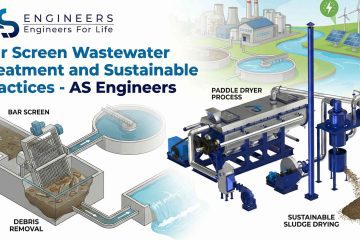
AS Engineers’ paddle dryer design uses indirect heating through hollow shafts and jacket, with hammer/wedge paddles for agitation and moisture removal. The process can be supported by cyclone, scrubber, bag filter, ID blower, condenser, chimney, screw conveyor, bagging, silo, or truck disposal system depending on the application.
For a deeper technical page, connect this section to thermal sludge drying system guide and how to choose a sludge paddle dryer.
Weight reduction is not the same as declassification
This point is critical.
Drying hazardous sludge reduces moisture and disposal weight. It does not automatically make the sludge non-hazardous. If the dried output still contains hazardous constituents, it must be handled according to the applicable hazardous waste category, authorisation, and approved disposal or utilization route.
Do not use drying as a shortcut for:
- Diluting hazardous waste
- Hiding hazardous constituents
- Mixing incompatible waste
- Avoiding documentation
- Unauthorised reuse
- Unapproved burning or open drying
- Disposal through non-authorised vendors
For hazardous sludge, testing and documentation are as important as equipment selection.
Approved recovery and reuse can reduce final disposal load
Some dried sludge or industrial residue may be suitable for approved recovery, co-processing, energy recovery, brick route, cement route, or other use cases. This depends on composition, calorific value, ash, heavy metals, chlorine, sulphur, oil content, odour, and buyer acceptance.
Possible routes may include:
| Route | When it may be possible | What must be checked |
|---|---|---|
| Cement co-processing | Suitable calorific value or mineral content | Approval, composition, chlorine, heavy metals |
| Alternative fuel | High calorific value waste | Safety, emissions, authorised user |
| Brick or construction route | Mineral-rich, stable residue | Leachability, composition, approval |
| Internal reuse | Process-compatible by-product | Quality, contamination, legal permission |
| TSDF disposal | No viable reuse route | Manifest, packing, storage, transport |
For this topic, add contextual links to sludge waste recycling, TSDF site standards, and industrial sludge disposal guide.
Method comparison: which option reduces hazardous waste weight fastest?
| Method | Weight reduction impact | Best for | Risk if done wrong |
|---|---|---|---|
| Source reduction | High | Process plants with repeated waste generation | Requires production-side changes |
| Segregation | Medium to high | Plants mixing multiple waste streams | Mislabeling or poor training |
| Chemical dosing control | Medium | ETP sludge with high chemical solids | Poor treatment performance if overdosed/underdosed |
| Mechanical dewatering | High for free water | Wet sludge, biological sludge, ETP sludge | Poor cake if feed is not conditioned |
| Thermal drying | High for moisture-heavy sludge | Filter cake, sticky sludge, industrial sludge | Vapour, odour, corrosion, or safety issues if not designed properly |
| Approved reuse/co-processing | High for final disposal reduction | Stable dried residue | Not valid without approval and testing |
| Better packaging/storage | Low to medium | Plants adding rainwater or debris | Leak/spill risk if storage is poor |
When paddle drying is a good fit
A paddle dryer is a strong option when the plant has wet, sticky, semi-solid, paste-like, or filter-cake sludge where moisture is driving disposal weight.
It is usually worth evaluating when:
- Sludge disposal is charged by weight.
- Wet sludge transport cost is high.
- The plant has limited sludge storage space.
- Sludge handling creates odour or hygiene problems.
- Dewatering has already reached its practical limit.
- The plant needs more predictable dry output.
- The final route requires lower moisture.
- The sludge is difficult to handle manually.
It may not be the first solution when the sludge quantity is very small, composition changes every batch, waste contains unknown solvents, or the plant has not completed basic waste characterization.
For agrochemical and chemical residues, link to agrochemical waste drying equipment.

RFQ checklist before selecting a hazardous sludge dryer
Before asking for a sludge dryer quotation, prepare these inputs:
| RFQ input | Why it matters |
|---|---|
| Sludge source | ETP, CETP, ZLD, process residue, filter cake |
| Daily quantity | Dryer capacity and operating hours |
| Feed moisture | Heat load and dryer sizing |
| Target final moisture | Disposal/reuse requirement |
| Sludge behaviour | Sticky, pasty, abrasive, corrosive, fibrous |
| Bulk density | Conveyor, dryer, and bagging design |
| pH and composition | MOC and safety review |
| Solvents/VOCs | Vapour handling and condenser/scrubber need |
| Heavy metals/salts | Disposal route and reuse limitation |
| Heating medium available | Steam, thermic fluid, hot water, direct fuel system |
| Site utilities | Power, fuel, water, compressed air |
| Pollution-control requirement | Cyclone, scrubber, bag filter, condenser |
| Final handling | Bagging, silo, screw conveyor, truck loading |
| Current disposal cost | ROI calculation basis |
| Authorised disposal route | TSDF, co-processing, approved user, internal route |
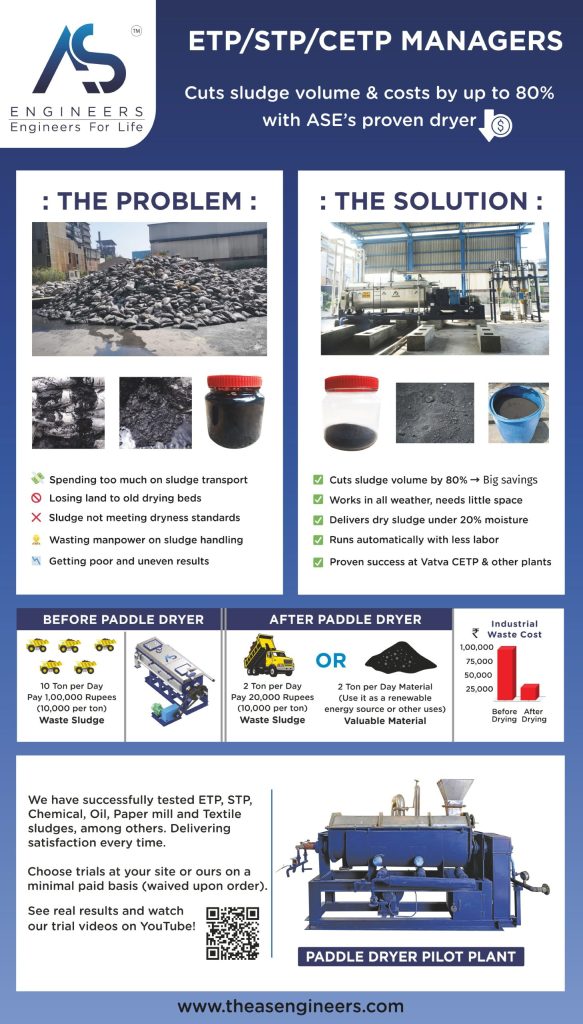
A pilot trial is useful when sludge behaviour is uncertain. AS Engineers’ source material confirms a 50 kg/hr pilot trial machine for demonstrations, with trials possible at AS Engineers’ works or client site on a minimal paid basis, waived upon order placement.
Common mistakes to avoid
Avoid these mistakes when trying to reduce hazardous waste weight:
- Selecting a dryer only by tons per day.
- Ignoring feed moisture and final moisture.
- Mixing hazardous and non-hazardous waste to simplify handling.
- Assuming dried sludge is automatically safe or reusable.
- Ignoring vapour treatment for solvent-bearing sludge.
- Not checking MOC for corrosive sludge.
- Comparing dryer price without calculating disposal savings.
- Sending wet sludge to TSDF without first checking dewatering and drying options.
- Not maintaining records of waste quantity, category, and disposal route.
For cost-side reading, connect this page with hidden cost of landfilling wet sludge and volume reduction trends in industrial ETP today.
Practical workflow for hazardous waste weight reduction
Use this step-by-step workflow:
- Map all waste streams before they enter the ETP.
- Separate hazardous, non-hazardous, oily, solvent, and solid waste streams.
- Test representative sludge samples.
- Improve chemical dosing and process control.
- Dewater sludge mechanically.
- Check whether additional drying is technically and commercially justified.
- Trial drying if material behaviour is uncertain.
- Decide final route: TSDF, co-processing, reuse, or other approved disposal.
- Build documentation for quantity, moisture, composition, and movement.
- Review results every month and adjust the process.
This approach helps the plant reduce avoidable weight without compromising safety or compliance.
FAQs
What is the safest way to reduce hazardous waste weight?
The safest way is to reduce waste at the source, segregate waste streams correctly, dewater wet sludge, and use thermal drying only when moisture is the major weight contributor. The final disposal or reuse route should follow applicable CPCB/SPCB authorisation and test reports.
Does drying make hazardous sludge non-hazardous?
No. Drying reduces moisture and weight, but it does not automatically change hazardous classification. The dried sludge may still need hazardous-waste handling if its composition falls under regulated categories.
Which method gives the biggest weight reduction for wet ETP sludge?
For wet ETP sludge, mechanical dewatering followed by thermal drying usually gives the biggest practical reduction because water is often the largest removable part of the total weight. The result depends on feed moisture, sludge behaviour, and final moisture target.
Can hazardous sludge be reused after drying?
Only if testing, composition, buyer acceptance, and regulatory approval support the reuse route. Some dried residues may be suitable for co-processing, fuel use, brick route, cement route, or other approved applications, but this should never be assumed without verification.
What data should I share before selecting a sludge dryer?
Share daily sludge quantity, feed moisture, desired final moisture, sludge source, pH, composition, solvent or VOC presence, current disposal route, heating medium, available utilities, site space, and final handling requirement.
Conclusion
The best methods to reduce hazardous waste weight are not one single machine or one disposal shortcut. A reliable plan combines source reduction, proper segregation, dewatering, sludge drying, approved recovery checks, and compliant disposal.
For industrial ETP sludge, the biggest weight problem is often moisture. A properly selected paddle dryer can reduce moisture, improve handling, reduce transport load, and support better disposal planning. But hazardous-waste classification, documentation, and final disposal route must always be verified separately.
If your plant is handling hazardous ETP sludge, filter cake, agrochemical residue, chemical sludge, pharma sludge, ZLD sludge, or sticky industrial waste, share your sludge quantity, moisture level, composition, heating medium, and disposal target. AS Engineers can review the application and suggest whether dewatering, paddle drying, or a combined sludge handling system is suitable for your site conditions.