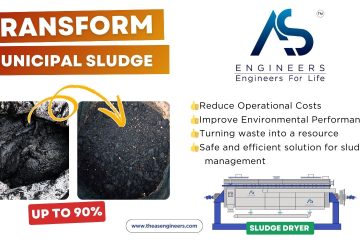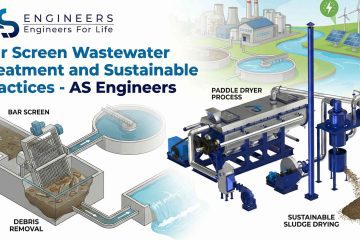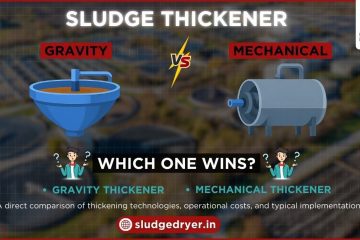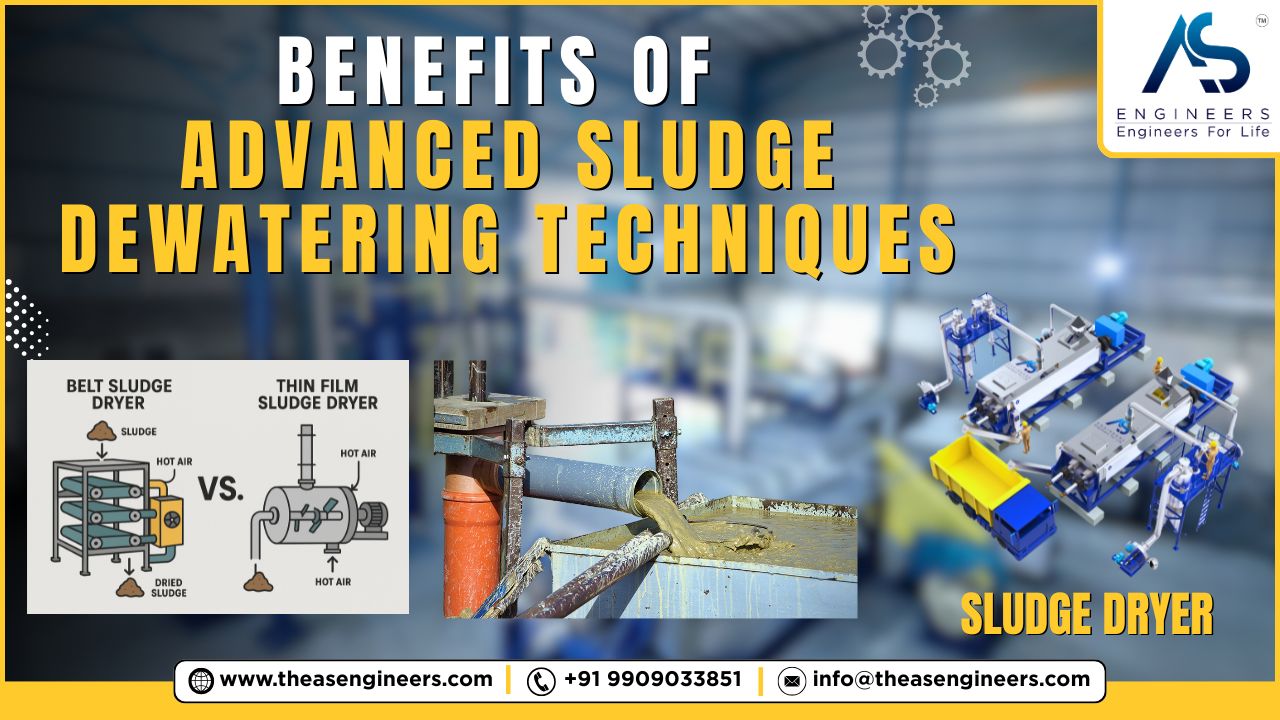
Advanced sludge dewatering benefits are most visible when a plant wants to reduce sludge handling difficulty, transport load, storage space, disposal pressure, and downstream drying cost. Dewatering removes a large portion of liquid water from sludge and converts it into a more manageable cake. For many ETP, STP and CETP plants, the strongest result comes when dewatering is followed by controlled sludge drying, especially when final moisture reduction, cleaner handling, or disposal-cost optimization is required.
Dewatering is not the same as drying. Dewatering is a mechanical separation step. Drying is a thermal moisture-removal step. Understanding this difference helps plant teams avoid wrong equipment selection.
What advanced sludge dewatering actually means
Advanced sludge dewatering means using controlled mechanical separation, sludge conditioning, automation, and process monitoring to remove water from sludge more consistently than basic manual or low-control methods.
Common advanced dewatering systems include:
| Dewatering method | How it works | Typical use |
|---|---|---|
| Filter press | Uses pressure to separate liquid from sludge solids | Chemical sludge, ETP sludge, high-solids cake requirement |
| Belt filter press | Uses gravity drainage and belt pressure | Municipal sludge, biological sludge, continuous operation |
| Screw press | Uses slow compression through a screw mechanism | STP sludge, biological sludge, low-maintenance operation |
| Decanter centrifuge | Uses centrifugal force to separate solids and liquid | High-flow wastewater plants, municipal sludge |
| Geotube / bag dewatering | Uses polymer conditioning and porous bags | Temporary or low-infrastructure sludge handling |
The right method depends on sludge type, solids concentration, particle size, oil and grease, polymer response, daily sludge generation, disposal route, and whether the plant needs only dewatering or further drying.
For a wider comparison of available options, see our guide on sludge dewatering techniques.
Dewatering vs sludge drying
Many plants use the word “drying” when they actually mean “dewatering.” This creates confusion during RFQ, vendor comparison, and cost calculation.
| Point | Sludge dewatering | Sludge drying |
|---|---|---|
| Main purpose | Remove liquid water mechanically | Evaporate remaining moisture thermally |
| Output | Dewatered sludge cake | Dried sludge, granules, powder, or semi-dry material depending on process |
| Equipment examples | Filter press, screw press, belt press, centrifuge | Paddle dryer, belt dryer, disc dryer, solar dryer, thin film dryer |
| Best for | First-stage volume reduction | Further moisture reduction and easier final handling |
| Energy source | Mechanical energy and polymer conditioning | Steam, thermic fluid, hot water, hot air, waste heat, or other heat source |
| Typical decision point | “Can I make sludge transportable?” | “Can I reduce final moisture and disposal burden further?” |
A plant should not buy a sludge dryer just because wet sludge is difficult to handle. First check whether the existing thickening and dewatering stage is performing properly. If the dewatered cake is still costly to store, transport, landfill, send to TSDF, co-process, or reuse, then a thermal sludge drying system becomes a stronger option.
Main benefits of advanced sludge dewatering
1. Lower sludge volume before disposal
The first benefit of dewatering is volume reduction. Wet sludge contains a large amount of water. Removing part of this water reduces the quantity that must be stored, loaded, transported, and disposed.
This matters in plants where sludge is sent to landfill, TSDF, cement co-processing, composting, incineration, or third-party handling. Even before thermal drying, a stable dewatered cake is easier to manage than watery sludge.
2. Easier material handling
Poorly dewatered sludge is messy, sticky, odorous, and difficult to move. It can create problems around pits, trolleys, screw conveyors, loaders, storage bays, and transport vehicles.
Better dewatering can improve:
| Handling issue | How dewatering helps |
|---|---|
| Sludge dripping during movement | Converts watery sludge into cake form |
| Excess pit storage | Reduces free water load |
| Manual handling difficulty | Makes sludge more predictable for loading |
| Odour and hygiene concerns | Reduces exposed wet sludge volume |
| Transport mess | Reduces leakage and spillage risk |
Dewatering does not automatically make sludge safe or compliant. Sludge composition, hazardous classification, leachability, and disposal route still need EHS review.
3. Lower transport load
Transport cost is usually linked to weight, volume, distance, handling method, and disposal facility charges. When a plant sends water-heavy sludge outside the premises, it is often paying to transport water.
Advanced sludge dewatering reduces the water load before transport. This can reduce the number of trips or the total transported weight, depending on sludge generation and disposal practice.
For plants that still face high transport cost after dewatering, the next step is to evaluate the hidden cost of landfilling wet sludge and check whether additional drying is justified.
4. Better feed condition for sludge drying
A paddle dryer or other thermal dryer performs better when the feed is reasonably consistent. If feed moisture changes heavily from batch to batch, the dryer may face unstable residence time, vapour load, heating demand, discharge condition, and product handling.
Advanced dewatering helps create a more stable feed cake before drying. This improves the reliability of downstream thermal drying design.
At AS Engineers, sludge drying selection depends on actual feed moisture, final moisture target, sludge behaviour, heating medium, vapour handling requirement, and discharge method. A dryer should not be selected only from daily tonnage.
5. Reduced storage pressure inside the plant
Wet sludge needs pits, tanks, bags, open yards, or temporary storage areas. These areas can become a hygiene, odour, housekeeping, and space problem, especially in chemical, textile, pharmaceutical, food, dye, paper, municipal, and CETP sites.
Dewatering reduces the burden on wet sludge storage. Drying can reduce it further when the plant wants a more stable and easier-to-handle final material.
6. Improved downstream disposal planning
Disposal agencies, co-processing facilities, composting units, brick users, cement plants, or TSDF handlers may have different acceptance expectations for moisture, consistency, packaging, calorific value, contamination, and hazardous classification.
Dewatering helps move sludge from liquid or slurry form toward cake form. Drying helps move cake toward a lower-moisture product. The correct route depends on sludge analysis and local disposal norms.
For broader disposal planning, see our guide on industrial sludge disposal.
7. Better control over polymer and solids capture
In many plants, the problem is not the dewatering machine alone. The real issue may be wrong polymer selection, poor polymer preparation, unstable feed solids, weak floc formation, oil and grease interference, worn filter cloth, incorrect belt tension, poor centrifuge settings, or lack of operator monitoring.
Advanced dewatering improves control over:
- polymer dosing
- floc size
- feed flow
- cake dryness
- filtrate clarity
- solids capture
- wash water usage
- equipment cleaning cycle
- operator intervention
This is why plant teams should measure dewatering performance instead of only checking whether “cake is coming out.”
When dewatering alone is enough
Dewatering may be enough when:
- the sludge cake is accepted by the disposal agency
- storage and transport cost is manageable
- final moisture is not a major issue
- the plant has enough space for cake storage
- sludge is not creating major odour or hygiene issues
- reuse or co-processing does not require lower moisture
- downstream dryer investment is not justified by sludge quantity
In such cases, focus on better dewatering equipment, polymer optimization, filter cloth maintenance, screw press settings, centrifuge control, and operator training.
When dewatering is not enough
Dewatering may not be enough when:
- the plant still pays high disposal or transport cost
- wet cake occupies too much space
- sludge is sticky, smelly, or difficult to load
- TSDF or disposal cost is high due to moisture
- cement, brick, fuel, or reuse route needs lower moisture
- sludge output varies and causes handling problems
- the plant wants a more controlled final product
- ZLD, ETP, CETP, or process plant sludge needs further volume reduction
In these cases, thermal drying should be evaluated after dewatering. A sludge treatment system using conductive paddle dryers can be suitable when indirect heat transfer, enclosed operation, controlled vapour handling, and compact layout are important.
How paddle drying supports dewatered sludge handling
A paddle dryer is not a replacement for every dewatering system. It is usually a downstream drying solution after thickening and dewatering.
In AS Engineers’ paddle dryer design, heat is transferred indirectly through hollow shafts and a jacket. The system can be configured with steam, thermic fluid, or other heating arrangements depending on the process requirement. The paddle dryer uses agitation, heat transfer, and residence time to remove moisture from sludge cake or similar wet material.
AS Engineers’ official catalogue describes paddle dryer options such as indirect heating using steam or thermal oil, feed handling for slurries, pastes, cakes, granules, and powders, material options including CS, SS304, SS316, Duplex Steel and other alloys, plus atmospheric, vacuum, or pressurized operation depending on requirement.
The catalogue also describes hollow shafts and jacket heat transfer, hammer/wedge paddles, standard, dual zone and vacuum dryer options, and connected systems such as feeding, scavenging, pollution control, solvent management, and product handling.
Dewatering and drying selection table
| Plant condition | Better first action |
|---|---|
| Sludge is still liquid or pumpable | Improve thickening/dewatering first |
| Dewatered cake is acceptable for disposal | Optimize dewatering and disposal logistics |
| Dewatered cake is still costly to transport | Evaluate dryer economics |
| Cake is sticky and difficult to store | Test sludge behaviour in dryer trial |
| Final moisture target is strict | Consider controlled thermal drying |
| Sludge has oil, solvent, toxic or hazardous components | Get EHS and process review before dryer selection |
| ZLD sludge quantity is high | Evaluate drying after dewatering |
| Plant wants reuse or co-processing | Check moisture, composition and acceptance criteria |
What data is required before selecting dewatering or drying equipment
Do not finalize equipment from only “tons per day.” Sludge behaviour changes from industry to industry.
For proper review, collect:
| RFQ input | Why it matters |
|---|---|
| Sludge source | ETP, STP, CETP, ZLD, chemical, textile, pharma, food, paper, refinery, etc. |
| Feed quantity | Daily average and peak sludge generation |
| Initial moisture | Determines water removal load |
| Current dewatering output | Shows whether the existing system is performing |
| Final moisture target | Decides whether drying is required |
| Sludge composition | Affects MOC, safety, vapour handling and disposal route |
| Oil and grease | Can affect dewatering and drying behaviour |
| Chlorides/corrosive content | Impacts material of construction |
| Stickiness and plastic phase | Important for paddle dryer performance |
| Heating medium available | Steam, thermic fluid, hot water, waste heat or other source |
| Disposal route | TSDF, landfill, co-processing, composting, incineration, brick, cement or reuse |
| Site space | Determines layout and integration |
| Pollution control need | Vapour, odour, fine dust and scrubber/cyclone/bag filter requirement |
For equipment selection, also review our guide on how to choose sludge dewatering equipment.
Common mistakes plants make with sludge dewatering
Mistake 1: Comparing machines only by price
A cheaper machine can become expensive if it gives poor cake dryness, low solids capture, high polymer demand, frequent breakdowns, difficult cleaning, or poor integration with downstream drying.
Mistake 2: Ignoring sludge variability
ETP sludge from chemical, dye, textile, pharma, food, paper, and metal processing plants can behave very differently. Even the same plant can generate different sludge during process changes, cleaning cycles, or chemical dosing changes.
Mistake 3: Expecting dewatering to achieve drying results
Mechanical dewatering cannot do the same job as thermal drying. Dewatering removes liquid water. Drying removes additional moisture by evaporation.
Mistake 4: Not checking filtrate quality
If solids capture is poor, solids can return to the treatment system through filtrate or centrate. This increases load on the plant and may reduce overall performance.
Mistake 5: Selecting a dryer without sludge testing
For sludge drying, trial or material review is important. Sticky, abrasive, corrosive, solvent-bearing, oily, or heat-sensitive sludge needs careful evaluation.
AS Engineers’ official materials mention a 50 kg/hr paddle dryer pilot trial machine for demonstrations and process evaluation, with trial options at AS Engineers’ works or client site on a paid basis that may be waived upon order.
Practical decision flow for plant teams
Use this simple decision path before buying equipment:
- Confirm current sludge generation per day.
- Measure inlet moisture and current cake moisture.
- Check whether the sludge is pumpable, semi-solid, sticky, granular, oily, corrosive or odorous.
- Review current disposal cost, transport frequency and storage area.
- Check disposal agency moisture acceptance.
- Optimize existing dewatering first if performance is poor.
- If dewatered cake is still costly or difficult, evaluate drying.
- Conduct material testing or pilot review before final dryer sizing.
- Prepare RFQ with feed moisture, target moisture, heating medium, MOC, vapour handling and disposal route.
- Compare total lifecycle cost, not only machine purchase price.
Where AS Engineers fits
AS Engineers supports industrial sludge drying applications where dewatering alone is not enough and the plant needs further moisture reduction, easier handling, reduced volume, and controlled downstream processing.
The AS Engineers paddle dryer ecosystem includes feeding, heating, drying, scavenging, pollution control, solvent/vapour management, and product handling sections depending on project requirement. It can be evaluated for ETP sludge, STP sludge, CETP sludge, industrial sludge, biological sludge, paper sludge and other compatible wet materials after process review.
For plants comparing dewatering and drying together, the useful question is not “Which machine is best?” The better question is:
What final sludge condition does the plant need, and what combination of dewatering plus drying reaches that condition reliably?
Conclusion
Advanced sludge dewatering benefits include lower sludge volume, easier handling, reduced transport load, better storage control, and improved downstream drying performance. But dewatering has a limit. It prepares sludge for disposal or further processing; it does not replace thermal drying when the plant needs a much lower final moisture level.
For ETP, STP, CETP and industrial wastewater plants, the best decision is usually a staged approach: first stabilize sludge generation, then optimize thickening and dewatering, then evaluate sludge drying only when the business case is clear.
If your plant is already producing dewatered cake but still facing high disposal cost, storage problems, odour, handling difficulty, or strict moisture expectations, share your sludge quantity, feed moisture, final moisture target, heating medium, disposal route, and site condition with AS Engineers. Our team can review whether a paddle dryer is technically suitable for your sludge drying requirement.
FAQs
What is the main benefit of advanced sludge dewatering?
The main benefit is reducing the water load in sludge before storage, transport, disposal, or drying. This makes sludge easier to handle and can reduce the burden on downstream equipment.
Is sludge dewatering the same as sludge drying?
No. Dewatering mechanically separates liquid water from sludge and produces cake. Drying uses heat to evaporate remaining moisture and produce a lower-moisture final material.
Which equipment is used for sludge dewatering?
Common equipment includes filter presses, belt filter presses, screw presses, decanter centrifuges, and geotube systems. The right choice depends on sludge type, flow rate, solids concentration, polymer response, and disposal requirement.
When should a plant use a sludge dryer after dewatering?
A sludge dryer should be considered when dewatered cake is still costly to transport, difficult to store, too wet for disposal or reuse, or unsuitable for the required final handling condition.
What information is needed for sludge dryer selection?
Important inputs include sludge type, quantity per day, initial moisture, final moisture target, sludge composition, stickiness, corrosive content, available heating medium, vapour handling need, site space, and disposal route.