An ETP, or Effluent Treatment Plant, treats industrial wastewater before it is discharged, reused, recycled, sent to a CETP, or processed through a ZLD system. A complete ETP is not only a water treatment system. It also creates a sludge stream that must be thickened, dewatered, dried where justified, stored, transported, reused, or sent for approved disposal.
For industrial plants, the main mistake is planning the treated water line but ignoring the sludge line. This creates storage problems, odour issues, high transport load, frequent disposal movement, and documentation risk later.
What is an ETP?
An Effluent Treatment Plant is a treatment system used to reduce pollutants from industrial wastewater. It may treat suspended solids, oil and grease, pH variation, colour, organic load, dissolved chemicals, salts, heavy metals, solvents, biological load, and process residues depending on the industry.
ETP design is not the same for every plant. A food processing ETP, textile dyeing ETP, pharmaceutical ETP, chemical ETP, electroplating ETP, paper mill ETP, and refinery ETP can have very different wastewater characteristics.
A practical ETP should answer four questions:
| Question | Why it matters |
|---|---|
| What is coming in? | Flow, pH, COD, BOD, TSS, TDS, oil, colour, metals, salts, solvents, and batch variation affect treatment design. |
| What quality is required at outlet? | Discharge, reuse, CETP transfer, irrigation, sewer, surface water, or ZLD requirement changes the treatment scheme. |
| What sludge will be generated? | Sludge quantity, moisture, hazardous status, odour, stickiness, and disposal route affect operating cost. |
| How will the plant be operated daily? | Chemical dosing, aeration, pumps, blowers, filter press operation, lab testing, and record keeping decide stability. |
For a broader wastewater process explanation, read the wastewater treatment process guide.
ETP, STP, CETP and ZLD: clear difference
| Term | Full form | What it treats | Typical use |
|---|---|---|---|
| ETP | Effluent Treatment Plant | Industrial wastewater from manufacturing or process operations | Chemical, pharma, textile, food, paper, metal finishing, refinery, and industrial plants |
| STP | Sewage Treatment Plant | Domestic sewage from toilets, canteens, offices, and residential areas | Factories, campuses, hotels, societies, institutions, municipalities |
| CETP | Common Effluent Treatment Plant | Effluent from multiple industrial units in a cluster | Industrial estates and small/medium units sharing treatment infrastructure |
| ZLD | Zero Liquid Discharge | Treated water recovery with no liquid discharge outside the plant boundary | Water-stressed plants, high-TDS industries, regulated clusters, reuse-focused facilities |
For sewage-specific comparison, see what is STP sewage treatment plant. For cluster-level treatment, see ETP vs CETP. For water recovery planning, see the zero liquid discharge guide.
When does an industry need an ETP?
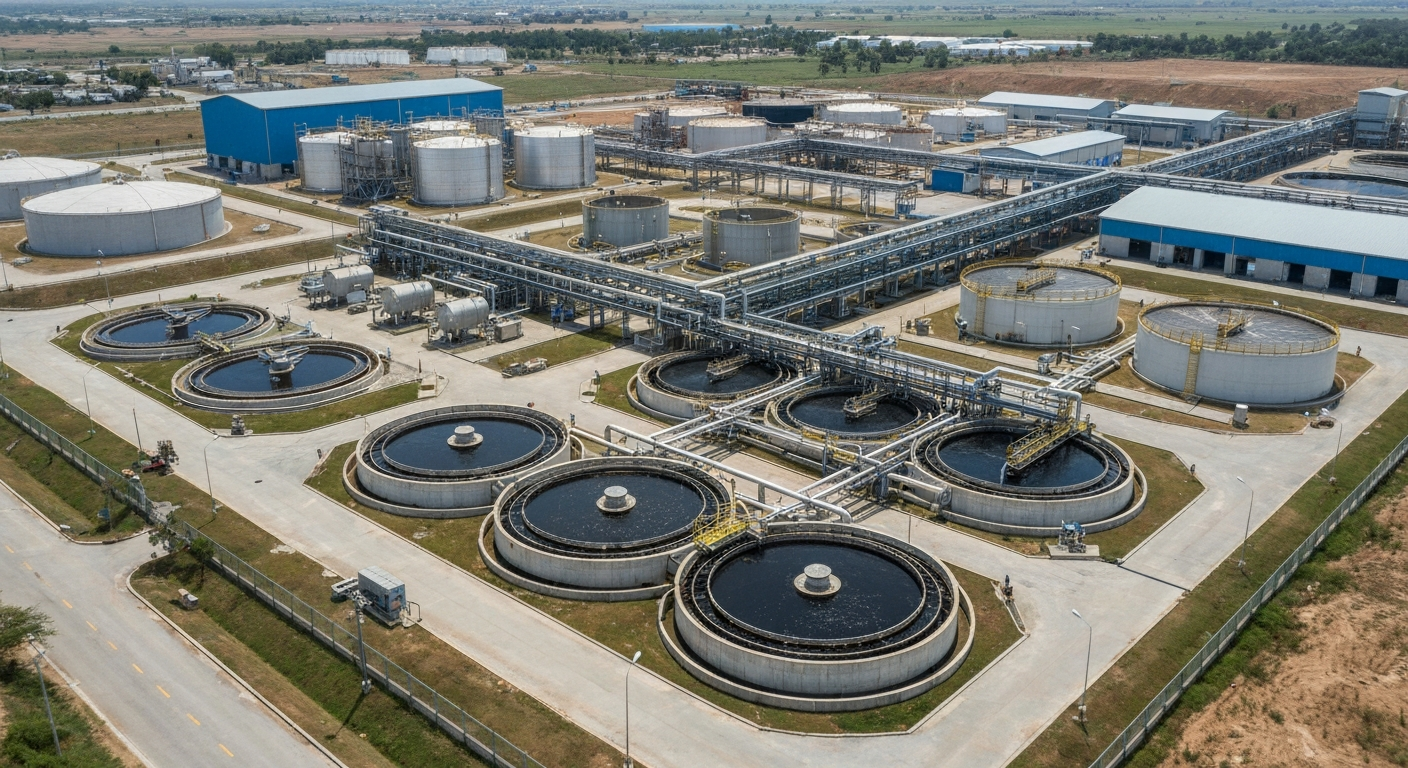
An industry generally needs an ETP when its process wastewater cannot be safely discharged, reused, or sent onward without treatment. The requirement depends on the process, local consent condition, discharge route, industry category, water chemistry, and State Pollution Control Board direction.
Common ETP users include:
| Industry | Common effluent concerns | Sludge concern |
|---|---|---|
| Pharmaceutical and API | High COD, solvents, active residues, batch variation | Chemical and biological sludge, vapour and hazardous classification review |
| Chemical and specialty chemical | pH variation, COD, salts, toxic compounds, process residues | Chemical sludge, salt-rich sludge, corrosive or sticky sludge |
| Textile and dyeing | Colour, TDS, COD, BOD, dyes, auxiliaries, salts | Chemical-biological sludge with colour and ash load |
| Food and beverage | High BOD, COD, oil and grease, suspended solids | Organic sludge, odour, dewatering load |
| Dairy | High BOD, fats, proteins, cleaning chemicals | Biological sludge and oily scum |
| Electroplating and metal finishing | Heavy metals, cyanide risk, pH, oil, suspended solids | Metal-bearing sludge, TSDF route review |
| Paper and pulp | Fibre, colour, COD, suspended solids | Fibre-rich and biological sludge |
| Refineries and petrochemicals | Oil and grease, hydrocarbons, emulsions | Oily sludge and chemical sludge |
| CETP clusters | Mixed industrial effluent | Highly variable mixed sludge |
A well-designed ETP starts with wastewater characterization. A single grab sample is not enough for batch plants, seasonal plants, cleaning-cycle discharge, high-salt processes, or plants with variable shifts.
Main stages of an Effluent Treatment Plant
A complete ETP usually follows a sequence. The exact layout changes based on wastewater quality, treatment target, available space, reuse requirement, and sludge route.
| ETP stage | Purpose | Common equipment or process |
|---|---|---|
| Screening | Remove large solids and floating matter | Bar screen, fine screen, screen chamber |
| Oil and grease removal | Separate floating oil, grease, scum, and light contaminants | Oil trap, grease trap, skimmer, DAF where required |
| Equalization | Balance flow, pH, temperature, and pollutant load | Equalization tank with mixer or aeration |
| pH correction | Bring wastewater into treatable pH range | Acid dosing, alkali dosing, pH controller |
| Coagulation and flocculation | Convert fine suspended solids into settleable flocs | Flash mixer, coagulant dosing, polymer dosing, flocculator |
| Primary clarification | Settle suspended solids and chemical sludge | Clarifier, tube settler, lamella clarifier |
| Biological treatment | Reduce biodegradable organic load | ASP, MBBR, SBR, MBR, anaerobic reactor |
| Secondary clarification | Separate biomass from treated water | Secondary clarifier, sludge return system |
| Tertiary treatment | Polish treated water | Sand filter, carbon filter, pressure filter, UF |
| Advanced treatment | Reuse, recycle, or ZLD preparation | RO, MEE, stripper, evaporator, crystallizer |
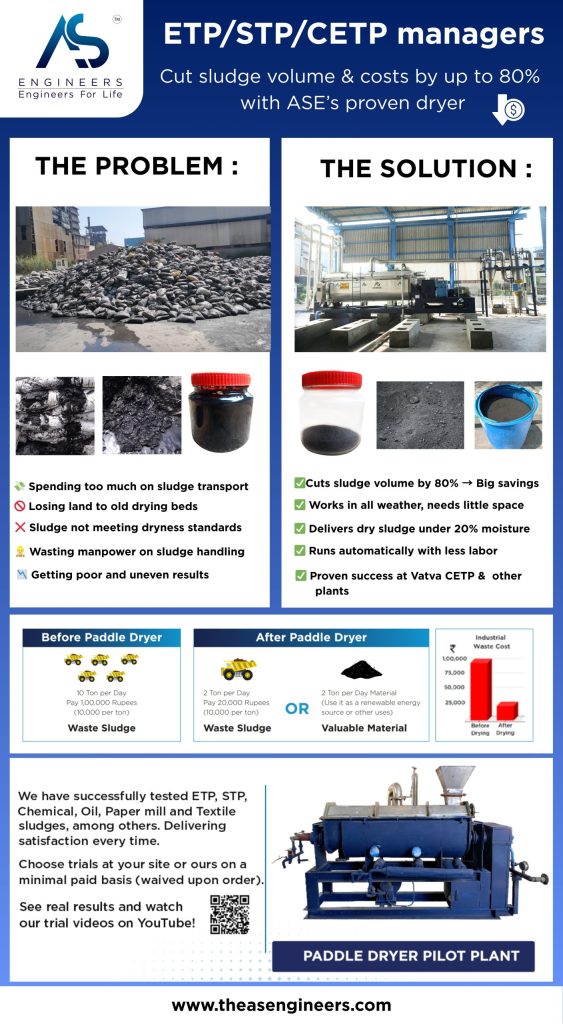
| Sludge handling | Reduce sludge volume and handling difficulty | Thickener, filter press, screw press, centrifuge, dryer |
The plant should be designed as a water stream and sludge stream together. If treated water meets target but wet sludge is unmanageable, the ETP is still incomplete from an operating point of view.
Where sludge is generated inside an ETP
ETP sludge can come from multiple points:
- Primary clarifier sludge from suspended solids and chemical flocs
- Secondary biological sludge from excess biomass
- DAF float sludge from oil, grease, and suspended matter
- Filter backwash sludge from tertiary filters
- RO reject and evaporator residue from reuse or ZLD systems
- Chemical precipitation sludge from metals, colour, phosphate, fluoride, or specific contaminants
- Oily sludge from oil-water separation systems
This sludge may be organic, inorganic, biological, chemical, oily, hazardous, non-hazardous, sticky, abrasive, corrosive, odorous, or salt-rich. That is why one sludge handling method does not work for every ETP.
Before finalizing sludge handling, plant teams should check:
- Daily wet sludge quantity
- Moisture after dewatering
- Source of sludge inside the ETP
- Sludge consistency, stickiness, bulk density, and flow behaviour
- Hazardous or non-hazardous classification
- pH, chloride, salts, oil, metals, solvents, and odour risk
- Current disposal cost and disposal frequency
- TSDF, co-processing, reuse, landfill, or incineration route
- Storage area and labour requirement
- Whether drying is technically and economically justified
For deeper sludge planning, read the ETP sludge challenges guide and industrial sludge disposal guide.
Dewatering first, drying second
Most ETP sludge should be mechanically dewatered before thermal drying. Dewatering removes free water using a filter press, screw press, belt press, centrifuge, or similar equipment. Drying then reduces retained and bound moisture.
This sequence is important because sending dilute slurry directly to a dryer increases heat load, dryer size, fuel consumption, vapour load, and operating cost.
A practical sequence is:
- Sludge thickening
- Mechanical dewatering
- Sludge cake collection
- Thermal drying, if justified
- Bagging, storage, reuse evaluation, co-processing, TSDF disposal, or other approved route
For equipment comparison, read sludge dewatering techniques and sludge press machine guide.
Where a sludge dryer fits in an ETP
A sludge dryer is usually placed after dewatering. Its role is to reduce moisture further so the sludge becomes lighter, more stable, easier to store, easier to transport, and easier to evaluate for disposal or approved reuse.
A dryer can be useful when:
| Wet sludge problem | How drying may help |
|---|---|
| High transport weight | Reduces water content and total load moved from the site |
| Frequent disposal movement | Can reduce disposal trips if dried material is accepted by the disposal route |
| Wet storage difficulty | Converts wet cake into a more manageable dried material |
| Odour and hygiene issues | Reduces wet sludge exposure when handled in a covered system |
| Space limitation | Dried sludge generally needs less storage volume than wet sludge |
| Co-processing or reuse evaluation | Lower moisture can support further testing and approval |
| ZLD residue burden | Helps manage concentrated sludge, salts, or solids after upstream treatment |
Drying is not required in every ETP. It should be evaluated based on sludge composition, moisture target, heating medium, disposal acceptance, vapour handling, dust handling, and trial results.

Why an indirect paddle dryer is used for many ETP sludge applications
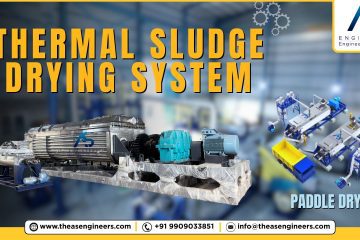
An indirect paddle dryer transfers heat through hollow shafts, jacketed surfaces, and paddles. The sludge does not need direct contact with flame or large volumes of hot gas. This can help reduce off-gas volume compared with many direct-contact drying systems, but final performance depends on actual feed and duty conditions.
AS Engineers’ paddle dryer design references include:
- Indirect heating through hollow shafts and jacket
- Dual counter-rotating shafts
- Wedge-shaped self-cleaning paddles
- Plug-flow material movement
- Standard dryer, dual-zone dryer, and vacuum dryer options
- Fuel and heating options such as steam, thermic fluid, hot water, natural gas, wood, coal, LDO, electricity, briquette, and other site-specific resources
- System integration around feeding, scavenging, pollution control, solvent management, and product handling
For configuration-level detail, see the paddle dryer configuration guide and thermal sludge drying system guide.
When an ETP sludge dryer is a good fit
A sludge dryer may be a good fit when:
- The plant generates regular ETP sludge volume
- Wet sludge storage or transport cost is becoming difficult
- Sludge is already mechanically dewatered
- The plant has limited sludge storage area
- The disposal route accepts dried sludge
- The plant has suitable steam, thermic fluid, gas, or other heat source
- Vapour, odour, dust, and condensate handling can be designed correctly
- Sludge trials confirm drying behaviour
- Purchase and EHS teams agree on the final disposal or reuse route
For cost-sensitive decisions, see industrial sludge dryer machine price and volume reduction trends in industrial ETP.
When a sludge dryer should not be selected blindly
Do not finalize a dryer only because sludge disposal cost is high. A dryer needs proper review when:
- Sludge composition is unknown
- Hazardous classification is not confirmed
- Sludge contains volatile solvents or flammable components
- Toxic vapour, explosive dust, or combustible dust risk may exist
- Sludge is too dilute and no dewatering stage is planned
- Disposal route does not accept dried material
- Heating medium and utility cost are not evaluated
- Final moisture target is treated as guaranteed without testing
- Upstream ETP is unstable and producing inconsistent sludge
- Odour and vapour treatment are not included in project scope
For high-risk sludge streams, review hazardous sludge, CPCB guidelines for hazardous waste disposal, and TSDF site standards.
Compliance and documentation checklist for ETP operators
Effluent treatment compliance depends on the consent condition, discharge route, local SPCB direction, industry type, CPCB standards, and sector-specific rules. Do not rely on a generic internet limit for plant action. Check the actual Consent to Establish, Consent to Operate, and latest applicable standard.
Maintain these records:
| Area | Records to maintain |
|---|---|
| Consent documents | CTE, CTO, discharge permission, reuse permission, ZLD condition if applicable |
| Water quality | pH, BOD, COD, TSS, TDS, oil and grease, colour, metals, sector-specific parameters |
| Flow | Inlet flow, treated water flow, reuse flow, reject flow, bypass record if any |
| Sludge | Quantity generated, moisture, classification, storage, transport, manifest, disposal receipt |
| Chemicals | Coagulant, polymer, acid, alkali, nutrient, antiscalant, cleaning chemicals |
| Equipment | Pumps, blowers, aerators, clarifiers, filters, RO, evaporator, dryer |
| Calibration | pH meter, flow meter, online analyser, dosing system, load cells |
| Disposal | TSDF receipts, transporter records, co-processing approvals, reuse documents |
| Maintenance | Sludge removal, press cloth cleaning, pump service, blower inspection, dryer cleaning |
| Incidents | Overflow, bypass, shock load, equipment failure, non-compliance action |
CPCB’s general discharge standards include parameters such as pH, suspended solids, BOD, COD, oil and grease, and metals. The actual limit can vary by receiving route, industry-specific standard, and consent condition.
Common ETP mistakes that create sludge problems
Treating sludge as a side issue
Many plants focus only on outlet water quality. Sludge quantity, moisture, odour, storage, labour, and disposal frequency are ignored until the sludge pit starts overflowing.
Selecting equipment before wastewater characterization
ETP design needs real wastewater data. Batch variation, cleaning discharge, peak production, high COD shock load, and seasonal changes must be captured before final equipment sizing.
Designing for average flow only
Average flow is not enough. ETPs should be checked against peak flow, peak load, batch discharge, shutdown-cleaning discharge, and future production increase.
Ignoring chemical dosing control
Overdosing chemicals increases sludge generation. Underdosing affects clarification and treated water quality. Both create operating problems.
Running biological treatment without control
Aeration, dissolved oxygen, MLSS, nutrients, return sludge, and sludge wasting affect biological treatment stability. Poor biological control often creates more sludge and poorer settling.
Buying a dryer before confirming disposal route
Drying reduces moisture, but it does not automatically make sludge acceptable for reuse or disposal. The final route must be confirmed before project approval.
RFQ checklist for ETP sludge dryer selection
Before asking for a sludge dryer quotation, share these inputs:
| Input | Why AS Engineers needs it |
|---|---|
| Industry and process | Sludge chemistry and risk vary by sector |
| ETP capacity | Helps understand wastewater and sludge load |
| Daily wet sludge quantity | Base input for dryer capacity |
| Moisture after dewatering | Determines evaporation load |
| Target final moisture | Affects heat load, residence time, and dryer size |
| Sludge form | Cake, paste, slurry, granule, sticky mass, oily sludge, or salt-rich residue |
| Chemical analysis | pH, chloride, salts, oil, metals, solvent risk, ash content |
| Current disposal route | TSDF, co-processing, landfill, incineration, reuse, or internal storage |
| Heating medium available | Steam, thermic fluid, gas, hot water, electricity, or other utility |
| Operating hours | Determines hourly evaporation rate |
| Vapour handling need | Scrubber, condenser, cyclone, bag filter, ID fan, or chimney |
| Space and layout | Feeding, dryer, discharge, bagging, access, maintenance clearance |
| Trial requirement | Confirms drying behaviour before final sizing |
For project support, see wastewater treatment plant consultants and sludge dryer manufacturers for ETP.
How AS Engineers supports ETP sludge drying projects
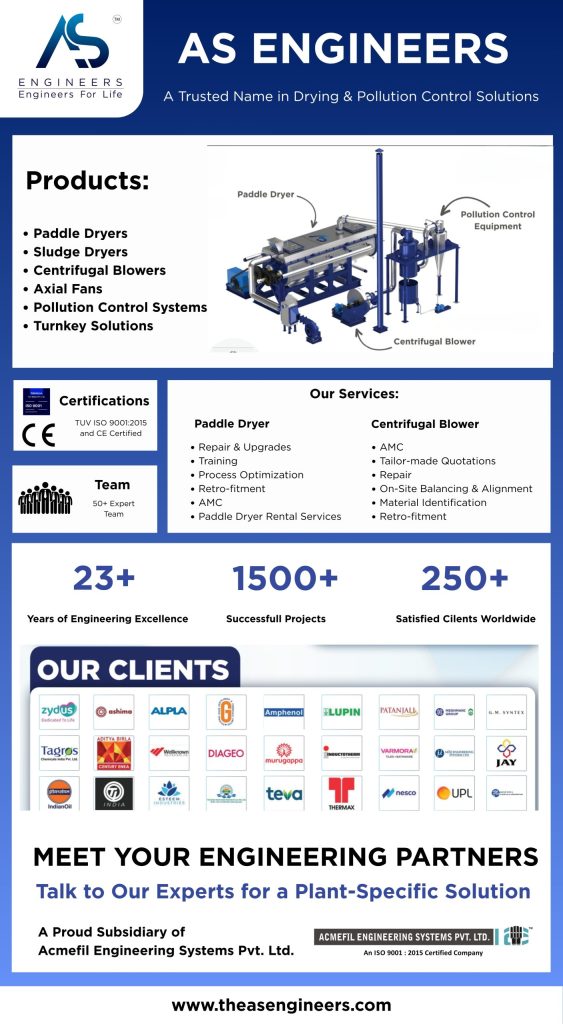
AS Engineers works in paddle dryers, sludge dryers, centrifugal blowers, pollution control equipment, and turnkey industrial systems. For ETP sludge applications, the practical review starts with the sludge itself: quantity, moisture, consistency, chemistry, heating medium, vapour handling, disposal route, and operating hours.
AS Engineers’ paddle dryer system can be evaluated with feeding, heating, drying, scavenging, pollution control, solvent or vapour management, and product handling sections. The system may include screw feeder, sludge pump, paddle dryer, FD blower, heat exchanger, cyclone, scrubber, bag filter, ID blower, condenser, screw conveyor, bagging system, silo, bucket elevator, or truck disposal system depending on the project.
For ETP aeration or air movement needs, AS Engineers ecosystem support is also available through industrial blowers for ETP plants.
Conclusion
An ETP is not complete when treated water leaves the plant. A reliable Effluent Treatment Plant also needs stable sludge handling, dewatering, drying evaluation, compliance records, disposal planning, and safe operation.
For industrial plants, the safest approach is to plan the water line and sludge line together. Check wastewater characterization, peak flow, treatment stages, sludge quantity, moisture, hazardous status, storage, transport, disposal route, and heating utility before finalizing equipment.
If your ETP is generating wet sludge regularly, share your sludge quantity, inlet moisture, target moisture, sludge analysis, heating medium, and disposal route with AS Engineers. The team can review whether dewatering alone is enough or whether an indirect paddle dryer should be evaluated for your plant.
FAQs
What is the full form of ETP?
ETP stands for Effluent Treatment Plant. It is used to treat industrial wastewater before discharge, reuse, recycling, CETP transfer, or ZLD processing.
What are the main stages of an ETP?
The main ETP stages are screening, oil and grease removal, equalization, pH correction, coagulation-flocculation, primary clarification, biological treatment, secondary clarification, tertiary treatment, advanced treatment, and sludge handling.
What is ETP sludge?
ETP sludge is the semi-solid residue generated during effluent treatment. It may come from primary clarification, biological treatment, chemical precipitation, filter backwash, DAF, RO reject, evaporator residue, or ZLD systems.
Is all ETP sludge hazardous?
No. ETP sludge classification depends on the industry, process chemistry, contaminants, and applicable rules. Chemical, pharmaceutical, electroplating, textile, refinery, and other industrial sludge streams may require hazardous waste review and approved disposal.
When should a sludge dryer be used in an ETP?
A sludge dryer should be evaluated when the plant generates regular dewatered sludge, wet sludge disposal is costly or difficult, storage space is limited, final disposal or reuse requires lower moisture, and sludge trials confirm that drying is safe and practical.