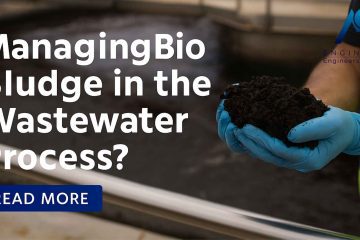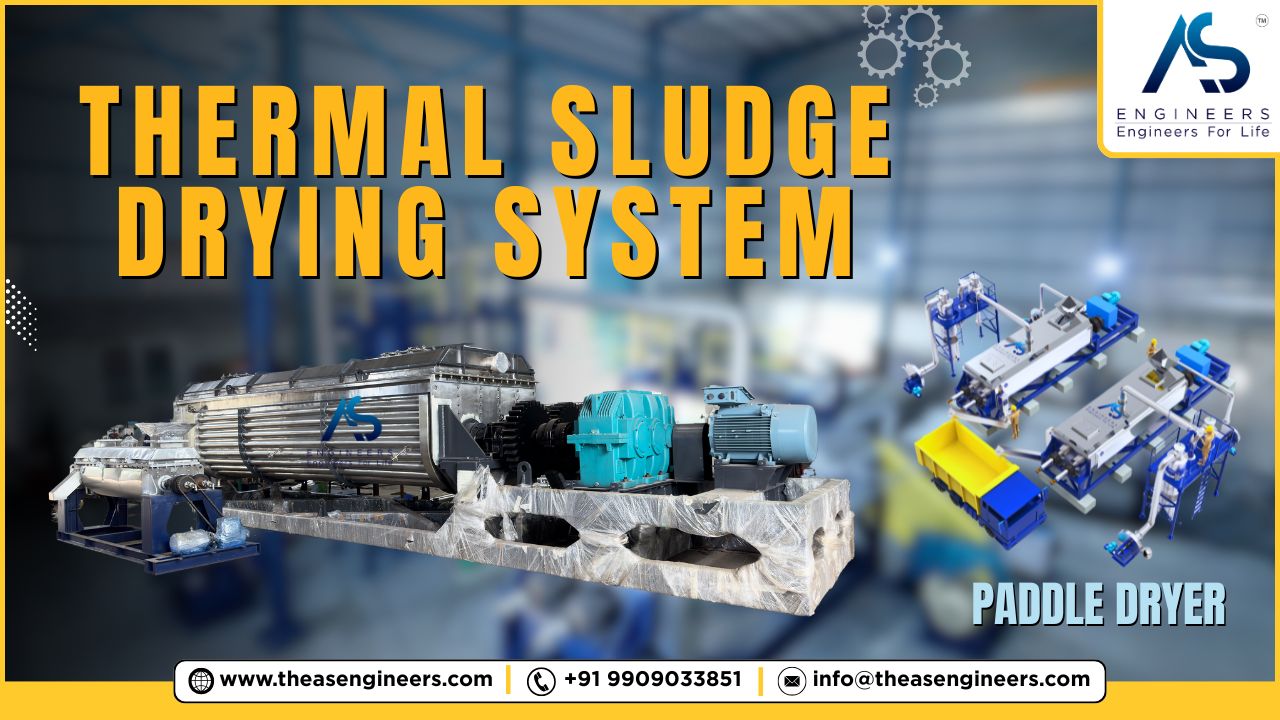
A thermal sludge drying system removes moisture from dewatered sludge using controlled heat. In industrial plants, it is usually installed after a filter press, screw press, belt press or centrifuge. The purpose is not only to “dry sludge,” but to reduce weight, volume, odour risk, storage burden, handling difficulty and disposal dependency.
For ETP, STP, CETP, chemical, textile, pharma, paper, food processing and ZLD plants, the correct dryer selection depends on feed moisture, sludge behaviour, final moisture target, heating medium, vapour handling, pollution-control arrangement, material of construction and disposal or reuse route.
If your sludge is still wet, sticky, heavy and expensive to transport after dewatering, a thermal drying system may be the next stage to evaluate.
What Is a Thermal Sludge Drying System?
A thermal sludge drying system is an engineered drying setup that uses heat to evaporate moisture from sludge. The system normally includes feeding equipment, the dryer body, heating arrangement, vapour handling, dust or fines separation, pollution-control equipment and dried product handling.
In simple terms:
| Stage | What happens |
|---|---|
| Dewatered sludge feed | Sludge cake enters the drying system after mechanical dewatering |
| Heat transfer | Heat reaches the sludge through hot air, heated surfaces or indirect heating media |
| Moisture evaporation | Water or solvent content evaporates from the sludge |
| Vapour handling | Vapour, odour, fines and condensable gases are handled through suitable downstream equipment |
| Dried sludge discharge | Output becomes lighter, lower-moisture and easier to handle |
| Disposal or reuse decision | Final route depends on sludge composition, lab testing and applicable rules |
Thermal drying is different from basic sludge dewatering. Dewatering removes free water mechanically. Thermal drying removes deeper moisture using heat.
Where Thermal Drying Fits in Sludge Treatment
For many plants, sludge handling follows this practical chain:
- Sludge generation from ETP, STP, CETP or process system
- Thickening or holding
- Conditioning, where required
- Mechanical dewatering
- Thermal sludge drying
- Storage, transport, disposal, co-processing or reuse evaluation
Thermal drying is generally not the first treatment step. It works best when the plant has already reduced free water through a filter press, screw press, belt press or centrifuge.
For a full treatment-chain view, read the guide on top sludge treatment methods and their applications.
How a Thermal Sludge Drying System Works
A complete thermal sludge drying system is more than one dryer machine. The performance depends on how the full line is planned.
Feed handling
Wet or dewatered sludge is stored in a hopper, silo or feed pit and then moved into the dryer by screw feeder, belt conveyor or sludge pump depending on consistency.
Sludge feed condition matters. A sticky cake from a filter press behaves differently from slurry, biological sludge, chemical sludge, oily sludge or sewage sludge.
Heat transfer
Heat can be transferred through direct hot air contact or indirectly through heated surfaces. In an indirect paddle dryer, heat is transferred through the hollow shafts, paddles and jacketed body while the sludge is mixed and moved forward.
Indirect drying is useful when the plant wants controlled heat transfer without direct flame contact with sludge.
Moisture evaporation
As the sludge receives heat, moisture evaporates. Residence time, sludge layer thickness, agitation, heating surface area and temperature control decide how stable the drying process will be.
Vapour and fines handling
Evaporated moisture must be removed from the system. Depending on sludge type, this vapour stream may carry odour, fines, condensable vapour or process-specific contaminants. The system may require cyclone, scrubber, condenser, bag filter, ID fan, chimney or other vapour-control equipment.
For sludge with hazardous, solvent-bearing, oily or unknown composition, vapour handling should be reviewed by process and EHS teams before final selection.
Dried product handling
The dried output may be discharged to screw conveyor, bagging system, silo, truck loading or further processing. Final reuse or disposal should never be assumed only because sludge is dry. It depends on lab analysis and applicable disposal or reuse permissions.
Types of Thermal Sludge Drying Systems
Different dryer technologies suit different sludge behaviours. The best system is not always the most advanced system. It is the system that matches sludge condition, site layout, utility availability and final objective.
| Dryer type | How it works | Good fit | Watch-outs |
|---|---|---|---|
| Paddle dryer | Indirect heat transfer through hollow shafts, paddles and jacketed surfaces | Sticky, paste-like, cake-like ETP/STP/industrial sludge | Needs correct feed, vapour handling and MOC selection |
| Rotary drum dryer | Hot air and rotating drum tumble material through the dryer | High-throughput granular or less sticky feed | Larger footprint, higher dust and off-gas handling requirement |
| Thin film dryer | Wipers spread sludge as a thin layer on heated surface | Heat-sensitive or difficult materials requiring short residence time | Higher mechanical complexity and application-specific selection |
| Fluidized bed dryer | Heated air suspends particles for fast heat transfer | Granular or pelletized sludge | Not ideal for all sticky cake sludge |
| Solar sludge dryer | Uses solar heat in covered drying beds or greenhouse-type structures | Low-energy drying where land and time are available | Slower, weather-dependent, larger area requirement |
| Belt dryer | Sludge moves on a belt through warm-air drying zones | Continuous lower-temperature drying | Needs feed conditioning and larger installation area |
For technology comparison, see belt sludge dryer vs thin film sludge dryer and solar drying of wastewater sludge.
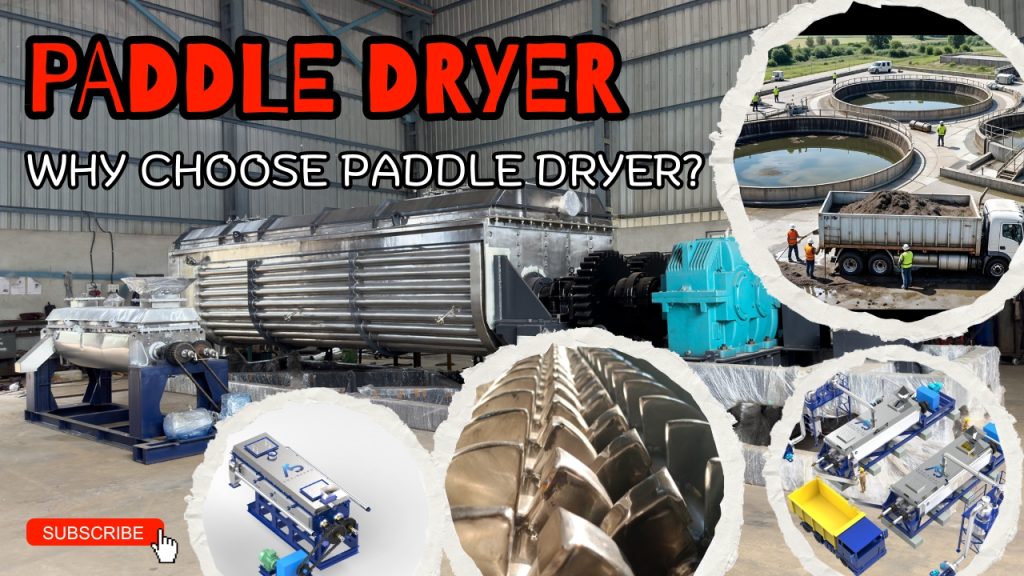
Why Paddle Dryers Are Commonly Considered for Industrial Sludge
For ETP, STP and industrial sludge, paddle dryers are often evaluated because many sludge cakes are sticky, paste-like, wet and difficult to move through direct-air systems.
An indirect paddle dryer uses heated rotating shafts and paddles inside a jacketed body. The paddles mix, shear and move the material while heat transfers through metal surfaces.
AS Engineers’ paddle dryer configuration can be designed with steam or thermal oil heating, atmospheric, vacuum or pressurized operating conditions, and material options such as CS, SS304, SS316, duplex steel or other alloys as per requirement. Final selection depends on actual sludge data and process duty.
In a paddle dryer, the plant team should evaluate:
| Selection area | Why it matters |
|---|---|
| Feed moisture | Decides heat load and residence time |
| Sludge stickiness | Decides paddle design, agitation and discharge reliability |
| Final moisture target | Changes dryer size, energy use and output handling |
| Heating medium | Steam, thermic fluid or hot water availability affects design |
| MOC | Corrosive or abrasive sludge may need upgraded material |
| Vapour stream | Determines cyclone, condenser, scrubber, bag filter or chimney planning |
| Discharge form | Powder, granule, semi-dry cake or fuel-like output needs different handling |
| Operating duty | Batch/continuous operation, hours per day and peak load affect sizing |
For deeper paddle dryer selection, use this sludge paddle dryer decision guide.
Direct Heating vs Indirect Heating
One of the biggest decisions in a thermal sludge drying system is whether the sludge should contact hot air directly or receive heat indirectly through heated surfaces.
| Point | Direct heating | Indirect heating |
|---|---|---|
| Heat contact | Hot air or gas contacts the material | Heat transfers through metal surface |
| Off-gas volume | Usually higher | Usually lower |
| Temperature control | Can be less precise depending on design | Better control through heating medium |
| Contamination risk | Higher because gas contacts material | Lower because heating medium stays separate |
| Sticky sludge handling | Depends on dryer type | Paddle dryer can handle many sticky/cake-like feeds |
| Vapour treatment | Larger air volume may need bigger treatment system | Lower off-gas volume can simplify downstream treatment |
| Best use | Large volume, compatible material, direct drying acceptable | ETP/STP/industrial sludge where controlled, enclosed drying is required |
For sticky industrial sludge, indirect thermal drying is often preferred because it gives better contact control and keeps the heating medium separate from the sludge.
Heating Medium and Fuel Planning
A dryer cannot be selected properly without checking site utilities. The heating medium affects operating cost, temperature control, maintenance and safety planning.
Common heating arrangements include:
| Heating medium | Used when |
|---|---|
| Steam | Plant already has boiler steam and pressure availability |
| Thermic fluid | Higher operating temperature is required and thermic system is available |
| Hot water | Lower-temperature duty or special process condition |
| Hot air | Direct or hybrid drying system where material and emission profile allow it |
Common fuel sources may include natural gas, coal, wood, briquette, LDO or electricity depending on site availability and economics.
Do not compare dryer cost only by machine price. Compare complete drying cost, including fuel, electricity, labour, maintenance, vapour treatment, spares, downtime and disposal savings.
What Data Is Needed Before Selecting a Thermal Sludge Dryer?
When I review a sludge drying requirement, I do not start with dryer size first. I first look at the sludge and the disposal problem. Wrong dryer sizing usually starts from incomplete sludge data.
Use this RFQ checklist before asking for a quotation.
| RFQ input | What to share |
|---|---|
| Sludge source | ETP, STP, CETP, ZLD, chemical, textile, pharma, paper, food, refinery, paint or other |
| Sludge type | Biological, chemical, mixed, oily, hazardous, municipal, primary, secondary |
| Current dewatering method | Filter press, screw press, centrifuge, belt press or drying bed |
| Daily quantity | kg/day or ton/day wet basis |
| Inlet moisture | Moisture percentage on wet basis |
| Target final moisture | Required output moisture or dryness |
| Feed form | Slurry, paste, cake, sticky mass, granules or powder |
| Chemical nature | pH, chlorides, salts, solvent traces, oil, heavy metals, corrosive content |
| Heating utility | Steam, thermic fluid, hot water, gas, coal, briquette, electricity |
| Operating hours | Batch or continuous, hours/day, days/month |
| Site constraints | Space, height, electrical load, utility access, civil foundation |
| Vapour route | Condenser, scrubber, cyclone, bag filter, chimney, existing pollution-control line |
| Final route | TSDF, landfill, co-processing, fuel, brick, cement, agriculture or internal reuse, only if permitted |
For price-related planning, read industrial sludge dryer machine price.
Cost and ROI: What Can Be Estimated and What Cannot
A thermal sludge drying system can reduce disposal burden because dried sludge has lower moisture, lower weight and lower volume than wet sludge. But exact savings cannot be claimed without actual site data.
Cost depends on:
- Wet sludge quantity per day
- Initial moisture and final moisture target
- Fuel type and fuel cost
- Dryer type and heating medium
- Electricity load
- Labour and automation level
- Disposal cost per ton
- Transport distance
- Maintenance and spare parts
- Vapour treatment requirement
- Civil, installation and commissioning cost
A practical way to calculate the business case is:
| Step | Calculation |
|---|---|
| 1 | Current wet sludge quantity per day |
| 2 | Current disposal and transport cost per ton |
| 3 | Moisture reduction target after drying |
| 4 | Expected dry sludge quantity after drying |
| 5 | New disposal or reuse route cost |
| 6 | Fuel + electricity + manpower + maintenance |
| 7 | Net daily or monthly saving |
| 8 | Capital cost and realistic payback range |
AS Engineers’ catalog shows an example where 10 ton/day wet sludge becomes 2 ton/day dried output, reducing disposal quantity significantly. Treat this as an example, not a guaranteed result for every sludge type.
For disposal economics, also connect this page with the hidden cost of landfilling wet sludge and industrial sludge disposal guide.
Vapour Handling and Pollution-Control Checks
Thermal sludge drying always needs a vapour-handling plan. Moisture does not disappear. It leaves the sludge as vapour and must be moved, condensed, scrubbed, filtered or discharged through a suitable system.
Depending on sludge composition, a drying line may need:
- ID fan for vapour movement
- Cyclone for dried fines
- Scrubber for odour or soluble vapour control
- Condenser for condensable vapour
- Bag filter for dust capture
- Chimney after treatment
- Heat tracing where condensation risk exists
- Safe access for inspection and maintenance
For hazardous, solvent-bearing, oily or high-odour sludge, do not finalise the dryer only from a sales quotation. Review vapour characteristics, EHS risk, local consent conditions and downstream pollution-control system capacity.
For related reading, use CPCB guidelines for hazardous waste disposal and TSDF site standards.
Fit and No-Fit Guidance
A thermal sludge drying system is suitable when the plant has a real moisture, volume, transport or disposal-cost problem. It is not suitable when the plant has not identified the sludge source, feed moisture, disposal route or utility availability.
| Situation | Fit? | Reason |
|---|---|---|
| Filter press sludge remains heavy and costly to transport | Yes | Thermal drying can reduce moisture further |
| ETP sludge has sticky cake-like behaviour | Often yes | Indirect paddle drying may handle sticky feed better |
| Plant needs controlled enclosed drying | Yes | Indirect systems reduce direct gas contact |
| Sludge has unknown hazardous composition | Verify first | Lab analysis and EHS review needed |
| Plant has no reliable fuel or heat source | Not ready | Operating cost may become high |
| Final reuse route is not approved | Not enough | Drying alone does not create legal reuse permission |
| Very low sludge quantity | Maybe | Compare capex against disposal cost |
| Large open land and low urgency | Solar may be evaluated | Drying speed and seasonality must be checked |
Common Mistakes While Buying a Sludge Drying System
Selecting only by dryer price
The cheapest machine can become expensive if it consumes more fuel, blocks frequently, needs higher maintenance or cannot meet final moisture target.
Giving only wet sludge quantity
Quantity alone is not enough. The supplier also needs inlet moisture, sludge behaviour, daily operating hours and final moisture target.
Ignoring vapour treatment
Many sludge drying problems start after moisture evaporates. Vapour, odour, dust and condensate need a proper route.
Assuming one dryer suits every sludge
Chemical sludge, biological sludge, sewage sludge, oily sludge, paper sludge and textile sludge behave differently. One standard design should not be blindly applied to all.
Claiming reuse without lab testing
Dried sludge may be suitable for disposal, co-processing or reuse only after composition testing and statutory approval. Dryness alone is not permission for agricultural, cement, brick or fuel use.
Not planning maintenance access
Dryers need access for inspection, shaft, bearing, gearbox, seals, paddles, discharge system, vapour line and cleaning. A compact layout is useful only if maintenance access is practical.
Thermal Sludge Drying Buyer Checklist
Before finalising the project, confirm these points with your internal team and supplier:
- Current sludge generation per day
- Existing dewatering equipment and moisture level
- Required final moisture range
- Sludge behaviour during heating
- Heating medium availability
- Fuel cost and monthly energy estimate
- MOC requirement based on sludge chemistry
- Vapour, odour and fines handling route
- Space and foundation requirement
- Discharge and bagging arrangement
- Maintenance access
- Spare parts availability
- Pilot trial requirement
- Disposal or reuse route after drying
- EHS and statutory review for hazardous sludge
AS Engineers also supports pilot trials for paddle dryer applications. A pilot trial is useful when sludge behaviour is uncertain, final moisture is strict, or the plant wants confidence before full-scale selection.
FAQs
What is a thermal sludge drying system used for?
A thermal sludge drying system is used to reduce moisture from dewatered sludge after ETP, STP, CETP or industrial wastewater treatment. It helps reduce sludge weight, volume, storage load, handling difficulty and disposal dependency.
Is thermal drying better than dewatering?
Thermal drying is not a replacement for dewatering. Dewatering removes free water mechanically, while thermal drying removes additional moisture using heat. In most industrial plants, dewatering comes first and drying comes after it.
Which dryer is suitable for sticky ETP sludge?
Sticky ETP sludge is often evaluated for an indirect paddle dryer because the rotating paddles mix, shear and move the sludge while heat transfers through hollow shafts and jacketed surfaces. Final suitability depends on sludge testing, feed behaviour, moisture target and vapour handling needs.
Can dried sludge be reused as fuel, fertilizer, brick raw material or cement input?
It may be possible in some cases, but it should not be assumed. Reuse depends on sludge composition, calorific value, contaminants, lab testing, buyer acceptance and applicable statutory approvals.
What details are needed for a sludge dryer quotation?
Share sludge source, wet quantity per day, inlet moisture, final moisture target, current dewatering method, feed consistency, chemical composition, heating medium, operating hours, site space, vapour handling requirement and final disposal or reuse route.
Conclusion
A thermal sludge drying system is useful when wet sludge remains heavy, difficult to handle, expensive to transport or difficult to store after dewatering. For ETP, STP, CETP and industrial plants, the strongest selection approach is to begin with sludge data, not dryer size.
For sticky, paste-like and cake-like sludge, an indirect paddle dryer can be a strong option because it uses controlled heat transfer through hollow shafts, paddles and jacketed surfaces while keeping the heating medium separate from the sludge. But the right design still depends on feed moisture, final moisture target, MOC, heating utility, vapour handling, discharge form and disposal route.
If you are evaluating a thermal sludge drying system for your plant, prepare your sludge quantity, moisture level, heating medium, operating hours and disposal cost data first. The AS Engineers team can review the duty condition and suggest a practical sludge drying configuration based on actual site requirements.