An STP, or Sewage Treatment Plant, is a wastewater treatment system designed to treat domestic sewage before reuse or discharge. It handles wastewater from toilets, bathrooms, kitchens, residential buildings, hotels, institutions, hospitals, offices, commercial complexes, and the domestic sewage portion of industrial sites.
A good STP does not only produce clearer water. It must also control odour, handle variable sewage load, maintain biological treatment health, support safe non-potable reuse, and manage the sludge generated during treatment.
Many STP problems begin when the plant is treated only as a civil tank system. In real operation, an STP is a process plant. It needs correct design, steady operation, regular testing, operator discipline, and a practical sludge handling plan.
For a broader wastewater overview, you can also read this guide on wastewater treatment plant fundamentals.
What Does STP Mean?
STP means Sewage Treatment Plant. It is an engineered system that treats sewage by removing physical, organic, biological, and sometimes nutrient-based pollutants from wastewater.
A typical STP treats:
| Sewage input | What the STP must reduce or control |
|---|---|
| Toilet wastewater | Organic load, suspended solids, pathogens, odour |
| Bathroom wastewater | Soap residues, organic matter, suspended solids |
| Kitchen wastewater | Oil, grease, food particles, organic load |
| Laundry and wash water | Detergents, suspended solids, dissolved impurities |
| Institutional and commercial sewage | Variable hydraulic and organic load |
| Domestic sewage from industrial premises | Human-use wastewater separate from process effluent |
The treated water is usually reused or discharged based on applicable local norms, consent conditions, and site requirements. Common reuse applications include toilet flushing, gardening, floor washing, cooling tower make-up after suitable treatment, and other non-potable uses.
STP vs ETP: What Is the Difference?
STP and ETP are often confused, but they are not the same.
| Point | STP, Sewage Treatment Plant | ETP, Effluent Treatment Plant |
|---|---|---|
| Main wastewater source | Domestic sewage | Industrial process wastewater |
| Typical users | Societies, hotels, campuses, offices, hospitals, commercial buildings | Chemical, pharma, textile, food, metal, dye, petrochemical, and process industries |
| Main pollutant type | Organic matter, suspended solids, nutrients, microbes, oil and grease | Chemicals, solvents, heavy metals, high COD, high TDS, oils, dyes, process residues |
| Treatment approach | Mostly biological with physical and tertiary polishing | Chemical, physical, biological, membrane, evaporation, or combined treatment |
| Sludge type | Sewage sludge, biological sludge, primary and secondary sludge | Industrial sludge, chemical sludge, biological sludge, hazardous or non-hazardous sludge depending on industry |
| Reuse decision | Usually non-potable reuse after required treatment | Depends on industry, treatment quality, ZLD requirement, and regulatory approval |
An STP treats sewage. An ETP treats industrial effluent. Some industrial sites need both because employee sewage and process wastewater should not be mixed without proper engineering review.
For industrial effluent treatment context, refer to the ETP effluent treatment plant guide.
Where Are STPs Used?
STPs are commonly used in:
- Residential societies and townships
- Hotels, resorts, and clubs
- Hospitals and healthcare buildings
- IT parks and commercial complexes
- Schools, colleges, and institutional campuses
- Malls and mixed-use buildings
- Municipal sewage treatment facilities
- Industrial estates for domestic sewage streams
- Construction camps, labour colonies, and remote facilities
The need, capacity, treated-water quality, testing frequency, reuse requirement, and approval process depend on the local municipal authority, State Pollution Control Board, Pollution Control Committee, project approval conditions, and site-specific consent.
Do not rely only on generic STP norms copied from the internet. Always check the latest local consent condition and approval requirement for that site.
How an STP Works
Most STPs work through five broad stages:
- Preliminary treatment
- Primary treatment
- Secondary biological treatment
- Tertiary treatment and disinfection
- Sludge handling, dewatering, drying, disposal, or approved reuse
For a simple stage-wise explanation, see this guide on the 4 stages of wastewater treatment process.
Preliminary Treatment
Preliminary treatment protects the STP from large solids, floating debris, grit, and material that can damage pumps or block downstream equipment.
Common units include:
| Unit | Purpose |
|---|---|
| Bar screen | Removes rags, plastics, wipes, sanitary waste, paper, and large solids |
| Grit chamber | Removes sand, gravel, and heavy inorganic particles |
| Oil and grease trap | Separates floating oil, grease, and scum |
| Collection sump | Receives incoming sewage before pumping or flow balancing |
This stage looks simple, but poor screening is one of the most common reasons for pump choking, odour, overflow, and operator complaints.
Primary Treatment
Primary treatment separates settleable solids and floating matter from sewage.
Typical units include:
- Equalization tank
- Primary settling tank or clarifier
- Sludge collection arrangement
- Scum removal system
- Flow control or pumping arrangement
The equalization tank is important because sewage load does not remain constant throughout the day. Morning and evening peak flows can overload the biological system if the flow is not balanced.
Primary sludge collected from this stage must be sent to sludge holding, digestion, dewatering, drying, or disposal depending on the STP design.
Secondary Biological Treatment
Secondary treatment is the heart of most STPs. It uses microorganisms to break down biodegradable organic matter in sewage.
Common biological treatment technologies include:
| Technology | How it works | Common fit |
|---|---|---|
| ASP, Activated Sludge Process | Aeration tank with suspended biomass and secondary clarifier | Larger plants with steady load and trained operation |
| MBBR, Moving Bed Biofilm Reactor | Biofilm grows on plastic media inside aeration tank | Compact sites, hotels, societies, commercial buildings |
| SBR, Sequential Batch Reactor | Fill, aeration, settling, and decanting happen in cycles | Variable load sites and space-sensitive projects |
| MBR, Membrane Bioreactor | Biological treatment plus membrane separation | High-quality reuse, compact footprint, premium applications |
| UASB or anaerobic systems | Anaerobic microbes treat sewage with lower aeration demand | Larger municipal or specific sewage conditions |
No technology is best for every site. Selection depends on sewage load, flow variation, land availability, operator skill, reuse target, power availability, maintenance capacity, sludge generation, and lifecycle cost.
You can read more on biological sludge and STP-side sludge behavior in the sewage sludge treatment guide.
Tertiary Treatment and Disinfection
Tertiary treatment polishes the treated water after biological treatment. It improves clarity, reduces residual suspended solids, controls odour, and prepares water for reuse or discharge.
Common tertiary units include:
- Pressure sand filter
- Activated carbon filter
- Multi-grade filter
- Ultra-filtration in advanced systems
- Chlorination
- UV disinfection
- Treated water storage tank
- Reuse pumping system
Tertiary treatment should be selected based on the final use of treated water. Gardening, flushing, cooling tower use, and discharge to a drain may require different levels of polishing and monitoring.
Key Components of a Sewage Treatment Plant
A practical STP normally includes the following components:
| Component | Role in the STP |
|---|---|
| Inlet chamber | Receives raw sewage |
| Bar screen | Removes large solids |
| Grit chamber | Removes sand and heavy grit |
| Oil and grease trap | Removes floatable grease and scum |
| Equalization tank | Balances flow and organic load |
| Aeration tank or biological reactor | Supports microbial treatment |
| Blower and diffuser system | Supplies oxygen for aerobic biology |
| Secondary clarifier | Separates treated water from biomass |
| Sludge return and wasting system | Controls biological sludge balance |
| Tertiary filters | Polishes treated water |
| Disinfection unit | Reduces microbial load |
| Treated water tank | Stores water for reuse or discharge |
| Sludge holding tank | Stores generated sludge |
| Dewatering system | Reduces free water from sludge |
| Sludge dryer or drying bed | Further reduces moisture where required |
The sludge handling section should not be treated as an afterthought. In many STPs, water treatment works acceptably, but wet sludge storage, transport, odour, and disposal become the real daily problem.
Types of STP Technologies
Activated Sludge Process
ASP is a proven biological treatment method. Sewage is aerated in a tank, microorganisms consume organic matter, and the biomass is settled in a clarifier.
Good fit: Large plants with steady load and trained operators.
Watch point: Requires aeration control, sludge return control, and regular monitoring.
MBBR
MBBR uses moving plastic media inside the aeration tank. Microorganisms grow as biofilm on the media and treat the sewage.
Good fit: Compact STPs, hotels, commercial buildings, societies, and retrofit projects.
Watch point: Media quality, screen protection, aeration distribution, and sludge removal need attention.
SBR
SBR treats sewage in timed cycles. The same tank can perform filling, aeration, settling, and decanting.
Good fit: Sites with variable sewage load and limited space.
Watch point: Automation, cycle timing, decanter performance, and operator discipline are important.
MBR
MBR combines biological treatment with membrane separation.
Good fit: High-quality treated water reuse, premium buildings, compact sites, hospitals, and projects with strict clarity requirements.
Watch point: Membrane fouling, cleaning cost, power use, and skilled operation must be considered.
Drying Bed Based Small Systems
Drying beds may be used for sludge drying in small or land-available facilities.
Good fit: Small STPs, favourable climate, low sludge quantity, and low urgency.
Watch point: Monsoon, odour, land requirement, manual handling, and slow drying can become limitations.
For a detailed comparison of sludge drying beds and thermal options, read the sludge drying bed guide and paddle dryer vs solar bed comparison.
Why STPs Fail in Real Operation
Most STP failures are not caused by only one equipment problem. They usually come from a combination of design gaps, poor O&M, inconsistent load, weak sludge handling, and lack of monitoring.
| Failure point | What happens | Practical correction |
|---|---|---|
| Poor screening | Pumps choke, overflow occurs, operators bypass units | Use proper screens and cleaning schedule |
| Shock load | Biological system becomes unstable | Use equalization and load balancing |
| Blowers switched off | Odour increases, biology collapses, outlet quality drops | Maintain continuous aeration as per process need |
| No sludge wasting plan | MLSS rises, clarifier carries solids, odour increases | Follow sludge wasting and testing schedule |
| Poor tertiary maintenance | Treated water becomes turbid or smelly | Backwash filters and maintain disinfection |
| Wet sludge storage | Odour, handling difficulty, transport cost, complaints | Add dewatering and drying plan |
| No testing discipline | Problems are noticed only after complaints or notices | Maintain lab records and routine checks |
| Wrong technology selection | High O&M cost or poor performance | Select based on flow, load, space, reuse, and operator skill |
A sewage treatment plant should be reviewed as a full process, not only as tanks and pumps.
STP Sludge: The Missing Part of Sewage Treatment
Every STP generates sludge. This sludge may come from primary settling, biological treatment, tertiary chemical treatment, or cleaning operations.
Common STP sludge types include:
- Primary sludge
- Secondary biological sludge
- Waste activated sludge
- Mixed sewage sludge
- Digested sludge
- Dewatered sludge cake
- Dried sewage sludge
For a deeper classification, read the guide on types of sewage sludge.
Wet STP sludge is difficult because it is heavy, odorous, unstable, and expensive to move. Even after dewatering, the sludge cake may still contain significant moisture. This is where many plants evaluate drying.
Dewatering vs Drying: What Is the Difference?
Dewatering and drying are not the same.
| Point | Sludge dewatering | Sludge drying |
|---|---|---|
| Main purpose | Remove free water mechanically | Remove deeper moisture thermally or naturally |
| Common equipment | Filter press, screw press, centrifuge, belt press | Paddle dryer, solar dryer, drying bed, disc dryer |
| Output | Wet sludge cake | Drier, lighter, more manageable sludge |
| Energy type | Mechanical pressure or centrifugal force | Heat, sun, hot air, steam, thermic fluid, or indirect heating |
| Best use | First-stage volume reduction | Further reduction before transport, disposal, co-processing, or approved reuse |
Dewatering is usually the first step. Drying is considered when wet cake is still too heavy, odorous, costly, or difficult to dispose of.
For selection basics, read sludge dewatering techniques and thermal sludge drying system guide.
When Does an STP Need a Sludge Dryer?
An STP may need sludge drying when:
- Sludge disposal cost is high
- Wet sludge transport is frequent or expensive
- Wet sludge storage causes odour complaints
- Sludge handling area is limited
- Drying beds are too slow or land-intensive
- Monsoon affects natural drying
- The plant needs better hygiene and easier handling
- The final disposal route needs lower moisture
- Sludge is being evaluated for co-processing, approved reuse, or controlled disposal
A dryer should not be selected only by KLD or tonnage. The right selection depends on sludge moisture, organic content, stickiness, ash content, salt load, feed consistency, odour control requirement, heating medium, final moisture target, and disposal or reuse route.
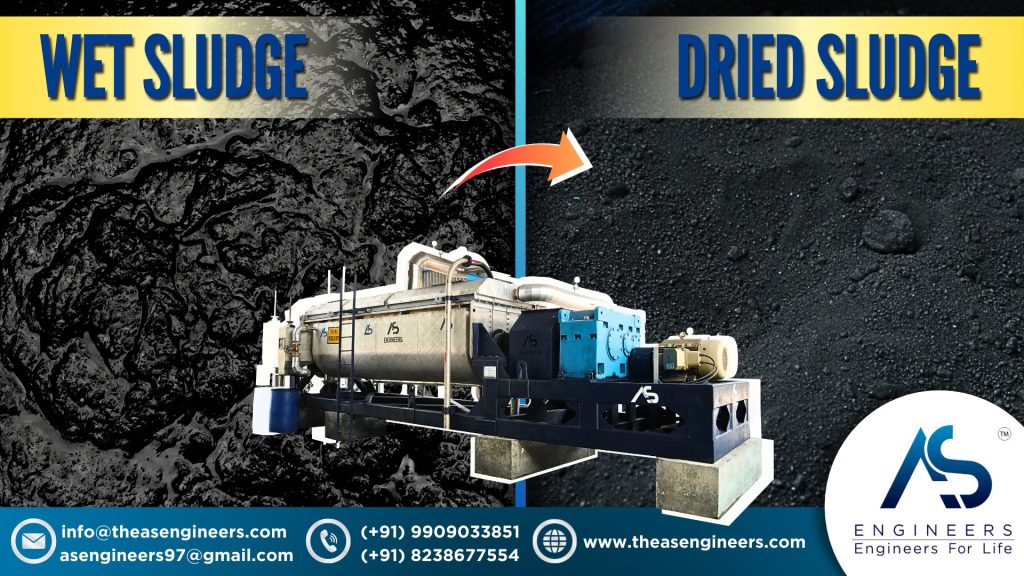
AS Engineers’ paddle dryer system uses indirect heat transfer through hollow shafts and jacket heating, with sludge feeding, drying, vapour handling, pollution-control support, and product handling configuration based on the application. For STP sludge drying selection, see the sludge paddle dryer selection guide and paddle dryer manufacturer in India.
STP Buyer Checklist Before Finalizing a Plant
Before selecting or upgrading an STP, collect these inputs:
| Input | Why it matters |
|---|---|
| Daily sewage flow in KLD | Decides hydraulic capacity |
| Peak flow and hourly variation | Prevents overload and bypassing |
| Influent BOD, COD, TSS, oil and grease | Defines treatment load |
| Reuse target | Decides tertiary treatment quality |
| Available land | Affects technology selection |
| Power availability | Important for aeration, pumps, automation |
| Operator skill level | Decides complexity of system |
| Odour sensitivity | Important for hotels, societies, campuses, hospitals |
| Sludge quantity | Impacts dewatering and drying |
| Disposal route | Decides final moisture and handling need |
| Local consent conditions | Defines legal operating target |
| Maintenance budget | Affects lifecycle performance |
RFQ Inputs for STP Sludge Drying
If the STP sludge is already becoming a handling or disposal problem, prepare these RFQ details before asking for a sludge dryer recommendation:
| RFQ input | Required detail |
|---|---|
| STP capacity | KLD or MLD |
| Sludge source | ASP, MBBR, SBR, MBR, primary sludge, mixed sludge |
| Feed form | Pumpable sludge, dewatered cake, sticky paste, semi-solid cake |
| Feed moisture | Current moisture percentage or lab report |
| Final moisture target | Required outlet moisture or disposal requirement |
| Daily sludge quantity | kg/day or ton/day |
| Current dewatering equipment | Filter press, screw press, centrifuge, belt press, drying bed |
| Heating medium available | Steam, thermic fluid, hot water, electricity, fuel option |
| Space available | Dryer room size and layout constraints |
| Vapour handling need | Odour, condenser, scrubber, ID fan, ducting |
| Material of construction concern | Corrosion, chloride, sulphide, chemical exposure |
| Disposal or reuse route | TSDF, co-processing, composting, incineration, approved reuse |
Sharing these details helps avoid wrong dryer sizing, wrong feeding design, poor vapour handling, and unrealistic final moisture expectations.
For disposal-route context, read the industrial sludge disposal guide.
Common Mistakes to Avoid
| Mistake | Why it creates problems |
|---|---|
| Selecting STP only by lowest capital cost | O&M, sludge, power, and compliance risk may increase later |
| Ignoring sludge generation | Water may be treated, but wet sludge becomes a daily burden |
| Copying another site’s STP technology | Sewage load, space, reuse target, and operator capability differ |
| Switching off blowers to save power | Biological treatment can become unstable |
| No laboratory testing | Operators cannot identify process drift early |
| No odour control plan | Complaints increase even when water looks clear |
| No dewatering or drying plan | Sludge storage and transport become expensive |
| Treating STP and ETP as same system | Domestic sewage and industrial effluent need different review |
FAQs
What is an STP in simple words?
An STP is a sewage treatment plant that treats domestic wastewater from toilets, bathrooms, kitchens, and buildings so the treated water can be reused for non-potable purposes or discharged as per local approval conditions.
What are the main stages of an STP?
The main STP stages are preliminary treatment, primary treatment, secondary biological treatment, tertiary filtration and disinfection, and sludge handling.
Is STP treated water safe to drink?
No. STP treated water should not be treated as drinking water unless it has gone through a separate approved potable water treatment and testing system. In most buildings, STP treated water is used only for non-potable applications such as flushing, gardening, and cleaning.
What is the difference between STP sludge and ETP sludge?
STP sludge comes mainly from domestic sewage treatment and biological treatment. ETP sludge comes from industrial effluent and may contain chemicals, salts, metals, dyes, oils, or hazardous constituents depending on the industry.
Does every STP need a sludge dryer?
No. Small STPs with low sludge quantity and enough drying-bed area may not need a dryer. A sludge dryer becomes useful when wet sludge is costly to transport, difficult to store, odorous, land-intensive, or needs lower moisture before disposal or approved reuse.
Conclusion
An STP is not only a water-cleaning unit. It is a complete sewage treatment and sludge management system. A reliable STP must handle incoming sewage, biological treatment, treated water polishing, reuse or discharge requirements, and the sludge generated during the process.
For builders, facility managers, consultants, and plant teams, the practical question is not only “Which STP technology should we use?” The stronger question is: “Can this STP operate reliably every day, meet local conditions, and manage sludge without odour, storage, transport, or disposal problems?”
If your STP sludge is wet, heavy, odorous, or expensive to move, share your sludge quantity, feed moisture, final moisture target, dewatering method, heating medium availability, and disposal route. The AS Engineers team can review whether paddle dryer-based sludge drying is suitable for your site conditions.