A sludge dewatering machine separates water from sludge so the plant gets a more manageable sludge cake instead of a heavy, wet, difficult-to-handle slurry. It is used in ETP, STP, CETP, ZLD and industrial wastewater plants to reduce sludge volume, improve handling, reduce transport load, and prepare sludge for drying, reuse, co-processing, or approved disposal.
The important point is simple: dewatering and drying are not the same. Dewatering removes free water mechanically. A sludge dryer, such as an indirect paddle dryer, is used when the plant needs lower final moisture, better handling, volume reduction beyond mechanical dewatering, or a more suitable discharge condition for the approved disposal or reuse route.
For a broader selection view, you can also read our guide on how to choose the right sludge dewatering equipment.
What is a sludge dewatering machine?
A sludge dewatering machine is equipment used to separate liquid from sludge solids. The liquid side is normally called filtrate or centrate, depending on the machine type. The solid output is called sludge cake.
In practical plant language, it converts this:
Wet sludge, high moisture, difficult to store, heavy to transport
Into this:
Dewatered sludge cake, lower volume, easier to move, easier to dry or dispose
Sludge dewatering machines are commonly used after primary treatment, secondary treatment, clarification, thickening, biological treatment, chemical treatment, DAF, or sludge holding tanks.
Common sludge sources include:
| Sludge source | Typical plant context |
|---|---|
| ETP sludge | Chemical, textile, pharma, food, metal finishing, dye, paper and industrial wastewater plants |
| STP sludge | Sewage treatment plants in municipal, institutional, commercial and residential projects |
| CETP sludge | Common effluent treatment plants handling mixed industrial waste streams |
| Biological sludge | Activated sludge, bio-sludge and microbial treatment sludge |
| Chemical sludge | Coagulation, precipitation, neutralization and process wastewater sludge |
| Oily sludge | Refinery, petrochemical, lubricant, machining and oil-contaminated wastewater |
| ZLD sludge | Concentrated wastewater residue from zero liquid discharge systems |
To understand the broader sludge process before equipment selection, see our guide on sludge dewatering techniques.
Dewatering vs thickening vs drying
Many buyers mix these three words. That causes wrong sizing, wrong vendor comparison and wrong purchase decisions.
| Process | Main purpose | Typical output | Common equipment |
|---|---|---|---|
| Thickening | Increase solids concentration before dewatering | Pumpable thickened sludge | Gravity thickener, DAF, rotary drum thickener |
| Dewatering | Remove free water mechanically | Sludge cake | Filter press, screw press, centrifuge, belt press |
| Drying | Remove remaining moisture using heat | Dried sludge or granular/powder-like output depending on material | Paddle dryer, disc dryer, belt dryer, thin film dryer |
Dewatering is normally the first major mechanical step. Drying is considered when the dewatered cake is still too wet, sticky, heavy, odorous, costly to transport, difficult to store, or unsuitable for the final disposal or reuse route.
A useful rule for buyers: do not ask only “which machine is cheapest?” Ask, “what final sludge condition does my plant actually need?”
How a sludge dewatering machine works
Most sludge dewatering machines follow the same process logic, even though the mechanical design differs.
1. Sludge collection and feeding
Sludge is collected from a sludge holding tank, thickener, clarifier, DAF, biological system, or ETP/STP sludge pit. It is then fed to the dewatering machine using a sludge pump, screw feeder, belt conveyor, or gravity feed arrangement depending on sludge consistency.
Feed quality matters. Thin watery sludge, sticky chemical sludge, oily sludge, fibrous sludge and biological sludge do not behave the same way.
For pump-side planning, read our guide on sludge pumps in wastewater treatment.
2. Conditioning and polymer dosing
Many sludge streams need conditioning before dewatering. Polymer or flocculant helps small particles join together so water separates more easily.
Poor polymer selection can cause weak cake formation, high filtrate solids, screen blinding, high chemical cost, and inconsistent discharge.
Important checks include:
- Polymer type and dosage
- Mixing time
- Sludge pH
- Feed solids percentage
- Oil and grease content
- Temperature
- Abrasive or corrosive solids
- Filtrate clarity requirement
3. Mechanical water separation
This is the core dewatering stage. Different machines use different force:
| Machine | Separation force |
|---|---|
| Filter press | Hydraulic pressure through filter cloth |
| Screw press | Gradual compression through screw and screen/disc gaps |
| Centrifuge | High-speed centrifugal force |
| Belt filter press | Gravity drainage plus pressure between moving belts |
| Volute or multi-disc press | Screw compression through fixed and moving rings |
The goal is not only to produce a dry-looking cake. Good dewatering also means acceptable solids capture, manageable filtrate/centrate quality, stable operation, and realistic maintenance load.
4. Filtrate or centrate return
The separated liquid goes back to the ETP/STP process or to another treatment stage. This liquid can carry suspended solids, polymer residue, dissolved salts, oil, or process chemicals.
This is why dewatering selection should involve the wastewater treatment team, not only the purchase department.
5. Sludge cake discharge
The sludge cake may drop into a trolley, bin, screw conveyor, belt conveyor, skip, bagging system, dryer feed system, or storage area.
Cake discharge behavior is important. Some sludge looks dry but remains sticky. Some cakes break easily. Some bridge inside hoppers. Some need immediate drying or covered storage to control odor and handling problems.
Main types of sludge dewatering machines
Filter press
A filter press uses plates, chambers and filter cloth to squeeze sludge under pressure. Water passes through the cloth, while solids remain inside the chambers as cake.
| Best fit | Where it works well |
|---|---|
| Chemical sludge | Good where high cake dryness and filtrate clarity are important |
| Inorganic sludge | Useful for metal finishing, chemical precipitation and mineral-heavy sludge |
| Batch operation | Suitable where trained operators are available |
| Limited automation budget | Often selected where batch handling is acceptable |
Advantages
- Strong cake formation for many chemical and inorganic sludges
- Good filtrate clarity when cloth, pressure and conditioning are correct
- Familiar technology for ETP operators
- Suitable for small and medium plants
Limitations
- Batch operation
- Cloth cleaning and replacement required
- Needs space for plate opening and cake discharge
- Operator discipline affects performance
- Sticky cake can be difficult to release
For a deeper related page, see our guide on plate and frame sludge press.
Screw press
A screw press moves conditioned sludge through a slow rotating screw. As the channel narrows, pressure increases and water exits through screens or rings.
| Best fit | Where it works well |
|---|---|
| STP sludge | Useful for biological and organic sludge |
| Low manpower sites | Continuous and relatively operator-friendly |
| Enclosed plants | Helps reduce open sludge handling |
| Moderate dryness requirement | Good where very high cake dryness is not the only priority |
Advantages
- Continuous operation
- Low-speed mechanical movement
- Compact and enclosed design
- Lower operator demand than many batch systems
- Suitable for many STP and organic sludge duties
Limitations
- Not ideal for every abrasive or difficult chemical sludge
- Cake dryness depends heavily on feed solids and conditioning
- Screens/discs need cleaning and inspection
- Throughput can be lower than centrifuge for some high-volume plants
To compare screw press and belt press in more detail, use our belt filter press vs screw press dewatering guide.
Decanter centrifuge
A decanter centrifuge rotates at high speed and separates solids from liquid using centrifugal force. Solids move toward the bowl wall and are conveyed out, while liquid exits separately.
| Best fit | Where it works well |
|---|---|
| High-volume plants | Continuous operation with compact footprint |
| Oily or fine sludge | Often considered where settling and pressing are difficult |
| Automated plants | Useful when instrumentation and trained operators are available |
| Plants needing fast separation | Strong option where flow is high and space is limited |
Advantages
- High-speed continuous separation
- Compact footprint
- Enclosed operation
- Good for many municipal and industrial sludge duties
- Can handle variable feed better than some pressure systems when properly designed
Limitations
- Higher power demand
- Skilled maintenance needed
- Wear risk from abrasive solids
- Vibration and balancing discipline are important
- Polymer optimization is critical
Belt filter press
A belt filter press spreads conditioned sludge over moving belts. Water first drains by gravity, then pressure rollers squeeze more water from the sludge.
| Best fit | Where it works well |
|---|---|
| Municipal sludge | Useful for many STP and sewage sludge applications |
| Food and paper sludge | Can work well with fibrous or organic sludge |
| Continuous operation | Suitable where steady feed is available |
| Plants with space | Needs more layout area than compact machines |
Advantages
- Continuous operation
- Good throughput for suitable sludge
- Visual operation makes troubleshooting easier
- Common in municipal and industrial wastewater treatment
Limitations
- Needs wash water
- Belt tracking and alignment must be maintained
- Open design may create odor and housekeeping issues
- Larger footprint than screw press or centrifuge
- Performance is sensitive to polymer and feed consistency
Volute or multi-disc sludge dewatering machine
A volute or multi-disc machine is a screw-based dewatering system with fixed and moving rings. It is often marketed as a sludge dehydrator, screw press, or multi-disc screw press.
| Best fit | Where it works well |
|---|---|
| STP sludge | Compact continuous dewatering |
| Low-noise plants | Slow-speed operation |
| Low operator availability | Automated operation possible |
| Moderate capacity plants | Useful for decentralized or packaged systems |
Advantages
- Compact
- Low-speed operation
- Continuous cake discharge
- Can be suitable for packaged STP/ETP projects
Limitations
- Feed limitations must be checked carefully
- Not every industrial sludge is suitable
- Disc/ring wear and cleaning need attention
- Manufacturer-specific design differences matter
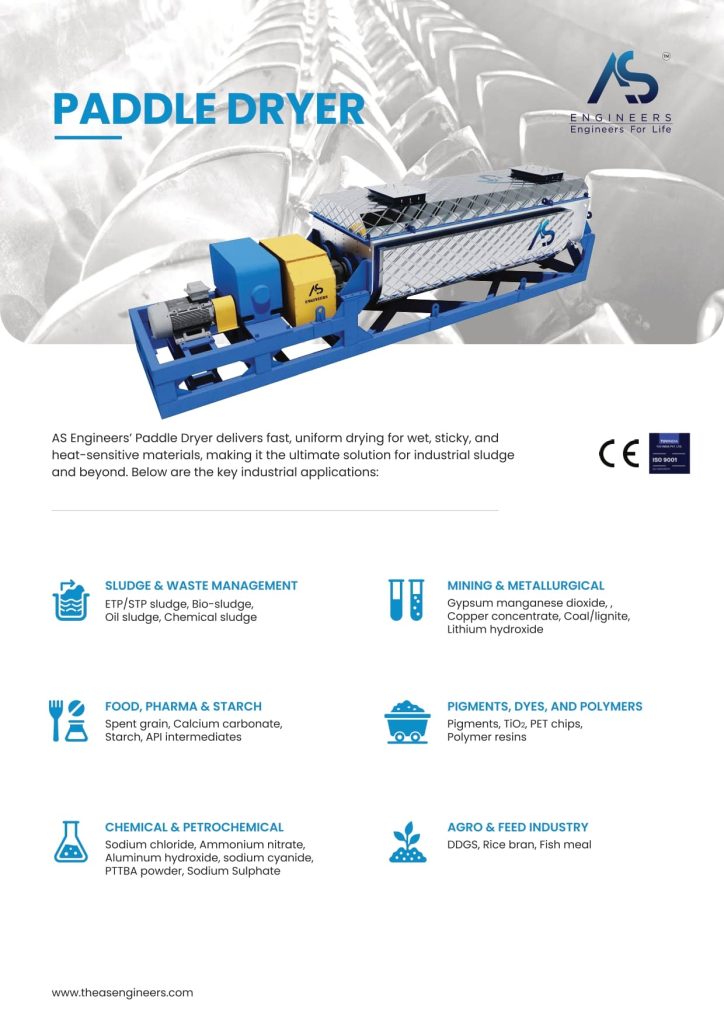
Paddle dryer after dewatering
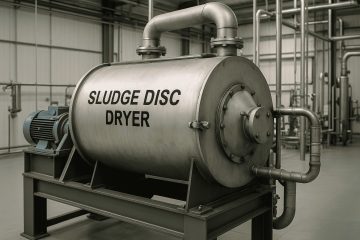
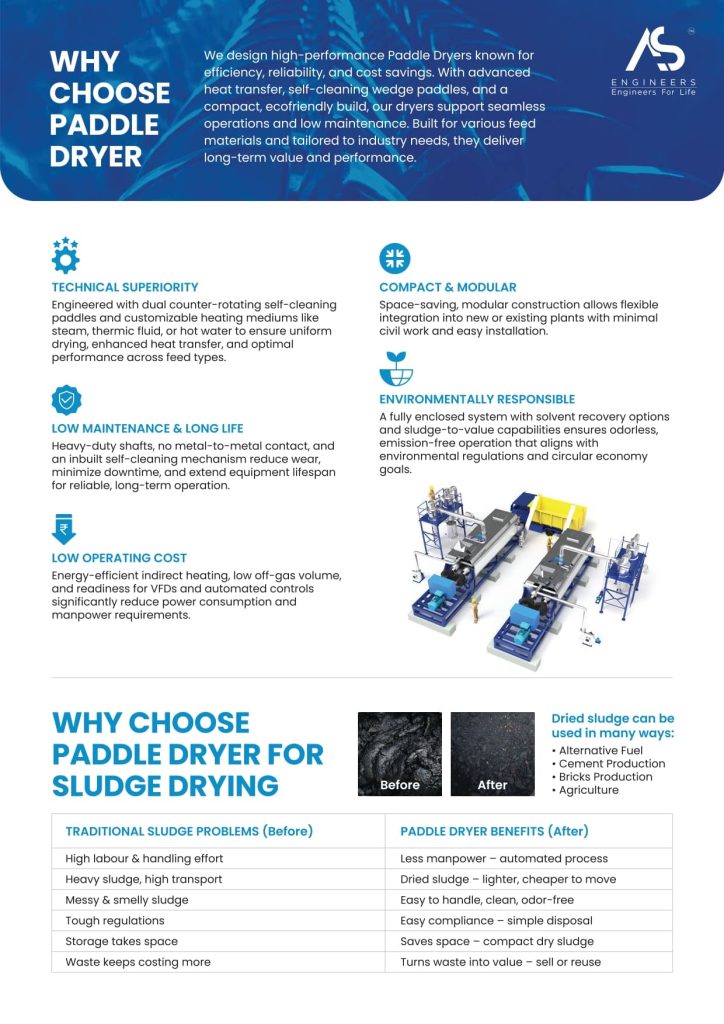
A paddle dryer is not a primary sludge dewatering machine. It is a thermal sludge drying system used after mechanical dewatering when the plant needs further moisture reduction.
This is important for plants handling:
- ZLD sludge
- Hazardous or high-disposal-cost sludge
- Sticky chemical sludge
- CETP sludge
- Sludge going to approved co-processing
- Sludge requiring better storage and transport condition
- Sludge where wet cake remains costly or difficult to handle
AS Engineers’ paddle dryer system uses indirect heat transfer through hollow shafts and jacketed surfaces. The system can be planned with feeding, heating, scavenging, pollution control, solvent/vapour handling and product handling equipment depending on the sludge and site requirement.
For technical detail, read our guide on thermal sludge drying systems and sludge drying methods.
Which sludge dewatering machine is best?
There is no single best sludge dewatering machine for every plant. The right choice depends on sludge source, solids content, chemical behavior, required cake dryness, daily load, disposal route, automation need, utility availability and maintenance capacity.
| Sludge condition | Practical machine direction |
|---|---|
| Chemical or inorganic ETP sludge | Filter press or recessed plate filter press is often reviewed first |
| Municipal STP biological sludge | Screw press, belt press or centrifuge can be considered |
| High-volume municipal sludge | Centrifuge or belt filter press may be evaluated |
| Fibrous food, paper or textile sludge | Belt press or screw press may be practical depending on conditioning |
| Oily sludge | Centrifuge may be considered, but pilot testing is important |
| Sticky sludge cake after filter press | Mechanical dewatering alone may not solve handling, drying may be needed |
| ZLD sludge or high-disposal-cost sludge | Dewatering plus paddle dryer is often evaluated |
| CETP mixed sludge | Testing is important because sludge composition can change significantly |
For disposal-side planning, read our industrial sludge disposal guide.
Selection checklist before buying a sludge dewatering machine
Before asking for a quotation, prepare these inputs. Without this data, vendors may quote the wrong machine size or give unrealistic performance expectations.
| RFQ input | Why it matters |
|---|---|
| Sludge source | ETP, STP, CETP, chemical, pharma, textile, food, paper or municipal sludge behaves differently |
| Wet sludge quantity | Needed for hydraulic capacity and machine sizing |
| Feed solids percentage | Dewatering performance depends heavily on feed concentration |
| Current moisture | Helps define baseline condition |
| Required cake dryness | Prevents wrong selection between dewatering and drying |
| Operating hours per day | Affects machine capacity and automation requirement |
| Peak flow | Prevents undersizing during high-load periods |
| Sludge pH | Affects MOC, corrosion risk and polymer selection |
| Oil and grease | Impacts separation and cake formation |
| Abrasive solids | Affects wear in centrifuges, pumps, screws and screens |
| Chloride or corrosive content | Influences stainless steel or alloy selection |
| Polymer trial result | Helps estimate chemical consumption and cake formation |
| Filtrate/centrate quality target | Prevents overload returning to ETP/STP |
| Available footprint | Belt press, filter press and dryer layouts differ |
| Utility availability | Power, wash water, air, steam, thermic fluid or fuel may be needed |
| Disposal route | TSDF, landfill, co-processing, reuse or drying route affects final moisture target |
| Downstream dryer need | Required when dewatered cake is still too wet or sticky |
A good RFQ should not ask only for “capacity in KLD.” Sludge dewatering is a solids-handling problem, not only a water-flow problem.
When dewatering alone is enough
Dewatering alone may be enough when:
- The sludge cake is accepted by the approved disposal route
- Moisture level is suitable for handling and transport
- Cake does not create odor, leakage or storage problems
- Disposal cost is manageable
- The plant does not need thermal drying for volume reduction
- The sludge is not targeted for reuse or co-processing that needs lower moisture
Even then, the plant should check solids capture, filtrate quality, sludge storage, operator safety and disposal documentation.
When sludge drying is needed after dewatering
A sludge dryer should be evaluated when:
- Dewatered cake is still too wet for disposal or reuse
- Transport cost remains high
- Cake is sticky and difficult to convey
- Storage space is limited
- Monsoon or humidity affects open drying
- Odor and hygiene issues remain
- ZLD residue needs further moisture reduction
- The plant wants a more stable final sludge output
- Approved co-processing or reuse requires a drier feed condition
For ZLD-specific context, read the zero liquid discharge guide.
Common mistakes in sludge dewatering machine selection
Buying based only on machine price
Low initial price can become expensive if the machine has poor solids capture, frequent breakdowns, high polymer consumption, high operator demand, or poor cake discharge.
Ignoring sludge testing
A catalogue cannot fully predict sludge behavior. Test sludge for feed solids, pH, oil and grease, particle behavior, abrasiveness, corrosiveness and cake formation. Pilot testing is useful when the sludge is variable, sticky, hazardous, oily or high-cost to dispose.
Confusing KLD with sludge capacity
ETP plant capacity in KLD is not the same as sludge quantity. A 500 KLD plant and another 500 KLD plant can generate very different sludge loads depending on process, chemical dosing, raw effluent and treatment scheme.
Not checking filtrate or centrate impact
The liquid separated from sludge returns to treatment. If it carries too many solids or chemicals, it can overload the ETP/STP and create a hidden operating problem.
Ignoring cake handling
Cake discharge is not the end of the process. Ask how the cake will be collected, conveyed, stored, dried, bagged, loaded or sent for disposal.
Assuming dewatering will meet every moisture target
Mechanical dewatering has practical limits. When the plant needs much lower final moisture, thermal drying should be evaluated instead of forcing a dewatering machine beyond its realistic duty.
Making compliance claims without local confirmation
Moisture requirements, acceptance conditions and documentation needs can vary by waste category, disposal route, consent condition and authorized facility. Always verify final requirements with the responsible consultant, SPCB/CPCB guidance, TSDF operator or approved disposal agency.
For regulatory background, use our CPCB hazardous waste disposal guide and TSDF site standards guide.
Maintenance points buyers should check
| Machine | Maintenance focus |
|---|---|
| Filter press | Filter cloth cleaning, plate condition, hydraulic system, cake release, feed pump |
| Screw press | Screen/disc cleaning, screw wear, polymer system, torque load, discharge cone |
| Centrifuge | Bowl wear, vibration, balancing, bearings, gearbox, scroll condition |
| Belt press | Belt tracking, wash water nozzles, roller alignment, belt tension, polymer mixing |
| Paddle dryer | Feed consistency, shaft drive, heating medium, vapour handling, seals, discharge condition |
The best dewatering machine is not only the one that works on day one. It must work consistently with the actual sludge, operator skill, maintenance budget and disposal requirement of the plant.
Practical decision framework
Use this quick selection logic before final vendor discussion:
| Your plant situation | Better next step |
|---|---|
| Sludge is watery and pumpable | Check thickening before dewatering |
| Sludge is chemical or inorganic | Evaluate filter press and pilot cake formation |
| Sludge is biological and operator availability is low | Evaluate screw press or suitable continuous system |
| Flow is high and space is limited | Evaluate centrifuge with maintenance and power cost |
| Sludge is fibrous or food/paper based | Evaluate belt press or screw press with polymer trial |
| Cake is still wet, sticky or costly to move | Evaluate paddle dryer after dewatering |
| Disposal route requires very dry output | Do not depend only on mechanical dewatering, review thermal drying |
| Sludge composition changes daily | Prioritize pilot trial and flexible design |
How AS Engineers helps with sludge drying after dewatering
At AS Engineers, we focus on the downstream problem many plants face after dewatering: the sludge cake is still heavy, sticky, wet, odorous, or costly to dispose.
For paddle dryer selection, we review:
- Feed moisture
- Desired final moisture
- Sludge source and composition
- Wet cake behavior
- Sticky or granular transition
- Heating medium availability
- Daily throughput
- Vapour and odour handling requirement
- Pollution control requirement
- MOC requirement
- Discharge and storage method
- Disposal or reuse route
AS Engineers’ sludge drying systems can be configured with feeding equipment, indirect heating, paddle dryer, scavenging system, cyclone, scrubber, bag filter, ID fan, condenser where required, screw conveyor, bagging system, silo or truck loading arrangement depending on the plant.
For equipment-specific context, see paddle dryer manufacturer in India and sludge dryer machine applications.
FAQs
What is a sludge dewatering machine?
A sludge dewatering machine separates water from sludge and produces a sludge cake that is easier to handle, transport, dry, reuse, or dispose of. Common machines include filter press, screw press, centrifuge, belt filter press and volute or multi-disc press.
Which sludge dewatering machine is best for ETP sludge?
For many chemical or inorganic ETP sludges, a filter press is commonly evaluated because it can form a strong cake and clear filtrate when sludge conditioning is correct. However, oily, biological, fibrous or mixed sludge may need a centrifuge, screw press or belt press. Sludge testing should guide the final choice.
Is a sludge dryer the same as a sludge dewatering machine?
No. A sludge dewatering machine removes free water mechanically. A sludge dryer removes remaining moisture using heat. In many ETP, STP, CETP and ZLD plants, mechanical dewatering comes first and thermal drying is added when the dewatered cake is still too wet, sticky, heavy or costly to dispose.
Can dewatering reduce sludge moisture below 20%?
Some sludge streams may reach low moisture with the right machine and conditioning, but mechanical dewatering has practical limits. When the plant requires consistently lower final moisture, especially for difficult industrial sludge or ZLD residue, a thermal sludge dryer should be evaluated after dewatering.
What details are needed for a sludge dewatering machine quotation?
A useful quotation needs sludge source, wet sludge quantity, feed solids, current moisture, desired cake dryness, pH, oil and grease, abrasive or corrosive content, operating hours, peak load, available utilities, layout space, automation need, disposal route and whether downstream sludge drying is required.
Conclusion
A sludge dewatering machine is essential for reducing wet sludge volume and improving handling in ETP, STP, CETP, ZLD and industrial wastewater plants. But the right machine depends on the actual sludge, not only on plant capacity or machine price.
Filter press, screw press, centrifuge, belt press and volute-type systems all have valid applications. The correct selection should be based on sludge testing, required cake dryness, solids capture, filtrate quality, operator availability, maintenance capacity, space and final disposal route.
When dewatering alone does not solve the problem, a sludge dryer becomes the next decision. A paddle dryer can help convert wet sludge cake into a drier, more manageable output for approved disposal, storage, transport, or reuse routes where the sludge composition allows.
For sludge drying after dewatering, share your sludge source, feed moisture, final moisture target, wet sludge quantity, heating medium availability, disposal route and site layout. The AS Engineers team can review the duty condition and suggest a practical sludge drying configuration based on real plant requirements.