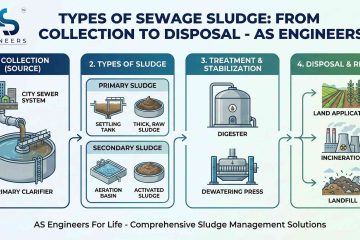
A sludge drying bed is a simple dewatering system used in wastewater treatment plants to reduce sludge moisture through drainage and evaporation. Wet sludge is spread over a shallow bed made with sand, gravel, and underdrain pipes. Free water drains downward, while sunlight, airflow, and time remove additional moisture from the sludge surface.
For small STPs, municipal plants, rural wastewater systems, and plants with enough land, a sludge drying bed can be practical and low-cost. For industrial ETPs, ZLD plants, high-volume sludge, rainy locations, or sites needing faster and more controlled moisture reduction, the drying bed often becomes a bottleneck.
This guide explains how sludge drying beds work, where they fit, where they fail, and when a plant should compare them with mechanical dewatering or thermal sludge drying.
What is a sludge drying bed?
A sludge drying bed is an engineered open or covered bed used to dewater sludge after primary treatment, secondary treatment, digestion, thickening, or other sludge handling steps. It is not only a pit for dumping sludge. A proper bed has filtration media, drainage layers, underdrain pipes, containment walls, and operating rotation.
In a conventional sand drying bed, sludge is applied in a controlled layer over sand. Water moves through the sand and gravel layers into the drainage system. The remaining sludge cake dries further due to natural evaporation.
A sludge drying bed is mainly a dewatering step, not a complete disposal solution. After drying, the sludge still needs safe handling, testing, storage, reuse, co-processing, landfilling, or further treatment depending on its source and contamination risk.
For a wider view of sludge handling routes, see our guide on sludge dewatering techniques and industrial sludge disposal.
How does a sludge drying bed work?
A sludge drying bed works through two main actions: drainage and evaporation.
Drainage happens first. When wet sludge is spread over the bed, free water moves downward through the sand and gravel. The underdrain pipes collect this filtrate and return it to the wastewater treatment system for further processing.
Evaporation happens gradually. Sunlight, temperature, wind, humidity, and exposure time remove more moisture from the sludge surface. As the sludge dries, cracks may form in the cake, helping additional moisture escape.
The drying cycle depends on many site conditions:
| Factor | Effect on drying bed performance |
|---|---|
| Sludge type | Biological sludge, primary sludge, chemical sludge, oily sludge, and faecal sludge behave differently |
| Feed solids | Very dilute sludge increases bed load and drying time |
| Sludge layer depth | Overloading slows drainage and may create odour |
| Climate | Rain, humidity, low temperature, and weak sunlight extend drying time |
| Drainage media | Clogged sand or poor gravel grading reduces drainage |
| Bed rotation | Too few beds cause operational delays |
| Sludge removal method | Manual removal increases labour and downtime |
| Final disposal route | Composting, landfill, cement co-processing, or drying need different cake quality |
In many plants, the problem is not the drying bed alone. The problem is overloaded sludge, poor pre-thickening, clogged sand, no rain protection, and no plan for dried sludge removal.
Main components of a sludge drying bed
A good sludge drying bed should be built as a controlled dewatering unit. The exact design depends on plant capacity, sludge characteristics, rainfall, land availability, and local regulatory requirements.
| Component | Purpose | Practical note |
| Sludge inlet system | Distributes sludge over the bed | Uneven loading creates wet zones and odour |
| Sand layer | Provides filtration surface | Fine sludge can clog sand over time |
| Gravel layer | Supports sand and improves drainage | Graded gravel prevents media migration |
| Underdrain pipes | Collect filtrate | Pipes must be accessible for flushing and cleaning |
| Bed slope | Helps drainage flow | Poor slope causes stagnant water pockets |
| Side walls or embankments | Contain sludge | Overflow risk increases during rain |
| Filtrate return line | Sends drained water back for treatment | Filtrate should not bypass treatment |
| Access path | Allows sludge removal | Loader or trolley access should be planned |
| Rain protection, optional | Reduces monsoon disruption | Covers or greenhouse systems improve predictability |
| Safety and odour control | Reduces nuisance and exposure | Especially important near residential or worker areas |
Typical drying bed design inputs
A drying bed should not be sized only by looking at available land. It should be sized from sludge production, solids loading, cycle time, drying season, rainfall, and standby bed requirement.
Before designing or modifying a sludge drying bed, collect these inputs:
| Input | Why it matters |
| Daily sludge volume | Determines total bed area and rotation |
| Sludge solids percentage | Low solids increase hydraulic load |
| Sludge source | STP sludge, ETP sludge, chemical sludge, oily sludge, and faecal sludge need different handling |
| Stabilization status | Unstabilized sludge can cause stronger odour and vector issues |
| Rainfall pattern | Monsoon areas may need covers or alternate drying |
| Desired final moisture | Natural beds may not reach the moisture needed for transport or reuse |
| Land availability | Drying beds are land-intensive |
| Labour availability | Manual sludge removal can become costly |
| Disposal route | TSDF, landfill, composting, cement kiln, or dryer feed need different cake conditions |
| Safety and compliance needs | Hazardous or contaminated sludge needs stricter review |
For STP and ETP planning, connect the drying bed decision with the complete wastewater treatment plant and ETP process instead of treating sludge drying as a separate civil job.
Types of sludge drying beds
Different drying bed designs exist because sludge behaviour, climate, space, and operating budget vary from site to site.
| Type | How it works | Best fit | Main limitation |
| Conventional sand drying bed | Sludge is spread over sand, gravel, and underdrain pipes | Small and medium plants with available land | Slow and weather-dependent |
| Paved drying bed | Sludge is placed on concrete or paved surface with drainage slope | Easier removal and cleaning | Less filtration than sand beds |
| Artificial media bed | Uses geotextile, porous media, or synthetic drainage surface | Fine sludge, clogging-prone sludge, higher maintenance concern | Higher initial cost |
| Covered drying bed | Uses roof or greenhouse-style cover | Rainy regions and monsoon-sensitive plants | Higher civil cost |
| Solar drying bed | Uses solar heat, ventilation, and sometimes mixing | Plants wanting low-energy drying with better control | Still needs land and weather planning |
| Vacuum-assisted drying bed | Uses suction through underdrains to speed water removal | Limited land, faster cycle need | Energy and maintenance cost increase |
| Planted drying bed | Uses selected plants and media for faecal sludge or decentralized systems | Long-cycle natural treatment systems | Requires biological and seasonal management |
For natural and solar approaches, compare this page with our solar drying wastewater sludge guide and paddle dryer vs solar bed comparison.
Advantages of sludge drying beds
Sludge drying beds are still used because they solve some sludge handling problems with simple civil construction and low energy demand.
Low energy requirement
Conventional drying beds mainly rely on gravity, sunlight, airflow, and time. Except for pumping, drainage, or optional vacuum/ventilation systems, energy use is low compared with mechanical or thermal systems.
Simple operation
The basic operation is easy to understand. Load sludge, allow drainage, allow evaporation, remove dried sludge, clean the bed, and repeat the cycle.
Lower mechanical complexity
A drying bed does not need high-speed rotating equipment, complex controls, or continuous mechanical drives. This makes it attractive for small plants with limited maintenance teams.
Useful for small and medium plants
When land is available and sludge volume is manageable, a drying bed can be a practical dewatering option for small municipal plants, decentralized wastewater systems, rural STPs, and some low-risk industrial sludge streams.
Supports reuse planning
Dried sludge may be easier to transport, compost, co-process, or send for further drying. However, reuse depends on sludge quality, stabilization, contamination, and local rules. Do not assume every dried sludge is safe for agriculture or fuel use.
Limitations of sludge drying beds
A sludge drying bed is not the right solution for every plant. Many failures happen when a drying bed is selected only because it looks simple or low-cost.
Large land requirement
Drying beds need much more land than mechanical dewatering or enclosed thermal drying. Urban STPs, industrial estates, CETPs, and plants with expansion pressure often struggle with this limitation.
Weather dependency
Rain, humidity, low sunlight, and monsoon periods can slow drying or re-wet the sludge. In Gujarat and many Indian industrial regions, summer drying may be strong, but monsoon performance must be planned separately.
Slow cycle time
Drying can take days to weeks depending on climate, sludge depth, and bed condition. This slow cycle limits throughput and may require several beds operating in rotation.
Labour-intensive removal
Dried sludge removal may need manual labour, wheelbarrows, loaders, or scrapers. If sludge hardens too much, removal becomes more difficult and can damage the bed surface.
Odour and vector issues
Overloaded beds, unstabilized sludge, thick sludge layers, poor drainage, and slow drying can cause odour, flies, mosquitoes, and hygiene problems.
Sand clogging
Fine particles, oily sludge, chemical sludge, and poorly conditioned sludge can clog sand. Once the media is clogged, drainage reduces and drying cycles become longer.
Not ideal for many industrial sludges
Industrial sludge can contain oils, chemicals, metals, salts, dyes, pigments, or hazardous constituents. Such sludge needs testing and approved disposal or treatment routes. Open drying may not be suitable for every ETP sludge.
For hazardous sludge and TSDF-linked disposal planning, also review CPCB hazardous waste disposal guidance and site-specific legal requirements before finalizing the sludge route.
Sludge drying bed fit and no-fit guide
| Plant condition | Drying bed fit? | Reason |
| Small STP with available land | Good fit | Low sludge volume and natural drying may be enough |
| Rural or decentralized wastewater system | Good fit | Land and labour may be available |
| Warm, dry climate | Good fit | Evaporation works better |
| Monsoon-heavy location | Conditional | Needs cover, extra beds, or backup route |
| High-volume CETP | Often weak fit | Land and cycle time become limiting |
| Compact industrial ETP | Often weak fit | Space and odour control are concerns |
| Oily sludge | Poor fit unless pre-treated | Oil slows drainage and clogs media |
| Hazardous chemical sludge | High caution | Open drying may create exposure and compliance risk |
| ZLD plant sludge | Usually needs better control | Moisture, salts, handling, and disposal cost matter |
| Sludge intended for fuel or co-processing | May need thermal drying | Higher dryness and consistency may be required |
Sludge drying bed vs mechanical dewatering vs thermal drying
A drying bed is only one sludge dewatering option. Plants should compare it with mechanical and thermal systems based on sludge volume, operating cost, land, final moisture, and disposal route.
| Method | Main role | Speed | Land need | Energy use | Best fit |
| Sludge drying bed | Natural dewatering | Slow | High | Low | Small plants with land |
| Geo-bag | Passive contained dewatering | Slow to medium | Medium | Low | Temporary or decentralized use |
| Belt filter press | Mechanical dewatering | Fast | Medium | Medium | Continuous municipal or industrial flow |
| Screw press | Mechanical dewatering | Fast | Low | Medium | Compact ETP/STP sludge dewatering |
| Centrifuge | Mechanical dewatering | Fast | Low | High | High-volume plants with trained operators |
| Solar drying | Low-energy drying | Medium | High | Low to medium | Plants with land and sun |
| Paddle dryer | Indirect thermal drying | Fast and controlled | Low | Higher than natural drying | Industrial sludge volume reduction, disposal cost reduction, controlled final moisture |
A drying bed removes water naturally. A mechanical dewatering machine reduces bulk moisture faster. A thermal sludge dryer removes additional bound moisture when the plant needs drier, lighter, more manageable sludge.
For plants comparing drying technologies, see our sludge drying methods guide and thermal sludge drying system guide.
When a sludge drying bed is enough
A sludge drying bed may be enough when:
| Condition | Why it works |
| Sludge quantity is low to moderate | Bed rotation remains manageable |
| Land is available | Large drying area is not a problem |
| Climate is dry for most of the year | Evaporation is reliable |
| Sludge is stabilized | Odour and vector risk reduce |
| Final disposal accepts semi-dry cake | Very low moisture is not required |
| Labour is available | Manual removal does not become a major cost |
| Rain backup exists | Monsoon disruption can be handled |
In such cases, the main focus should be good bed design, correct loading depth, regular media cleaning, filtrate return, and safe dried sludge handling.
When to consider a sludge dryer instead of only a drying bed
A plant should consider a sludge dryer when the drying bed creates land, time, odour, hygiene, or disposal-cost problems.
Common trigger points include:
| Trigger | What it means |
| Wet sludge storage is increasing | Existing drying bed area is not enough |
| Sludge is not drying during monsoon | Weather dependency is hurting operations |
| Labour cost is rising | Manual removal and handling are becoming inefficient |
| Transport cost is high | Moist sludge weight is increasing disposal cost |
| Odour complaints are frequent | Open drying is not controlled enough |
| Dried sludge moisture is inconsistent | Downstream disposal or reuse needs better control |
| Plant is expanding | Existing bed area cannot handle future sludge load |
| ZLD sludge or industrial sludge is difficult to handle | Controlled drying may be required |
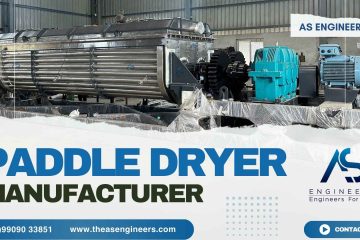
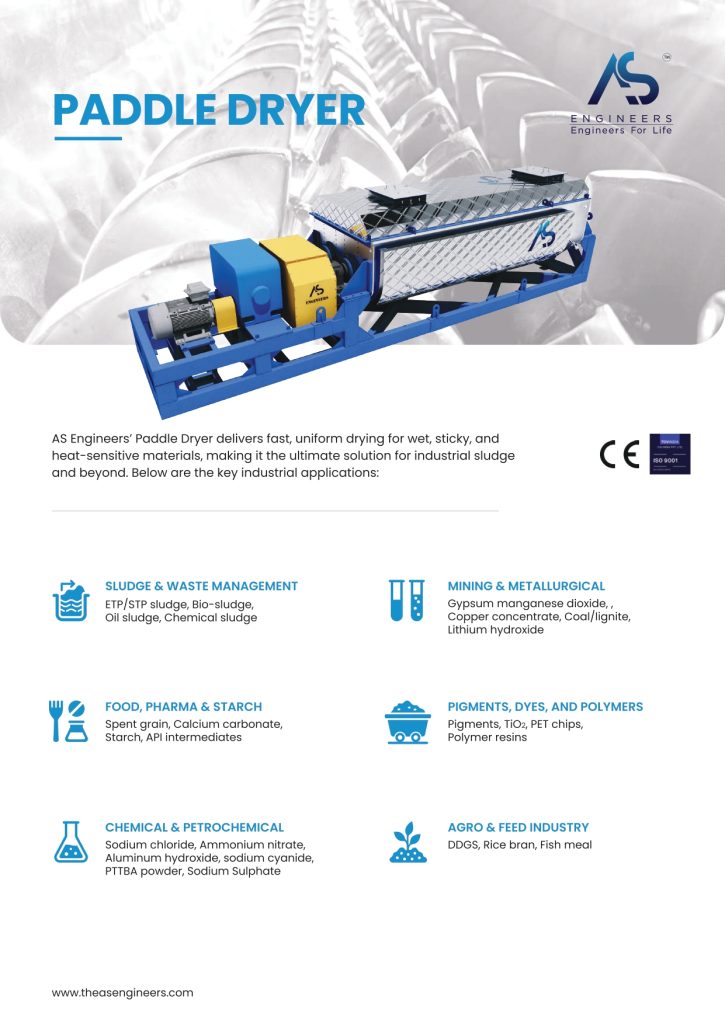
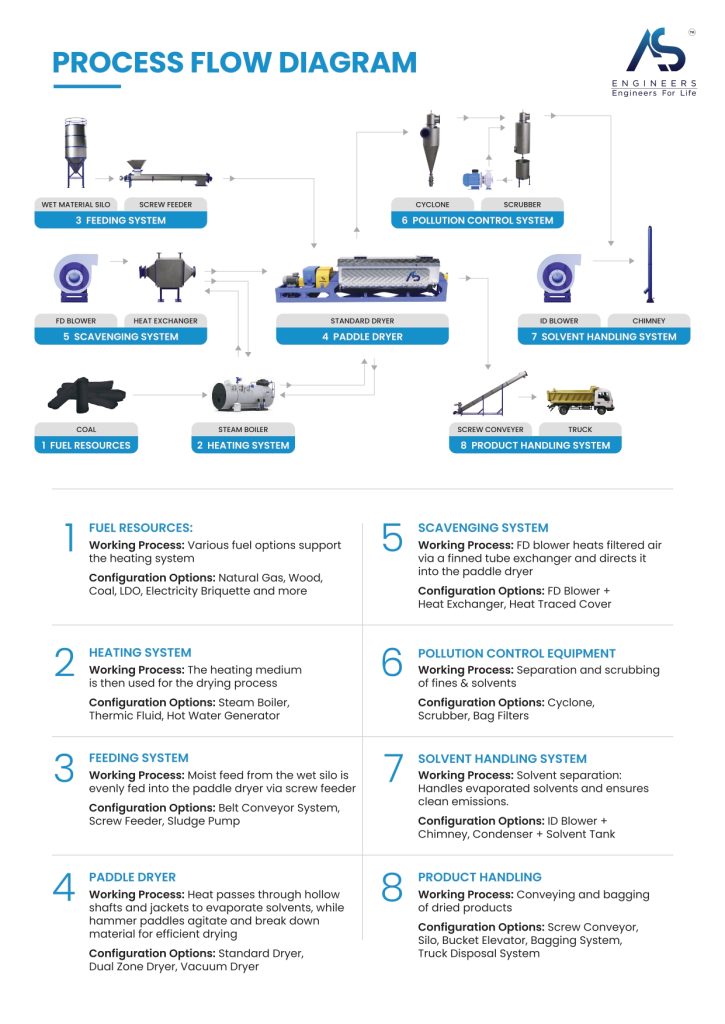
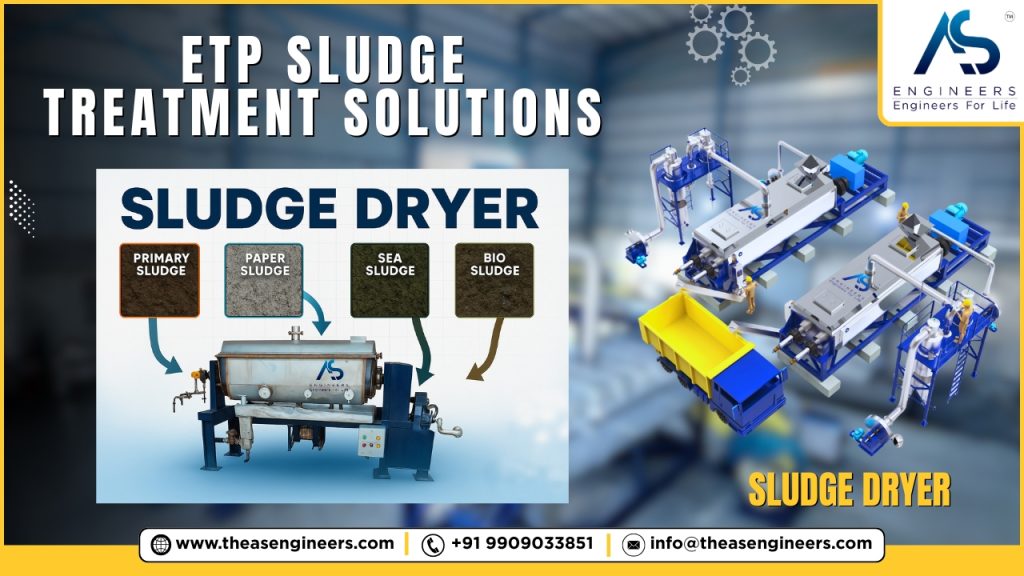
AS Engineers’ paddle dryer is an enclosed indirect drying option for sludge and industrial wet materials. In a paddle dryer, heat transfer occurs through hollow shafts and jacketed surfaces, while paddles mix and move the material. This type of system is considered when natural drying is too slow, land is limited, or the plant needs controlled final moisture.
For selection details, use our sludge paddle dryer selection guide and sludge dryer machine applications guide.
Operating mistakes that reduce sludge drying bed performance
Many drying beds underperform because of operation, not only design.
| Mistake | Result | Better practice |
| Loading sludge too deep | Slow drying, odour, anaerobic zones | Keep loading depth within design limit |
| Using beds for unstabilized sludge | Odour and vector issues | Stabilize or condition sludge first |
| Ignoring sand clogging | Poor drainage | Clean, scrape, or replace media when required |
| No bed rotation plan | Continuous sludge backlog | Use multiple beds in sequence |
| No monsoon protection | Re-wetting and overflow | Add covers, drainage, or backup drying route |
| Poor filtrate handling | Treatment bypass risk | Return filtrate to treatment system |
| Removing sludge too late | Hard cake and difficult cleaning | Monitor moisture and remove at planned dryness |
| No disposal plan | Dried sludge accumulates | Link drying with disposal, reuse, or co-processing route |
Practical maintenance checklist
Use this checklist during routine drying bed operation.
| Checkpoint | Frequency | What to look for |
| Sludge loading thickness | Every cycle | Uniform layer, no overloading |
| Drainage flow | First 24 to 48 hours | Slow drainage may indicate clogging |
| Sand surface | Every cycle | Crusting, clogging, uneven wet spots |
| Underdrain pipes | Scheduled | Blockage, backflow, poor slope |
| Embankments | Monthly | Cracks, leakage, overflow marks |
| Odour and vectors | Daily during operation | Flies, mosquitoes, anaerobic smell |
| Rainwater entry | During monsoon | Re-wetting, ponding, overflow |
| Sludge cake dryness | Before removal | Handling suitability |
| Removal access | Every cycle | Loader path, trolley route, worker safety |
| Final disposal log | Every batch | Quantity, destination, test requirements |
RFQ checklist for sludge drying bed upgrade or dryer comparison
Before asking any equipment supplier or consultant for a solution, prepare clear duty data. This avoids wrong recommendations.
Share these inputs:
| RFQ input | Details to provide |
| Plant type | STP, ETP, CETP, ZLD, municipal, pharma, textile, chemical, food, paper, refinery |
| Sludge source | Primary, secondary, biological, chemical, oily, mixed, digested, faecal |
| Wet sludge quantity | kg/hr, ton/day, or m³/day |
| Feed moisture or solids | Lab-tested if possible |
| Present dewatering method | Drying bed, filter press, centrifuge, screw press, geo-bag |
| Existing drying time | Normal season and rainy season |
| Current disposal method | Landfill, TSDF, composting, co-processing, incineration, reuse |
| Target final moisture | Required for disposal, transport, storage, fuel, or reuse |
| Space available | Existing bed area and possible expansion area |
| Odour or hygiene issue | Yes/no, location sensitivity |
| Utilities available | Steam, thermic fluid, gas, electricity, hot air, waste heat |
| Material concerns | Oil, salt, corrosiveness, toxic constituents, odour, stickiness |
| Compliance boundary | Local disposal and hazardous waste requirements |
When I review a sludge drying requirement, I do not start with the dryer type. I first look at feed moisture, sludge behaviour, disposal route, land, seasonality, utilities, and the real reason the current sludge handling system is failing.
Sludge drying bed decision summary
Choose a sludge drying bed when land is available, sludge volume is manageable, climate supports natural drying, and the plant can tolerate longer drying cycles.
Improve an existing drying bed when the basic concept works but performance suffers due to rain, clogging, poor loading depth, poor drainage, or poor bed rotation.
Compare mechanical dewatering when the plant needs faster volume reduction before drying or disposal.
Compare a sludge dryer when the plant needs controlled moisture reduction, compact footprint, lower transport weight, better handling, and less dependence on weather.
A drying bed is simple, but it is not always cheaper when land, labour, slow cycles, wet sludge transport, odour control, and monsoon disruption are included.
FAQs on sludge drying beds
What is the purpose of a sludge drying bed?
The purpose of a sludge drying bed is to reduce water content in sludge so it becomes easier to handle, transport, store, dispose of, compost, or send for further treatment. It mainly works through drainage and evaporation.
How long does sludge take to dry in a drying bed?
Drying time depends on sludge type, layer depth, weather, drainage media, and bed condition. In warm and dry conditions it may take days to a few weeks. In humid, rainy, or overloaded conditions, drying can take much longer.
Is a sludge drying bed suitable for industrial ETP sludge?
It depends on the sludge composition. Some industrial sludges clog beds, smell strongly, contain oil, or need controlled disposal. Chemical, hazardous, oily, high-salt, or dye-containing sludge should be reviewed carefully before open drying is selected.
What is the difference between a sludge drying bed and a sludge dryer?
A sludge drying bed uses natural drainage and evaporation. A sludge dryer uses controlled heat transfer to remove moisture faster and more consistently. A drying bed is land-intensive and weather-dependent, while a dryer is more compact and controlled.
Can dried sludge from a drying bed be used as fertilizer?
Only if the sludge is properly stabilized, tested, and legally accepted for land application. Municipal sludge and industrial sludge can contain contaminants. Never assume dried sludge is safe for agriculture without testing and regulatory approval.
Conclusion
A sludge drying bed is a proven and simple method for reducing sludge moisture in wastewater treatment plants. It works well where sludge volume is moderate, land is available, weather is favourable, and the final dried cake does not need very low moisture.
But for many industrial ETPs, CETPs, ZLD plants, urban STPs, and high-volume sludge operations, drying beds become slow, land-heavy, labour-intensive, and difficult during monsoon. In those cases, the better decision is not simply “drying bed or no drying bed.” The better decision is to compare the full sludge route: thickening, dewatering, drying, disposal, handling, odour, space, utilities, and long-term operating cost.
If your plant is struggling with wet sludge storage, high transport cost, slow drying, odour, or limited land, share your sludge quantity, feed moisture, final moisture target, disposal route, and available utilities. The AS Engineers team can review whether your site needs drying bed improvement, mechanical dewatering, solar drying, or an enclosed sludge dryer configuration.