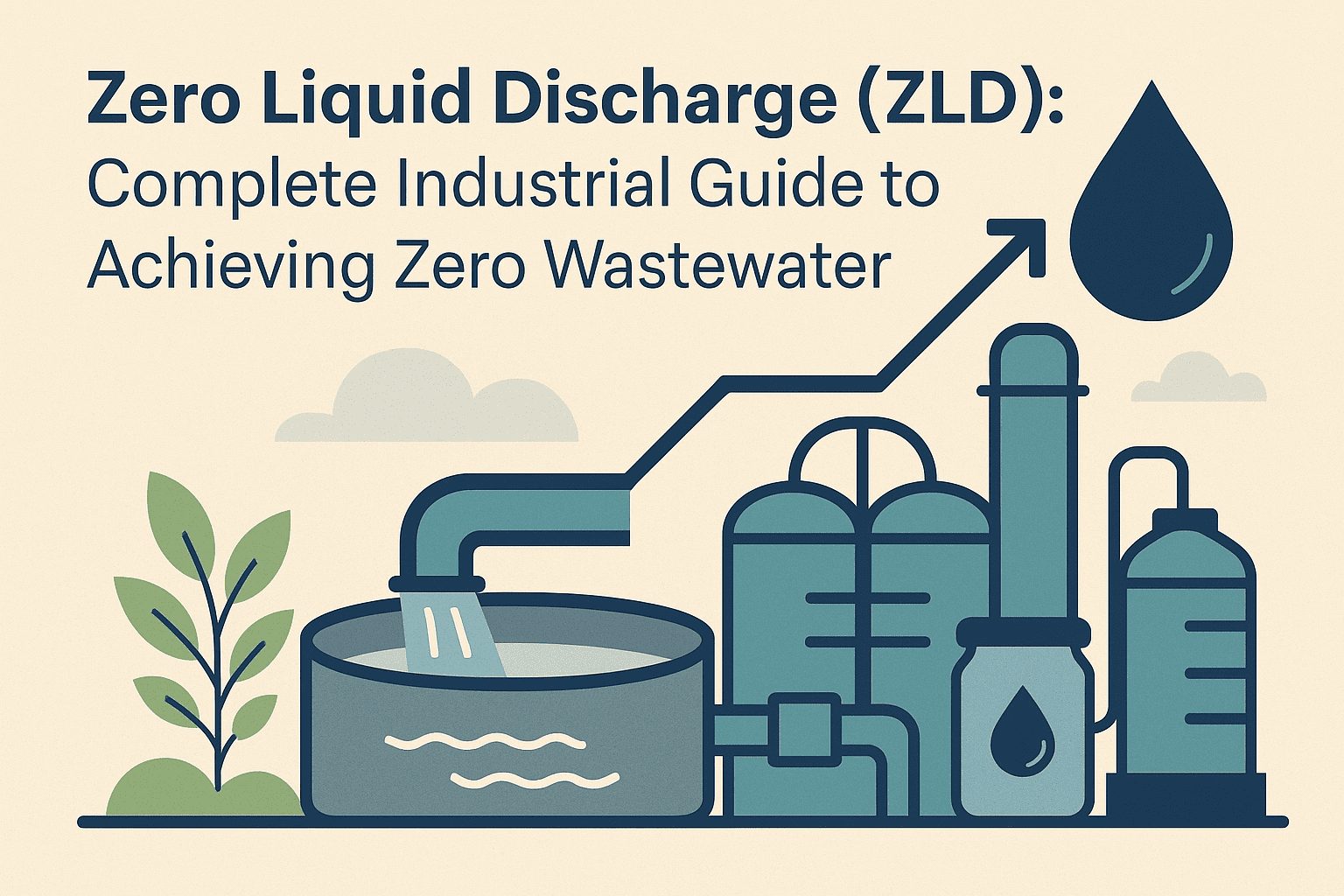
Zero Liquid Discharge, or ZLD, is an industrial wastewater treatment approach where treated water is recovered for reuse and the remaining concentrated sludge, salts, and solids are handled separately. In practical plant operation, ZLD is not just an RO, evaporator, or ATFD system. It is a complete treatment chain that must also manage the final residue safely.
For many industries, the difficult part starts near the end of the ZLD process: RO reject, MEE concentrate, ATFD cake, ETP sludge, and high-moisture solids. This is where a properly selected sludge dryer or paddle dryer can support volume reduction, safer handling, and better disposal planning.
What Is Zero Liquid Discharge?
Zero Liquid Discharge is a wastewater management system designed to prevent treated effluent from being discharged outside the plant boundary. The system treats wastewater, recovers reusable water, and converts the remaining pollutants into concentrated solids, slurry, sludge, or salts for controlled handling.
A practical ZLD system usually combines several stages:
| Stage | Purpose |
|---|---|
| Pre-treatment | Remove oil, grease, suspended solids, pH imbalance, and difficult contaminants before membrane or evaporation stages |
| Biological or chemical treatment | Reduce organic load, COD/BOD load, color, metals, or process-specific pollutants where applicable |
| Membrane treatment | Recover water through UF, RO, or related membrane systems |
| Evaporation | Concentrate high-TDS reject or difficult wastewater using MEE or similar systems |
| Crystallization / ATFD | Convert concentrated reject into salts, crystals, or semi-dry residue |
| Sludge drying | Reduce moisture in sludge, wet cake, or residue for easier handling and disposal |
For a deeper understanding of upstream treatment stages, see our guide on effluent treatment plants and wastewater treatment plant operation.
ZLD Is a System, Not One Machine
One common mistake is treating ZLD as one equipment purchase. A ZLD plant is a chain of connected systems. If one stage is weak, the next stage becomes overloaded.
For example, poor pre-treatment can foul RO membranes. Poor RO reject management can overload the evaporator. Poor final solids handling can create storage, odour, labour, and disposal problems.
That is why ZLD selection must start with wastewater chemistry, not only plant capacity.
ZLD vs Conventional ETP
| Point | Conventional ETP | ZLD System |
|---|---|---|
| Main purpose | Treat wastewater before discharge or reuse | Recover water and avoid liquid discharge from the plant |
| Final output | Treated effluent and sludge | Recovered water, concentrated reject, salts, sludge, or dry residue |
| Complexity | Moderate, depending on industry | Higher because it combines treatment, recovery, evaporation, and solids handling |
| Sludge load | ETP sludge remains | ETP sludge plus ZLD reject/residue may need handling |
| Operating focus | Compliance with discharge norms | Water recovery, reject concentration, residue handling, and operating cost control |
| Buyer risk | Under-designed treatment | Under-designed reject, evaporator, sludge, or salt handling system |
ZLD does not remove the need for sludge management. It often makes sludge and residue handling more important because liquid discharge is reduced and solids become more concentrated.
When Is ZLD Required?
ZLD requirements depend on industry type, wastewater composition, location, discharge permission, consent conditions, and regulatory direction from the relevant authority. It should not be assumed that every industry must install ZLD in the same way.
CPCB’s ZLD status report explains that ZLD is not generally prescribed for all sectors under environmental rules, and that applicability can be decided case by case by SPCBs, PCCs, or environmental clearance conditions, especially in sensitive, polluted, or water-scarce areas.
For Indian plants, the right approach is to check:
- Consent to Establish and Consent to Operate conditions
- SPCB/PCC instructions
- Environmental clearance conditions, if applicable
- Industry-specific discharge norms
- Water scarcity and reuse requirements
- Waste classification and TSDF acceptance criteria
- Sludge and salt disposal route
For compliance-related disposal reading, see our guides on CPCB hazardous waste disposal and TSDF site standards.
How a ZLD System Works
A ZLD plant normally follows a staged approach. The exact configuration changes based on wastewater chemistry, flow rate, TDS, COD, suspended solids, hardness, silica, metals, solvents, and final reuse requirement.
| ZLD stage | What happens | Common buyer question |
|---|---|---|
| Equalization | Wastewater flow and quality are balanced | Is flow continuous or batch-wise? |
| Primary treatment | Oil, solids, pH, color, or chemicals are reduced | Is pre-treatment strong enough for RO/MEE? |
| Biological or chemical treatment | Organic load or difficult contaminants are treated | Is COD/BOD suitable for downstream systems? |
| UF / RO | Water is recovered and reject is concentrated | What is expected recovery and membrane fouling risk? |
| MEE / evaporator | RO reject or high-TDS stream is concentrated | What is steam/energy demand? |
| ATFD / crystallizer | Concentrated reject becomes salt, cake, or residue | Is the output dry enough for handling? |
| Sludge dryer / paddle dryer | Wet sludge or residue is dried further | What final moisture and disposal route are required? |
If the final stage is ignored, the plant may recover water but still struggle with wet sludge, sticky residue, odour, storage, manpower, and disposal cost.
Where Sludge Drying Fits in a ZLD Plant
Sludge drying usually comes after dewatering, evaporation, crystallization, or ATFD when the plant still has wet cake, paste, residue, or sludge that is difficult to transport or dispose.
A sludge dryer can support ZLD plants by:
- Reducing moisture in wet sludge or residue
- Lowering handling difficulty
- Reducing storage space requirement
- Improving bagging or conveying conditions
- Supporting safer transport to approved disposal facilities
- Reducing dependency on open storage or manual handling
- Making final residue more predictable for disposal planning
For a focused guide on this topic, read ZLD sludge handling and drying.
Why Wet Sludge Becomes a Problem in ZLD Plants
ZLD plants are usually designed to reduce or eliminate liquid discharge. But the contaminants do not disappear. They become concentrated in sludge, salt, cake, slurry, or residue.
Common problems include:
| Problem | Plant-side impact |
|---|---|
| High moisture sludge | Higher transport weight and more difficult handling |
| Sticky or pasty residue | Bridging, choking, poor discharge, manual cleaning |
| Mixed salts and organics | Disposal route becomes more complex |
| Odour and hygiene issues | Poor storage conditions near ETP/ZLD area |
| Variable feed quality | Dryer performance changes from batch to batch |
| Wrong MOC selection | Corrosion risk from chlorides, salts, chemicals, or pH imbalance |
| Poor vapour handling | Odour, condensation, and emission-control concerns |
Many ZLD failures are not only treatment failures. They are also residue-handling failures.
Paddle Dryer Role in ZLD Sludge Drying
A paddle dryer is an indirect heat transfer dryer used for wet cake, sludge, paste, slurry, and similar feed materials. Heat is transferred through hollow shafts and jacketed surfaces, while rotating paddles mix and move the material through the dryer.
For ZLD sludge and residue, this indirect drying approach can be useful where the plant needs controlled drying, compact layout, lower off-gas volume, and enclosed handling.
AS Engineers’ paddle dryer design supports indirect heating through steam or thermic fluid, with feed handling for slurries, pastes, cakes, granules, and powders. Material of construction options include Carbon Steel, SS304, SS316, Duplex Steel, and other alloys depending on application requirement.
Paddle Dryer vs ATFD vs Solar Drying in ZLD
| Option | Best fit | Limitation |
|---|---|---|
| ATFD | Concentrated liquid, mother liquor, salts, crystallization duty | Not always ideal for all sludge or bulky wet cake |
| Paddle dryer | Wet cake, sludge, paste, residue, dewatered solids | Needs correct feed data, MOC, heating medium, and vapour handling |
| Solar drying | Low-energy sludge drying where land and climate support it | Slow, weather-dependent, large area requirement |
| Direct hot air dryer | Some granular or non-sticky materials | Higher air handling and emission-control requirement |
| Mechanical dewatering | Reduces free water before drying | Cannot normally reach low final moisture alone |
For many plants, mechanical dewatering and thermal drying are not competitors. They work together. Dewatering removes free water first, and thermal drying reduces remaining moisture when disposal, storage, or reuse needs demand it.
Read more on sludge dewatering techniques and conductive paddle dryers for sludge treatment.
When a Sludge Dryer Makes Sense in ZLD
A sludge dryer may be suitable when the plant has:
- High disposal cost for wet sludge
- High moisture in dewatered sludge cake
- Sticky or difficult-to-handle ZLD residue
- Limited storage area near ETP/ZLD plant
- Frequent sludge truck movement
- Odour, hygiene, or manual handling issues
- Requirement for bagging, conveying, or controlled disposal
- Need to reduce final residue volume before TSDF or approved disposal
A dryer should not be selected only by daily tonnage. Feed behavior, moisture range, salt content, pH, corrosive contaminants, final moisture target, heating medium, and vapour treatment are equally important.
When ZLD Sludge Drying May Not Be the Right First Step
A sludge dryer may not be the first priority when:
- The upstream ETP is unstable
- Sludge generation is too low for thermal drying economics
- The plant has not finalized disposal route
- Feed composition changes widely without testing
- The residue contains hazardous, volatile, or combustible components without proper safety review
- The buyer expects drying to solve a chemical treatment problem
- MOC and vapour handling data are not available
In these cases, first stabilize the ETP/ZLD process and collect real sludge samples. Then evaluate drying through pilot testing or detailed engineering review.
Key Design Inputs for ZLD Sludge Dryer Selection
When I review a ZLD sludge drying requirement, I do not start with dryer size alone. I first check the sludge behavior, upstream treatment process, final disposal route, and site utilities. Wrong input data can lead to wrong dryer sizing, wrong MOC, poor discharge, or avoidable maintenance problems.
Use this checklist before sending an RFQ:
| Input | Why it matters |
|---|---|
| Source of sludge | ETP, RO reject, MEE, ATFD, filter press, centrifuge, clarifier, or mixed source |
| Feed quantity | Required for dryer sizing and operating hours |
| Initial moisture | Determines heat load and drying duty |
| Final moisture target | Impacts dryer residence time and fuel/steam demand |
| Feed consistency | Slurry, paste, wet cake, sticky cake, granular, or powder |
| Chemical composition | MOC, corrosion, vapour handling, and disposal route |
| TDS/chloride/salt load | Important for corrosion and residue behavior |
| pH range | Influences MOC and safety review |
| Heating medium | Steam, thermic fluid, hot water, or other site utility |
| Vapour treatment | Condenser, scrubber, cyclone, bag filter, chimney, or other system |
| Discharge form | Powder, granule, cake, lump, baggable material, or conveyor discharge |
| Operating hours | Batch, semi-continuous, or continuous duty |
| Disposal route | TSDF, co-processing, incineration, reuse, or approved landfill |
For budget planning, see our guide on industrial sludge dryer machine price.
Common Mistakes in ZLD Sludge Drying Projects
| Mistake | Why it creates problems |
|---|---|
| Buying dryer based only on tons per day | Moisture, stickiness, and chemistry decide actual heat load and residence time |
| Ignoring upstream variation | ETP or RO reject quality changes can affect drying behavior |
| Selecting MOC without chloride/pH data | Corrosion risk increases in high-salt or aggressive residue |
| No vapour handling plan | Odour, condensation, and emission-control issues may appear |
| Expecting fixed final moisture without testing | Final moisture depends on feed behavior, heat input, residence time, and operating control |
| Ignoring discharge handling | Dried material may need screw conveyor, bagging, silo, or truck loading system |
| Treating ZLD as only a compliance purchase | Operating cost, maintenance, residue handling, and utilities decide long-term success |
For plant-level issues, read top challenges for ZLD plants.
Industries Where ZLD and Sludge Drying Are Commonly Considered
ZLD and sludge drying are commonly evaluated in industries where wastewater has high TDS, color, COD, salts, chemicals, or disposal restrictions.
Typical industries include:
- Textile and dyeing
- Pharmaceutical and API
- Chemical and specialty chemical
- Agrochemical
- Distillery and fermentation
- Food processing
- Metal finishing
- Power and boiler water systems
- Pulp and paper
- CETP and industrial clusters
Each industry has a different residue profile. A textile ZLD residue does not behave like pharmaceutical sludge. Agrochemical sludge does not behave like paper sludge. Selection must be based on actual sample data.
How AS Engineers Supports ZLD Sludge Drying Requirements
AS Engineers supports industrial sludge drying requirements where wet sludge, paste, cake, or residue needs controlled moisture reduction. The review normally starts with the process source, feed moisture, final moisture target, MOC requirement, heating medium, vapour handling, and disposal route.
AS Engineers’ sludge drying and paddle dryer ecosystem can support:
- ETP sludge drying
- STP sludge drying
- Industrial sludge drying
- Wet cake and paste drying
- ZLD residue drying review
- Paddle dryer configuration review
- Pilot trial discussion where applicable
- OEM spares, service, and retrofitment support
For dryer selection, see how to choose a sludge paddle dryer and paddle dryer manufacturer in India.
Related ZLD Equipment from the AS Engineers Ecosystem
A complete ZLD plant may require equipment beyond sludge drying. For full ZLD process systems, evaporators, membrane systems, MEE, and ATFD-related equipment, AS Engineers’ group ecosystem includes Acmefil Engineering Systems Pvt. Ltd.
Useful references:
- Zero liquid discharge system
- Multi-effect evaporator manufacturers
- Membrane technology
- Agitated thin film dryer manufacturers
This separation is important. SludgeDryer.in should help buyers understand sludge drying and final residue handling, while Acmefil is a better support reference for the broader ZLD system package.
Practical Buyer Checklist Before Finalizing a ZLD Sludge Dryer
Before finalizing a dryer, ask these questions:
- Is the feed from ETP, RO reject, MEE, ATFD, filter press, or mixed sludge?
- What is the average and peak sludge generation per day?
- What is the initial moisture and target final moisture?
- Is the sludge sticky, abrasive, corrosive, fibrous, oily, or salt-heavy?
- What is the chloride, TDS, pH, and solvent content?
- What heating medium is available at site?
- Is vapour condensation, scrubbing, or filtration required?
- How will dried material be discharged, stored, bagged, or transported?
- What is the approved disposal or reuse route?
- Has a pilot trial or sample drying test been considered?
A good ZLD project is not complete when water is recovered. It is complete only when the final solids are also handled safely, practically, and economically.
FAQs
What is Zero Liquid Discharge?
Zero Liquid Discharge is an industrial wastewater treatment approach where water is recovered and reused while the remaining contaminants are converted into concentrated solids, sludge, salts, or residue for controlled handling.
Does ZLD mean there is no waste at all?
No. ZLD means the plant aims to avoid liquid discharge. It still produces solids, sludge, salts, or residue. These final outputs must be dried, stored, transported, reused, or disposed through an approved route.
Where does a sludge dryer fit in a ZLD plant?
A sludge dryer fits near the final residue-handling stage. It can dry dewatered sludge, wet cake, paste, or residue generated from ETP, RO, MEE, ATFD, or other ZLD stages.
Is ZLD mandatory for every industry in India?
No. ZLD applicability depends on industry type, location, wastewater characteristics, consent conditions, and regulatory direction. Plants should verify requirements with the applicable SPCB, PCC, environmental clearance conditions, and current legal documents.
What data is needed to select a ZLD sludge dryer?
Important inputs include sludge source, daily quantity, initial moisture, final moisture target, feed behavior, pH, TDS, chloride level, chemical composition, heating medium, vapour handling need, MOC requirement, and final disposal route.
Conclusion
Zero Liquid Discharge is not only a water recovery system. It is a complete wastewater, reject, sludge, salt, and residue management strategy. The water recovery side may include membranes, evaporators, MEE, ATFD, and crystallization, but the final solids still need proper handling.
For many industrial plants, sludge drying becomes important because wet ZLD residue can increase storage, transport, odour, labour, and disposal difficulty. A properly selected paddle dryer or sludge dryer can support final moisture reduction, enclosed handling, and better disposal planning.
If you are evaluating sludge drying for a ZLD, ETP, STP, RO reject, MEE, or ATFD residue stream, share your feed source, moisture range, quantity, chemical composition, heating medium, vapour handling need, and disposal route. The AS Engineers team can review the requirement based on actual site and process conditions.