A wastewater treatment plant removes contaminants from used water so the treated water can be safely discharged, reused, or sent to the next treatment stage. A complete wastewater treatment plant should not be understood only as tanks, blowers, pumps and filters. It also has a sludge-handling side, because every STP, ETP, CETP or industrial wastewater system generates solids that must be thickened, dewatered, dried, stored, transported, disposed of or reused.
In practical plant operation, the treated water line and the sludge line must be planned together. Ignoring sludge handling is one of the most common reasons a wastewater treatment plant becomes costly, messy or difficult to operate.
The U.S. Geological Survey describes wastewater as used water from homes, industries and businesses that must be cleaned before release, while FAO explains conventional wastewater treatment as a combination of physical, chemical and biological processes used to remove solids, organic matter and sometimes nutrients.
What Is a Wastewater Treatment Plant?
A wastewater treatment plant is an engineered system that treats contaminated water through physical separation, biological treatment, chemical treatment, filtration, disinfection and sludge management.
The objective depends on the source of wastewater:
| Wastewater source | Typical plant type | Main treatment concern | Sludge concern |
|---|---|---|---|
| Domestic sewage | STP | BOD, COD, TSS, odour, pathogens | Biological sludge, sewage sludge |
| Industrial effluent | ETP | Chemicals, pH, oil, colour, COD, salts, metals | Chemical sludge, ETP sludge |
| Cluster-level industrial wastewater | CETP | Mixed industrial effluent from multiple members | Variable and often difficult sludge |
| High-reuse or zero discharge plants | ZLD-linked system | Water recovery and reject minimization | Concentrated solids and wet residue |
| Septage or faecal sludge | FSTP | Septic tank sludge and septage | High-moisture organic sludge |
A wastewater treatment plant is not only a pollution-control asset. For industrial and municipal users, it is also connected to water reuse, disposal cost, space use, odour control, EHS risk, regulatory confidence and long-term plant reliability.
The World Bank also frames modern wastewater management as a resource-recovery opportunity, where treated water, nutrients, energy and biosolids can create value when facilities are planned and operated properly.
Why Wastewater Treatment Plants Matter
Wastewater treatment plants matter because untreated wastewater can harm water bodies, public health, industry operations and downstream water users. Treatment plants reduce pollutant load before discharge or reuse.
For Indian projects, the reuse and circular economy angle is also becoming stronger. CPCB’s treated sewage water reuse guideline discusses reuse in agriculture, thermal power plants, pulp and paper, textile industry and municipal applications, and notes the need to move toward circular economy pathways in the wastewater sector.
For plant teams, the practical benefits are:
- Cleaner discharge or reuse-quality water, depending on treatment design
- Reduced pollutant load before water leaves the site
- Better control over odour, solids and wastewater variability
- Improved readiness for inspections and audits
- Reduced pressure on freshwater use where reuse is technically allowed
- Better sludge handling when thickening, dewatering and drying are planned correctly
The key point is simple: a wastewater treatment plant is only complete when both treated water and sludge output are managed.
How a Wastewater Treatment Plant Works
A wastewater treatment plant normally has two connected flows:
- Liquid treatment line: Treats water.
- Sludge handling line: Handles solids generated during treatment.
FAO describes conventional wastewater treatment in increasing treatment levels: preliminary, primary, secondary and tertiary or advanced treatment, with disinfection sometimes following the final stage.
Stage 1: Inlet Collection and Equalization
Wastewater first reaches the plant through drains, pipelines, tankers or process collection systems.
In industrial plants, wastewater flow and quality may change throughout the day. Equalization helps stabilize flow, pH, pollutant load and shock loads before downstream treatment.
Without proper equalization, biological treatment can become unstable and chemical dosing can become inconsistent.
Stage 2: Screening and Grit Removal
The first physical treatment step removes large materials such as plastic pieces, rags, grit, sand, stones and floating debris.
Common equipment includes:
- Bar screens
- Fine screens
- Grit chambers
- Oil and grease traps
- Skimmers
This stage protects pumps, blowers, clarifiers, aeration systems and downstream equipment from blockage and wear.
For deeper detail on screening-related equipment, the page can internally link to bar screen wastewater treatment and coarse screens in wastewater treatment.
Stage 3: Primary Treatment
Primary treatment removes settleable solids and floating material. The wastewater passes through a primary clarifier or settling tank where heavier solids settle and lighter scum rises.
This stage reduces suspended solids and part of the organic load, but it does not complete the treatment. It also generates primary sludge, which must be collected and sent to sludge handling.
Stage 4: Secondary Biological Treatment
Secondary treatment uses microorganisms to break down organic matter. This is where BOD and biodegradable COD reduction usually happen.
Common biological treatment technologies include:
| Technology | Typical use | Practical note |
|---|---|---|
| Activated Sludge Process | Municipal and industrial wastewater | Needs proper aeration, return sludge control and monitoring |
| MBBR | STP and ETP applications | Uses biofilm carriers for biological treatment |
| SBR | Batch treatment applications | Works in timed cycles of fill, react, settle and decant |
| MBR | High-quality treated water applications | Combines biological treatment with membrane separation |
| Anaerobic treatment | High-organic industrial wastewater | Can reduce organic load and support biogas generation in suitable cases |
The biological stage also generates secondary sludge. This sludge is often lighter, more biological and more difficult to handle than settled inorganic solids.
Stage 5: Secondary Clarification
After biological treatment, water flows to a secondary clarifier. Biomass settles, and clarified water moves forward.
Part of the settled biomass may return to the biological tank as return activated sludge. Excess sludge is removed as waste sludge and sent to sludge thickening or dewatering.
If this balance is wrong, the plant can face bulking sludge, poor settling, high TSS in treated water or unstable biological performance.
Stage 6: Tertiary Treatment and Polishing
Tertiary treatment improves treated water quality further when the plant needs reuse, stricter discharge quality or better final polishing.
Common tertiary systems include:
- Pressure sand filter
- Activated carbon filter
- Ultrafiltration
- Reverse osmosis, where required
- Chemical polishing
- Nutrient removal
- Disinfection by chlorine, UV or ozone
- Final storage or reuse tank
The final treatment design depends on discharge norms, reuse target, water chemistry and plant operating conditions.
Stage 7: Sludge Thickening, Dewatering and Drying
This is the part many wastewater treatment plant articles treat as secondary, but in real plant operation it is critical.
Wastewater treatment generates sludge from:
- Primary clarification
- Biological treatment
- Chemical treatment
- Neutralization
- Coagulation and flocculation
- Tertiary treatment
- ZLD or evaporator residue streams
A practical sludge line usually looks like this:
- Sludge collection
- Sludge thickening
- Conditioning, where required
- Mechanical dewatering
- Sludge drying, if dewatered cake is still too wet
- Storage, bagging, transport, disposal or reuse
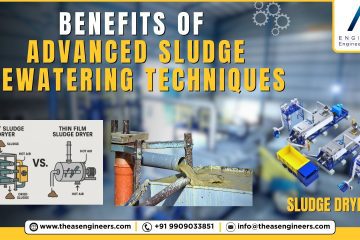
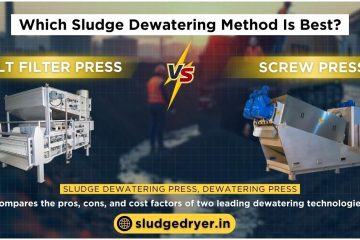
For plants comparing this stage, link to sludge dewatering techniques, advanced sludge dewatering benefits and sludge drying methods and systems.
STP, ETP, CETP and ZLD: What Is the Difference?
| Plant type | Full form | Wastewater handled | Best-fit explanation |
|---|---|---|---|
| STP | Sewage Treatment Plant | Domestic sewage from toilets, kitchens, bathrooms and buildings | Used for residential, commercial, institutional and municipal sewage |
| ETP | Effluent Treatment Plant | Industrial wastewater from manufacturing processes | Used in chemical, pharma, textile, food, dye, paper and similar industries |
| CETP | Common Effluent Treatment Plant | Effluent from multiple industries in a cluster | Useful where many small or medium units share treatment infrastructure |
| ZLD | Zero Liquid Discharge | High-reuse wastewater systems with no intended liquid discharge | Focuses on water recovery and solid residue handling |
| FSTP | Faecal Sludge Treatment Plant | Septage and faecal sludge from septic tanks | Used where sewer networks are limited or decentralized sanitation is needed |
For related topic clusters, connect this page to ETP effluent treatment plant guide, what is STP sewage treatment plant, CETP key concepts and zero liquid discharge guide.
Main Components of a Wastewater Treatment Plant
A wastewater treatment plant may include:
| Component | Role |
|---|---|
| Inlet chamber | Receives wastewater into the plant |
| Bar screen or fine screen | Removes large solids |
| Grit chamber | Removes sand, grit and heavy inorganic particles |
| Equalization tank | Balances flow and pollutant load |
| Oil and grease trap | Removes floating oil and grease |
| pH correction system | Controls acidity or alkalinity |
| Coagulation and flocculation tank | Helps remove suspended and colloidal particles |
| Primary clarifier | Settles heavier solids |
| Aeration tank or bioreactor | Supports biological treatment |
| Blowers | Supply air for biological treatment |
| Secondary clarifier | Separates biomass from treated water |
| Filters | Polish treated water |
| Disinfection system | Reduces pathogens before reuse or discharge |
| Sludge thickener | Concentrates sludge before dewatering |
| Dewatering machine | Reduces free water in sludge |
| Sludge dryer | Reduces additional moisture after dewatering |
| Pumps and transfer systems | Move water, sludge and chemicals |
| Instrumentation | Supports monitoring and control |
This component list should not be copied blindly into plant design. Actual design depends on influent quality, flow, treatment target, land, utility, sludge behavior and regulatory requirement.
Sludge Is Not a Side Issue in Wastewater Treatment
A plant may produce treated water successfully and still fail operationally if sludge handling is poor.
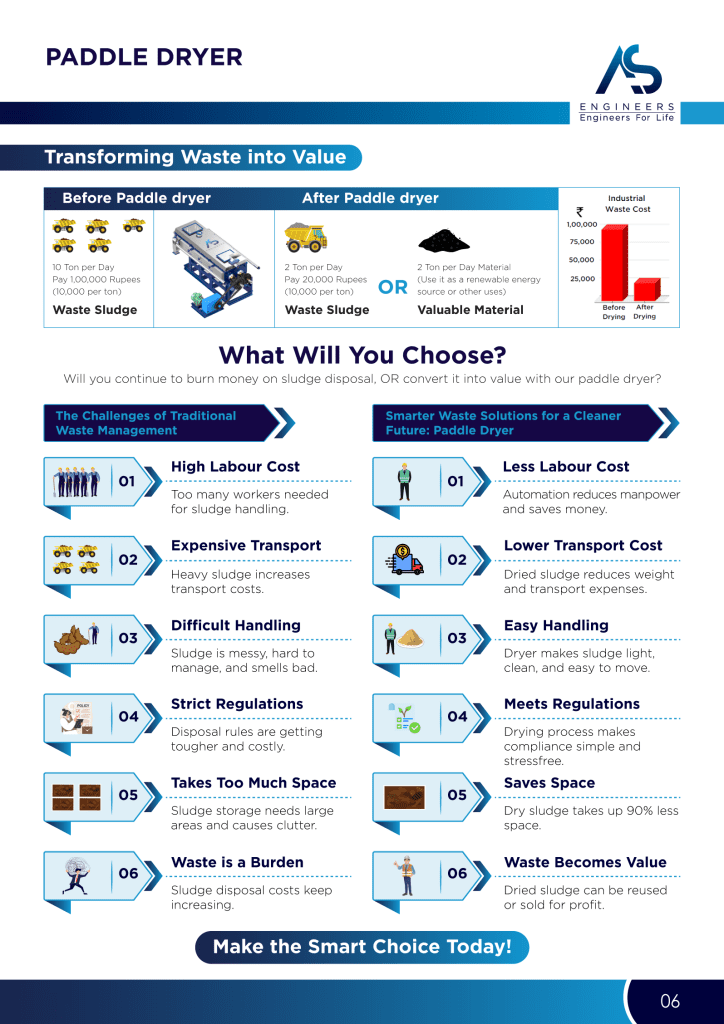
Wet sludge creates common problems:
- High disposal weight
- High transport cost
- Odour and hygiene concerns
- Storage space pressure
- Sticky handling
- Poor bagging and truck loading
- Vendor dependency
- Difficulty during monsoon or high-production periods
- Unclear final disposal or reuse route
This is why sludge should be planned from the beginning, not after commissioning.
For a broader cluster connection, use sludge management guide and industrial sludge disposal guide.
Where a Sludge Dryer Fits in a Wastewater Treatment Plant
A sludge dryer fits after thickening and mechanical dewatering. It does not replace the wastewater treatment plant, and it does not treat the liquid effluent directly.
Its role is to reduce moisture in dewatered sludge cake when the plant still has a disposal, storage, transport, handling or downstream reuse problem.
A simplified sequence is:
Wastewater treatment → sludge generation → thickening → dewatering → drying → final handling
A dryer becomes relevant when:
- Dewatered sludge is still too wet or heavy
- Disposal cost is strongly linked to weight or volume
- Storage area is limited
- Sludge is sticky, odorous or difficult to move
- The plant needs better bagging or truck handling
- A downstream route needs lower moisture
- Sludge volume is consistent enough to justify thermal drying review
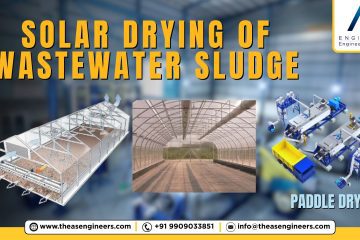
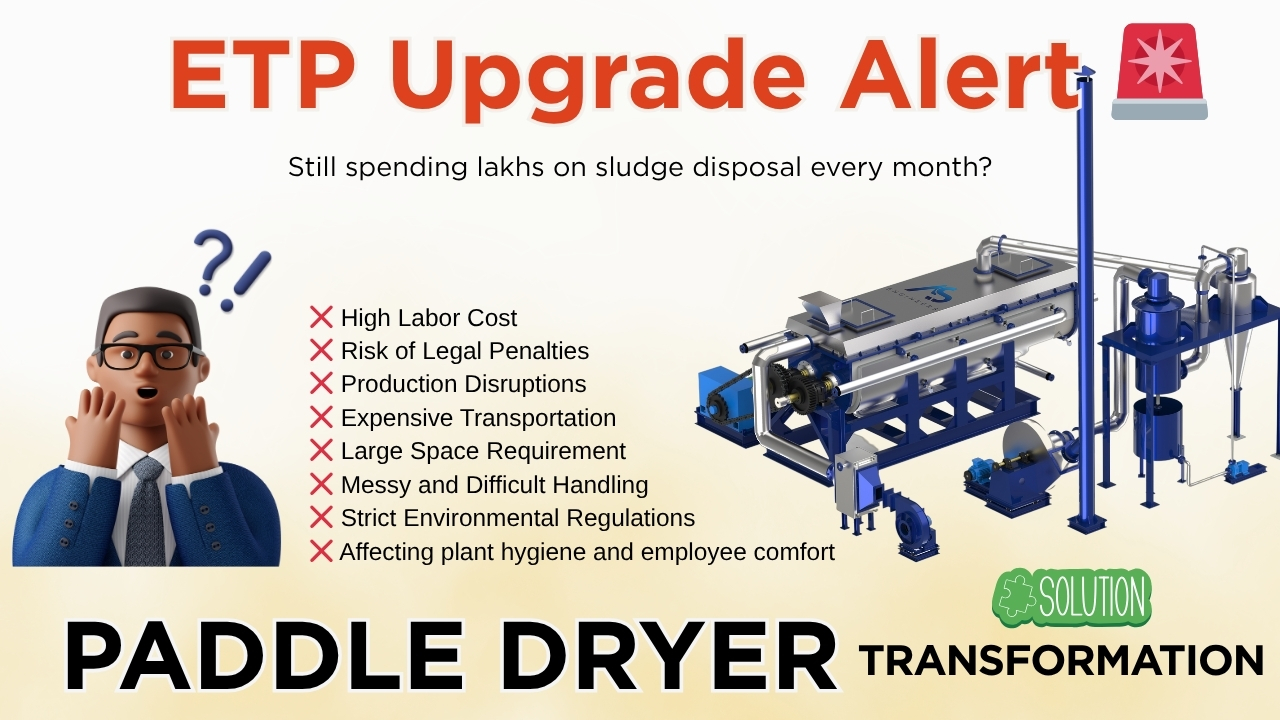
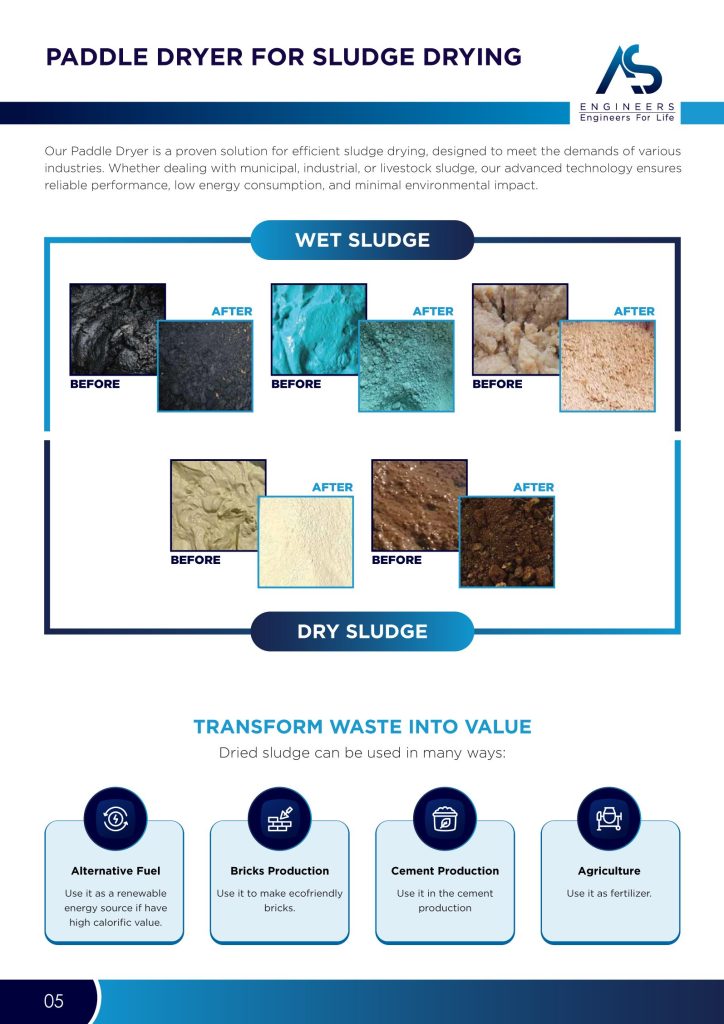
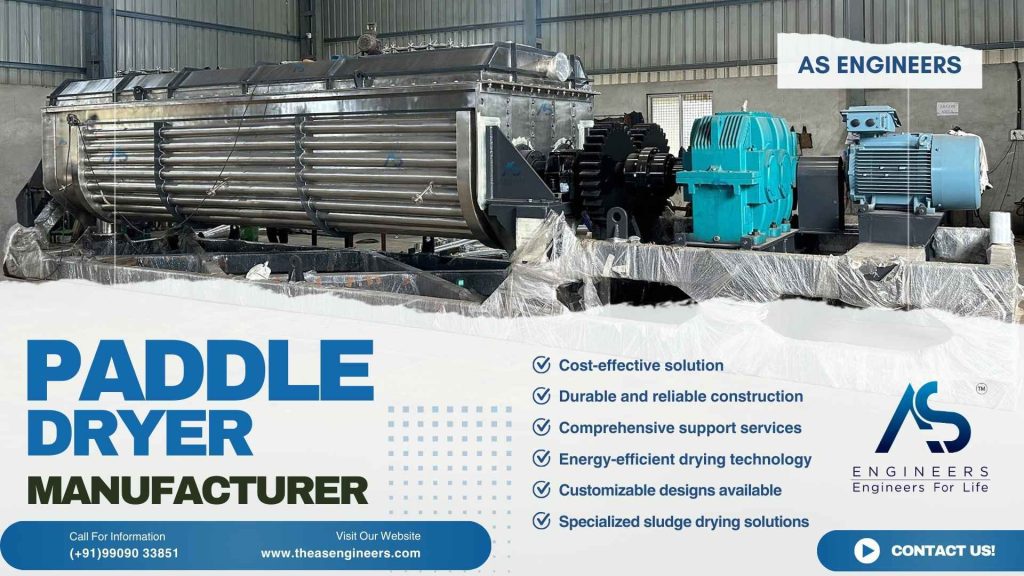
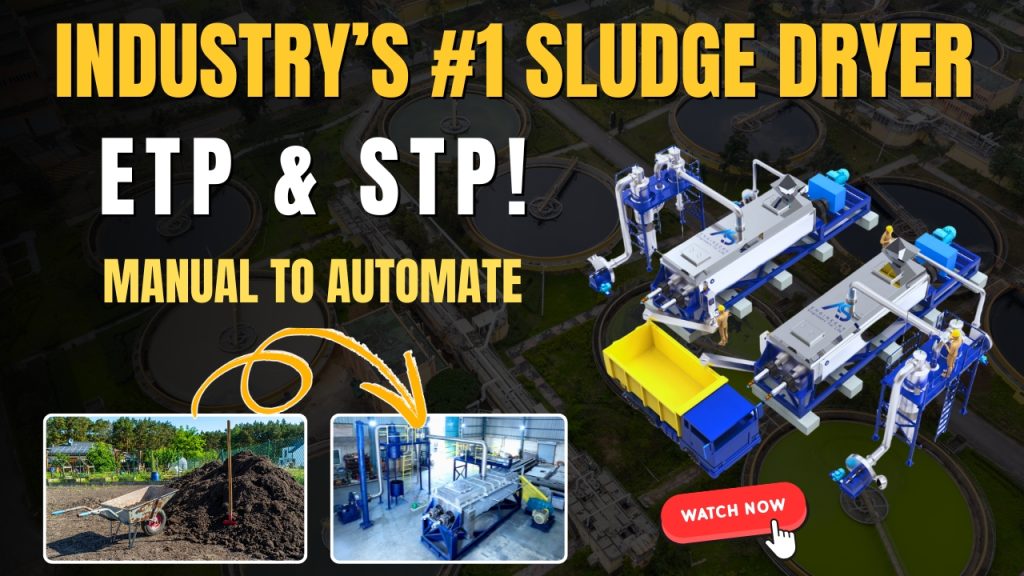
AS Engineers’ paddle dryer system uses indirect heat transfer through hollow shafts and jacket heating, with hammer or wedge paddles that agitate the feed and help remove bound moisture. The system configuration can include feeding, heating, scavenging, pollution control through cyclone, scrubber or bag filter, solvent or vapour management, and product handling.
Paddle Dryer Role in Wastewater Sludge Drying
For many ETP, STP and CETP sludge applications, a paddle dryer is considered because sludge is often wet, sticky, semi-solid or difficult to expose evenly to heat.
A paddle dryer can be useful where the plant needs:
- Indirect heat transfer
- Enclosed drying chamber
- Lower off-gas volume compared with many direct-contact systems
- Continuous mixing
- Controlled discharge
- Handling of pastes, cakes, slurries, powders or granules
- Integration with vapour and fines handling
AS Engineers’ catalogue states paddle dryer features such as indirect steam or thermal oil heating, flexible drying levels, feed handling for slurries, pastes, cakes, granules and powders, atmospheric/vacuum/pressurized design options, material options including CS, SS304, SS316 and Duplex Steel, self-cleaning paddles, plug flow mechanism and compact layout.
Do not select a sludge dryer only by tons per day. The dryer must be reviewed against feed moisture, final moisture target, sludge chemistry, stickiness, heating medium, vapour handling, dust/fines risk, MOC and final disposal or reuse route.
Wastewater Treatment Plant Selection Checklist
Before selecting or upgrading a wastewater treatment plant, prepare these inputs.
| Input | Why it matters |
|---|---|
| Average and peak flow | Avoids undersized tanks, pumps and aeration |
| Influent BOD, COD and TSS | Defines biological and physical treatment load |
| pH and temperature | Affects treatment chemistry and biological health |
| Oil and grease | Impacts screening, skimming and downstream treatment |
| TDS and salts | Important for reuse, RO, evaporator and ZLD planning |
| Heavy metals or toxic compounds | Can affect biological treatment and sludge disposal |
| Flow variability | Determines equalization requirement |
| Treated water target | Defines discharge, reuse or ZLD pathway |
| Sludge quantity | Sizes sludge thickening, dewatering and drying systems |
| Sludge moisture | Determines dewatering and dryer load |
| Sludge disposal route | Affects final moisture and handling system |
| Land availability | Impacts technology choice and layout |
| Utility availability | Steam, thermic fluid, power, fuel, compressed air and water |
| Operator skill level | Affects automation and maintenance planning |
Common Mistakes in Wastewater Treatment Plant Planning
Designing only around KLD or MLD
Flow capacity is important, but it is not enough. A 500 KLD plant treating domestic sewage is not the same as a 500 KLD plant treating textile, pharma, chemical or food-processing effluent.
Ignoring peak load
Many plants work during average flow but fail during shock load, batch discharge or cleaning cycles.
Treating sludge as an afterthought
Sludge storage, dewatering, drying and disposal should be part of the plant design. Otherwise, the plant may produce wet sludge faster than it can handle it.
Selecting a dryer without sludge testing
Sludge can behave as slurry, sticky paste, cake, lumps, powder or semi-solid mass. Testing helps avoid wrong assumptions about feed behavior, moisture target and discharge handling.
Underestimating blowers and pumps
Aeration blowers, sludge pumps, transfer pumps and recirculation pumps are not accessories. They directly affect uptime, treatment quality and maintenance cost.
Assuming dried sludge can always be reused
Dried sludge reuse depends on composition, receiving facility requirements and applicable regulations. Some sludge may be suitable for approved co-processing or reuse routes, while hazardous, high-metal, high-salt or unstable sludge may still require authorized disposal.
RFQ Checklist for Wastewater Treatment Plant and Sludge Dryer Review
Use this checklist before asking for a technical proposal.
| Category | Details to share |
|---|---|
| Wastewater source | STP, ETP, CETP, ZLD, process wastewater, sewage, mixed effluent |
| Flow data | Average flow, peak flow, operating hours, batch or continuous discharge |
| Influent analysis | BOD, COD, TSS, pH, oil and grease, TDS, colour, metals, nutrients |
| Treatment target | Discharge, reuse, RO feed, ZLD feed or process reuse |
| Existing system | Tanks, pumps, blowers, clarifiers, filters, dewatering system |
| Current problem | High COD, high TSS, odour, sludge volume, disposal cost, unstable biology |
| Sludge source | Primary, secondary, chemical, biological, mixed sludge, ZLD residue |
| Sludge quantity | Kg/day or tons/day after thickening or dewatering |
| Feed moisture | Moisture percentage after dewatering |
| Target moisture | Required final moisture or dryness objective |
| Sludge behavior | Sticky, pumpable, granular, fibrous, oily, corrosive, abrasive |
| Heating utility | Steam, thermic fluid, hot water, electricity, fuel availability |
| Vapour handling | Water vapour, solvent vapour, odour, fines, scrubber requirement |
| Final handling | Bagging, silo, conveyor, truck loading, disposal, co-processing, reuse |
| Site constraints | Space, height, access, foundation, utilities, operator access |
When a Sludge Dryer Is Not the First Step
A sludge dryer may not be the first discussion if:
- The wastewater treatment plant is not producing stable sludge
- Thickening is poor
- Dewatering equipment is not optimized
- Polymer dosing is wrong
- Sludge moisture varies too much
- The final disposal route is not decided
- The plant has not tested sludge behavior
- Fuel or heating utility is unavailable
- Vapour handling requirements are unclear
In those cases, fix the upstream sludge line first. Drying is strongest when the upstream treatment and dewatering stages are stable enough to feed the dryer consistently.
Practical Way to Upgrade an Existing Wastewater Treatment Plant
For an existing STP, ETP or CETP, do not start with a machine list. Start with a diagnostic review.
A practical review sequence is:
- Confirm actual influent and treated water data.
- Review hydraulic load and peak flow.
- Check screening, equalization and oil/grease removal.
- Review biological treatment stability.
- Check sludge generation and sludge withdrawal.
- Evaluate thickening and dewatering performance.
- Measure sludge moisture and disposal cost.
- Decide whether drying is technically and commercially justified.
- Review vapour, odour, fines and pollution-control needs.
- Prepare an RFQ with real plant data.
For sludge-side upgrades, connect this page to sludge pumps in wastewater treatment, sludge transfer pumps and sludge dewatering machine guide.
Conclusion
A wastewater treatment plant is not only a water-cleaning system. It is a complete treatment and solids-management system. The liquid line removes contaminants from wastewater, while the sludge line handles the solids generated during treatment.
For STP, ETP, CETP and ZLD-linked plants, sludge management should be designed early. Thickening, dewatering and drying affect disposal cost, storage space, hygiene, handling and long-term plant operation.
If your wastewater treatment plant is struggling with wet sludge weight, storage, odour, disposal cost or handling difficulty after dewatering, share your sludge quantity, feed moisture, target moisture, heating utility, disposal route and site layout. AS Engineers can review the sludge drying requirement and suggest a practical direction based on actual operating conditions.
FAQs
What is a wastewater treatment plant?
A wastewater treatment plant is a system that treats used water from domestic, commercial, municipal or industrial sources. It removes solids, organic load, suspended particles, oil, chemicals, pathogens or other contaminants depending on the plant design and treatment target.
What are the main stages of a wastewater treatment plant?
The main stages are preliminary treatment, primary treatment, secondary biological treatment, tertiary polishing or advanced treatment, disinfection and sludge handling. Sludge handling usually includes collection, thickening, dewatering, drying and final disposal or reuse.
What is the difference between STP and ETP?
An STP treats domestic sewage from toilets, bathrooms, kitchens, buildings and municipal systems. An ETP treats industrial effluent from manufacturing processes such as chemical, pharma, textile, food, dye, paper or similar industries.
Where does a sludge dryer fit in wastewater treatment?
A sludge dryer fits after sludge thickening and mechanical dewatering. It reduces additional moisture from dewatered sludge cake when the plant needs lower weight, easier handling, reduced storage burden or a specific downstream disposal or reuse condition.
Can dried sludge from a wastewater treatment plant be reused?
Sometimes, but not always. Dried sludge reuse depends on sludge composition, regulatory requirements, receiving facility specifications and safety conditions. Some sludge may be used in approved routes such as co-processing, cement, fuel, bricks or agriculture, while unsuitable sludge may still require authorized disposal.