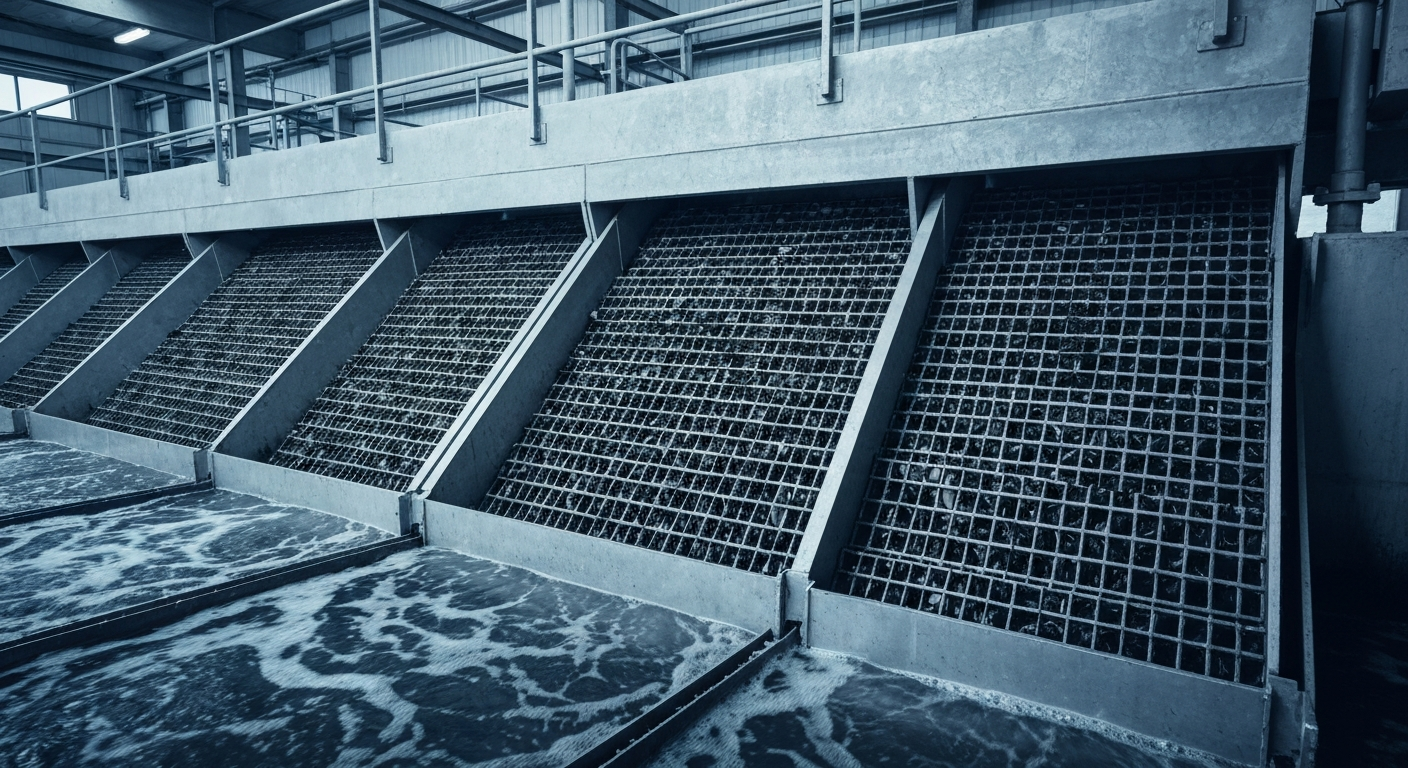
Coarse screens are the first physical protection step in many wastewater treatment plants. They remove large solids such as rags, plastics, sticks, leaves, bottles and stones before the flow reaches pumps, grit removal systems, biological treatment units and sludge handling equipment.
For STP and ETP plants, coarse screens do not “dispose of sludge” directly. Their real value is upstream protection. When screening is poor, downstream sludge handling becomes more difficult because pumps clog, channels overflow, solids escape into treatment units, and maintenance teams spend more time clearing avoidable blockages.
What Are Coarse Screens in Wastewater Treatment?
Coarse screens are screening devices installed near the inlet or headworks of a wastewater treatment plant. They usually use vertical or inclined bars with clear openings between the bars. Wastewater passes through the openings, while large floating and coarse solids are trapped on the screen face.
In practical terms, coarse screens protect:
- Inlet pumps
- Grit removal systems
- Equalization tanks
- Primary treatment units
- Aeration and biological treatment systems
- Sludge pumps and sludge handling equipment
- Downstream fine screens, membranes or sensitive treatment equipment
The Water Environment Federation describes headworks screening as a physical barrier that prevents debris from entering downstream processes where it can create operational and maintenance problems.
Why Coarse Screens Matter Before Sludge Handling
A common misunderstanding is that coarse screens are part of sludge disposal. They are not. They are part of preliminary treatment.
The difference matters.
| Stage | Main purpose | What it handles |
|---|---|---|
| Coarse screening | Remove large debris from incoming wastewater | Rags, plastics, sticks, stones, bottles, large floating solids |
| Grit removal | Remove heavy inorganic particles | Sand, grit, gravel, small heavy particles |
| Primary / biological treatment | Separate and treat organic load | Suspended solids, BOD/COD load, biomass |
| Sludge dewatering | Reduce water from generated sludge | Primary sludge, biological sludge, ETP/STP sludge |
| Sludge drying | Further moisture reduction and volume reduction | Dewatered wet sludge or sludge cake |
When coarse screening is weak, non-process solids can move forward and disturb the entire treatment line. In many plants, this appears as pump choking, rake jamming, high manual cleaning, uneven flow, and poor reliability in later sludge movement.
How Coarse Screens Work
A coarse screen works by forcing wastewater through a screen rack or bar rack. Large debris remains on the upstream side of the screen, while screened wastewater continues to the next treatment stage.
The cleaning method may be manual or mechanical.
Manual coarse screens are usually used in smaller plants or as standby/bypass screens. Operators remove trapped solids using a rake. This is simple, but it depends heavily on operator discipline and safe access.
Mechanically cleaned coarse screens use an automatic rake, chain, reciprocating mechanism or similar cleaning system to remove accumulated screenings. This is preferred where flow is higher, debris load is frequent, or manual cleaning creates safety and downtime concerns.
Coarse Screens vs Fine Screens vs Trash Racks
The right screen type depends on the kind of solids entering the plant and the protection needed downstream.
| Screen type | Typical role | Practical use |
|---|---|---|
| Trash rack | Removes very large debris | Logs, branches, stones, large floating objects in high-load inlet conditions |
| Coarse screen / bar screen | Removes large solids before treatment | Rags, plastics, sticks, bottles, leaves, large coarse solids |
| Fine screen | Removes smaller fibrous and suspended material | Wipes, hair, smaller solids, protection for sensitive downstream systems |
| Microscreen | Very fine polishing or advanced screening | Fine suspended solids, tertiary or specialized treatment duties |
WEF guidance classifies screens by opening size and notes that coarse screens are commonly used to remove coarse screenings such as rags, sticks, leaves, food particles, plastics and rocks.
Manual vs Mechanically Cleaned Coarse Screens
| Factor | Manual coarse screen | Mechanically cleaned coarse screen |
|---|---|---|
| Best fit | Small STP/ETP, standby channel, low debris load | Medium to large plant, high flow, frequent debris |
| Cleaning | Operator cleans with rake | Automatic rake or cleaning mechanism |
| Labour requirement | Higher | Lower routine manual intervention |
| Overflow risk | Higher if not cleaned on time | Lower when correctly designed and maintained |
| Safety concern | More operator exposure | Reduced manual handling, but mechanical safety controls needed |
| Capex | Lower | Higher |
| Reliability | Depends on operator discipline | Depends on mechanism, controls and maintenance |
For industrial plants, the decision should not be based only on initial cost. A low-cost manual screen can become expensive if it causes frequent pump choking, unsafe manual cleaning, or production-side wastewater disruptions.
Key Design Factors for Coarse Screens
Coarse screen selection should be done by a wastewater design engineer or EPC based on actual inlet conditions. The following points are important during design review.
| Design factor | Why it matters |
|---|---|
| Peak flow and average flow | Screen must handle hydraulic load without backing up the inlet channel |
| Debris load | Plants with rags, plastic, packaging waste or storm inflow need stronger screening |
| Bar spacing / clear opening | Too wide may allow harmful debris forward, too narrow may cause frequent blinding |
| Approach velocity | If too low, solids may settle before the screen; if too high, screen performance can suffer |
| Screen angle | Affects cleaning access, screen face area and installation footprint |
| Channel width and depth | Impacts hydraulic capacity and maintenance access |
| Bypass arrangement | Needed so the plant can operate during cleaning or breakdown |
| Material of construction | Corrosion, abrasion and wastewater chemistry must be considered |
| Cleaning control | Timer-based, level-based or differential head control changes operating reliability |
| Screenings handling | Captured material must be drained, compacted or safely transferred for disposal |
WEF operator guidance recommends asking design questions around approach velocity, overflow protection, screen capacity, screen cleaning water, cleaning controls and screen angle during screen review.
Common Problems Seen in Coarse Screens
When I review sludge handling issues, the problem is not always the dryer, pump or dewatering unit. Sometimes the root cause starts much earlier at the inlet screening stage.
Common coarse screen problems include:
- Screen blinding due to heavy rags, plastics or fibrous solids
- High headloss across the screen
- Overflow at inlet channel during peak flow
- Manual cleaning delays
- Mechanical rake jamming
- Corrosion of bars or frame
- Debris bypassing through damaged screen openings
- Poor screenings drainage
- Odour and hygiene issues around collected screenings
- Downstream pump choking despite screening
If these issues are ignored, the plant may still “run,” but operators lose time in cleaning, repairs, bypassing and emergency intervention.
Coarse Screen Maintenance Checklist
A coarse screen is a simple device, but poor maintenance can create major plant-side problems.
Use this checklist during routine inspection:
| Checkpoint | What to verify |
|---|---|
| Bar rack condition | Bent bars, broken bars, corrosion, uneven openings |
| Screen face | Accumulated rags, plastics, sacks, fibrous solids |
| Flow level | Excessive upstream water level or visible headloss |
| Cleaning mechanism | Rake travel, chain condition, motor operation, limit switches |
| Bearings and moving parts | Lubrication, abnormal noise, vibration, overheating |
| Drainage area | Screenings not lying in standing water |
| Safety guards | Covers, railings, warning signs and lockout points |
| Bypass channel | Available and not blocked |
| Odour and hygiene | Safe handling, PPE, washdown and cleaning practice |
| Record keeping | Cleaning frequency, breakdowns, peak-load incidents |
For mechanically cleaned screens, maintenance should include electrical control checks, alignment of cleaning parts, and inspection after high-debris events such as storms or abnormal industrial discharge.
What Happens to Screenings?
The material removed by coarse screens is called screenings, not sludge. Screenings normally contain plastics, rags, paper, wood, leaves, grit and other unwanted solids.
Screenings handling usually involves:
- Raking or mechanical removal from the screen face
- Draining excess water
- Washing or compacting where required
- Transfer to bins or containers
- Disposal according to applicable local rules and plant practice
Operators should not mix screenings with process sludge without checking the plant’s disposal plan. Screenings may contain plastics and inorganic debris that are not suitable for the same handling route as biological or industrial sludge.
Where Sludge Drying Fits After Coarse Screening
After coarse screening, wastewater moves through grit removal, primary or biological treatment, clarification, thickening and dewatering. The sludge produced from these stages is usually wet, heavy and difficult to transport.
This is where sludge drying becomes relevant.
A sludge dryer or paddle dryer is used after sludge generation and dewatering, not at the screening stage. Its purpose is to reduce moisture further, improve handling, reduce volume, and make the final material easier to transport, store or dispose of depending on sludge composition and regulatory route.
AS Engineers’ paddle dryer system uses indirect heat transfer through hollow shafts and jacket heating, with self-cleaning wedge-shaped paddles and mixing action. The catalogue also lists feed handling, heating, pollution control, solvent management and product handling as parts of the complete paddle dryer process flow.
Coarse Screening and Paddle Drying: The Correct Process Link
Coarse screens and paddle dryers are not competing technologies. They work at different points in the wastewater and sludge management chain.
| Equipment | Plant location | Main function |
|---|---|---|
| Coarse screen | Inlet / headworks | Remove large debris from incoming wastewater |
| Sludge pump | Sludge transfer line | Move sludge between thickening, dewatering or drying stages |
| Dewatering machine | Sludge handling area | Reduce free water and form sludge cake |
| Paddle dryer / sludge dryer | Final sludge reduction stage | Reduce moisture and volume of dewatered sludge cake |
Good screening helps protect the early treatment process. Good sludge drying helps reduce the final burden of wet sludge handling.
For related reading, see our guides on sludge dewatering techniques, sludge transfer pumps, and thermal sludge drying systems.
Selection Questions for STP and ETP Teams
Before selecting or upgrading a coarse screen, plant teams should answer these practical questions:
- What is the average and peak inlet flow?
- Is the plant municipal STP, industrial ETP, CETP, ZLD pretreatment, or process wastewater system?
- What type of debris enters the inlet chamber?
- Is there high ragging, plastic, packaging waste, fibre or storm inflow?
- Are pumps choking frequently?
- Is there a bypass channel?
- Is manual cleaning safe and realistic for the site?
- Is the screen protecting downstream fine screens, MBR, pumps or sludge handling equipment?
- Is there space for mechanical cleaning equipment?
- How will screenings be drained, compacted, stored and removed?
- What material of construction is suitable for the wastewater condition?
- Who will maintain the screen and how often?
For sludge drying review after the treatment stage, the RFQ should include feed moisture, final moisture target, sludge type, daily throughput, heating medium, operating hours, MOC expectation, vapour handling need and final disposal or reuse route.
Common Buyer Mistakes
Many STP and ETP problems become expensive because the early screening stage is treated as a small civil item instead of a reliability-critical unit.
Avoid these mistakes:
- Choosing bar spacing without downstream review
The spacing should protect pumps and treatment units without creating constant blinding. - No bypass channel
If the screen blocks or needs maintenance, the plant needs a safe operating route. - Ignoring screenings handling
Removing debris from water is only half the job. The captured material must be drained, stored and disposed of safely. - Using manual screens where debris load is too high
Manual cleaning may look cheaper, but it can increase labour, safety exposure and downtime. - Mixing screenings with sludge without review
Screenings and sludge are different waste streams. Their disposal route should be checked separately. - Blaming downstream sludge equipment for upstream screening failure
Repeated pump choking, fibrous solids and plastic carryover often begin at the screen.
Practical Plant Example
Consider an industrial ETP where operators complain about frequent sludge pump choking. The first reaction may be to change the pump or increase motor capacity. But if rags, plastics or fibrous pieces are passing through poor inlet screening, the pump is only receiving the problem created upstream.
A better review sequence is:
- Check inlet coarse screen condition
- Check bar spacing and damaged openings
- Check cleaning frequency and bypass condition
- Check grit and solids carryover
- Check sludge pump suction line and strainer
- Check dewatering feed consistency
- Review sludge drying only after upstream solids control is stable
This approach avoids wrong equipment blame and helps the plant solve the real bottleneck.
Coarse Screens in Industrial Wastewater Plants
Industrial ETP plants may face different screening conditions compared with municipal STPs.
| Industry / plant type | Screening concern |
|---|---|
| Textile and dyeing | Fibres, lint, threads, packaging pieces |
| Food processing | Organic pieces, peels, packaging, fat-related deposits |
| Pharma and chemical | Batch discharge variation, PPE pieces, packaging contamination |
| Paper and pulp | Fibrous material, paper pieces, pulp carryover |
| Dairy and beverage | Organic residues, packaging pieces, plastic waste |
| CETP | Mixed debris from multiple member units |
| Municipal STP | Rags, plastics, wipes, leaves, household solids |
For industrial plants, screening review should be linked with the full wastewater and sludge handling route. A screen that works for one site may not work for another site with different waste characteristics.
When to Upgrade a Coarse Screen
Consider upgrading or redesigning the coarse screening system when:
- Pumps choke frequently
- Operators clean the screen too often
- Inlet channel overflows during peak flow
- Downstream fine screens blind quickly
- Rags or plastics reach treatment tanks
- Manual cleaning is unsafe or unreliable
- Screen bars are corroded, bent or broken
- Debris load has increased after plant expansion
- A new MBR, fine screen, sludge pump or dewatering system is being added
Upgrading the screen may not directly reduce sludge volume, but it can improve the reliability of the treatment process that produces and handles sludge.
How AS Engineers Supports the Sludge Handling Stage
AS Engineers works in paddle dryer / sludge dryer systems, centrifugal blowers, pollution control equipment and turnkey support equipment. The company catalogue lists paddle dryer / sludge dryer, centrifugal blower, pollution control equipment and turnkey solutions as core product areas.
For sludge drying projects, AS Engineers reviews process-side inputs such as sludge type, feed moisture, final moisture target, heating medium, material behavior, vapour handling, pollution control requirement, and product handling method.
This is important because a sludge dryer should not be selected only by tonnage. Wet sludge behavior, stickiness, abrasiveness, organic/inorganic composition, heating route and final disposal plan all affect dryer configuration.
For deeper sludge drying selection, read our guide on how to choose a sludge paddle dryer and the paddle dryer configuration guide.
RFQ Inputs for Sludge Drying After Screening and Dewatering
When sharing a sludge dryer requirement, include:
| RFQ input | Why it matters |
|---|---|
| Sludge source | STP, ETP, CETP, pharma, chemical, textile, food, paper, refinery |
| Feed form | Slurry, wet cake, paste, sticky sludge, dewatered sludge |
| Feed moisture | Defines evaporation load |
| Required final moisture | Defines drying target and retention requirement |
| Daily throughput | Helps review dryer capacity |
| Operating hours | Impacts equipment sizing and duty cycle |
| Heating medium | Steam, thermic fluid, hot water or other site utility |
| MOC expectation | Depends on corrosion and sludge chemistry |
| Vapour handling | Needed for odour, solvent, moisture and emission control review |
| Disposal / reuse route | Landfill, TSDF, co-processing, fuel, brick, cement, fertilizer where permitted and suitable |
| Site constraints | Space, layout, feeding height, discharge handling, utility availability |
Do not finalize dryer sizing without material testing or proper duty data. For difficult sludge, pilot testing can reduce selection risk.
Frequently Asked Questions
What is the main purpose of coarse screens?
The main purpose of coarse screens is to remove large solids from incoming wastewater before it reaches pumps and downstream treatment equipment. They protect the plant from clogging, damage, overflow and avoidable maintenance.
Are coarse screens used for sludge disposal?
No. Coarse screens are used for preliminary wastewater screening. They remove screenings such as rags, plastics and sticks. Sludge disposal or sludge drying happens later after treatment, thickening and dewatering.
What is the difference between coarse screens and fine screens?
Coarse screens remove larger debris at the inlet stage. Fine screens remove smaller fibrous and suspended material and are often used to protect sensitive downstream systems such as advanced biological treatment or membrane-based systems.
Should an STP or ETP use manual or mechanical coarse screens?
Small plants or standby channels may use manual coarse screens. Medium and large plants, high-flow systems, and sites with frequent debris usually need mechanically cleaned screens to reduce manual cleaning and downtime.
How does coarse screening help sludge drying?
Coarse screening does not dry sludge directly. It helps by protecting the wastewater treatment process from large debris. A more stable treatment process supports smoother sludge pumping, dewatering and later sludge drying.
Conclusion
Coarse screens are not glamorous equipment, but they are one of the most important protection points in STP and ETP operation. A correctly selected and maintained coarse screen removes large debris before it can damage pumps, block channels, disturb treatment units or create sludge handling problems.
For plant teams, the right way to see coarse screening is simple: it protects the beginning of the wastewater process, while dewatering and sludge drying manage the final sludge burden.
If your plant is facing wet sludge disposal cost, difficult sludge handling, high transport load or inconsistent sludge cake after treatment, share the sludge type, feed moisture, final moisture target, throughput, heating medium and site condition. The AS Engineers team can review the sludge drying requirement and suggest a practical configuration based on actual duty data.