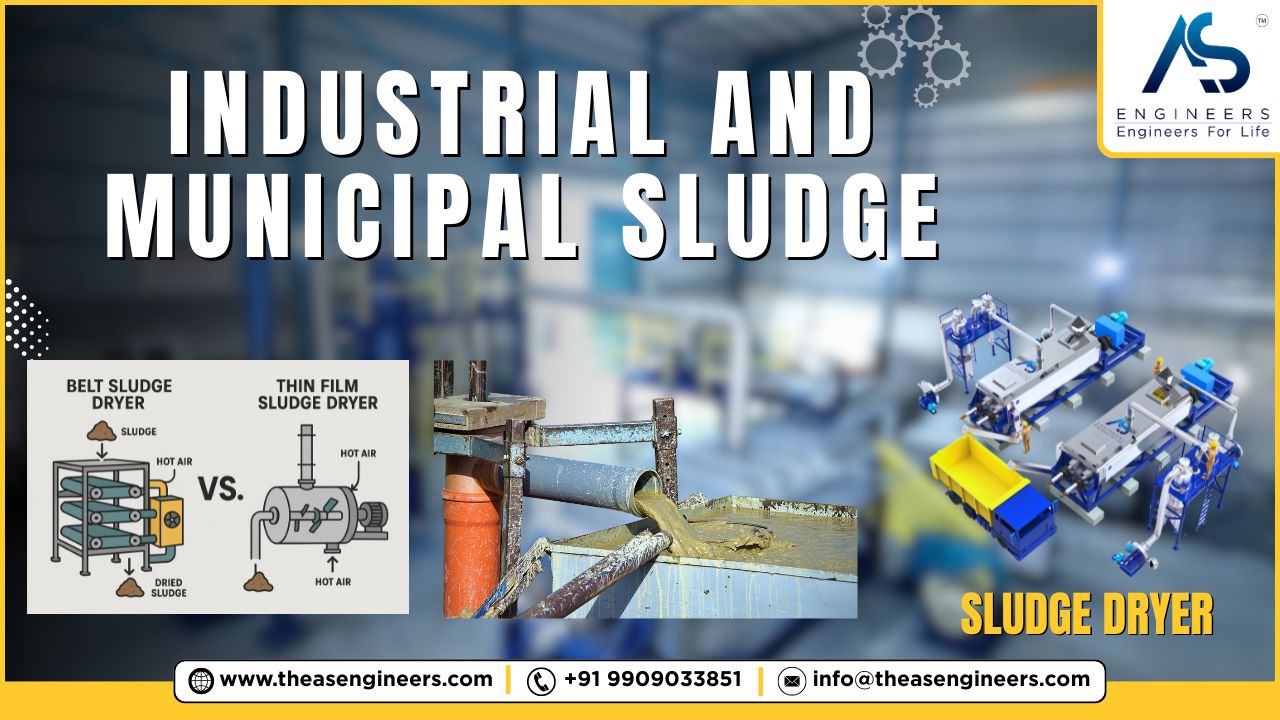
Industrial and municipal sludge management is the controlled handling of sludge from ETPs, STPs, CETPs and wastewater treatment plants through testing, thickening, dewatering, drying, transport, reuse or safe disposal. The correct route depends on sludge source, moisture level, chemical composition, pathogen risk, calorific value, local regulatory requirements and the final disposal or reuse plan.
For many plants, the real cost is not only “sludge disposal.” It is the cost of moving water, storing wet solids, managing odour, handling sticky cake, arranging transport, and keeping documentation ready for audits.
That is why sludge management should not start with a disposal vendor. It should start with sludge characterization and process planning.
What is industrial and municipal sludge?
Sludge is the semi-solid residue generated when wastewater treatment systems separate solids from water.
Industrial sludge usually comes from ETPs, process wastewater systems, ZLD plants, chemical processing, textile dyeing, pharma manufacturing, food processing, paper mills, refineries, metal finishing, agrochemical units and other industrial operations. Its risk level depends on the industry, chemicals used, heavy metals, solvents, salts, pH, oil and grease, and other contaminants.
Municipal sludge usually comes from STPs and sewage treatment systems handling domestic wastewater. It may include primary sludge, secondary biological sludge, digested sludge, faecal sludge or mixed sewage sludge depending on the treatment process.
For deeper background, read the dedicated guides on industrial sludge management and municipal sludge.
Industrial sludge vs municipal sludge
| Point | Industrial Sludge | Municipal Sludge |
|---|---|---|
| Main source | ETP, CETP, process wastewater, ZLD, chemical or manufacturing operations | STP, sewage treatment plant, municipal wastewater system |
| Typical concern | Chemicals, salts, heavy metals, solvents, oil, pH, process contaminants | Pathogens, odour, organic matter, nutrients, moisture, public health risk |
| Moisture challenge | Often sticky, variable, corrosive or difficult to dry | Often high moisture and biologically active |
| Testing priority | Hazardous classification, pH, heavy metals, COD, salts, oil and grease, volatile components | Pathogen risk, solids, nutrients, heavy metals, stability, odour |
| Reuse possibility | Depends strongly on composition and statutory acceptance | Possible only after treatment and testing, depending on local rules and end use |
| Drying role | Reduces moisture, weight, handling difficulty and transport burden | Reduces moisture, improves storage and may support selected disposal or reuse routes |
The mistake many plants make is treating every sludge as the same material. Sludge from a textile ETP, pharma ETP, paper mill, STP and CETP will not behave the same inside a dryer, during storage, or at final disposal.
Start with sludge testing, not equipment selection
Before selecting any sludge treatment or drying system, collect representative sludge samples and test the material.
Important parameters include:
- Wet sludge quantity per day
- Feed moisture or total solids
- pH
- Ash content
- Volatile solids
- Chlorides, sulphates or salts
- Oil and grease
- Heavy metals
- COD/BOD carryover where relevant
- Calorific value if fuel use is being explored
- Pathogen indicators for municipal or biological sludge
- Odour and volatile components
- Corrosive or abrasive behaviour
- Current dewatering output from filter press, centrifuge or screw press
For hazardous or chemically complex sludge, review the plant’s classification and disposal route with the relevant SPCB/PCC, EHS consultant, TSDF operator or approved laboratory. A dryer can reduce moisture, but it does not automatically change the legal classification of sludge.
Read more on hazardous sludge and chemical sludge treatment before finalizing the route.
The practical sludge management chain
A good sludge management system normally follows a sequence.
| Step | Purpose | Typical equipment or action |
|---|---|---|
| 1. Source identification | Know where sludge is generated | ETP, STP, CETP, clarifier, biological system, ZLD, process tank |
| 2. Characterization | Understand risk and handling behaviour | Lab testing, moisture testing, chemical analysis |
| 3. Thickening | Reduce free water before dewatering | Gravity thickener, DAF, sludge thickener |
| 4. Dewatering | Convert pumpable sludge into cake | Filter press, screw press, centrifuge, belt press |
| 5. Drying | Reduce remaining moisture and weight | Paddle dryer, sludge dryer, thermal dryer |
| 6. Vapour and fines control | Manage vapour, odour and entrained particles | Cyclone, scrubber, bag filter, condenser, ID fan, chimney |
| 7. Storage and handling | Keep dried material manageable | Screw conveyor, silo, bagging system, truck loading |
| 8. Disposal or reuse | Send material to approved route | TSDF, co-processing, fuel use, brick/cement/agriculture route where permitted |
Drying should normally come after reasonable thickening and dewatering. Sending very dilute sludge directly to thermal drying can increase fuel load and operating cost.
For equipment-stage selection, see sludge dewatering techniques and sludge dryer machine applications.
Where paddle drying fits in sludge management
A paddle dryer is useful when wet sludge cake remains heavy, sticky, costly to transport, difficult to store, or unsuitable for direct disposal because of moisture.
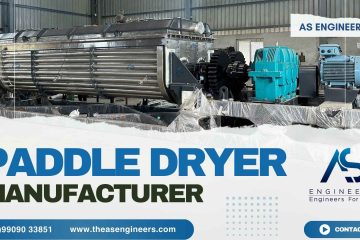
In an AS Engineers paddle dryer, heat transfers indirectly through hollow shafts and jacketed surfaces. Dual counter-rotating shafts and wedge-shaped paddles help mix, shear and expose sludge to heated surfaces. The sludge does not directly contact the heating medium.
This indirect drying approach is especially relevant when the buyer wants:
- Reduced moisture after mechanical dewatering
- Lower wet sludge transport load
- Better handling of sticky cake
- More controlled vapour handling than open drying
- Compact drying compared with open sludge drying beds
- A closed or semi-closed system with cyclone, scrubber, bag filter, condenser or chimney arrangement as required
- A custom dryer configuration based on sludge behaviour and utilities
For layout-level understanding, review the paddle dryer configuration guide.
When sludge drying is a good fit
Sludge drying is usually worth evaluating when one or more of these conditions are present:
| Situation | Why drying may help |
|---|---|
| Wet sludge disposal cost is high | Drying reduces water content and can lower transport/disposal burden |
| Long-distance transport is required | Lower moisture can reduce number of trips and leakage risk |
| Sludge storage area is limited | Drier sludge generally needs less space than wet sludge |
| Sludge is sticky and difficult to handle | Controlled drying can improve discharge and handling behaviour |
| Plant wants co-processing or fuel route | Calorific value and dryness must be checked first |
| STP sludge has odour and hygiene issues | Dewatering plus drying can improve storage discipline |
| ETP sludge is going to TSDF | Lower moisture can improve logistics, subject to acceptance conditions |
| ZLD sludge is increasing | Drying may support final volume reduction after evaporation/crystallization stages |
For ZLD-linked solids, read the guide on ZLD sludge.
When sludge drying may not be the first step
A dryer is not always the immediate answer. First check these conditions:
| Condition | Better first action |
|---|---|
| Sludge is too dilute | Improve thickening and dewatering first |
| Sludge composition is unknown | Test and classify before selecting equipment |
| Sludge has volatile solvents | Review condenser, vapour handling, explosion/fire safety and EHS requirements |
| Sludge is highly corrosive | Review MOC, pH, chlorides and operating temperature |
| Output reuse route is not approved | Do not assume dried sludge can be sold or reused |
| Feed rate is unstable | Stabilize upstream sludge generation and feeding |
| Final moisture target is unclear | Define disposal, storage or reuse requirement first |
| Plant has no space for vapour treatment | Review full system layout, not only dryer body |
This is why RFQ data matters. Motor HP or dryer length alone is not enough to select a sludge dryer.
Industrial sludge management: key plant-side risks
Industrial sludge can be more unpredictable than municipal sludge because every process generates different residues.
Important risk factors include:
- Heavy metals in chemical, metal finishing, dye, pigment or pharma waste
- High salt load in ZLD and chemical sludge
- Acidic or alkaline sludge pH
- Oil and grease in refinery, automotive and food sludge
- Solvent traces in pharma, chemical or coating applications
- Abrasive ash or mineral solids
- Odour and volatile release during heating
- Corrosion risk in contact surfaces, vapour ducts and pollution-control equipment
For industrial sludge, drying should be connected with classification, MOC selection, vapour management and final disposal acceptance.
A good RFQ should mention whether the sludge is from chemical, textile, pharma, food, paper, refinery, CETP, ZLD, metal finishing, dye intermediate, agrochemical or another process.
Municipal sludge management: key plant-side risks
Municipal sludge management has a different problem profile.
The main concerns are:
- High organic content
- Odour
- Biological activity
- Pathogen risk
- High moisture after dewatering
- Public handling sensitivity
- Land application restrictions
- Storage and transport hygiene
- Monsoon handling problems in open systems
Municipal sludge may have reuse potential only after proper treatment, testing and approval. Do not treat dried municipal sludge as fertilizer, fuel or construction material unless the composition, pathogen control, heavy metal level, and local acceptance route are confirmed.
For more details, see sewage sludge treatment.
Disposal and reuse options
The final route depends on sludge analysis and local acceptance.
| Route | Suitable when | Caution |
|---|---|---|
| TSDF or secured landfill | Hazardous or non-reusable industrial sludge | Classification and moisture acceptance matter |
| Municipal landfill or approved disposal | Non-hazardous sludge accepted by local rules | Avoid free liquid, odour and leachate issues |
| Co-processing or alternative fuel | Dried sludge has useful calorific value | Check heavy metals, chlorine, ash and end-user limits |
| Cement or brick route | Mineral/ash profile supports use | Needs buyer acceptance and regulatory clearance |
| Agriculture or soil use | Treated biosolids meet applicable criteria | Not suitable for contaminated or pathogen-risk sludge |
| Incineration | High-risk sludge requiring thermal destruction | Requires emissions control and ash disposal |
| Composting | Stable organic municipal sludge | Needs pathogen control, bulking material and monitoring |
A dryer supports moisture reduction. It does not automatically approve the final route. Final reuse or disposal must be decided through lab analysis and regulatory acceptance.
For compliance-oriented reading, see CPCB guidelines for hazardous waste disposal.
Cost planning for sludge drying
The cost of sludge management depends on four practical variables:
- How much water is present in the sludge.
- How far the sludge travels for disposal.
- What the disposal vendor charges by weight or volume.
- What fuel, steam or thermal oil cost is required for drying.
AS Engineers’ official sludge drying FAQ gives the following indicative fuel consumption basis for reducing sludge from 80% initial moisture to 20% final moisture:
| Fuel input | Indicative sludge dried |
|---|---|
| 1 kg wood | 5 kg sludge |
| 1 kg coal | 8.25 kg sludge |
| 1 Nm³ gas | 22.5 kg sludge |
| 1 kg LDO | 21 kg sludge |
Use this only as a starting reference. Real operating cost depends on sludge moisture, feed consistency, target final moisture, heating medium, dryer configuration, insulation, utility cost, vapour handling and operating hours.
RFQ checklist for industrial and municipal sludge dryer selection
Send these details before asking for a quotation:
| RFQ input | What to provide |
|---|---|
| Plant type | ETP, STP, CETP, ZLD, chemical, pharma, textile, paper, food, refinery or other |
| Sludge source | Primary, secondary, biological, chemical, mixed, filter press cake, centrifuge cake |
| Wet sludge quantity | kg/day, ton/day or m³/day |
| Operating hours | Batch/continuous requirement, hours per day |
| Feed moisture | Current moisture percentage or total solids |
| Final moisture target | Required outlet moisture or dryness |
| Sludge test report | pH, ash, volatile solids, heavy metals, salts, oil/grease, calorific value if needed |
| Current dewatering system | Filter press, screw press, centrifuge, belt press or none |
| Heating utility | Steam, thermic fluid, hot water, gas, coal, wood, LDO, electricity or available boiler |
| Vapour handling need | Cyclone, scrubber, bag filter, condenser, chimney, odour control |
| MOC preference | CS, SS304, SS316, duplex or other alloy based on corrosion risk |
| Discharge plan | Bagging, screw conveyor, silo, truck loading or disposal container |
| Final route | TSDF, landfill, fuel, cement, bricks, agriculture or other approved route |
| Site constraints | Space, height, foundation, power, pollution-control layout, access for maintenance |
This information helps avoid wrong sizing, wrong MOC, wrong vapour system, and unrealistic moisture targets.
Common sludge management mistakes
Mistake 1: Selecting equipment before testing sludge
Without a sludge test report, the buyer may miss corrosion, hazardous classification, volatile content or unrealistic moisture targets.
Mistake 2: Treating dewatering and drying as the same process
Dewatering removes free water mechanically. Drying removes more moisture using heat. Both stages have different operating costs and equipment logic.
Mistake 3: Ignoring vapour and odour handling
Drying produces vapour and may carry fines, odour or volatile components. The system may need cyclone, scrubber, bag filter, condenser, ID fan or chimney arrangement.
Mistake 4: Assuming dried sludge is automatically reusable
Reuse depends on composition and regulatory acceptance. Dry sludge can still be hazardous or unsuitable for reuse.
Mistake 5: Asking only for dryer price
The correct comparison is total sludge management cost: dewatering, drying, fuel, power, spares, labour, transport, disposal, maintenance and compliance documentation.
How AS Engineers supports sludge drying projects
AS Engineers manufactures paddle dryers, sludge dryers, centrifugal blowers and pollution-control equipment for industrial drying and fluid mechanics applications. For sludge drying systems, the typical engineering discussion includes feed system, paddle dryer configuration, heating medium, vapour handling, pollution-control equipment, discharge system and service access.
AS Engineers supports standard dryer, dual zone dryer and vacuum dryer configurations depending on the application. The system may include screw feeder, sludge pump, hollow shaft and jacket heating, cyclone, scrubber, bag filter, condenser, ID fan, chimney, screw conveyor, bagging system, silo or truck loading system depending on the project requirement.
For the main product page, visit paddle dryer manufacturer in India.
Practical selection advice from AS Engineers
When I review an industrial or municipal sludge drying requirement, I do not start with dryer size alone. I first ask for sludge source, daily quantity, current moisture, final moisture target, sludge test report, existing dewatering system, fuel or heating medium availability, vapour handling requirement, discharge plan and final disposal route.
If these details are missing, the quotation becomes a guess. If these details are clear, the dryer configuration, MOC, heating area, vapour handling and discharge system can be discussed with much better accuracy.
Conclusion
Industrial and municipal sludge management should be treated as a complete system, not a last-minute disposal activity. The correct approach starts with sludge testing, then moves through thickening, dewatering, drying, vapour handling, storage, transport and final disposal or reuse planning.
For ETP, STP and CETP teams, sludge drying becomes useful when wet sludge is increasing transport cost, storage burden, odour risk, hygiene issues or disposal difficulty. A paddle dryer can reduce moisture and improve handling, but the final route must always depend on sludge composition, site conditions and regulatory acceptance.
If you are planning sludge drying for an industrial ETP, municipal STP, CETP or ZLD plant, share sludge quantity, moisture, test report, current dewatering system, heating utility and disposal route. The AS Engineers team can review the requirement and suggest a dryer configuration based on real operating conditions.
FAQs
What is industrial and municipal sludge management?
Industrial and municipal sludge management is the process of testing, handling, thickening, dewatering, drying, storing, transporting, reusing or disposing of sludge generated from ETPs, STPs, CETPs and wastewater treatment plants. The correct method depends on sludge source, moisture, contaminants, pathogen risk, final route and local rules.
What is the difference between industrial sludge and municipal sludge?
Industrial sludge comes from manufacturing or process wastewater systems such as chemical, pharma, textile, paper, food, refinery, metal finishing or ZLD plants. Municipal sludge comes from sewage or STP systems. Industrial sludge usually needs stronger chemical and hazardous classification checks, while municipal sludge needs more attention to pathogen, odour and public-health risk.
Is sludge drying required after dewatering?
Not always. Dewatering may be enough if disposal cost, moisture level and handling are acceptable. Sludge drying becomes useful when dewatered cake is still too wet, heavy, sticky, odorous, expensive to transport or difficult to store. Drying should be evaluated after checking the current dewatering performance.
Can dried sludge be reused?
Dried sludge can sometimes be used as alternative fuel, in cement, bricks, composting or agriculture, but only when lab analysis and regulatory acceptance support that route. Drying reduces moisture; it does not automatically make sludge safe or legally reusable.
What information is required for a sludge dryer quotation?
A proper RFQ should include plant type, sludge source, wet sludge quantity, feed moisture, final moisture target, sludge test report, current dewatering method, heating utility, operating hours, vapour handling need, MOC requirement, discharge plan and final disposal or reuse route.