ZLD plant challenges in Dahej and Bharuch usually start with high-TDS wastewater, variable effluent chemistry, scaling, membrane fouling, high evaporation cost, skilled manpower needs, and final sludge disposal. A zero liquid discharge system may stop liquid discharge, but it does not remove the need to manage concentrated sludge, salts, MEE residue, ATFD output, and hazardous solid waste safely.
For industrial plants, the real question is not only “Do we need ZLD?” The better question is: Can our ZLD plant run reliably every day without choking membranes, overloading evaporators, increasing energy cost, or creating a difficult sludge disposal problem?
This guide explains the major ZLD plant challenges, where sludge drying fits, and what information your team should prepare before selecting a sludge dryer or paddle dryer for ZLD residue.
Quick answer: what are the biggest ZLD plant challenges?
The biggest challenges for ZLD plants are:
| ZLD challenge | What it affects | Plant-side risk |
|---|---|---|
| High TDS and salinity | RO, MEE, MVR, ATFD, crystallizer | Scaling, higher pressure, lower recovery |
| Variable wastewater chemistry | Pretreatment and dosing | Unstable performance and frequent adjustment |
| Oil, grease, suspended solids | Membranes and heat transfer surfaces | Fouling, choking, cleaning shutdowns |
| High energy demand | Evaporation and crystallization | Higher operating cost |
| Final sludge and salt residue | Storage, drying, transport, TSDF route | Higher disposal cost and handling issues |
| Corrosion and scaling | MOC, piping, heat exchanger, dryer | Maintenance and breakdown risk |
| Skilled operation | Daily ZLD control | Wrong dosing, poor monitoring, compliance risk |
| Compliance records | Consent, sampling, disposal manifest | Inspection and documentation gaps |
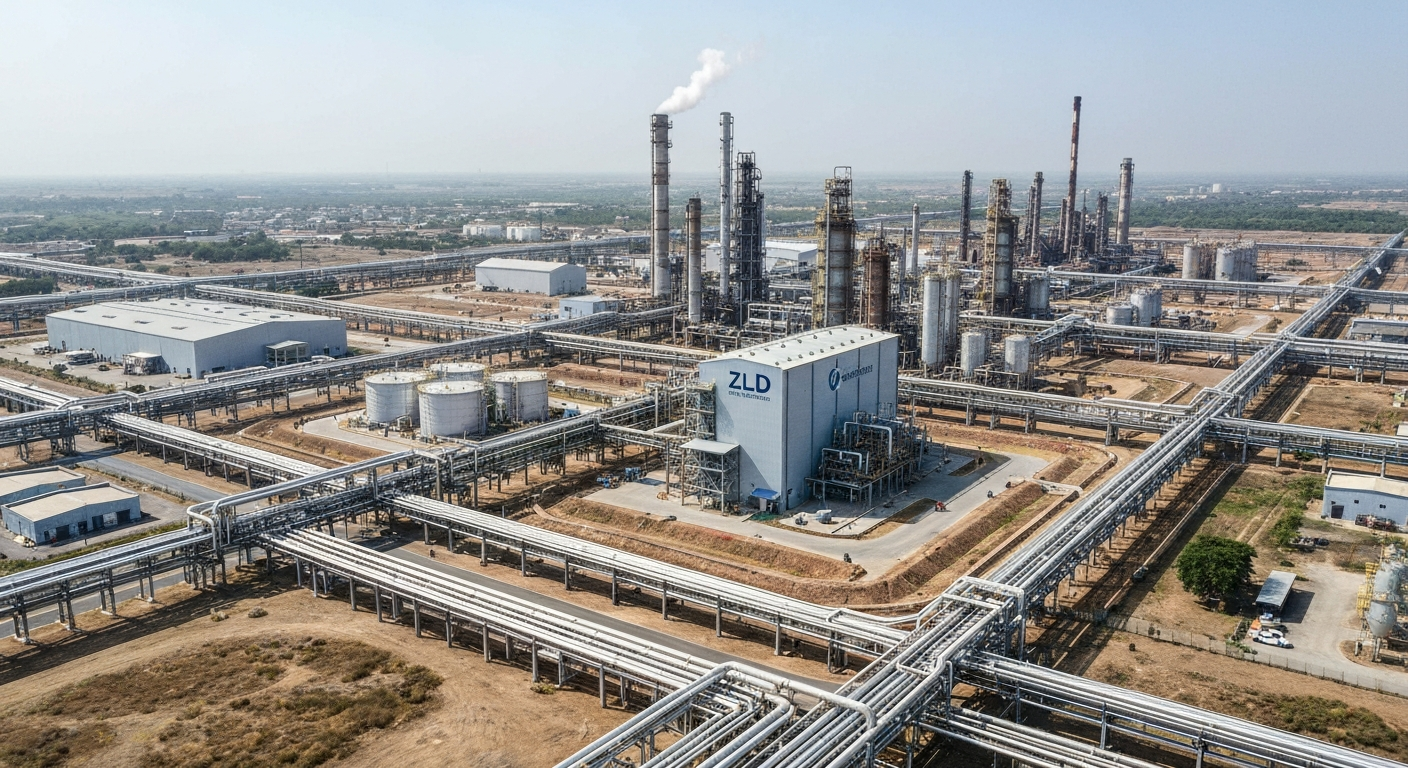
A ZLD plant should be reviewed as a complete chain: ETP → pretreatment → RO or membrane stage → evaporator/MEE/MVR → ATFD or crystallizer → sludge/salt handling → disposal or reuse route.
For a broader process explanation, see this zero liquid discharge guide.
Why ZLD plants in Dahej and Bharuch need careful design
Dahej and Bharuch are important industrial belts for chemical, pharmaceutical, dye, textile, petrochemical, specialty chemical and allied manufacturing units. Many of these plants handle wastewater that changes with production batch, raw material, washing cycle, cleaning chemicals, utilities and process load.
That variability creates three common issues:
- The ZLD plant may be designed for average wastewater, but the real plant receives shock loads.
- The liquid treatment side may work, but final wet residue becomes expensive to handle.
- The plant may meet discharge intent on paper, but daily records, sludge disposal route, MEE residue handling and operator discipline decide long-term reliability.
ZLD is not one machine. It is a connected system. A mistake in segregation, pretreatment, dosing, evaporation or sludge handling can affect the full chain.
Challenge 1: high TDS wastewater and mixed effluent streams
High total dissolved solids make ZLD difficult because salts become more concentrated at every recovery stage. As concentration increases, the plant faces higher osmotic pressure, higher scaling tendency and more stress on membranes, evaporators and crystallizers.
Common contributors include:
- Process washing water
- Mother liquor or process reject
- RO reject
- Boiler blowdown
- Scrubber bleed
- Cooling tower blowdown
- Chemical cleaning wastewater
- Floor washings
- High-COD or high-salt batch streams
The first practical step is stream segregation. Do not mix every wastewater stream blindly. High-strength streams, dilute streams, oily streams, acidic streams, alkaline streams and solvent-bearing streams may need different treatment logic.
If your team is still mapping ETP and wastewater basics, this effluent treatment plant guide will support the cluster.
Challenge 2: weak pretreatment before RO, MEE or ATFD
Pretreatment is where many ZLD plants win or fail. If suspended solids, hardness, oil, silica, heavy metals, organics or incompatible chemicals pass forward, downstream equipment becomes unstable.
A weak pretreatment stage can cause:
- RO membrane fouling
- Higher chemical cleaning frequency
- MEE scaling
- ATFD choking
- Corrosion in pipelines and contact parts
- Poor condensate quality
- Higher sludge load
- Shorter equipment life
Important pretreatment checks include pH correction, oil and grease removal, coagulation/flocculation, clarification, filtration, hardness control, silica control, COD reduction where required, and proper chemical dosing.
The key point: ZLD performance is not only decided by the evaporator or dryer. It starts from wastewater characterization and pretreatment discipline.
Challenge 3: scaling, fouling and corrosion
Scaling and fouling are among the most common ZLD plant challenges. Scaling can occur when calcium, magnesium, silica, sulfate, carbonate, chloride or mixed salts reach supersaturation. Fouling may come from suspended solids, organic load, oil, biomass, polymer carryover or poor filtration.
Corrosion risk increases when chloride, acidic conditions, alkaline conditions, temperature and poor MOC selection combine.
Plant teams should monitor:
- pH
- TDS
- TSS
- COD/BOD
- hardness
- chloride
- sulfate
- silica
- oil and grease
- conductivity
- temperature
- flow variation
- scaling index where applicable
For sludge dryer selection, corrosion and abrasion are not small points. They influence MOC, surface finish, shaft design, paddle design, vapour handling and maintenance planning.
Challenge 4: high energy cost in evaporation and crystallization
ZLD becomes more expensive near the final concentration stage because the remaining water is harder to remove. RO and membrane systems can recover a large portion of water depending on chemistry, but the final brine or reject often needs thermal treatment.
This is where plants face high energy demand from:
- MEE
- MVR
- ATFD
- crystallizer
- dryer
- hot air or steam systems
- thermic fluid systems
- auxiliary blowers, pumps and condensers
Energy cost is not only a machine issue. It depends on inlet moisture, feed temperature, concentration, heat recovery, insulation, duty cycle, steam/thermic fluid availability and plant operation discipline.
For sludge-side evaluation, review the thermal sludge drying system guide before finalizing equipment.
Challenge 5: final sludge, salt and residue disposal
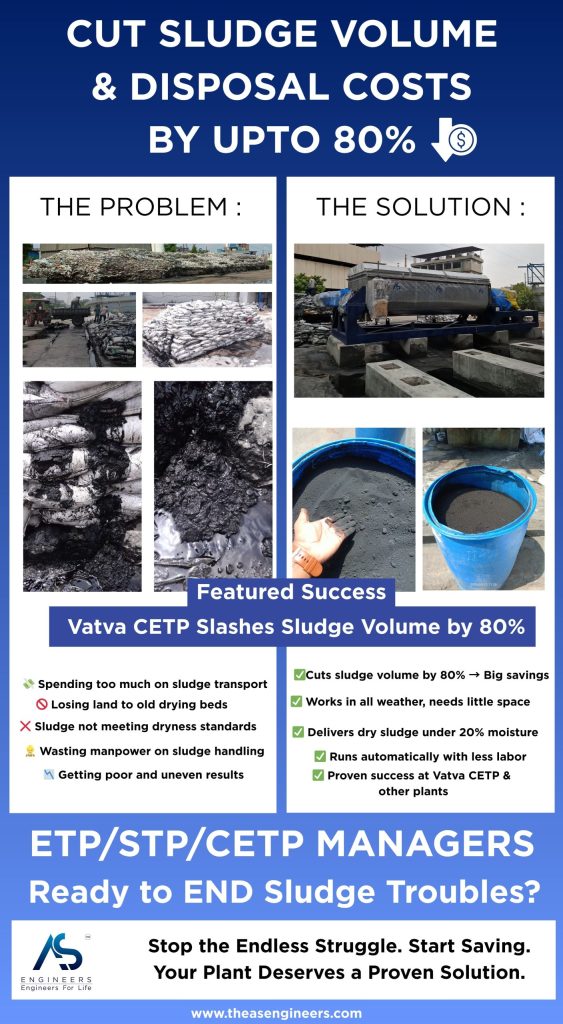
ZLD eliminates liquid discharge, but it creates a concentrated solid or semi-solid residue. This may include chemical sludge, mixed salts, ATFD residue, crystallizer solids, RO/MEE concentrate solids, biological sludge, or hazardous sludge depending on the plant.
This final residue creates practical problems:
- Wet sludge is heavy to transport.
- Sticky sludge is difficult to feed and convey.
- High moisture increases storage volume.
- Odour and hygiene can become a concern.
- Hazardous sludge may require strict disposal route control.
- TSDF transport and disposal cost can increase.
- Poor drying can create re-wetting, lumping or handling issues.
This is where a sludge dryer or paddle dryer can support the ZLD loop. The dryer does not replace ETP, RO, MEE, MVR, ATFD or crystallizer. It supports the final solid handling stage by reducing moisture and improving handling where the sludge is suitable for thermal drying.
Read more on ZLD sludge handling and industrial sludge disposal.
Where a paddle dryer fits in a ZLD plant
A paddle dryer is usually considered after dewatering, evaporation, concentration or residue generation, depending on the plant layout. It is useful when the final wet sludge or concentrated residue needs controlled indirect drying.
In a typical ZLD-related sludge drying duty, the plant may have:
- Wet sludge from ETP or chemical treatment
- Filter press cake
- Centrifuge cake
- MEE residue
- ATFD residue
- Salt-rich wet solids
- Concentrated industrial sludge
- Mixed organic/inorganic solids
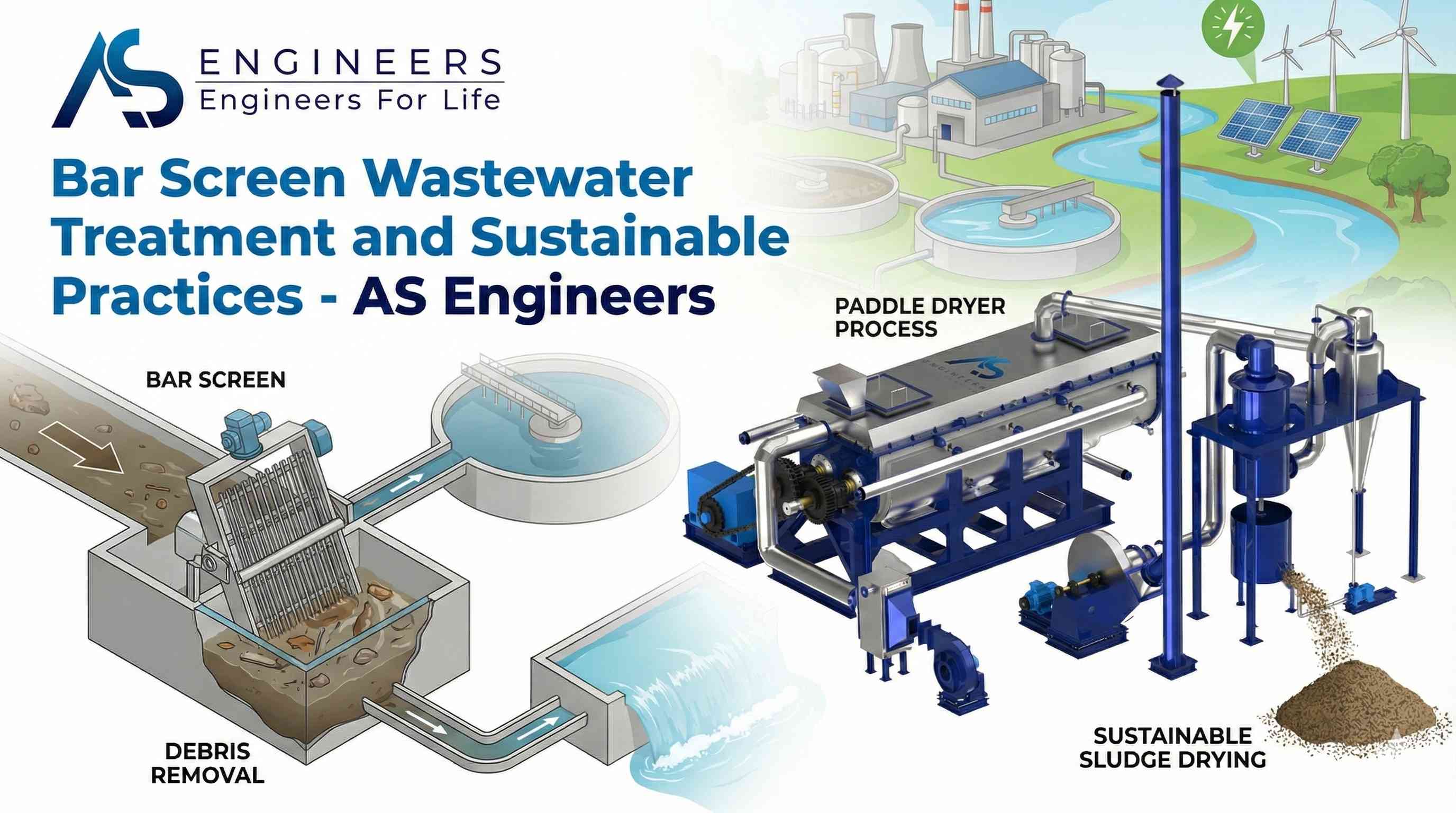
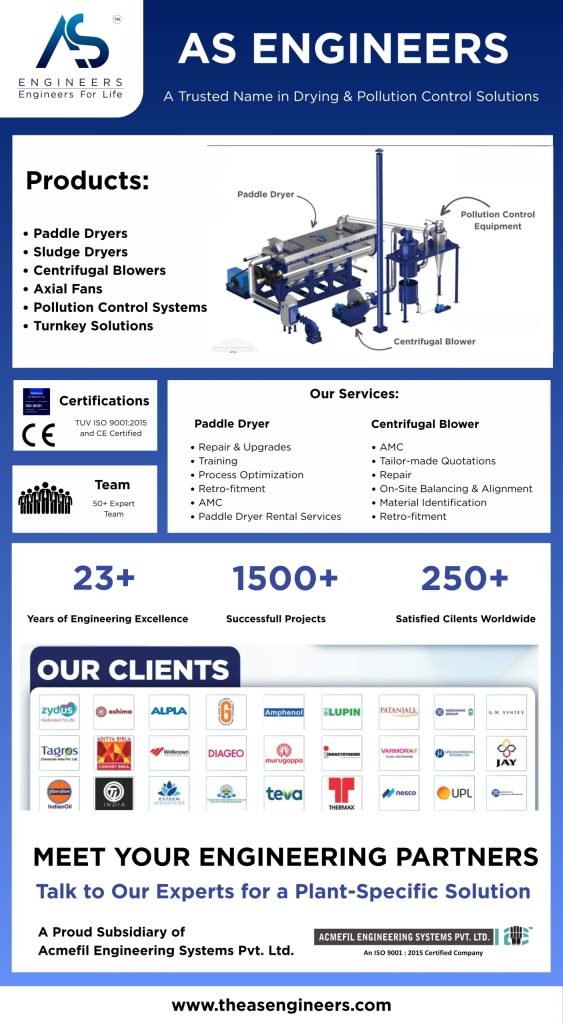
AS Engineers’ paddle dryer works on indirect heat transfer through hollow shafts and jacket heating. The catalog describes hollow shaft and jacket heat transfer, wedge-shaped paddles, dual counter-rotating shafts, plug flow, and configurations such as standard dryer, dual zone dryer and vacuum dryer.
The same source also lists heating options such as steam and thermic fluid, feed handling options, pollution-control equipment such as cyclone, scrubber and bag filter, and product handling options such as screw conveyor, bagging system, silo, bucket elevator and truck disposal system.
Paddle dryer fit and no-fit guide for ZLD residue
| Condition | Paddle dryer fit? | Practical note |
|---|---|---|
| Wet filter press cake from ETP | Often suitable | Trial is recommended for sticky or corrosive sludge |
| High-moisture chemical sludge | Often suitable | MOC and vapour handling must be reviewed |
| Salt-rich ATFD residue | Conditional | Abrasion, scaling and discharge behaviour must be tested |
| Solvent-bearing residue | Conditional | Needs vapour, condensation, safety and EHS review |
| Highly corrosive chloride stream | Conditional | MOC selection is critical |
| Explosive, reactive or unstable material | Not direct approval | Requires specialist safety review before any drying decision |
| Very low moisture dry powder | May not be needed | Conveying or cooling may be more relevant |
| Unknown composition sludge | Do not finalize | First test moisture, solids, pH, chloride, organics and hazard class |
For comparison of available methods, refer to sludge drying methods and best practices.
Challenge 6: regulatory and documentation pressure
For ZLD plants in Gujarat, compliance is not only about installing equipment. The plant must maintain operating records, analysis reports, flow data, sludge disposal records, hazardous waste documentation where applicable, and evidence that treated/recovered water is reused or managed as approved.
Plant teams should regularly verify requirements from official sources such as:
Do not rely only on old consultant notes or generic internet articles. Consent conditions, sector-specific directions, hazardous waste requirements and local inspection expectations can change.
For related disposal awareness, read CPCB guidelines for hazardous waste disposal and TSDF site standards.
Challenge 7: operator skill and daily monitoring
ZLD systems need trained operators. Even a well-designed plant can fail if operators do not understand flow control, dosing, pH correction, membrane cleaning, evaporator operation, residue discharge, dryer feeding and safety checks.
Training should cover:
- Effluent segregation
- Chemical dosing logic
- pH and conductivity monitoring
- RO cleaning triggers
- MEE/MVR/ATFD operating parameters
- Sludge dryer feed consistency
- Dryer discharge observation
- Vapour and condensate handling
- Emergency response
- Record keeping for audits and inspections
A daily ZLD log should not be treated as paperwork only. It is the first warning system for scaling, fouling, moisture variation and residue handling problems.
Challenge 8: wrong equipment selection from incomplete RFQ data
Many ZLD sludge drying problems start during purchase. The supplier receives only “sludge quantity” and “moisture,” but the real duty needs much more information.
Before asking for a sludge dryer quotation, prepare:
| RFQ input | Why it matters |
|---|---|
| Sludge source | ETP, RO reject, MEE residue, ATFD residue, filter press cake, centrifuge cake |
| Feed quantity | Hourly and daily load |
| Initial moisture | Determines heat load |
| Target final moisture | Affects dryer size and residence time |
| Bulk density | Affects feeding and discharge |
| Stickiness and phase behaviour | Affects paddle design and cleaning |
| pH and corrosive content | Affects MOC |
| Chloride/sulfate/silica/salt content | Affects scaling, corrosion and abrasion |
| Organic content/COD | Affects vapour handling and odour |
| Hazard classification | Affects safety and disposal route |
| Heating medium | Steam, thermic fluid, hot water or other available utility |
| Vapour handling need | Scrubber, condenser, cyclone, bag filter, ID fan |
| Disposal or reuse route | TSDF, co-processing, internal reuse, approved end use |
| Available space | Affects layout and auxiliary equipment |
| Operating hours | Affects capacity selection |
AS Engineers also supports paddle dryer pilot trials, with the catalog mentioning a 50 kg/hr pilot trial machine for demonstrations and trial objectives such as performance evaluation, issue identification, process optimization and feasibility assessment.
Common mistakes in ZLD sludge drying projects
Avoid these mistakes before final purchase:
- Selecting dryer size from wet sludge quantity only
Moisture, solids behaviour, heat sensitivity and final moisture target are equally important. - Ignoring MOC selection
High chloride, acidic or alkaline sludge can create corrosion risk. - Not testing sticky sludge
Some sludge changes from paste to lump to powder during drying. Trial data helps reduce surprises. - Forgetting vapour handling
Drying may release water vapour, odour, fine particles or solvent vapour depending on sludge composition. - Treating ZLD sludge as uniform
Chemical sludge, biological sludge, MEE residue and salt-rich sludge behave differently. - Assuming drying automatically means reuse
Reuse depends on composition, legal permission, calorific value, contamination, buyer acceptance and disposal approvals. - Not planning maintenance access
Paddle shaft access, gearbox maintenance, bearing access, cleaning points and safe shutdown procedure matter.
Practical diagnostic checklist for existing ZLD plant problems
Use this checklist when the ZLD plant is running but sludge handling is becoming costly:
| Symptom | Possible cause | What to check |
|---|---|---|
| RO cleaning frequency increased | Fouling or scaling | Pretreatment, SDI, hardness, oil and grease, dosing |
| MEE scaling | Inadequate softening or high silica/salts | Feed chemistry, antiscalant, blowdown, cleaning records |
| ATFD residue too sticky | Moisture or solids behaviour | Feed consistency, temperature, scraper operation |
| Sludge dryer discharge uneven | Feed variation or wrong residence time | Feed rate, moisture, paddle condition, heating medium |
| High fuel/steam consumption | High moisture load or poor heat transfer | Feed moisture, insulation, condensate recovery, scaling |
| Odour near sludge storage | Wet sludge holding time | Dryer scheduling, storage cover, vapour handling |
| Disposal cost increasing | High final moisture or volume | Dewatering, drying target, disposal route, TSDF records |
When AS Engineers can help
AS Engineers can review sludge drying requirements for ZLD plants when the final residue needs moisture reduction, better handling, lower transport burden or more controlled disposal preparation.
Share these inputs for a technical discussion:
- Industry and location
- Sludge source and process stage
- Feed quantity per hour/day
- Initial and target moisture
- Sludge composition report
- pH, chloride, TDS, organics and hazard class
- Current dewatering method
- Heating medium available
- Existing pollution-control setup
- Desired handling route after drying
- Photos or videos of sludge behaviour
- Space and layout limitations
For ZLD-related paddle dryer context, you can also review AS Engineers’ ecosystem page on paddle dryer in ZLD plant.
Frequently asked questions
What are the main challenges for ZLD plants?
The main ZLD plant challenges are high TDS wastewater, scaling, membrane fouling, variable effluent chemistry, high evaporation energy cost, corrosion, skilled operation needs, compliance documentation and final sludge or salt residue disposal.
Why does sludge disposal remain a problem if the plant is already ZLD?
ZLD removes liquid discharge, but the contaminants remain as sludge, salts, concentrate or residue. This final solid or semi-solid material still needs safe drying, storage, transport, disposal, co-processing or approved reuse depending on its composition and legal category.
Is a paddle dryer always suitable for ZLD sludge?
No. A paddle dryer is suitable only when the sludge or residue behaviour, moisture, chemistry, corrosiveness, thermal stability and vapour handling requirement fit the dryer design. Sticky, corrosive, solvent-bearing or hazardous materials need careful review and, where possible, pilot testing.
What data is needed before selecting a sludge dryer for a ZLD plant?
You should provide feed quantity, initial moisture, target final moisture, source of sludge, chemical composition, pH, chloride, salt content, hazardous classification, available heating medium, vapour handling need, operating hours and final disposal route.
Can dried ZLD sludge be reused?
Sometimes, but not automatically. Reuse depends on composition, contamination level, calorific value, regulatory permission, industry acceptance and final application. Do not claim reuse until lab data, legal route and buyer/end-use approval are confirmed.
Conclusion
ZLD plant challenges in Dahej and Bharuch are not limited to RO, MEE, ATFD or crystallizer selection. The final sludge and residue handling stage can decide whether the plant remains practical, compliant and cost-controlled over time.
A good ZLD strategy should connect wastewater characterization, stream segregation, pretreatment, water recovery, evaporation, residue concentration, sludge drying, vapour handling, disposal documentation and maintenance planning.
If your ZLD plant is struggling with wet sludge, sticky residue, high disposal volume or difficult handling, share your sludge data, moisture target, heating medium and disposal route with AS Engineers. The team can review whether a paddle dryer or another sludge drying approach fits your actual operating condition.