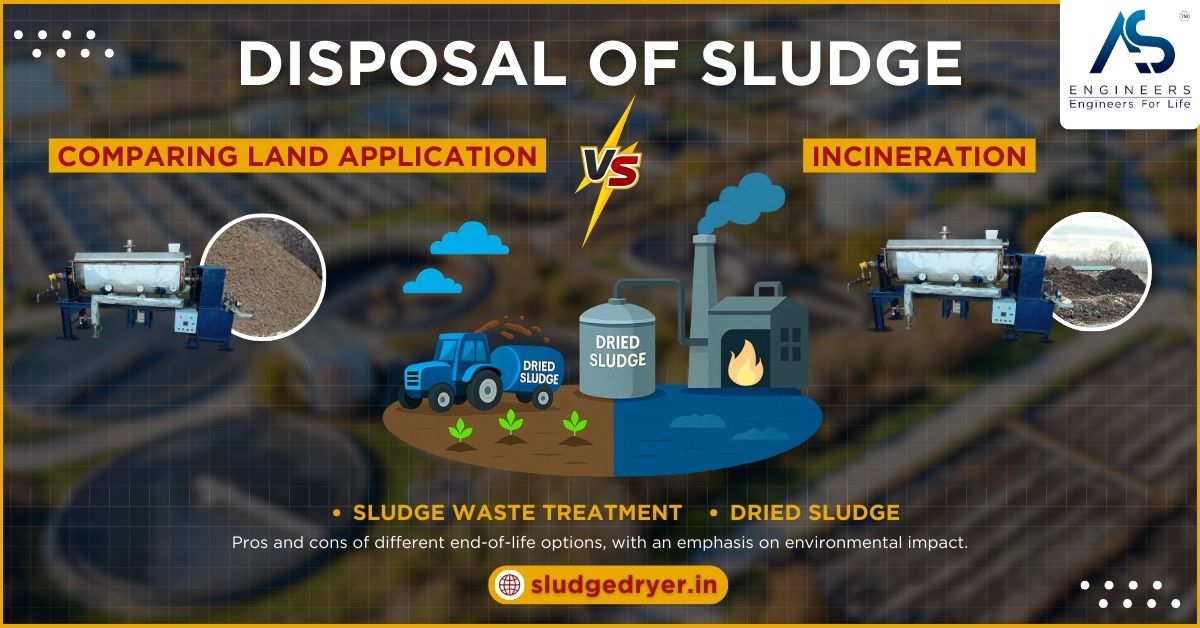
Disposal of sludge should not be decided only by what looks cheaper on paper. Land application can be useful when treated sludge is safe, nutrient-rich, tested, and approved for soil use. Incineration can be suitable when sludge is contaminated, difficult to reuse, or needs major volume reduction. For many STP, ETP, CETP, and industrial plants, the practical decision starts before disposal, with dewatering, drying, testing, and safe handling.
In my view, the real question is not simply “land application or incineration?” The better question is: what is the sludge made of, how much moisture does it contain, what risk does it carry, and which final route is legally and practically acceptable?
What disposal of sludge means
Disposal of sludge is the final handling or use of treated sludge after wastewater treatment, thickening, dewatering, stabilization, drying, or other preparation steps.
In wastewater treatment, sludge may come from:
- STP plants handling domestic sewage
- ETP plants handling industrial effluent
- CETP facilities handling mixed industrial wastewater
- Food, pharma, chemical, textile, paper, dye, petroleum, refinery, and agrochemical plants
- Biological treatment systems, clarifiers, filter presses, decanters, and sludge drying systems
Before final disposal, sludge normally needs evaluation for moisture, organic content, pathogens, heavy metals, salts, pH, hazardous contaminants, calorific value, odour, leachability, and handling behaviour.
For a wider background on sludge treatment routes, see our guide on sludge treatment and disposal.
Quick answer: land application vs incineration
| Factor | Land application | Incineration |
|---|---|---|
| Basic idea | Treated sludge is applied to land as soil conditioner or nutrient source | Sludge is thermally treated to destroy organics and reduce volume |
| Best suited for | Stable, tested, nutrient-rich, low-contaminant biosolids | Contaminated, restricted, high-risk, or non-reusable sludge |
| Main benefit | Nutrient recycling and organic matter return | High volume reduction and pathogen destruction |
| Main risk | Soil contamination, odour, runoff, public resistance, long-term pollutant build-up | Air emissions, ash disposal, high energy demand, pollution-control requirement |
| Moisture sensitivity | Wet sludge increases transport and spreading difficulty | Wet sludge increases energy load and auxiliary fuel demand |
| Testing need | Very high, especially metals, pathogens, nutrients, and emerging contaminants where relevant | Very high, especially calorific value, ash, chlorine, sulphur, metals, and air-emission risk |
| Industrial ETP fit | Limited, only if sludge is proven safe and permitted | Often more relevant for restricted or contaminated streams, subject to approved route |
| Drying relevance | Improves handling and transport, but does not make unsafe sludge suitable for soil | Improves combustion efficiency and reduces water load before thermal treatment |
Land application of sludge
Land application means spreading, incorporating, injecting, or otherwise applying treated sludge to land for soil improvement, crop nutrient value, reclamation, or similar approved beneficial use.
This route is usually discussed for biosolids, not raw sludge. The sludge must be treated, stabilized, tested, and acceptable under applicable rules before it can be used on land.
Land application can make sense when the sludge has:
- Useful organic matter
- Nitrogen and phosphorus value
- Low heavy-metal concentration
- Controlled pathogens
- Acceptable odour profile
- Low industrial contamination risk
- Suitable moisture and texture for handling
- Approved land, crop, and application conditions
For more on biosolids and reuse thinking, read biosolid: turning waste into valuable resources.
Benefits of land application
Land application is attractive because it can convert treated sludge from a disposal burden into a resource.
The main benefits are:
| Benefit | Why it matters |
|---|---|
| Nutrient recycling | Treated sludge may return nitrogen, phosphorus, and micronutrients to soil |
| Soil organic matter | Organic material can improve soil structure when the sludge is safe and properly applied |
| Lower final-disposal pressure | Less dependence on landfill or incineration when reuse is permitted |
| Circular economy fit | Useful where sludge quality, land availability, and acceptance support reuse |
| Lower thermal-treatment demand | Avoids combustion when the sludge is suitable for beneficial use |
Land application is not automatically the “greenest” option. It is beneficial only when the sludge quality, land conditions, application rate, monitoring system, and local approval are strong enough.
Limitations of land application
Land application becomes risky when the sludge contains contaminants that can accumulate in soil or move into water.
Important concerns include:
- Heavy metals such as lead, cadmium, chromium, mercury, nickel, copper, and zinc
- Industrial chemicals from mixed effluent streams
- High salts or unsuitable pH
- Pathogens if treatment is incomplete
- Pharmaceutical residues and personal care chemicals
- PFAS or other persistent contaminants where relevant
- Microplastics
- Odour and vector attraction
- Runoff during rain
- Public resistance near agricultural or residential areas
For industrial ETP sludge, land application should be treated with extra caution. Chemical, pharma, dye, textile, tannery, refinery, metal-finishing, and agrochemical sludge can contain constituents that make land use unsuitable unless testing and regulatory approval clearly support it.
For hazardous or restricted streams, also review CPCB guidelines for hazardous waste disposal and TSDF site standards.
Incineration of sludge
Incineration is the controlled thermal treatment of sludge in an enclosed system. It destroys much of the organic fraction, reduces sludge volume, and converts remaining inorganic material into ash.
Incineration may be considered when:
- Sludge is not suitable for land application
- Land availability is limited
- Sludge has biological or contamination risk
- High volume reduction is required
- The facility has access to an approved incineration or co-processing route
- Air-pollution-control and ash-disposal systems are properly planned
- Sludge has adequate dryness or can be dried before thermal treatment
Incineration is not just “burning sludge.” It needs controlled feed preparation, combustion control, flue-gas treatment, ash handling, monitoring, maintenance, and regulatory approval.
Benefits of incineration
| Benefit | Why it matters |
|---|---|
| Major volume reduction | Final material for disposal is much lower than wet sludge volume |
| Pathogen destruction | Thermal treatment can destroy biological hazards when properly operated |
| Useful for restricted sludge | Suitable where land application is not allowed or not safe |
| Year-round operation | Less dependent on weather and agricultural season |
| Energy recovery potential | Possible when system design, sludge dryness, and calorific value support it |
Incineration can be a practical route for municipal and industrial sludge where reuse is not suitable. But the economics and environmental performance depend heavily on moisture, calorific value, plant design, pollution-control systems, and ash management.
Limitations of incineration
Incineration has its own risks and costs.
The main limitations are:
- High moisture sludge consumes more energy
- Auxiliary fuel may be required if sludge is too wet or low in calorific value
- Air emissions need proper control
- Ash may concentrate metals and require approved disposal
- Plant operation needs skilled supervision
- Poor feed consistency can disturb combustion stability
- Scrubbers, bag filters, cyclones, ID fans, and emission systems must be maintained
- Capex and Opex can be high compared with simpler disposal routes
This is why sludge drying before incineration can become important. A wet sludge stream is often a water-evaporation problem before it becomes a thermal-disposal problem.
Why sludge drying matters before disposal
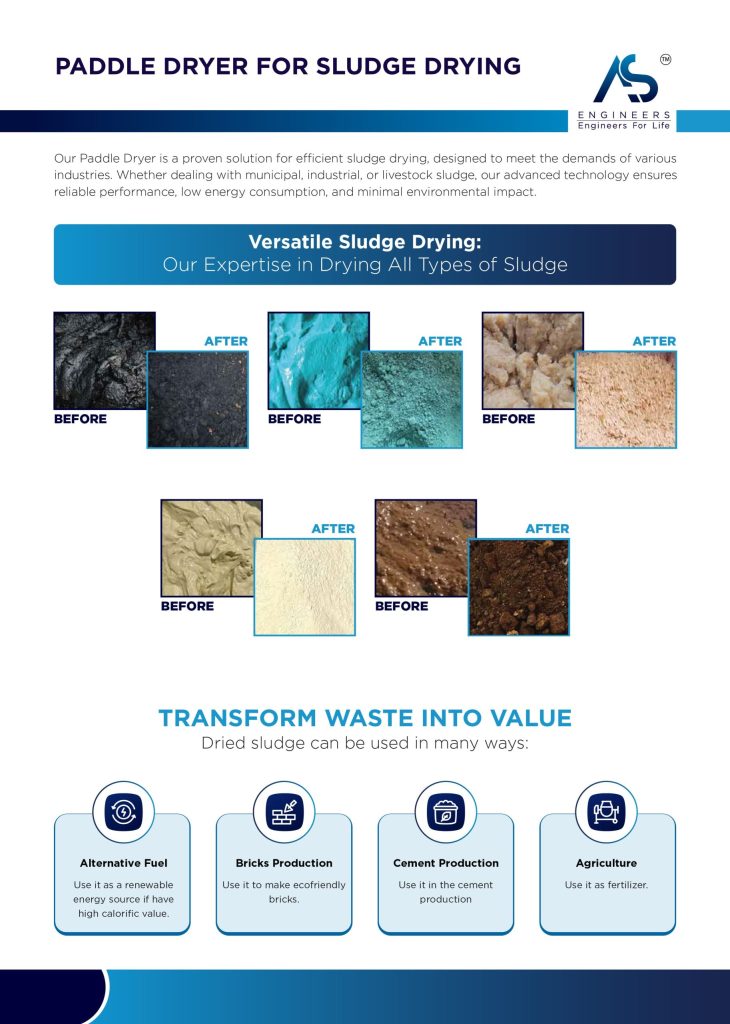
Sludge drying is not always the final disposal method. It is often a pre-treatment step that improves the economics, handling, transport, storage, and final-disposal flexibility of sludge.
A sludge dryer can help before land application, incineration, co-processing, landfill, TSDF disposal, or resource recovery by reducing moisture and making the material easier to handle.
At AS Engineers, our sludge drying approach is based on indirect heat transfer through paddle dryer technology. The paddle dryer uses hollow shafts and jacket heating to transfer heat to the sludge, while paddles mix and break the wet material. Depending on the application, the system may include feeding, heating, drying, vapour handling, pollution-control, and product-handling sections.
To understand the dryer side in more detail, read thermal sludge drying system guide and sludge treatment with conductive paddle dryers.
How drying changes the disposal decision
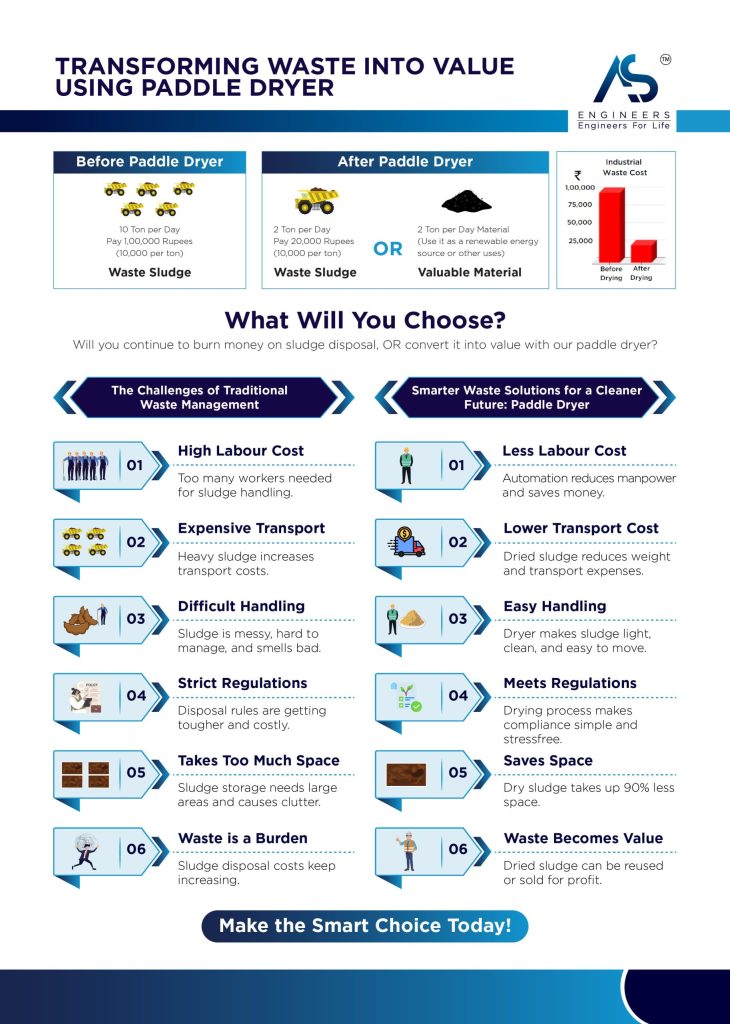
| Problem with wet sludge | What drying can improve |
|---|---|
| High transport weight | Lower moisture means less mass to move |
| Difficult handling | Dried sludge can be easier to convey, store, bag, or truck |
| Odour and hygiene issues | Controlled drying can reduce wet-sludge handling problems |
| Poor incineration efficiency | Lower moisture improves thermal-treatment feasibility |
| Large storage footprint | Dried sludge generally needs less storage volume |
| Unclear end-use route | Drying creates more options for disposal or reuse evaluation |
| High disposal frequency | Volume reduction can reduce truck movements and handling cycles |
Drying does not remove every contaminant. It does not automatically make sludge safe for land application. It does not replace laboratory testing or regulatory approval. Its main role is to reduce moisture, improve handling, and prepare sludge for a more practical final route.
For wet-sludge economics, see the hidden cost of landfilling wet sludge and volume reduction trends in industrial ETP today.
Which method should your plant choose?
There is no single winner. Use this decision logic.
| Choose land application when | Choose incineration when |
|---|---|
| Sludge is treated and tested as safe for land use | Sludge is unsuitable for land use |
| Nutrient value is useful and controlled | Contamination or public-risk concern is high |
| Pathogen and vector-attraction requirements are met | Pathogen destruction and volume reduction are priorities |
| Land, crop, season, and application rate are approved | Land availability is limited |
| Public acceptance and monitoring are manageable | Air-pollution-control and ash disposal are properly planned |
| The sludge is mainly municipal biosolids or safe organic sludge | The sludge comes from restricted industrial or mixed streams |
For many industrial plants, the final route is not a direct choice between land application and incineration. It may include dewatering, drying, authorized landfill, TSDF, co-processing, cement-kiln use, boiler co-firing where permitted, or material recovery after testing.
For industrial streams, start with industrial sludge disposal guide before selecting the final route.
Important testing before sludge disposal
Before deciding the disposal of sludge, request a current laboratory report. At minimum, the report should cover:
| Test area | Why it matters |
|---|---|
| Moisture and total solids | Determines transport load, drying need, and incineration energy demand |
| Volatile solids | Helps evaluate organic content and combustion behaviour |
| pH and alkalinity | Affects soil use, corrosion, handling, and treatment compatibility |
| Heavy metals | Critical for land application, ash disposal, and hazardous classification |
| Pathogens | Important for biosolids and land-use safety |
| Nutrients | Needed for land-application planning |
| COD/BOD | Indicates organic load and treatment history |
| Chloride, sulphate, TDS | Relevant for corrosion, ash, and downstream treatment |
| Calorific value | Important for incineration or co-processing |
| Leachability | Important for landfill, TSDF, and ash disposal |
| Odour and volatile compounds | Relevant for handling, storage, and public acceptance |
If sludge comes from industrial effluent, do not rely only on municipal biosolids logic. Industrial sludge should be treated as source-specific material.
Common mistakes in disposal of sludge
The mistakes I see most often are practical, not theoretical.
Plants often compare disposal options without checking the moisture load. A route may look cheaper until the plant calculates the actual transport weight, storage area, labour, odour control, and repeated handling cost.
Another mistake is treating dewatered sludge as “dry.” Filter press cake may still contain high moisture. That moisture affects transport, incineration fuel demand, and storage hygiene.
A third mistake is assuming land application is always sustainable. It is sustainable only when the sludge is safe, treated, tested, traceable, and applied correctly.
A fourth mistake is treating incineration as a simple volume-reduction shortcut. Incineration needs correct feed preparation, air-pollution-control equipment, ash management, and approved operating practice.
A fifth mistake is asking for a sludge dryer quotation without disposal-route clarity. The dryer should be selected around feed moisture, final moisture target, daily tonnage, sludge behaviour, heating medium, vapour handling, pollution-control requirement, and final disposal objective.
RFQ checklist for sludge drying before disposal
When you ask AS Engineers for sludge drying support, share these inputs:
| RFQ input | Details to share |
|---|---|
| Sludge source | STP, ETP, CETP, pharma, chemical, textile, food, paper, refinery, ZLD, biological sludge, or mixed sludge |
| Daily quantity | Wet sludge quantity per day or per batch |
| Feed moisture | Current moisture percentage or total solids |
| Final moisture target | Required dryness for disposal, storage, incineration, co-processing, or handling |
| Sludge behaviour | Sticky, pasty, fibrous, granular, abrasive, corrosive, odorous, or heat-sensitive |
| Disposal route | Land application, landfill, TSDF, incineration, cement kiln, boiler, composting, fertilizer, bricks, or other route |
| Lab report | Metals, pH, TDS, organics, calorific value, hazardous indicators, and other relevant parameters |
| Heating medium | Steam, thermic fluid, hot water, or site fuel options |
| Vapour handling | Water vapour, solvent vapour, odour, scrubber need, condenser need, cyclone, bag filter, or chimney route |
| Material handling | Feeding method, screw feeder, sludge pump, conveyor, bagging, silo, or truck loading |
| Utilities and layout | Available space, power, steam, fuel, foundation, shed height, and access for maintenance |
For equipment selection, also see how to choose a sludge paddle dryer and paddle dryer manufacturer in India.
Where AS Engineers fits in sludge disposal planning
AS Engineers does not decide regulatory approval for your sludge disposal route. That must come from your EHS consultant, laboratory testing, local authority, SPCB/CPCB route, authorized vendor, or project consultant.
Our role is equipment-focused. We help plants evaluate whether sludge drying can reduce moisture, improve handling, reduce transport burden, support incineration or co-processing preparation, and make final sludge management more practical.
AS Engineers works with paddle dryer and sludge dryer systems, along with feeding, heating, vapour handling, pollution-control, and product-handling sections where required. For connected system capability, you can also review AS Engineers’ paddle dryers for sludge drying and sludge wastewater treatment resources.
For broader group drying-system support, Acmefil’s sludge dryer and paddle dryer pages may also be useful as sister-company engineering references.
Conclusion
Disposal of sludge is not a one-line decision. Land application can be a good route for treated, tested, low-risk biosolids where soil use is approved and monitored. Incineration can be a stronger route where sludge is contaminated, land use is not practical, or major volume reduction is required. Both options fail when the plant ignores moisture, testing, handling, and compliance requirements.
For STP, ETP, CETP, and industrial plants, sludge drying often becomes the practical bridge between wet sludge and final disposal. It can reduce moisture, improve transport and storage, support incineration or co-processing, and create a more manageable material for the approved route.
If your plant is comparing land application, incineration, TSDF, landfill, or co-processing, start with the sludge lab report, moisture level, final-disposal objective, and site constraints. Then select the drying system around those conditions, not around motor HP or equipment size alone.
FAQs
Is land application the best method for disposal of sludge?
Land application can be suitable for treated biosolids with acceptable nutrient value, pathogen control, contaminant levels, and regulatory approval. It is not suitable for every sludge stream, especially industrial ETP sludge with uncertain chemicals, heavy metals, high salts, or hazardous constituents.
Is incineration better than land application?
Incineration is better when sludge cannot be safely reused on land, when volume reduction is critical, or when contamination risk is high. Land application is better when the sludge is safe, beneficial as a soil amendment, and approved for controlled use. The right answer depends on sludge testing and site conditions.
Does sludge drying replace final disposal?
No. Sludge drying is usually a pre-treatment step. It reduces moisture and improves handling, but the dried sludge still needs an approved final route such as land application, incineration, co-processing, TSDF, landfill, composting, or other permitted use.
Why is moisture important before incineration?
High moisture means the incineration system must spend more energy evaporating water before it can thermally treat the sludge solids. Drying can improve feed consistency and reduce the water load before thermal treatment.
Can industrial sludge be used for land application?
Only when testing and local approval confirm that the sludge is safe for land use. Many industrial sludge streams contain contaminants that may make land application unsuitable. Chemical, pharma, dye, textile, refinery, tannery, and metal-processing sludge should be evaluated very carefully.