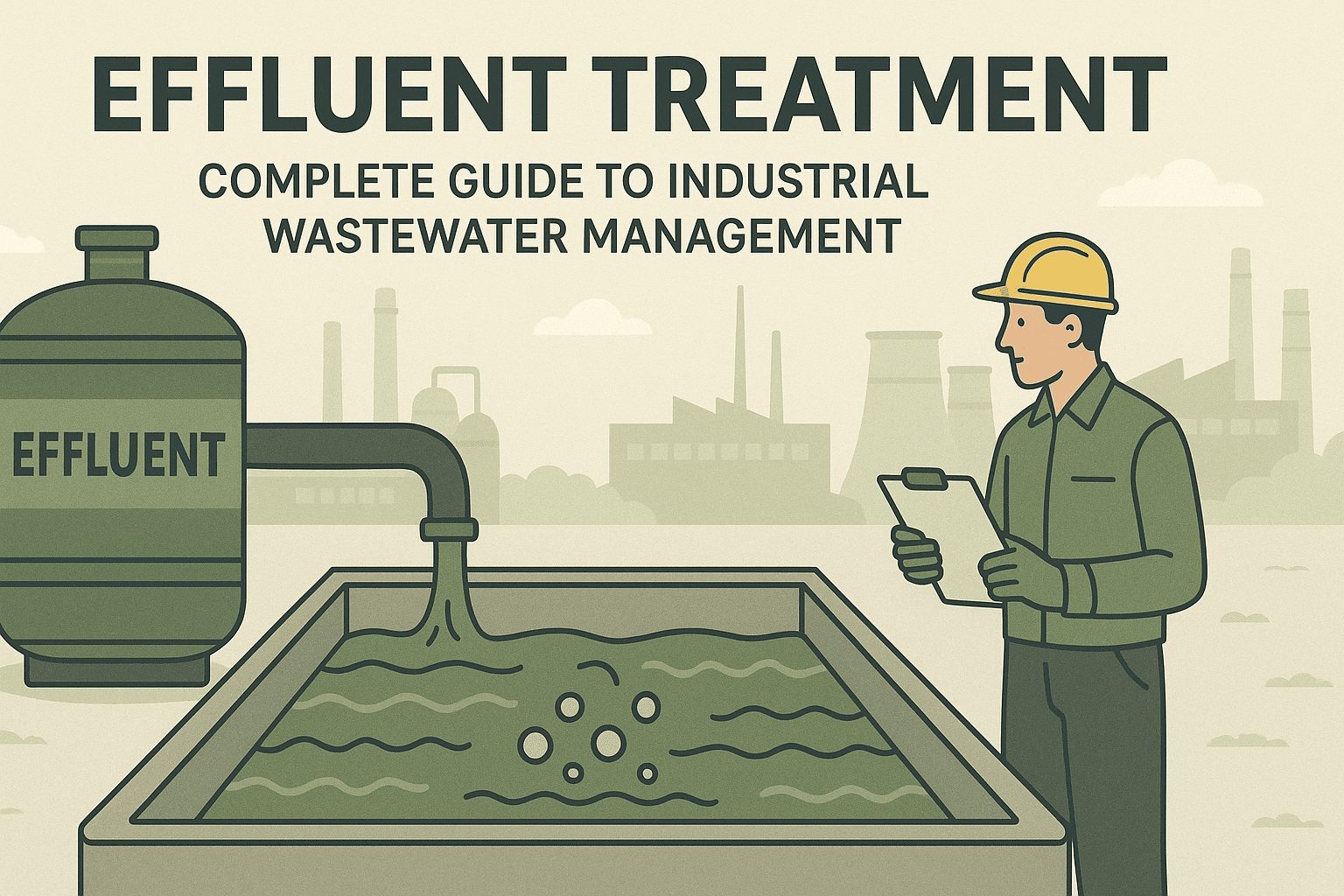
Effluent treatment is the process of treating industrial wastewater before discharge, reuse, recycling, or zero liquid discharge. For a plant team, an effluent treatment plant is not only a compliance asset. It also decides water recovery, sludge generation, disposal cost, odour control, operating stability, and long-term environmental risk.
In many industries, the ETP is planned around water quality, but the sludge stream is treated as an afterthought. That is where operating problems begin. Wet ETP sludge is heavy, difficult to store, expensive to transport, and often requires careful disposal based on its composition.
This guide explains how effluent treatment works, where sludge is generated, what plant teams should check, and how drying can support better ETP sludge handling when it is selected with proper process data.
What is effluent treatment?
Effluent treatment is the treatment of wastewater generated from industrial processes such as washing, reaction, rinsing, cleaning, cooling, scrubbing, filtration, dyeing, plating, fermentation, food processing, chemical manufacturing, pharma production, textile processing, and other plant activities.
Industrial effluent may contain suspended solids, dissolved salts, organic load, oil and grease, colour, heavy metals, acids, alkalis, chemicals, solvents, nutrients, biological load, or toxic contaminants depending on the process.
An effluent treatment plant usually combines physical, chemical, biological, and advanced treatment stages to reduce pollutants before the water is discharged, reused, sent to a CETP, or processed through a ZLD system.
Effluent, sewage, and sludge are not the same
| Term | Meaning | Typical source | Why it matters |
|---|---|---|---|
| Effluent | Wastewater from an industrial process | Chemical, textile, pharma, food, engineering, paper, metal finishing, dye, and other plants | Requires treatment based on process chemistry |
| Sewage | Domestic wastewater | Toilets, canteens, offices, residential areas | Usually treated in an STP |
| Sludge | Semi-solid residue generated during treatment | Clarifiers, biological treatment, filters, centrifuges, presses, evaporators, ZLD systems | Requires dewatering, drying, reuse, or disposal planning |
For a deeper wastewater process overview, see this guide on the wastewater treatment process. For sewage-specific comparison, refer to what is STP.
When does an industry need an ETP?
An industry generally needs an effluent treatment plant when its process generates wastewater that cannot be safely discharged or reused without treatment. The requirement depends on local consent conditions, industry category, receiving environment, process chemicals, wastewater volume, and pollutant load.
Common ETP users include:
| Industry | Common wastewater concerns |
|---|---|
| Textile and dyeing | Colour, TDS, COD, BOD, salts, dyes, auxiliaries |
| Chemical and specialty chemical | COD, pH variation, toxic compounds, salts, process residues |
| Pharmaceutical and API | High COD, solvents, active residues, variable batch wastewater |
| Food and beverage | BOD, COD, oil and grease, suspended solids, organic sludge |
| Dairy | High BOD, fats, proteins, cleaning chemicals |
| Metal finishing and plating | Heavy metals, pH, cyanide risk, oil, suspended solids |
| Paper and pulp | Fibre, colour, COD, biological sludge |
| Refineries and petrochemical | Oil and grease, hydrocarbons, emulsions, chemical sludge |
| CETP clusters | Mixed industrial effluent, variable load, high sludge responsibility |
A well-designed ETP starts with wastewater characterization. Without sampling and realistic operating data, equipment selection becomes guesswork.
Main stages of an effluent treatment plant
A complete ETP is usually built as a sequence. The exact flow changes by industry, contaminant profile, discharge standard, and reuse target.
| Stage | Purpose | Common equipment or process |
|---|---|---|
| Screening | Remove large solids and floating matter | Bar screen, fine screen, chamber |
| Oil and grease removal | Separate floating oil, grease, and scum | Oil trap, grease trap, skimmer |
| Equalization | Balance flow, pH, temperature, and pollutant variation | Equalization tank with mixer or aeration |
| pH correction | Bring wastewater into treatable range | Acid/alkali dosing, pH control system |
| Coagulation and flocculation | Convert fine particles into settleable flocs | Coagulant dosing, polymer dosing, flash mixer, flocculator |
| Primary clarification | Settle suspended solids and chemical sludge | Clarifier, tube settler, lamella clarifier |
| Biological treatment | Reduce biodegradable organic load | Aeration tank, MBBR, MBR, ASP, SBR, anaerobic reactor |
| Secondary clarification | Separate biomass from treated water | Secondary clarifier, sludge return system |
| Tertiary treatment | Polish treated water | Sand filter, carbon filter, pressure filter, UF |
| Advanced treatment | Reuse, recycle, or ZLD preparation | RO, MEE, stripper, evaporator, crystallizer |
| Sludge handling | Reduce sludge volume and disposal difficulty | Thickener, filter press, centrifuge, screw press, dryer |
The plant should be designed as a water stream and sludge stream together. A treatment plant that produces water within target but creates unmanageable wet sludge is still an operational problem.
Why sludge planning must start early in ETP design
ETP sludge comes from several points, including primary clarification, chemical precipitation, biological treatment, filter backwash, tertiary treatment, evaporation, and ZLD systems.
The sludge may be organic, inorganic, biological, chemical, oily, hazardous, non-hazardous, sticky, abrasive, corrosive, odorous, or salt-rich. Because of this, a single sludge handling method does not work for every plant.
Before selecting a sludge handling system, plant teams should check:
- Source of sludge inside the ETP
- Daily wet sludge quantity
- Feed moisture after dewatering
- Sludge consistency, stickiness, and flow behaviour
- Hazardous or non-hazardous classification
- pH, chloride, salts, oil, metals, and solvent risk
- Final disposal route, reuse route, or TSDF requirement
- Storage space, odour, hygiene, and transport cost
- Seasonal variation and batch variation
- Whether sludge can be dried safely and economically
For sludge-specific planning, refer to industrial sludge management and ETP sludge challenges.
Dewatering first, drying second
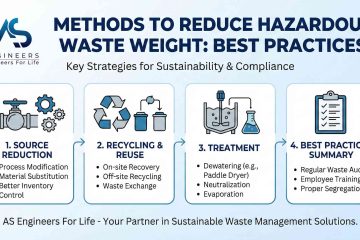
Most ETP sludge should be mechanically dewatered before thermal drying. Dewatering removes free water using a filter press, screw press, belt press, centrifuge, or similar equipment. Drying then reduces the remaining bound and retained moisture.
This sequence matters because sending very dilute slurry directly to a dryer can increase energy load, dryer size, and operating cost. A dryer is usually more practical after mechanical dewatering has already reduced the water load.
Typical sequence:
- Sludge thickening
- Mechanical dewatering
- Sludge cake collection
- Thermal drying, if justified
- Bagging, storage, reuse, co-processing, or approved disposal
Read more on sludge dewatering techniques before finalizing the dryer stage.
Where a sludge dryer fits in an effluent treatment plant
A sludge dryer is usually placed after dewatering. Its role is to reduce moisture further so the sludge becomes lighter, more stable, easier to handle, and less expensive to store or transport.
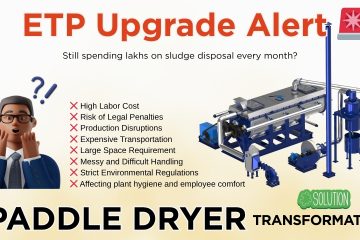
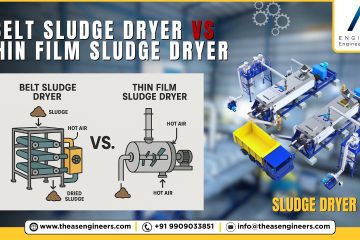
For ETP sludge, an indirect paddle dryer can be useful when the plant needs controlled drying of sludge cake, paste-like material, sticky sludge, or difficult industrial residues.
In an indirect paddle dryer, heat is transferred through hollow shafts, jacket, and paddles. The sludge does not need direct contact with flame or hot gas. This can help reduce off-gas volume compared with many direct-contact drying systems, but final performance depends on feed moisture, sludge chemistry, heating medium, vapour handling, residence time, and target moisture.
AS Engineers’ paddle dryer design references include indirect heating through hollow shafts and jacket, dual counter-rotating shafts, wedge-shaped paddles, plug-flow movement, and configuration options such as standard dryer, dual-zone dryer, and vacuum dryer. AS Engineers’ official material also shows the broader drying system around fuel, heating, feeding, dryer, scavenging, pollution control, solvent management, and product handling.
For dryer configuration details, see paddle dryer configuration and thermal sludge drying systems.
What ETP sludge drying can improve
Drying is not required in every ETP, but it can solve specific plant-side problems.
| Problem with wet ETP sludge | How drying may help |
|---|---|
| High transport weight | Reduces water content and total disposal load |
| Wet storage difficulty | Converts sludge cake into a more manageable dried material |
| Odour and hygiene problems | Can reduce wet sludge exposure when handled in a closed system |
| High TSDF or disposal frequency | Reduces the number of wet sludge movements when feasible |
| Limited space | Dried sludge generally needs less storage volume |
| Difficult reuse or co-processing | Lower moisture can support further evaluation for approved end use |
| ZLD residue burden | Helps manage concentrated sludge or solids after upstream treatment |
Drying should not be sold as a universal solution. It should be evaluated based on sludge composition, heating medium, moisture target, disposal route, and regulatory acceptance.
When a sludge dryer is a good fit
A sludge dryer may be a good fit when:
- The plant generates regular ETP sludge volume
- Wet sludge transport or disposal cost is high
- Sludge is already mechanically dewatered
- Storage space is limited
- The plant wants a more controlled covered sludge handling route
- The sludge needs lower moisture before disposal, reuse, or co-processing evaluation
- The plant has steam, thermic fluid, gas, or another suitable heat source
- Vapour, odour, dust, and condensate handling can be designed properly
- Sludge trials confirm drying behaviour
When a sludge dryer should not be selected blindly
A dryer should not be finalized without further review when:
- Sludge composition is unknown
- Hazardous classification is not confirmed
- Sludge contains volatile solvents or flammable components
- Explosive dust or toxic vapour risk may exist
- Sludge is too dilute and no dewatering stage is planned
- Disposal route does not accept dried material
- Heating medium and utility cost are not evaluated
- The plant expects guaranteed final moisture without testing
- The project is mainly a compliance issue, but the treatment process itself is unstable
For hazardous sludge handling, also review hazardous sludge and CPCB guidelines for hazardous waste disposal.
Industry-wise effluent and sludge risks
| Industry | Effluent concern | Sludge concern | Dryer planning note |
|---|---|---|---|
| Textile and dyeing | Colour, COD, TDS, salts | Chemical sludge, dye sludge | Check salts, colour, ash, and disposal route |
| Chemical | Variable pH, COD, toxic compounds | Chemical sludge, salt-rich sludge | Characterization is essential before drying |
| Pharmaceutical | Batch variation, solvents, high COD | Biological and chemical sludge | Vapour and solvent safety must be reviewed |
| Food and beverage | High BOD/COD, fats, organic load | Biological sludge, odour | Dewatering quality strongly affects dryer load |
| Metal finishing | Heavy metals, pH, oil | Metal-bearing sludge | TSDF route and hazardous status must be checked |
| Paper | Fibre, colour, suspended solids | Fibre sludge, biological sludge | Bulk density and fibre behaviour affect handling |
| CETP | Mixed wastewater | Mixed industrial sludge | Variability and member discharge control are critical |
| ZLD plant | Concentrated rejects, salts | Evaporator salts, concentrated sludge | Dryer selection depends on upstream process and final residue |
ZLD and effluent reuse: plan the sludge stream first
Zero Liquid Discharge can reduce liquid discharge by treating and recovering water through advanced stages such as filtration, membrane systems, evaporators, crystallizers, and residue handling. However, ZLD does not remove the waste problem. It converts the liquid problem into concentrated sludge, salts, or solids that still need handling.
Before selecting a ZLD or reuse system, plant teams should ask:
- What is the final reject stream?
- How much sludge or salt will be generated daily?
- Is the residue hazardous or non-hazardous?
- Can it be dried, bagged, stored, or transported safely?
- Is a TSDF or approved disposal route available?
- What is the expected moisture after filtration or centrifuging?
- Can the residue be tested in a pilot dryer before final equipment sizing?
For more detail, see the zero liquid discharge guide and top challenges for ZLD plants.
Compliance and documentation checklist for Indian plants
Effluent treatment compliance depends on the consent condition, industry type, receiving route, local SPCB direction, CPCB standards, and any sector-specific rules. Do not rely on a generic internet limit without checking the actual consent document.
As a practical checklist, maintain:
| Area | What to maintain |
|---|---|
| Consent documents | CTO, CTE, discharge permission, reuse permission, ZLD condition if applicable |
| Sampling records | pH, BOD, COD, TSS, TDS, oil and grease, metals, sector-specific parameters |
| Flow records | Inlet flow, treated water flow, reuse flow, reject flow |
| Sludge records | Quantity generated, moisture, classification, storage, transport, manifest |
| Chemical use | Coagulant, polymer, acid, alkali, nutrient, antiscalant, cleaning chemicals |
| Equipment logs | Pumps, blowers, aerators, clarifiers, filters, RO, evaporator, dryer |
| Calibration | pH meter, flow meter, online analyser, load cells, dosing system |
| Disposal documents | TSDF receipts, reuse approval, co-processing records, transporter records |
| Maintenance logs | Sludge removal, filter cleaning, press cloth change, pump maintenance |
| Incident records | Bypass, overflow, shock load, failure, non-compliance action |
CPCB’s general discharge standards include parameters such as pH, suspended solids, BOD, and COD, but limits vary by receiving route and applicable regulation. CPCB documents show pH 5.5 to 9.0 under listed general discharge routes, while BOD, COD, and suspended solids limits vary by disposal route. Always verify against current consent and sector-specific norms before publication or plant action.
Common ETP mistakes that create sludge problems
Treating sludge as a secondary issue
Many plants focus on treated water quality but ignore where the sludge will go. This creates storage, odour, labour, and disposal problems later.
Selecting equipment before wastewater characterization
ETP design needs real wastewater data. A single grab sample may not represent batch variation, seasonal load, cleaning cycle discharge, or peak concentration.
Undersizing equalization
Without enough equalization, downstream chemical and biological treatment becomes unstable. Shock loads also change sludge quantity and quality.
Not separating streams at source
High-strength, oily, toxic, acidic, or solvent-bearing streams should not always be mixed directly with general wastewater. Segregation may reduce treatment load.
Poor dewatering before drying
If sludge cake moisture remains too high, the dryer becomes overloaded. Good dewatering reduces drying duty.
Assuming ZLD means no waste
ZLD can reduce liquid discharge, but it still produces concentrated sludge, salts, or solids.
Ignoring vapour and odour handling
Drying wet sludge generates vapour. The system needs suitable vapour handling, condensation, scrubbing, or exhaust treatment depending on sludge and heating method.
Making compliance claims without testing
No supplier should promise compliance only from equipment selection. Compliance depends on treatment design, operation, chemical dosing, monitoring, maintenance, and regulatory approval.
RFQ checklist for ETP sludge drying
Before asking for a sludge dryer quotation, prepare these inputs:
| Input | Why supplier needs it |
|---|---|
| Industry and process | Identifies likely sludge chemistry and risk |
| ETP flow rate | Shows plant scale and sludge generation basis |
| Sludge source | Primary, biological, chemical, RO reject, ZLD residue, mixed sludge |
| Wet sludge quantity | Required for dryer capacity estimate |
| Feed moisture after dewatering | Defines evaporation load |
| Target final moisture | Affects dryer size and energy load |
| Sludge consistency | Sticky, pasty, granular, fibrous, oily, abrasive |
| Hazardous classification | Decides safety, disposal, and design review |
| pH and corrosive components | Helps select MOC |
| Chlorides, salts, metals | Important for corrosion and residue behaviour |
| Oil, solvent, VOC risk | Affects vapour handling and safety review |
| Heating medium | Steam, thermic fluid, hot water, gas, electricity, site utility |
| Available space | Layout, access, maintenance clearance |
| Pollution control need | Scrubber, cyclone, condenser, bag filter, ID fan |
| Product handling | Screw conveyor, bagging, silo, truck loading |
| Disposal route | TSDF, co-processing, landfill, reuse, internal approval |
| Trial requirement | Confirms drying behaviour before final order |
AS Engineers’ official catalogue lists paddle dryer options for slurries, pastes, cakes, granules, and powders, with material options such as CS, SS304, SS316, Duplex Steel, and other alloys depending on requirement. It also references steam and thermal oil heating options, along with standard, dual-zone, and vacuum dryer configurations.
AS Engineers support for ETP sludge drying
AS Engineers works in paddle dryers, sludge dryers, centrifugal blowers, pollution control equipment, and turnkey solutions. The company’s catalogue states 25+ years of experience in fluid mechanics and drying solutions, ISO 9001:2015 certification, 500+ clients, and 1500+ projects.
For ETP sludge drying inquiries, the useful starting point is not “dryer price” alone. The better starting point is sludge behaviour.
Share feed moisture, final moisture target, wet sludge quantity, heating medium, sludge source, hazardous status, disposal route, and site constraints. These details help the team review whether a paddle dryer, dewatering improvement, pilot trial, or different sludge handling route should be considered.
AS Engineers’ official paddle dryer material also mentions a 50 kg/hr pilot trial machine for demonstrations and feasibility assessment. Use a pilot trial when sludge behaviour is uncertain, sticky, variable, or disposal-critical.
Conclusion
Effluent treatment is not complete when treated water leaves the ETP. A practical ETP also needs stable sludge handling, dewatering, drying evaluation, compliance records, disposal planning, and safe operation.
For industrial plants, the biggest mistake is treating ETP sludge as a by-product that can be solved later. Sludge quantity, moisture, hazardous status, storage, transport, and disposal route should be checked during ETP planning itself.
If your plant is facing high wet sludge handling cost, storage issues, odour, TSDF movement frequency, or ZLD residue problems, review the sludge stream with actual data. A sludge dryer may be useful after dewatering, but only when the sludge composition, moisture target, heating medium, vapour handling, and disposal route support the decision.
For AS Engineers review, prepare your ETP sludge details, dewatering output moisture, daily sludge quantity, disposal route, and final moisture target before requesting a dryer recommendation.
FAQs
What is effluent treatment in industry?
Effluent treatment is the treatment of wastewater generated from industrial processes before discharge, reuse, recycling, or ZLD. It may include screening, equalization, pH correction, chemical treatment, biological treatment, filtration, advanced treatment, and sludge handling.
What is the difference between ETP and STP?
An ETP treats industrial wastewater, while an STP treats domestic sewage. ETP wastewater is usually more variable because it depends on process chemicals, production batches, cleaning cycles, salts, oil, colour, metals, and other industrial contaminants.
Why does an ETP generate sludge?
An ETP generates sludge when suspended solids, chemicals, biological solids, precipitated contaminants, oil residues, or concentrated rejects are separated from wastewater. This sludge must be thickened, dewatered, dried, reused, or disposed through an approved route depending on its composition.
Can ETP sludge be dried?
Yes, ETP sludge can often be dried after mechanical dewatering, but suitability depends on sludge composition, hazardous classification, moisture level, stickiness, heating medium, vapour handling, and disposal route. A pilot trial is useful when sludge behaviour is uncertain.
Is ZLD required for every industry?
No. ZLD requirement depends on industry type, location, consent condition, water reuse target, discharge permission, and regulatory direction. Even when ZLD is used, the plant must still manage concentrated sludge, salts, or solid residue safely.