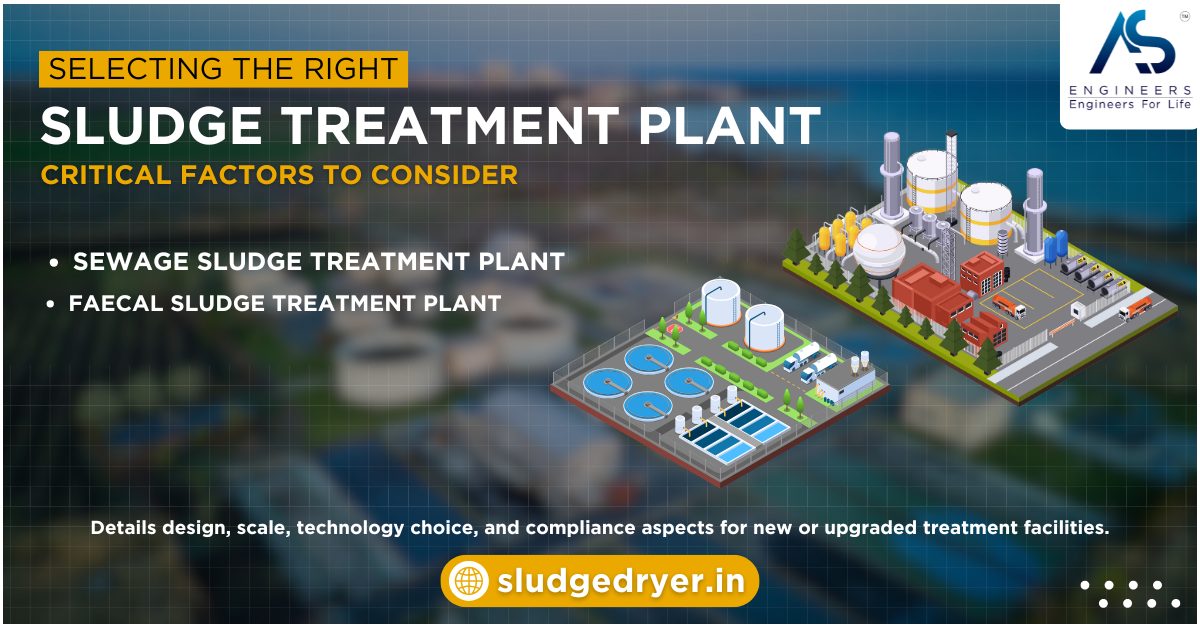
A sludge treatment plant reduces, stabilizes, dewaters, dries, and prepares sludge from wastewater treatment for safer disposal, reuse, co-processing, or further handling. The right plant is not selected from equipment price alone. It depends on sludge type, feed moisture, solids load, contaminants, daily generation, disposal route, available space, operator skill, energy source, and pollution-control requirements.
For STPs, ETPs, CETPs, faecal sludge facilities, and industrial wastewater plants, the main question is simple: what final sludge condition do you need, and what operating risk are you trying to reduce?
What Is a Sludge Treatment Plant?
A sludge treatment plant is a system that receives sludge from wastewater treatment and converts it into a safer, smaller-volume, easier-to-handle output. The treatment train may include screening, thickening, conditioning, stabilization, mechanical dewatering, thermal drying, vapour handling, odour control, and final product handling.
In practical plant terms, wet sludge creates four problems: water, weight, odour, and disposal difficulty. A properly designed sludge treatment plant controls these issues before the sludge reaches storage, transport, landfill, TSDF, composting, cement co-processing, or any approved reuse route.
Before selecting equipment, it helps to understand what sludge is and how it behaves.
Sludge Treatment Plant Process Flow
A sludge treatment plant is not one machine. It is a connected process train. Each stage affects the next stage.
| Stage | Purpose | Common Equipment | Selection Notes |
|---|---|---|---|
| Collection and equalization | Balance sludge flow and composition | Sludge holding tank, equalization tank, sludge pumps | Important when sludge generation changes by batch, shift, or season |
| Screening and grit protection | Remove rags, plastics, grit, and large solids | Bar screen, coarse screen, fine screen, grit removal | Protects pumps, presses, feeders, and dryer internals |
| Thickening | Increase solids before further treatment | Gravity thickener, mechanical thickener, DAF | Reduces volume before dewatering or digestion |
| Conditioning | Improve separation and handling | Polymer dosing, lime, pH correction, mixing | Exact dosing should be based on sludge testing |
| Stabilization | Reduce odour and biological activity | Aerobic digestion, anaerobic digestion, lime stabilization, composting | More common in municipal and sewage sludge treatment |
| Dewatering | Convert liquid sludge into cake | Filter press, belt press, screw press, centrifuge | Usually required before thermal sludge drying |
| Drying | Remove additional free and bound moisture | Paddle dryer, thermal dryer, solar bed, drying bed | Selected when lower moisture, volume reduction, or better handling is needed |
| Vapour and odour control | Handle exhaust, vapour, fines, and odour | Condenser, cyclone, scrubber, bag filter, ID fan, chimney | Must match sludge chemistry and local pollution-control requirements |
| Product handling | Move dried solids safely | Screw conveyor, silo, bagging system, bucket elevator, truck loading | Design depends on final disposal or reuse route |
For a broader comparison, refer to top sludge treatment methods and their applications and sludge dewatering techniques.
Where a Sludge Dryer Fits in the Treatment Plant
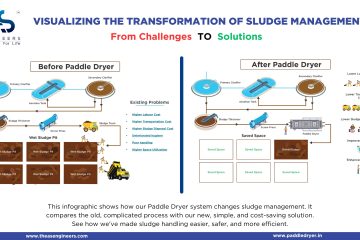
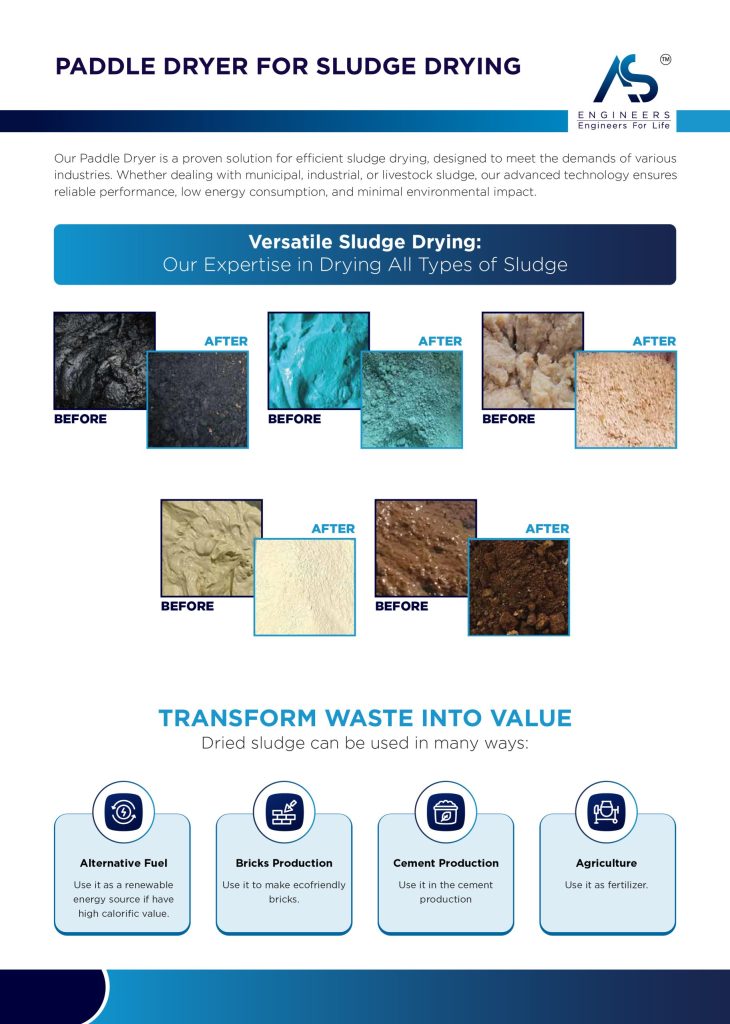
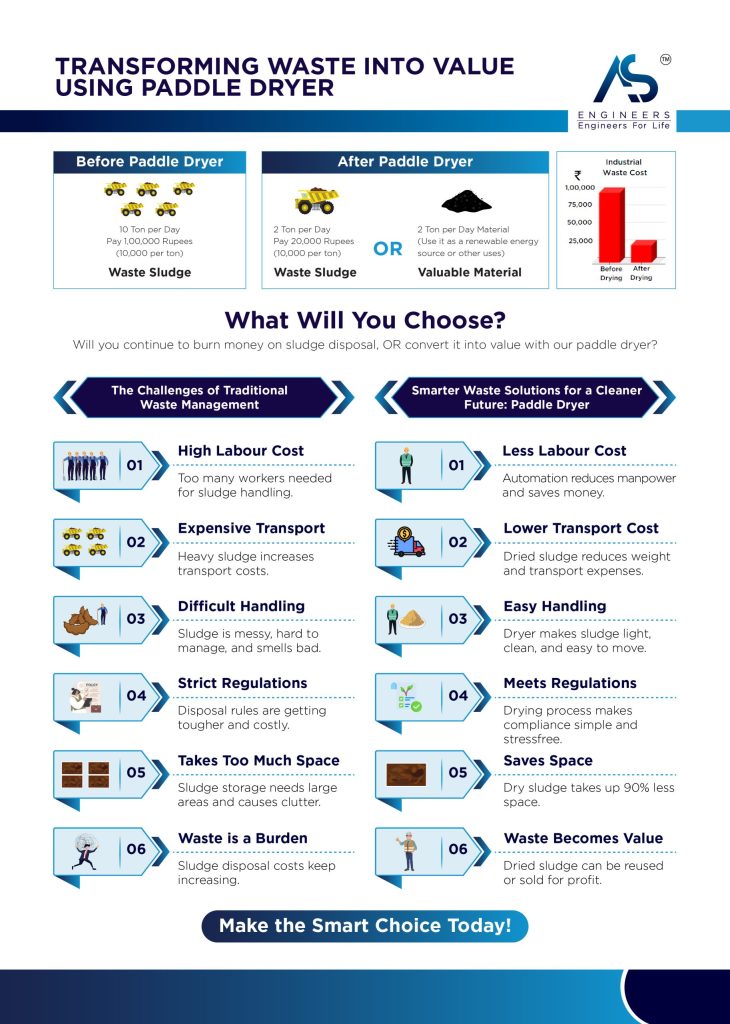
Mechanical dewatering is normally used before drying, but dewatered sludge cake can still be heavy, wet, odorous, and costly to move. A sludge dryer is added when the plant needs lower moisture, reduced transport burden, improved storage, or better downstream handling.
At AS Engineers, a paddle sludge dryer uses indirect heat transfer through hollow shafts and a jacket. Wedge-shaped paddles agitate the sludge and help prevent material buildup. Counter-rotating shafts improve mixing and heat transfer. The dryer can be integrated with feed handling, heating medium, scavenging air, cyclone, scrubber, bag filter, vapour management, and dried product conveying.
When I review a sludge treatment plant requirement, I do not start with dryer size. I first ask for feed moisture, final moisture target, kg/hr or TPD sludge generation, sludge source, dewatering output, heating medium, vapour route, available footprint, and final disposal plan. Without these inputs, any equipment recommendation is only a rough guess.
For dryer-level planning, use the paddle dryer configuration guide and the thermal sludge drying system guide.
Sludge Type Changes the Plant Design
The same sludge treatment plant layout cannot be blindly applied to every sludge. Municipal sludge, ETP sludge, faecal sludge, biological sludge, oily sludge, and ZLD sludge behave differently.
| Sludge Type | Typical Source | Design Caution | Dryer Relevance |
|---|---|---|---|
| STP sludge | Sewage treatment plant | Odour, pathogens, biological activity, daily variability | Drying helps reduce volume and improve handling after dewatering |
| ETP sludge | Chemical, pharma, textile, food, paper, dye, or other industrial plants | pH, salts, solvents, colour, oil, heavy metals, hazardous characteristics | Needs sludge testing, MOC review, and vapour handling study |
| Faecal sludge | Septic tanks, pit latrines, septage collection | Grit, trash, inconsistent solids, odour | Requires strong screening and cautious downstream treatment |
| Biological sludge | Biological wastewater treatment | High moisture, organic content, variable dewatering response | Dewatering quality strongly affects dryer load |
| ZLD sludge | Evaporator, crystallizer, RO reject treatment, MEE, ATFD systems | High salts, corrosive solids, sticky or abrasive behaviour | MOC, feed handling, and product discharge are critical |
| Oily or refinery sludge | Oil and gas, refinery, petroleum handling | Oil, grease, VOC, fire and odour risk | Requires engineering and safety review before drying selection |
For related sludge-type pages, see STP sludge sewage treatment guide, faecal sludge treatment plants, and ETP sludge challenges and treatment solutions.
Sludge Treatment Technologies Compared
| Technology | Best Fit | Weak Fit | Buyer Check |
|---|---|---|---|
| Drying beds | Small plants, low sludge load, available land | High rainfall areas, space-limited plants, urgent drying needs | Land, climate, drainage, odour control |
| Mechanical dewatering | First-stage volume reduction before disposal or drying | When very low final moisture is required | Cake solids, polymer use, sludge consistency |
| Anaerobic or aerobic digestion | Municipal and biological sludge with organic content | Highly toxic, saline, solvent-heavy, or unstable industrial sludge | Retention time, gas handling, odour, operator skill |
| Composting | Stabilized organic sludge with reuse route | Hazardous or contaminated sludge | Space, bulking agent, odour, market acceptance |
| Thermal sludge drying | Plants needing lower moisture, lower transport burden, and better handling | Projects with no sludge data, no vapour route, or no fuel plan | Feed moisture, final moisture, fuel, MOC, pollution control |
| Incineration or co-processing | Final destruction or approved energy recovery route | Small plants without emission-control budget | Ash, emissions, calorific value, approvals |
If the main challenge is water removal before disposal, compare sludge dewatering equipment selection with sludge drying methods and best practices.
Key Design Factors Before Selecting a Sludge Treatment Plant
Sludge test data
The first input is not plant capacity. It is sludge behaviour. Share moisture, total solids, volatile solids, pH, oil and grease, salts, chlorides, heavy metals where applicable, particle size, stickiness, odour, and hazardous classification where relevant.
Daily and peak sludge load
A plant designed only for average flow may struggle during peak loading. Share daily sludge generation, peak sludge generation, number of operating hours, batch frequency, and future expansion load.
Existing dewatering performance
If the sludge is already dewatered, share the current cake moisture and dewatering technology. A filter press cake, centrifuge cake, screw press cake, and belt press cake may behave differently in the dryer.
Final moisture target
Do not specify “dry sludge” without a number. Final moisture target affects dryer size, heat load, residence time, fuel requirement, vapour load, and product handling.
Material of construction
Industrial sludge can be corrosive or abrasive. MOC selection may require Carbon Steel, SS304, SS316, Duplex Steel, or other alloys depending on sludge chemistry and operating condition.
Heating medium and fuel availability
Thermal drying needs a practical heat source. Steam, thermic fluid, hot water, natural gas, coal, wood, LDO, electricity, or briquette-based systems may be considered depending on the plant. Fuel selection should be based on site availability, economics, and EHS requirements.
Vapour and odour handling
Drying does not end at moisture removal. Vapour, fines, odour, and possible solvent traces need a safe route. Depending on sludge chemistry, the system may need condenser, cyclone, scrubber, bag filter, ID fan, chimney, or a combined pollution-control arrangement.
AS Engineers’ broader ecosystem also includes airflow and pollution-control knowledge. For wastewater-related air movement, refer to high-pressure blowers in wastewater treatment.
Space and layout
Many sludge treatment projects fail at layout level. The plant needs space for sludge receiving, dewatering, dryer access, maintenance clearance, discharge handling, electrical panel, fuel/heating system, ducting, pollution-control equipment, and truck movement.
Automation and operator skill
A sophisticated plant without trained operators can become unreliable. Decide early how much automation is required for feeding, temperature control, moisture control, discharge, interlocks, alarms, and maintenance records.
Maintenance and spare parts
A sludge treatment plant should be selected with long-term operation in mind. Check access for cleaning, shaft inspection, bearing service, gearbox service, screw feeder maintenance, pump maintenance, and bag filter or scrubber upkeep.
AS Engineers offers support for paddle dryer repair, system upgrades, retro-fitment, OEM spare parts, and service support. For dryer equipment planning, you can also review sludge dryers guide and paddle dryer manufacturer in India.
Sludge Dryer Selection Checklist
Use this checklist before asking for a quotation.
| Input | Why It Matters |
|---|---|
| Sludge source | STP, ETP, CETP, FSTP, ZLD, paper, chemical, pharma, food, refinery, textile, dye, or other source changes design |
| Feed moisture | Drives evaporation load and dryer sizing |
| Final moisture target | Determines heat duty and residence time |
| Daily sludge quantity | Defines dryer capacity and operating hours |
| Peak sludge quantity | Prevents undersized feeding and storage systems |
| Dewatering method | Filter press, belt press, screw press, centrifuge, or drying bed output affects feed behaviour |
| Bulk density | Affects feeder, dryer hold-up, and conveyor design |
| Stickiness and flowability | Impacts paddle design, feeding, discharge, and cleaning |
| pH, salts, chlorides | Important for MOC and corrosion review |
| Oil, grease, solvent, VOC | Important for vapour handling and EHS review |
| Heating medium | Steam, thermic fluid, hot water, gas, coal, wood, LDO, electricity, briquette, or other fuel |
| Pollution-control requirement | Cyclone, scrubber, bag filter, condenser, ID fan, chimney, or combined system |
| Disposal or reuse route | Landfill, TSDF, co-processing, cement, composting, agriculture, brick, or fuel use changes final product target |
| Site layout | Affects installation, ducting, maintenance, and material movement |
| Automation expectation | Helps decide control panel, sensors, interlocks, and operating philosophy |
For plant teams comparing disposal options, the industrial sludge disposal guide and hidden cost of landfilling wet sludge are useful next reads.
Common Mistakes in Sludge Treatment Plant Selection
Selecting equipment before testing sludge
A catalogue capacity is not enough. Sludge chemistry, moisture, stickiness, and dewatering response must be understood before final selection.
Treating STP sludge and ETP sludge as the same
STP sludge and ETP sludge can have completely different risks. Industrial ETP sludge may contain salts, colour, solvents, oils, metals, or other contaminants that need special review.
Ignoring the dewatering stage
A dryer installed after poor dewatering will need to evaporate more water. This increases heat load and operating cost. Dewatering and drying should be planned together.
Not defining the final disposal route
The final disposal or reuse route decides moisture target, product form, packaging, and compliance requirements. A plant designed for landfill may not be suitable for cement co-processing, agriculture, or brick use without proper approvals and testing.
Forgetting vapour, odour, and fines
Drying creates vapour and may carry fines. These must be handled through proper ducting, scrubbing, filtering, condensing, or exhaust design based on the sludge and local requirements.
Asking only for lowest price
The lowest-price plant can become expensive if it causes downtime, poor drying, odour complaints, high fuel use, maintenance difficulty, or product handling problems.
RFQ Inputs to Share With AS Engineers
For a serious sludge treatment plant or sludge dryer quotation, share the following:
- Sludge source and industry
- STP, ETP, CETP, FSTP, ZLD, or process origin
- Daily sludge generation in kg/day or TPD
- Peak sludge generation
- Feed moisture percentage
- Current dewatering method and cake moisture
- Target final moisture
- Bulk density and sludge behaviour
- pH, salts, chlorides, oil and grease, solvent, VOC, or hazardous data where applicable
- Available heating medium or fuel
- Operating hours per day
- Existing layout or available space
- Pollution-control expectation
- Final disposal or reuse route
- Automation requirement
- Pilot trial requirement, if material behaviour is uncertain
A well-prepared RFQ saves time and reduces wrong equipment assumptions.
When a Pilot Trial Is Useful
A pilot trial is useful when sludge behaviour is uncertain, feed is sticky, output moisture is strict, solvent or odour handling is sensitive, or the plant wants to check feasibility before full-scale equipment selection.
AS Engineers’ official material mentions a 50 kg/hr paddle dryer pilot trial machine for demonstrations and feasibility review. Pilot testing can help evaluate performance, identify issues, optimize the drying process, and confirm whether a paddle dryer is suitable for the application.
EHS and Compliance Notes
Sludge treatment involves odour, pathogens, contaminants, heat, rotating equipment, vapour, dust, and disposal responsibilities. Equipment selection alone does not guarantee legal compliance. Final plant design should be reviewed with the project consultant, EHS team, plant authority, and applicable pollution-control requirements.
For Indian industrial wastewater and sludge-related planning, also review CPCB guidelines for hazardous waste disposal and zero liquid discharge sludge where applicable.
Frequently Asked Questions
What is the main purpose of a sludge treatment plant?
The main purpose of a sludge treatment plant is to reduce sludge volume, improve handling, stabilize the sludge where required, remove water, control odour, and prepare the sludge for safe disposal, reuse, co-processing, or further treatment.
Is sludge dewatering enough, or is sludge drying also required?
Dewatering may be enough when the disposal route accepts wet cake and transport cost is manageable. Sludge drying is considered when the plant needs lower moisture, lower transport burden, less storage load, better hygiene, or a more stable final product for approved downstream use.
How do I choose between drying beds and a thermal sludge dryer?
Drying beds may suit small plants with low sludge load, available land, and suitable climate. A thermal sludge dryer is usually considered when land is limited, sludge quantity is higher, drying time must be controlled, or the plant needs lower moisture output with better process control.
What data is required for sludge dryer selection?
The key inputs are sludge source, daily quantity, peak quantity, feed moisture, final moisture target, dewatering method, bulk density, stickiness, pH, salts, oil and grease, solvent or VOC risk, heating medium, operating hours, pollution-control requirement, site layout, and final disposal or reuse route.
Can one sludge treatment plant handle both STP sludge and ETP sludge?
It may be possible in some cases, but it should not be assumed. STP sludge and ETP sludge can have different moisture, odour, chemical, biological, and hazardous characteristics. Testing and engineering review are required before mixing or co-treating different sludge streams.
Conclusion
A sludge treatment plant should be designed from sludge behaviour, not from a standard equipment list. The correct process depends on sludge type, moisture, solids load, dewatering output, disposal route, energy source, pollution-control need, and maintenance capability.
For many plants, the best result comes from combining proper thickening, dewatering, drying, vapour handling, and product handling into one practical system. If your plant is evaluating sludge drying, share the sludge test data, feed moisture, final moisture target, daily load, heating medium, and disposal route. The AS Engineers team can review the requirement and suggest a practical sludge dryer configuration based on actual site conditions.