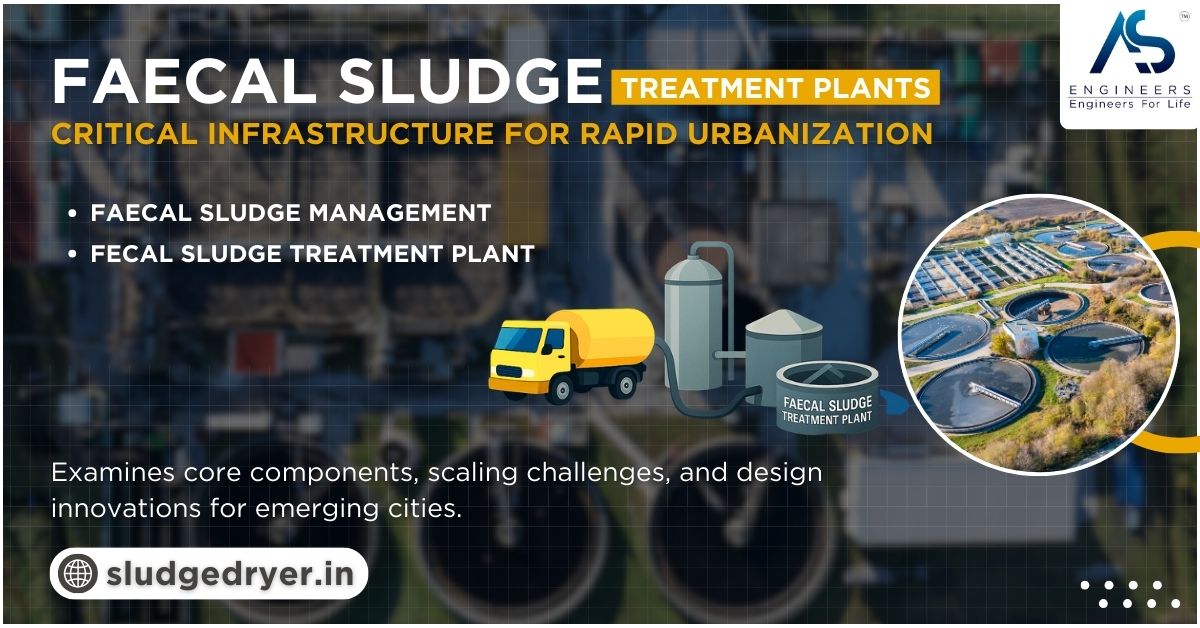
A faecal sludge treatment plant, or FSTP, treats sludge and septage removed from septic tanks, pit latrines, community toilets, and other on-site sanitation systems. A good FSTP does not only receive waste. It controls tanker discharge, removes grit and debris, separates solids and liquids, treats the liquid stream, dries or stabilizes the solids, and verifies whether the final output can be disposed of or reused safely.
This matters because sewer networks do not cover every settlement, town, peri-urban area, industrial colony, institution, or public sanitation zone. WHO/UNICEF’s 2025 JMP update reported that 3.4 billion people still lacked safely managed sanitation in 2024, so non-sewered sanitation and faecal sludge management remain important parts of public health infrastructure.
For plant owners, municipalities, EPC teams, consultants, and project engineers, the real question is not only “Which FSTP technology is best?” The better question is: what is the incoming sludge quality, how much land is available, what final disposal or reuse route is allowed, and whether passive drying, mechanical dewatering, thermal drying, or a hybrid system fits the site.
What is a faecal sludge treatment plant?
A faecal sludge treatment plant is a facility designed to receive and treat faecal sludge from on-site sanitation systems. Unlike a conventional sewage treatment plant, which receives wastewater through a sewer network, an FSTP usually receives concentrated sludge by vacuum tanker or desludging vehicle.
Faecal sludge can be highly variable. One tanker may carry dilute septic tank sludge. Another may carry thick pit sludge with grit, plastics, cloth, fats, oils, grease, and high organic load. This variation is why FSTP design must begin with characterization, not only with daily KLD capacity.
A practical FSTP usually handles five duties:
| Duty | What happens | Why it matters |
|---|---|---|
| Reception | Tanker unloading, volume recording, sampling | Prevents uncontrolled dumping and supports billing/O&M records |
| Preliminary treatment | Screening, grit removal, trash separation | Protects pumps, beds, presses, pipes, and downstream units |
| Solid-liquid separation | Drying beds, settling-thickening, geobags, screw press, centrifuge | Reduces hydraulic and solids load for further treatment |
| Liquid treatment | ABR, planted gravel filter, constructed wetland, polishing pond, MBBR, STP co-treatment where allowed | Reduces pollution load before discharge or reuse |
| Solids treatment | Drying, composting, stabilization, thermal drying, co-processing, safe disposal | Converts wet, difficult sludge into a more manageable form |
The Swachh Bharat Mission faecal sludge management manual and India’s FSSM advisory both describe FSTP planning as a complete service chain, covering collection, transport, treatment, O&M, and safe disposal or reuse.
Faecal sludge treatment plant process flow
A well-designed FSTP is not one machine. It is a treatment chain. The exact flow depends on sludge quality, land, climate, reuse target, local norms, and O&M capability.
A practical flow looks like this:
Tanker unloading and receiving chamber
Vacuum tankers discharge into a controlled receiving station. The plant should have a safe unloading point, flow measurement where possible, sampling access, spill control, and washable flooring. Poor receiving design creates odor, overflow, worker exposure, and inaccurate volume records.
Screening and grit removal
This is a non-negotiable stage. Faecal sludge often contains rags, plastics, stones, sand, sanitary waste, hair, and other non-biodegradable matter. These materials can block pumps, choke pipelines, damage dewatering equipment, reduce drying bed performance, and increase maintenance.
Equalization or holding
Sludge quality changes from tanker to tanker. Equalization helps smooth incoming variations before downstream treatment. In smaller plants, operational scheduling and batch handling may play this role.
Solid-liquid separation
This is the main reduction stage. Depending on site conditions, the plant may use unplanted drying beds, planted drying beds, settling-thickening tanks, geotubes, screw presses, centrifuges, or a combination. India’s FSSM advisory lists both non-mechanized options such as planted and unplanted drying beds, and mechanized options such as screw press and centrifuge.
Liquid treatment
The separated liquid, or percolate, still needs treatment. Common options include anaerobic baffled reactors, horizontal planted gravel filters, polishing ponds, constructed wetlands, chlorination where applicable, MBBR, or co-treatment in an STP where the receiving STP can safely accept the load.
Solids drying, stabilization, or thermal treatment
After dewatering, solids may still contain too much moisture for easy transport, covered storage, composting, co-processing, or controlled disposal. This is where drying becomes important. Drying may be passive, solar-assisted, greenhouse-based, mechanical, thermal, or hybrid.
Final disposal or reuse
Treated solids should not be marketed or used casually. Reuse as compost, soil conditioner, fuel, co-processing feed, or construction material depends on lab results, pathogen reduction, heavy metals, local approvals, and the intended end use. A dried product is not automatically safe simply because it looks dry.
FSTP vs STP: what is the difference?
| Point | Faecal Sludge Treatment Plant | Sewage Treatment Plant |
|---|---|---|
| Waste source | Septic tanks, pit latrines, public toilets, containment systems | Sewer network wastewater |
| Transport | Usually vacuum tanker or desludging vehicle | Gravity sewer or pumping network |
| Feed nature | Highly variable, concentrated, often high solids and grit | More diluted and continuous |
| Main challenge | Intake variation, solids handling, odor, grit, pathogen risk, drying | Hydraulic flow, biological treatment, aeration, sludge handling |
| Solids handling | Central design issue | Often a downstream sludge management issue |
| Best suited for | Non-sewered or partly sewered towns, peri-urban areas, institutions, clusters | Sewer-connected towns, cities, campuses, industrial estates |
| Drying requirement | Often important because solids are difficult to transport or reuse wet | Important where STP sludge disposal cost or handling is a problem |
For more context on sewage systems, link this page to the existing guide on what is STP and STP sludge handling.
Main faecal sludge treatment technologies
No single FSTP technology is best for every site. Selection depends on incoming sludge, land, climate, operator skill, energy availability, disposal route, and project budget.
| Technology | Best fit | Limitation |
|---|---|---|
| Unplanted drying bed | Small towns, warm climate, lower O&M capability, available land | Needs land, weather exposure affects drying, manual removal |
| Planted drying bed | Low-energy treatment with vegetation-assisted dewatering | Needs design discipline, bed management, periodic harvesting |
| Settling-thickening tank | Initial solid-liquid separation before further treatment | Needs sludge withdrawal and downstream solids treatment |
| Geobag/geotube | Batch dewatering where civil footprint must be controlled | Polymer use, bag handling, final solids management |
| Screw press | Mechanized dewatering for controlled throughput | Requires power, maintenance, screening, polymer in many cases |
| Centrifuge | Faster mechanical dewatering and compact footprint | Higher energy, skilled maintenance, sensitive to grit |
| Co-treatment at STP | Where STP capacity and loading acceptance are verified | Can overload STP if faecal sludge load is not controlled |
| Composting | Organic reuse route where pathogen and quality standards can be met | Needs bulking material, time, monitoring, market acceptance |
| Thermal drying | Further moisture reduction after dewatering | Needs fuel/heat source, vapor/odor handling, trained operation |
| Hybrid system | Towns needing reliability across seasons | Needs better process integration and O&M planning |
If the plant has limited land, heavy monsoon impact, or high transport cost for wet sludge, the drying stage deserves special attention. See the related guide on sludge drying beds and paddle dryer vs solar bed area requirement for deeper comparison.
Why drying is critical in faecal sludge treatment plants
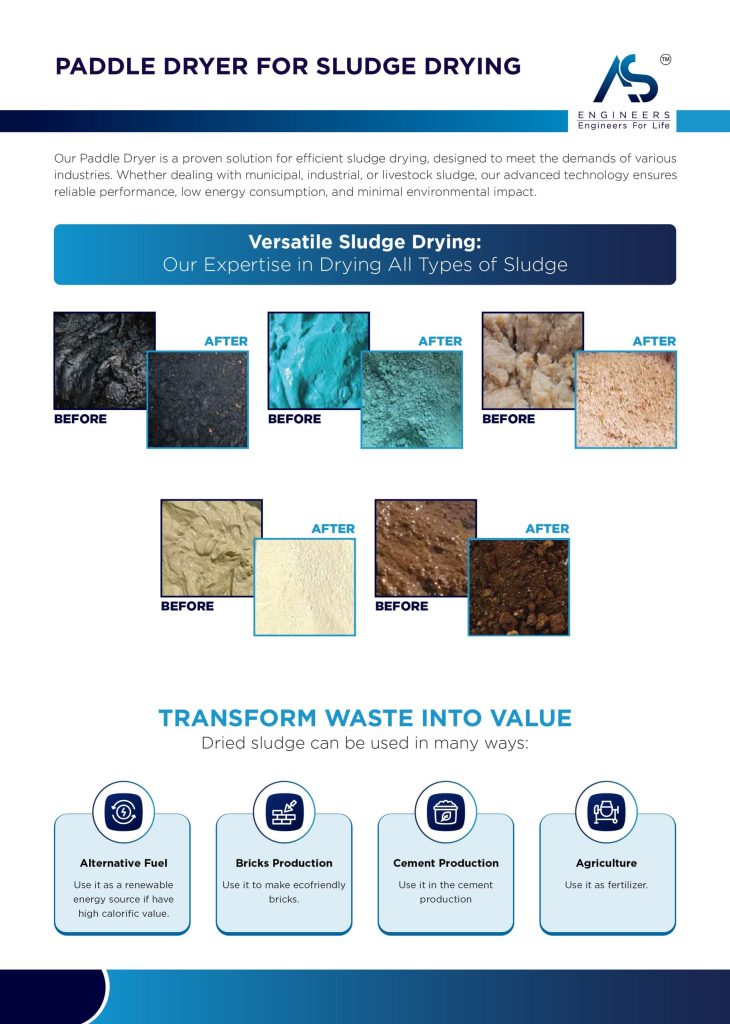
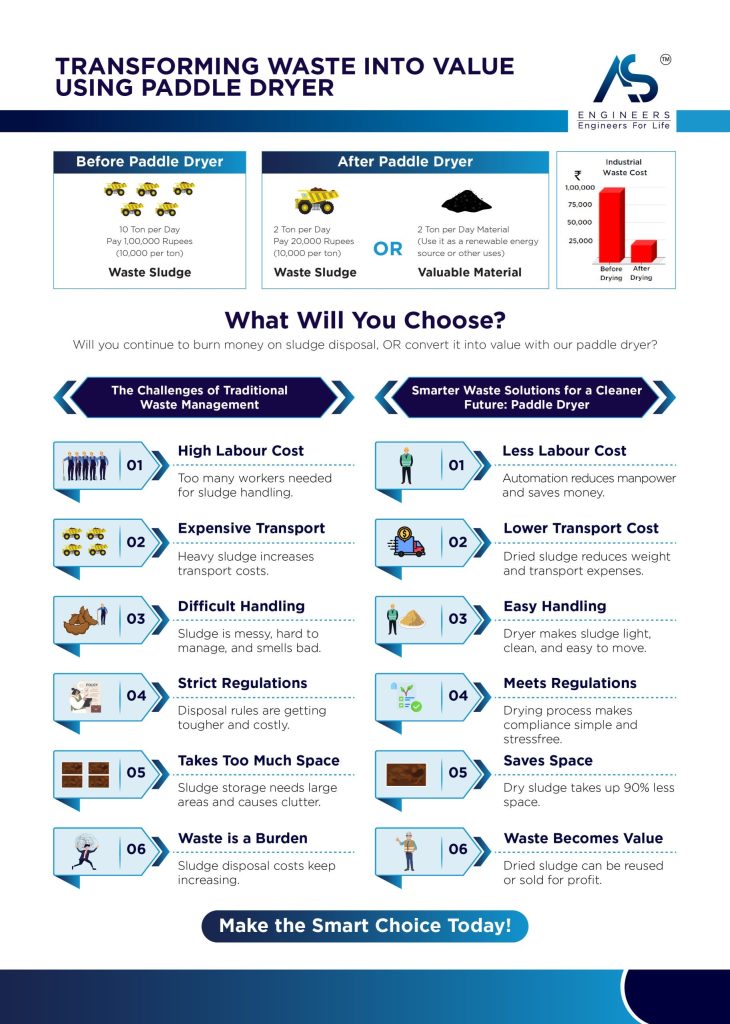
Faecal sludge becomes expensive and risky to manage when it remains wet. Wet sludge is heavy, odorous, difficult to store, harder to transport, and more likely to create complaints around the plant. Drying reduces free moisture, improves handling, reduces transport load, and supports controlled downstream use or disposal.
Drying can be done in different ways:
| Drying route | What it does | Where it fits |
|---|---|---|
| Open drying bed | Uses drainage and evaporation | Low-cost sites with land and suitable weather |
| Covered drying bed | Protects drying from rainfall | Monsoon-prone areas |
| Solar/greenhouse drying | Uses solar heat with enclosure | Sites needing better drying than open beds |
| Mechanical dewatering plus drying | Press or centrifuge reduces water before final drying | Compact or higher-throughput plants |
| Thermal drying | Uses controlled heat to reduce moisture further | Plants needing smaller disposal volume, better handling, or fuel/co-processing route |
When I review a sludge drying requirement, I do not start with the dryer model. I first ask about incoming sludge source, total solids, volatile solids, grit, trash load, dewatering stage, moisture target, final disposal route, available fuel, odor-control requirement, and whether the project has approval for the intended reuse route.
Where a sludge dryer fits in an FSTP
A sludge dryer is usually not the first unit after tanker unloading. In most FSTP layouts, raw faecal sludge should first pass through screening, grit control, and solid-liquid separation. A dryer becomes relevant when the separated solids or dewatered cake still need further moisture reduction.
A thermal sludge dryer may be considered when:
- land for passive drying beds is limited;
- monsoon or humidity makes passive drying unreliable;
- transport distance makes wet sludge expensive;
- the plant needs a more consistent dry solids output;
- downstream disposal, co-processing, compost blending, or controlled storage requires lower moisture;
- odor and covered handling are important;
- the project has budget and trained operators for fuel, heat, vapor, and safety management.
A thermal dryer may not be the right first choice when the sludge is extremely dilute, screening is poor, fuel is unavailable, maintenance capability is weak, or final disposal approval is unclear.
For broader sludge drying selection, connect this page to thermal sludge drying systems, sludge dryers guide, and sludge dewatering equipment selection.
How AS Engineers can support the drying stage
AS Engineers’ verified product ecosystem includes paddle dryer/sludge dryer, centrifugal blower, pollution control equipment, and turnkey solution capabilities in company source material. The AS Engineers catalog also describes sludge drying systems with fuel resources, heating system, feeding system, paddle dryer, scavenging system, pollution control system, solvent management, and product handling system.
For FSTP and septage projects, AS Engineers should be positioned carefully as a sludge drying and solids-handling equipment partner, not as a blanket municipal approval authority. The right fit is usually the dewatered solids stage, where sludge has already passed through screening and separation.
Relevant AS Engineers drying inputs include:
| Input | Why AS Engineers needs it |
|---|---|
| Source of sludge | Septic tank, pit latrine, public toilet, STP sludge, mixed sewage sludge |
| Daily solids quantity | Dryer sizing depends on solids load, not only tanker volume |
| Feed moisture | Determines heat load and dryer residence time |
| Final moisture target | Affects dryer selection and discharge handling |
| Sludge consistency | Sticky, pasty, fibrous, granular, gritty, or pumpable |
| Screening quality | Rags, plastics, grit, and stones can damage equipment |
| Heating medium | Steam, thermic fluid, hot water, or other approved heat source |
| Available fuel | Gas, LDO, biomass, electricity, or site-specific source |
| Vapor and odor handling | Determines ducting, ID fan, scrubber, condenser, or chimney needs |
| Final disposal route | Composting, landfill, co-processing, fuel use, or other approved route |
The AS Engineers source documents describe indirect heating using steam or thermal oil, self-cleaning wedge-shaped paddles, hollow shafts and jacket heat transfer, dual counter-rotating shafts, and sludge drying system integration with cyclone, scrubber, bag filter, ID blower, condenser, screw conveyor, bagging, silo, bucket elevator, and truck disposal options.
Passive drying bed vs thermal drying in FSTP projects
| Selection factor | Passive drying bed | Thermal sludge dryer |
|---|---|---|
| Land requirement | High | Lower |
| Energy requirement | Low | Higher |
| Weather dependency | High | Lower |
| Monsoon reliability | Weak unless covered | Better if designed properly |
| O&M skill | Lower to moderate | Moderate to high |
| Output consistency | Variable | More controllable |
| Odor control | Difficult in open systems | Can be enclosed and ducted |
| Capital cost | Usually lower | Usually higher |
| Best use | Small towns, available land, simple O&M | Land-limited, higher-throughput, controlled solids reduction projects |
A passive drying bed can be the correct answer for many small FSTPs. Thermal drying becomes more relevant when land, seasonality, transport cost, odor management, or output consistency becomes a major constraint.
Common mistakes in FSTP drying projects
Mistake: sizing only by tanker KLD
Tanker volume is not enough. A 20 KLD FSTP with dilute septage and a 20 KLD FSTP with high-solids pit sludge are not the same design problem. Solids load, TS, TSS, TVS/TSS, grit, and moisture target matter.
Mistake: sending unscreened sludge to mechanical equipment
Rags, stones, plastics, and grit increase wear and blockage risk. Screening and grit control must be treated as equipment protection, not as optional civil work.
Mistake: assuming drying equals sanitization
Drying improves handling and reduces moisture. It does not automatically prove pathogen safety, fertilizer suitability, or legal reuse eligibility. Final use needs lab testing and local regulatory approval.
Mistake: ignoring vapor and odor handling
Thermal drying releases vapor and odor-bearing air. The system must plan for ducting, ID fan, scrubber, condenser, chimney, or other approved treatment route depending on site conditions.
Mistake: copying another town’s FSTP design
Faecal sludge characteristics, climate, land cost, operator skill, local disposal rules, and final reuse markets differ from site to site. A design that works in one district can fail in another.
RFQ checklist for faecal sludge drying systems
Before asking for a sludge dryer quotation for an FSTP, prepare these details:
| RFQ input | Required details |
|---|---|
| Project type | New FSTP, FSTP upgrade, STP co-treatment, drying stage retrofit |
| Plant capacity | KLD incoming sludge plus expected peak tanker flow |
| Solids load | TS, TSS, TVS/TSS if available |
| Feed to dryer | Raw sludge, thickened sludge, dewatered cake, drying bed output |
| Feed moisture | Current moisture range |
| Final moisture target | Required dry solids or handling target |
| Sludge source | Septic tanks, pit latrines, public toilets, institutional sewage, mixed sludge |
| Contaminants | Grit, plastics, cloth, grease, sand, stones |
| Existing upstream equipment | Screens, grit chamber, thickener, drying bed, screw press, centrifuge |
| Available utilities | Steam, thermic fluid, electricity, fuel, water, compressed air |
| Vapor treatment | Scrubber, condenser, chimney, odor-control requirement |
| Space available | Dryer area, maintenance access, truck movement, covered storage |
| Final route | Disposal, composting, co-processing, fuel, storage, landfill, reuse |
| Compliance responsibility | Local consultant, ULB, EPC, pollution control authority, lab testing agency |
| Operating model | Municipal team, private operator, EPC O&M, contractor model |
Share these inputs before final selection. Without them, any dryer quote will be incomplete.
Planning checklist for municipalities, EPCs, and consultants
Use this checklist before finalizing an FSTP layout:
| Check | Why it matters |
|---|---|
| Service area and desludging frequency | Defines incoming volume and scheduling |
| Tanker access and road width | Prevents unloading bottlenecks |
| Buffer distance and odor control | Reduces public complaints |
| Monsoon management | Prevents bed flooding and rewetting |
| Screenings disposal route | Avoids accumulated trash at plant |
| Sludge characterization | Prevents over-sizing or under-sizing |
| Liquid treatment capacity | Protects discharge/reuse compliance |
| Solids drying strategy | Controls transport, storage, and final handling |
| O&M budget | Keeps plant functional after commissioning |
| Lab testing plan | Supports safe disposal or reuse decision |
| Emergency storage | Handles tanker surges and downtime |
| Operator safety | Reduces disease exposure and accident risk |
India’s FSSM advisory for small and medium towns emphasizes that technology choice should consider town class, on-site sanitation strengthening, treatment options, and local site conditions. It also lists drying beds and mechanized dewatering among technology options, depending on project needs.
Practical fit guide
| Site condition | Recommended direction |
|---|---|
| Small town, low budget, available land | Planted or unplanted drying bed with proper liquid treatment |
| High rainfall or monsoon impact | Covered drying beds, greenhouse-assisted drying, or hybrid drying |
| Limited land near urban area | Mechanical dewatering and possible thermal drying |
| Existing STP with spare capacity | Evaluate controlled co-treatment, not blind dumping |
| High odor complaint risk | Enclosed receiving, covered handling, odor ducting and treatment |
| Long transport distance to disposal site | Improve dewatering and drying to reduce wet load |
| Reuse as compost or manure desired | Treat as regulated output, verify pathogen and contaminant levels |
| Co-processing or fuel route considered | Check calorific value, ash, moisture, metals, and buyer acceptance |
| Weak O&M capability | Avoid overly complex equipment unless operator training and AMC are secured |
Conclusion
A faecal sludge treatment plant is not only a sanitation asset. It is a complete solids and liquid management system that must work in real operating conditions. The plant must receive tanker sludge safely, remove debris and grit, separate solids and liquids, treat the percolate, dry or stabilize the solids, and verify the final disposal or reuse route.
For FSTP projects, drying should be selected with discipline. Open drying beds may be suitable where land and climate support them. Covered beds, greenhouse drying, mechanical dewatering, and thermal drying become important when land is limited, monsoon affects drying, transport cost is high, or consistent solids output is required.
If you are planning an FSTP drying stage, do not send only KLD capacity. Share the sludge source, feed moisture, solids data, dewatering method, final moisture target, fuel availability, vapor/odor handling requirement, and final disposal route. AS Engineers can review the sludge drying requirement and suggest a dryer-side configuration based on actual site and process conditions.
FAQs
What is a faecal sludge treatment plant?
A faecal sludge treatment plant receives and treats sludge from septic tanks, pit latrines, community toilets, and other on-site sanitation systems. It usually includes tanker receiving, screening, solid-liquid separation, liquid treatment, sludge drying or stabilization, and final disposal or reuse after testing.
Is an FSTP the same as an STP?
No. An STP treats wastewater carried through a sewer network. An FSTP treats concentrated sludge and septage transported by tankers from on-site sanitation systems. FSTPs usually face higher variation in solids, grit, odor, and sludge consistency.
Can faecal sludge be dried in a sludge dryer?
Yes, but usually after screening and dewatering. Raw tanker sludge is often too variable and dilute for direct thermal drying. A dryer is more practical for thickened sludge, dewatered cake, or solids that need further moisture reduction before disposal or approved reuse.
Which is better for FSTP, drying bed or thermal dryer?
Drying beds are better where land is available, energy budget is low, and climate supports evaporation. Thermal dryers are better where land is limited, monsoon affects drying, output consistency is important, or transport/disposal cost of wet sludge is high.
Is dried faecal sludge safe to use as fertilizer?
Not automatically. Dried faecal sludge can be considered for reuse only after proper treatment, pathogen reduction, contaminant testing, and local regulatory approval. Moisture reduction alone should not be treated as proof of safety.