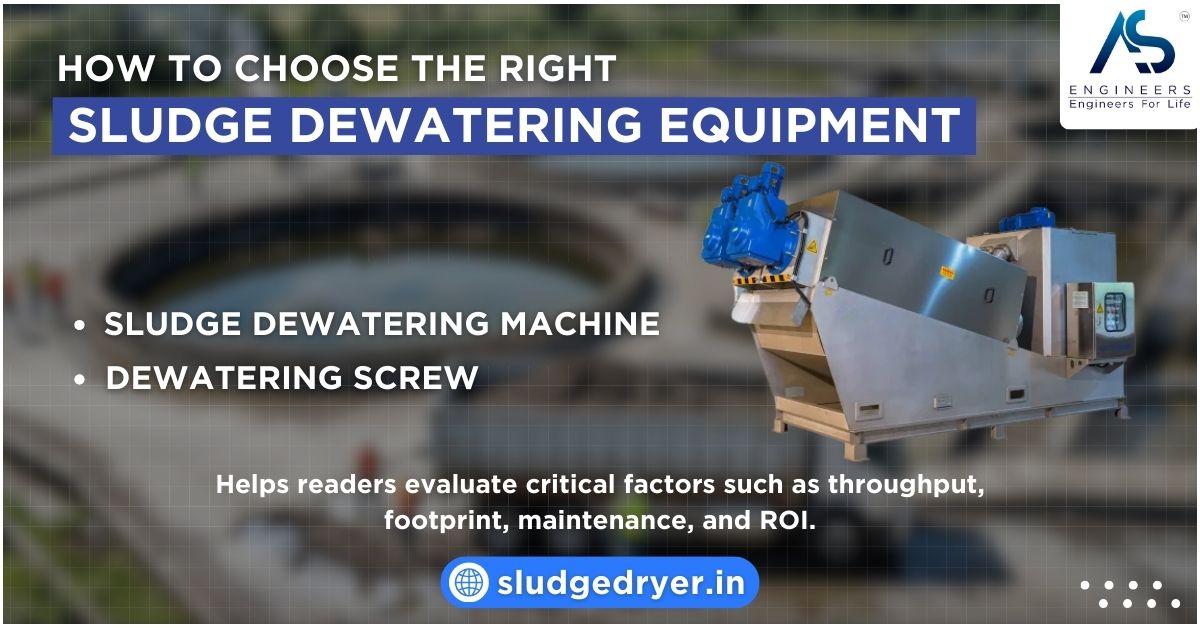
Choosing the right sludge dewatering equipment depends on sludge type, feed solids, required cake dryness, daily sludge load, disposal route, operating cost, available space, and maintenance capacity. A screw press, belt filter press, centrifuge, and filter press can all work, but they do not deliver the same cake dryness, power use, operator demand, or long-term cost.
For many ETP and STP plants, the correct answer is not only “which dewatering machine should we buy?” The better question is, “What final sludge condition do we need before transport, disposal, reuse, co-processing, or thermal drying?”
Dewatering is only one stage in sludge handling
Sludge handling normally moves through four practical stages:
| Stage | Purpose | Typical equipment or process |
|---|---|---|
| Thickening | Increase solids concentration before mechanical equipment | Gravity thickener, DAF, sludge thickener |
| Conditioning | Improve water release from sludge | Polymer dosing, lime conditioning, pH adjustment |
| Dewatering | Convert liquid or semi-liquid sludge into handleable cake | Screw press, belt filter press, centrifuge, filter press |
| Drying | Remove additional moisture using heat when lower weight or better handling is required | Paddle sludge dryer, thermal sludge drying system |
If your plant is still comparing basic process stages, read this guide on sludge thickener fundamentals before finalizing a dewatering machine.
First define what your plant actually needs
Before comparing machines, collect these inputs:
| Input | Why it matters |
|---|---|
| Sludge source | STP sludge, ETP sludge, biological sludge, chemical sludge, oily sludge, and paint sludge behave differently |
| Feed solids percentage | Low-solids sludge may need thickening before dewatering |
| Wet sludge kg/day or tons/day | Determines equipment size, cycle frequency, and automation level |
| Peak sludge generation | Average load alone can lead to undersizing |
| Oil, grease, fiber, grit, and abrasive solids | Affects clogging, wear, filter cloth life, and screw/bowl wear |
| Required final cake dryness | Drives selection between screw press, belt press, centrifuge, filter press, or dryer |
| Disposal or reuse route | TSDF, landfill, composting, co-processing, incineration, cement use, or internal reuse may require different moisture limits |
| Available space and utilities | Floor area, headroom, drainage, wash water, power, compressed air, and access for maintenance matter |
| Operator availability | Some systems need closer monitoring, cleaning, and batch handling |
| Total cost of ownership | Power, polymer, cloth/belt replacement, spares, labor, maintenance, and avoided disposal cost should be included |
When I review a sludge dewatering equipment requirement, I do not start from machine price. I first check sludge behavior, disposal cost, required output moisture, plant layout, and whether the plant wants only dewatering or dewatering plus drying.
Quick equipment selection table
| Equipment | Best fit | Main strength | Main limitation |
|---|---|---|---|
| Screw press | Small to medium STP/ETP plants, low manpower sites, relatively consistent sludge | Compact, low-speed, low operator attention | Lower cake dryness compared with a filter press |
| Belt filter press | Continuous municipal STP or larger ETP sludge flow | Continuous operation and suitable for steady throughput | Needs belt washing, polymer control, and more floor space |
| Decanter centrifuge | High-throughput plants with limited footprint | Compact and continuous with high processing capacity | Higher power, vibration, noise, and rotating-part maintenance |
| Filter press | Industrial ETP sludge where dry cake is important | Produces drier mechanically dewatered cake | Batch process, cycle time, cloth cleaning, and cake discharge handling |
| Paddle sludge dryer after dewatering | Plants where dewatered cake is still costly to transport or dispose | Further moisture reduction and improved handling | Requires heat source, vapour handling, and drying trial validation |
For a deeper overview of available technologies, also connect this page with sludge dewatering techniques and sludge dewatering machine guide.
Screw press: best for compact, low-attention operation
A screw press uses a slow-rotating screw to move sludge through a narrowing screen or dewatering zone. Water drains through the screen while solids move toward discharge as cake.
Choose a screw press when:
- Your plant has limited space.
- Operator availability is limited.
- Sludge generation is small to medium.
- Low-speed, low-noise operation is preferred.
- Your disposal route accepts moderate cake dryness.
- You want lower mechanical complexity than high-speed rotating equipment.
Be careful when sludge contains high fiber, grit, sticky material, or variable solids. These conditions can affect screen cleaning and output consistency.
A screw press is often selected because it looks simple, but it still needs correct polymer conditioning, feed control, and routine cleaning. Do not assume “low maintenance” means “no maintenance.”
Belt filter press: best for continuous large-flow sludge
A belt filter press uses gravity drainage and pressure between moving belts to remove water from conditioned sludge. The U.S. EPA describes belt filter presses as equipment used to remove water from liquid wastewater residuals and produce a non-liquid cake, with dewatering helping reduce volume and costs for storage, transfer, processing, end use, or disposal.
Choose a belt filter press when:
- Sludge flow is continuous.
- Your plant has enough floor space.
- Wash water is available.
- Operators can monitor belt tracking, belt tension, polymer dosing, and spray cleaning.
- You are handling municipal STP sludge or a steady industrial ETP sludge stream.
Avoid choosing a belt press only because it is familiar. In plants with variable industrial sludge, oil and grease, or frequent process changes, belt cleaning and polymer control can become daily pain points.
Decanter centrifuge: best for high-throughput compact layouts
A decanter centrifuge separates solids and liquid using high-speed rotation. It can be attractive where the plant needs continuous high-throughput dewatering but has limited space.
Choose a decanter centrifuge when:
- Throughput is high.
- Floor space is limited.
- The plant can manage power demand.
- Skilled maintenance support is available.
- Vibration, noise, rotating assembly wear, and balancing requirements are acceptable.
Centrifuges are not weak machines, but they are unforgiving when abrasive sludge, poor maintenance, or wrong operating settings are ignored. Bearings, scroll wear, vibration monitoring, and spare support should be checked before purchase.
Filter press: best when drier industrial ETP sludge cake matters
A filter press, including plate-and-frame or recessed chamber designs, is a batch dewatering system. It uses pressure through filter cloths to produce a relatively drier cake compared with many continuous systems.
Choose a filter press when:
- You are handling industrial ETP sludge.
- Disposal cost is high and cake dryness matters.
- Batch operation is acceptable.
- The plant can manage cake discharge and cloth washing.
- There is space for cake collection, trolley movement, and operator access.
If your plant handles chemical, pharma, textile, ceramic, paint, dye, pigment, agrochemical, or metal-processing sludge, filter press selection should include cloth material, plate design, chemical compatibility, feed pump selection, cake discharge method, and conditioning practice.
For a focused page on this equipment type, connect this article to plate and frame sludge press.
When mechanical dewatering is not enough
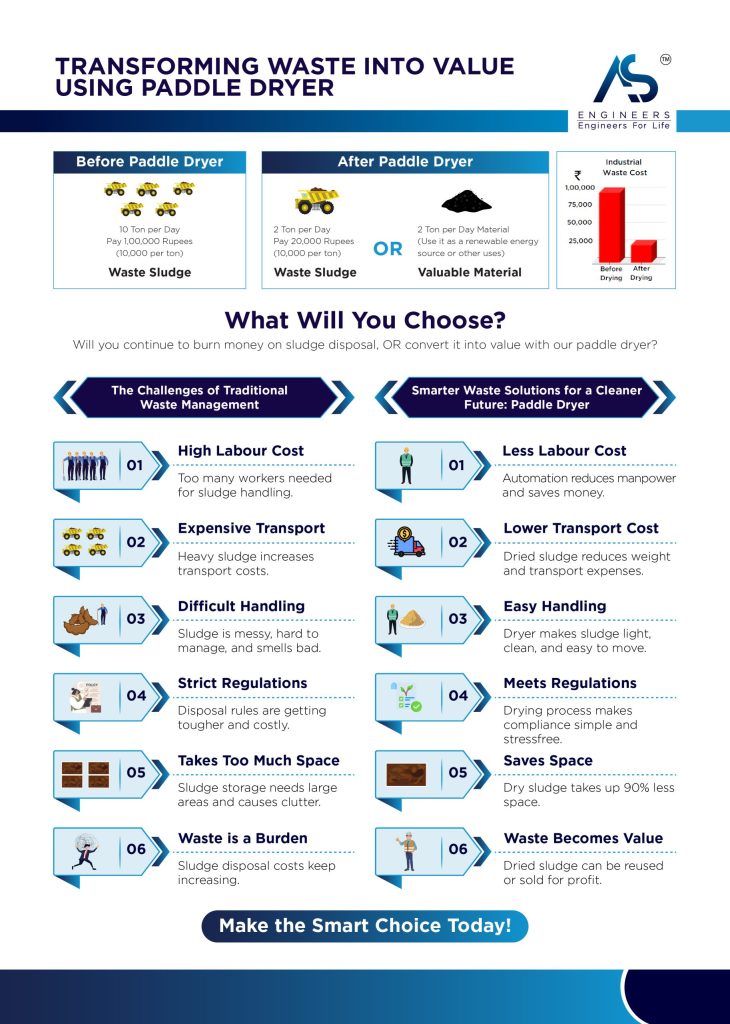
Mechanical dewatering reduces free water, but it normally does not remove enough bound moisture for every disposal or reuse route. If the plant still pays high transport or disposal cost after dewatering, thermal drying may be worth evaluating.
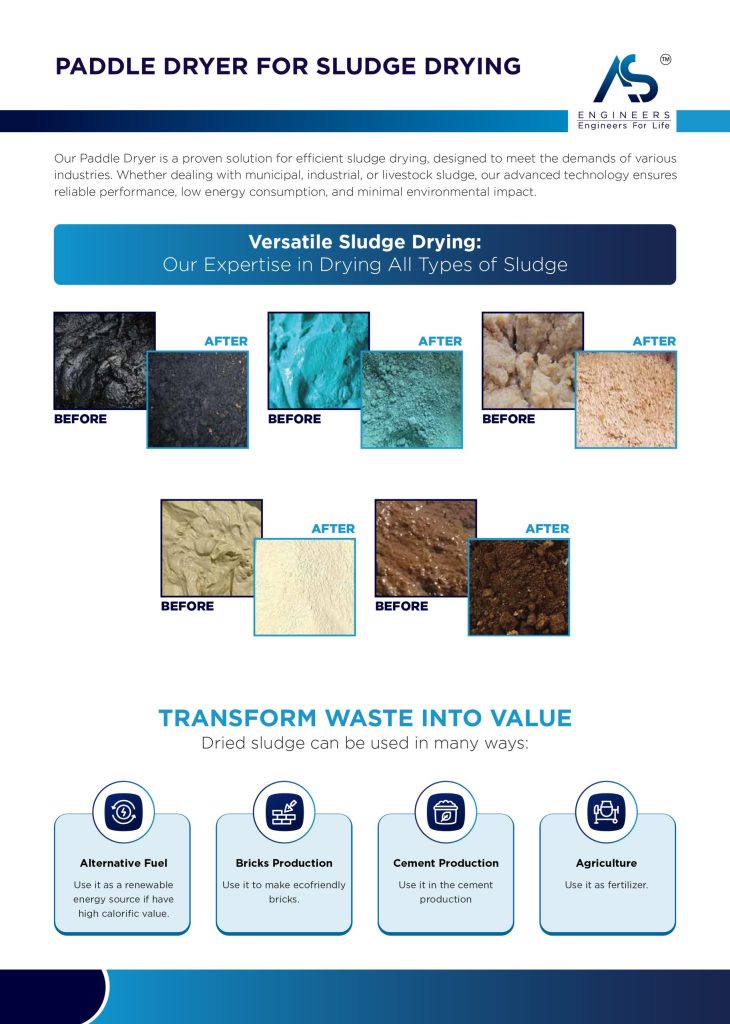
This is where a thermal sludge drying system becomes relevant. A paddle dryer is often used downstream of dewatering when the plant wants lower moisture, lower sludge weight, improved handling, reduced storage volume, or better suitability for selected reuse or co-processing routes.
AS Engineers’ paddle dryer design uses indirect heat transfer through hollow shafts and jacketed surfaces, with paddle agitation to move and break down wet cake. AS Engineers’ source documents show configurations such as standard dryer, dual zone dryer, vacuum dryer, feeding system, heating system, scavenging system, pollution control equipment, solvent management, and product handling system.
For broader understanding, use guide to sludge dryers and AS Engineers’ sludge dryer manufacturer page as supporting links.
Selection by sludge type
| Sludge type | Selection note |
|---|---|
| Municipal STP sludge | Belt press, centrifuge, or screw press can work depending on flow, operator skill, and cake dryness target |
| Biological sludge | Conditioning is important because biological sludge can hold water strongly |
| Chemical ETP sludge | Filter press is often preferred when dry cake and disposal cost are major concerns |
| Oily sludge | Test before selection because oil and grease can affect polymer response, cloth blinding, and screen cleaning |
| Textile sludge | Check color, fiber, chemical load, and final disposal requirement |
| Pharma or chemical sludge | MOC, hazardous classification, solvent trace, pH, and disposal route must be reviewed carefully |
| Paint or pigment sludge | Abrasion, stickiness, and filter cloth blinding risk should be checked |
| ZLD sludge | Dewatering and drying may both be required depending on salt load, moisture target, and disposal route |
If your sludge category is still unclear, start with what is sludge and industrial sludge disposal guide.
Selection by final objective
| Plant objective | Better direction |
|---|---|
| Reduce liquid sludge volume before transport | Thickening plus mechanical dewatering |
| Make cake easier to handle | Screw press, belt press, centrifuge, or filter press based on sludge type |
| Achieve drier industrial cake mechanically | Filter press |
| Handle large continuous STP sludge flow | Belt filter press or centrifuge |
| Reduce operator attention in small to medium plants | Screw press |
| Reduce downstream disposal weight beyond mechanical dewatering | Add thermal drying after dewatering |
| Prepare for reuse, fuel, cement, or other value route | Dewatering plus drying, subject to sludge composition and regulatory approval |
Do not assume dried sludge can always be reused. Sewage and industrial sludge may contain contaminants, pathogens, heavy metals, chemicals, oil, or salts. End use must be checked through testing and applicable regulatory route.
Total cost of ownership matters more than purchase price
Many plants compare only machine price. That is a procurement mistake.
A better sludge dewatering equipment comparison includes:
- Machine purchase cost
- Civil foundation and installation
- Polymer system
- Feed pump
- Cake discharge arrangement
- Wash water system
- Power consumption
- Operator manpower
- Cloth, belt, screw, bearing, or wear part replacement
- Downtime risk
- Spares availability
- Maintenance contract
- Disposal cost before and after dewatering
- Need for downstream drying
- Space cost and storage cost
- Documentation and reporting requirement
Use this simple decision formula:
True monthly cost = equipment operating cost + maintenance cost + chemical cost + labor cost + disposal cost after dewatering
Then compare it with:
Current monthly cost = wet sludge handling + transport + disposal + storage + operator effort
Only then can the plant understand whether a screw press, belt press, centrifuge, filter press, or sludge dryer gives the better long-term result.
Do not ignore compliance and documentation
For Indian plants, sludge disposal is not only a mechanical handling issue. ETP and STP sludge must be characterized and routed according to applicable state pollution control board, CPCB, TSDF, co-processing, or reuse requirements.
At minimum, your plant should maintain:
- Sludge generation quantity
- Sludge test reports
- Moisture percentage before and after treatment
- Disposal route
- Transport records
- Storage records
- Authorization and consent-related documents
- Vendor equipment manual
- Maintenance records
- Operator training records
- Trial and commissioning reports
This page is not a legal compliance document. For hazardous sludge, co-processing, land application, reuse, or TSDF disposal, confirm the latest applicable requirement with your EHS consultant and state pollution control board.
RFQ checklist for sludge dewatering equipment
Send this information before asking for a quotation:
| RFQ input | Details to provide |
|---|---|
| Plant type | ETP, STP, CETP, ZLD, process plant, municipal plant |
| Industry | Chemical, pharma, textile, food, paper, ceramic, paint, dye, refinery, agrochemical, municipal |
| Sludge type | Biological, chemical, mixed, oily, hazardous, non-hazardous, sewage, industrial |
| Wet sludge quantity | kg/day or tons/day, average and peak |
| Feed solids | TS percentage and moisture percentage |
| Existing treatment | Thickener, DAF, clarifier, filter press, drying bed, centrifuge, screw press |
| Current disposal route | TSDF, landfill, co-processing, incineration, reuse, composting, other |
| Current disposal cost | Cost per kg or ton, if available |
| Required cake dryness | Final moisture or dry solids target |
| Space available | Floor area, headroom, discharge area |
| Utilities available | Power, water, compressed air, steam, thermic fluid, fuel |
| Automation need | Manual, semi-automatic, PLC, SCADA integration |
| Material concern | pH, chloride, solvent, corrosive, abrasive, sticky, fibrous, oily |
| Downstream dryer need | Required if mechanical dewatering is not enough |
| Trial requirement | Lab test, pilot test, or on-site trial requirement |
For drying after dewatering, AS Engineers can review feed moisture, final moisture target, heating medium, throughput, vapour handling, and discharge handling through its paddle dryer and sludge dryer engineering support.
Common mistakes while selecting sludge dewatering equipment
| Mistake | Why it hurts the plant |
|---|---|
| Selecting only by lowest machine price | Can increase polymer, power, downtime, disposal, and maintenance cost |
| Ignoring sludge testing | Real sludge behavior often differs from brochure assumptions |
| Using average sludge flow only | Peak load can overload the machine |
| Not checking cake discharge | Dry cake handling can become a bottleneck |
| Ignoring polymer preparation | Poor conditioning reduces cake dryness and filtrate quality |
| No space for maintenance | Equipment becomes difficult to service after installation |
| No plan for filtrate return | Filtrate quality affects upstream ETP/STP load |
| Assuming dewatering equals drying | Mechanical dewatering and thermal drying solve different moisture problems |
| Not checking disposal route acceptance | Cake dryness alone does not prove reuse or disposal suitability |
| Missing spares and service support | Downtime can stop sludge handling quickly |
Where AS Engineers fits in the decision
AS Engineers is not only connected with sludge drying. Its wider ecosystem includes paddle dryer/sludge dryer systems, centrifugal blowers, pollution control equipment, and supporting systems such as bag filters, scrubbers, cyclones, conveying, and product handling.
For plants where dewatering alone is not enough, AS Engineers can review whether a downstream paddle sludge dryer is technically and commercially sensible. The drying system may include feeding, indirect heating, scavenging, ID fan, cyclone, scrubber or bag filter, condenser or chimney, and dried product handling depending on the sludge and vapour condition.
AS Engineers also supports pilot trials for drying validation. Before committing to a full-scale dryer, plants can share sludge samples and operating data to evaluate feasibility, moisture reduction, handling behavior, and process risks.
For related support, see AS Engineers’ pollution control equipment and Acmefil’s zero liquid discharge system page where broader wastewater and concentration systems are relevant.
Conclusion
The right sludge dewatering equipment is the one that matches your sludge, not the one that looks best in a catalogue. A screw press may be ideal for a compact low-attention plant. A belt filter press may suit continuous municipal or large ETP sludge. A centrifuge may work where high throughput and compact footprint are priorities. A filter press may be the better choice when industrial ETP sludge needs drier cake.
If mechanical dewatering still leaves costly wet cake, evaluate thermal sludge drying as the next step. Share your sludge source, wet sludge quantity, feed moisture, desired final moisture, disposal route, and plant layout before finalizing the equipment.
For an AS Engineers review, prepare the RFQ checklist above and connect your dewatering requirement with the right downstream sludge drying decision.
Frequently Asked Questions
What is the best sludge dewatering equipment?
There is no single best sludge dewatering equipment for every plant. Screw presses, belt filter presses, centrifuges, and filter presses all work under different conditions. The best choice depends on sludge type, feed solids, cake dryness target, operating hours, space, utilities, maintenance skill, and disposal route.
Which sludge dewatering equipment gives the driest cake?
A filter press generally produces a drier mechanically dewatered cake compared with screw presses, belt presses, and many centrifuge applications. Actual cake dryness depends on sludge characteristics, conditioning, pressure, cycle time, cloth condition, and operation.
Is sludge drying required after dewatering?
Sludge drying is required only when mechanical dewatering does not achieve the required final moisture, disposal weight reduction, storage improvement, or reuse condition. For high-disposal-cost industrial sludge, a paddle sludge dryer downstream of a filter press can be evaluated.
What is the difference between sludge thickening and sludge dewatering?
Sludge thickening increases solids concentration in dilute sludge before mechanical treatment. Sludge dewatering applies mechanical force to produce a handleable cake. Thickening reduces volume before dewatering, while dewatering prepares sludge for transport, disposal, drying, or further processing.
What information is needed for a sludge dewatering equipment quotation?
A useful quotation needs sludge source, industry, wet sludge quantity, feed solids, current moisture, desired cake dryness, daily and peak load, sludge test report, pH, oil and grease, abrasive or corrosive content, available utilities, space, automation need, and disposal route.