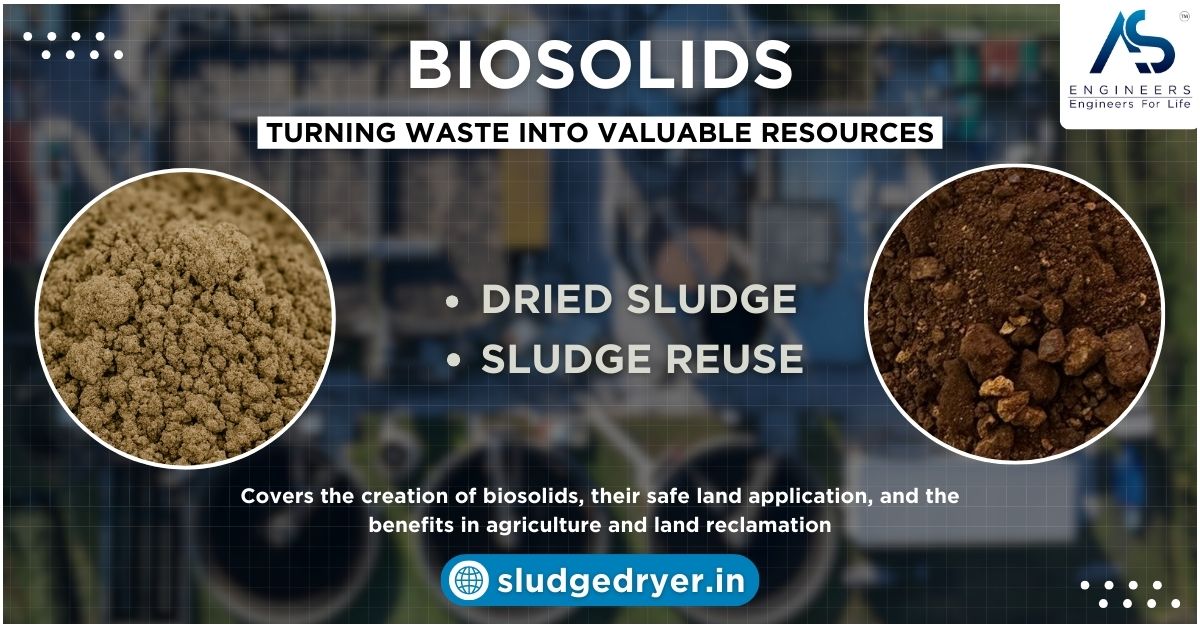
Biosolids are treated sewage sludge that can become a useful resource only when the sludge is properly stabilized, dried, tested, and approved for the intended end use. For STP operators, municipalities, wastewater consultants, and industrial plants, the real value is not just “reuse.” The value comes from reducing wet sludge volume, improving handling, lowering transport load, and creating a dry output that may be suitable for agriculture, cement, fuel, bricks, or controlled disposal.
A sludge dryer plays an important role in this conversion because wet sludge is difficult to store, transport, reuse, or dispose of economically. Before drying, the sludge should be understood as part of the complete treatment chain: source, sludge type, dewatering level, contamination risk, final moisture target, and permitted end use.
What are biosolids?
Biosolids are treated sewage sludge from wastewater treatment plants. In simple terms, sludge becomes biosolids only after it has gone through treatment steps that reduce pathogens, stabilize organic matter, and make the material suitable for a defined reuse or disposal route.
This distinction matters.
Raw sludge is not automatically biosolids. Dewatered sludge is not automatically biosolids. Dried sludge is also not automatically safe for unrestricted use. The final classification depends on treatment quality, pathogen reduction, heavy metal levels, organic contaminants, moisture level, odour condition, nutrient profile, and local regulatory acceptance.
For a basic sludge-treatment foundation, read this guide on what sludge is and how it behaves in wastewater treatment.
Why biosolids matter in sludge management
Most wastewater treatment plants do not struggle only with treated water. They also struggle with the solid residue left behind after primary and secondary treatment. This sludge can be bulky, wet, odorous, biologically active, and expensive to transport.
Biosolids management helps plants move from a disposal-only mindset to a resource-recovery mindset.
The practical goals are:
| Plant-side problem | Biosolids and drying objective |
|---|---|
| High wet sludge volume | Reduce moisture and bulk before transport |
| Odour and hygiene issues | Improve handling through stabilization and drying |
| High disposal cost | Reduce mass sent to landfill, TSDF, or disposal site |
| Difficult manual handling | Convert sticky wet sludge into dry or semi-dry material |
| Limited storage space | Reduce storage footprint and improve logistics |
| No reuse pathway | Create a tested output that may support controlled reuse |
| EHS concern | Reduce exposure risk through contained handling and planned disposal |
For disposal comparison, connect this topic with land application vs incineration in sludge disposal.
Sludge to biosolids: the treatment chain
Biosolids are produced through a sequence of treatment steps. The exact system depends on plant size, sludge source, available land, budget, fuel, and final disposal route.
Sludge generation
Sludge usually comes from primary clarifiers, secondary clarifiers, biological treatment systems, STPs, ETPs, or mixed wastewater systems. In municipal plants, the sludge may contain organic matter and nutrients. In industrial wastewater, the sludge can also contain process chemicals, metals, salts, oils, solvents, dyes, or other contaminants.
This is why sludge source matters before deciding reuse.
For STP-specific context, refer to STP sludge and sewage treatment guidance.
Thickening
Thickening increases the solids concentration before dewatering. It does not make sludge dry, but it reduces the amount of water that must be handled in the next stage. Gravity thickeners and mechanical thickeners are commonly used depending on sludge type and plant layout.
For selection comparison, see gravity vs mechanical sludge thickener comparison.
Stabilization
Stabilization reduces biological activity, odour risk, and pathogen load. It may involve anaerobic digestion, aerobic digestion, lime stabilization, composting, thermal processes, or other approved methods.
For biosolids reuse, stabilization is critical. Drying wet sludge without understanding stabilization status can create a dry material that is easier to move, but not necessarily acceptable for reuse.
Dewatering
Dewatering removes free water mechanically. Belt filter presses, screw presses, centrifuges, plate-and-frame presses, and filter presses may be used. Dewatering normally produces sludge cake, but this cake still contains significant moisture.
For a buyer-side comparison, read how to choose the right sludge dewatering equipment.
Thermal drying
Thermal drying removes additional moisture by evaporation. This is where a sludge dryer becomes valuable. Drying can reduce weight, improve storage, reduce transport load, and prepare the output for controlled reuse, co-processing, incineration, or disposal.
AS Engineers’ sludge drying approach is based on paddle dryer technology, where indirect heat transfer from hollow shafts and jacket surfaces dries sludge while wedge-shaped paddles agitate and move the material through the dryer. For detailed dryer selection, read how to choose a sludge paddle dryer.
How a sludge dryer helps convert sludge into useful biosolids
A sludge dryer does not replace testing, stabilization, or compliance approval. Its role is to reduce moisture and improve the physical condition of sludge so the material becomes easier to handle, transport, store, and evaluate for reuse.
In a paddle-type sludge dryer, heat is transferred indirectly through the hollow shaft, jacket, and heated surfaces. The paddles mix, shear, and expose sludge to the heated surfaces. This helps evaporate moisture while keeping the process more contained than open drying methods.
AS Engineers’ paddle dryer configuration includes feeding, heating, drying, scavenging, pollution-control, solvent/vapour handling, and product-handling systems depending on the application. Supporting equipment may include screw feeders, sludge pumps, FD blowers, ID blowers, cyclone separators, scrubbers, bag filters, condensers, screw conveyors, bagging systems, silos, or truck disposal systems.
For process-level understanding, visit thermal sludge drying system guide and advanced sludge drying technologies.
Possible end uses of dried biosolids
Dried biosolids can support different reuse or disposal routes, but only after testing and approval. The right use depends on sludge composition, final moisture, calorific value, nutrient value, ash content, heavy metals, pathogens, odour, contaminants, and buyer acceptance.
| Possible route | When it may fit | What must be checked first |
|---|---|---|
| Agriculture or soil conditioning | Municipal/STP sludge with useful nutrients and low contaminant risk | Pathogens, heavy metals, nutrient loading, pH, crop restrictions, local permission |
| Cement production | Dried material has acceptable ash, calorific value, and chemistry | Moisture, ash, chloride, sulphur, heavy metals, feeding consistency |
| Alternative fuel | Dried biosolids have usable calorific value | CV, moisture, ash, emissions impact, combustion compatibility |
| Brick production | Material can be blended without harming brick quality | Ash, organics, shrinkage, metals, odour, process compatibility |
| Land reclamation | Nutrient and organic matter value can support soil improvement | Site approval, metal limits, pathogen reduction, water contamination risk |
| Controlled disposal | Reuse is not suitable or not approved | Moisture, classification, disposal-site requirement, handling safety |
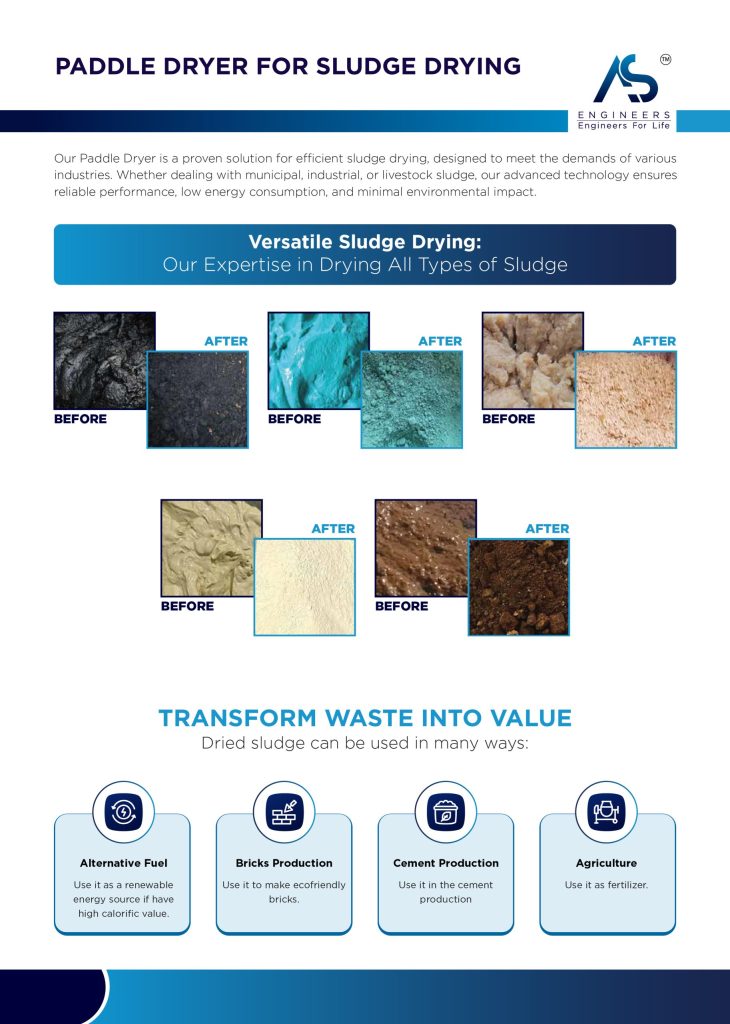
AS Engineers’ own sludge-drying material notes identify possible dried sludge uses such as alternative fuel, cement production, agriculture, and bricks production. In actual projects, these uses should be validated through lab reports and local approval before commercial adoption.
For the broader reuse topic, connect this page with sludge waste recycling.
Biosolids reuse is not only a drying decision
This is where many plant teams make a mistake. They assume that if sludge is dry, it is automatically valuable. That is not correct.
Dryness improves logistics. It does not automatically prove safety or market value.
Before claiming biosolids reuse, the plant should evaluate:
| Checkpoint | Why it matters |
|---|---|
| Sludge source | Municipal sludge, biological sludge, chemical sludge, and industrial sludge behave differently |
| Treatment method | Stabilization and pathogen reduction affect reuse eligibility |
| Final moisture | Moisture affects transport, storage, dust, fuel value, and shelf stability |
| Heavy metals | Metals can restrict agriculture and land application |
| PFAS and emerging contaminants | Some regions now evaluate these risks more strictly |
| Calorific value | Required for fuel or co-processing evaluation |
| Nutrient profile | Required for fertilizer or soil-conditioning claims |
| Odour condition | Impacts storage, public acceptance, and worker exposure |
| Dusting tendency | Over-dried granular biosolids may require enclosed handling |
| Local regulatory approval | Reuse depends on jurisdiction and end-use category |
For Indian industrial sludge and ETP-side decisions, this page should be read with industrial sludge disposal guide.
Where sludge drying creates measurable plant value
The strongest business case for sludge drying usually starts with logistics, not reuse.
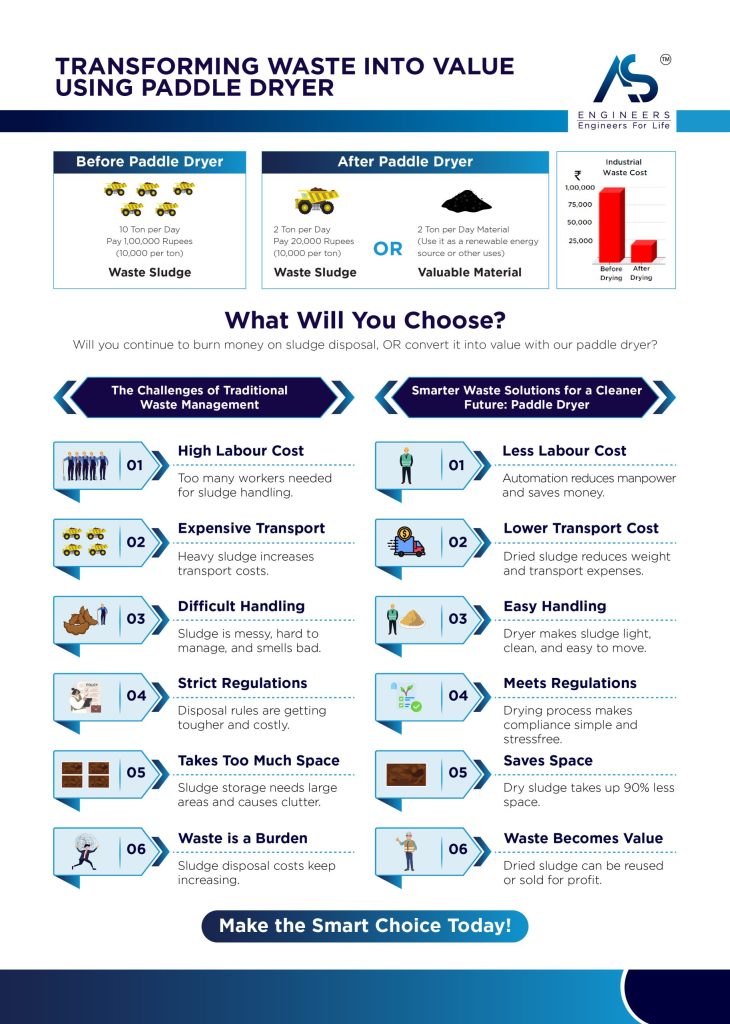
Wet sludge is expensive because it carries water. When plants mechanically dewater sludge and then thermally dry it, the transport and storage burden can reduce significantly. AS Engineers’ catalogue uses a sludge-drying example where 10 tons per day of wet sludge becomes 2 tons per day after drying, with the dried output either sent for lower-volume disposal or considered for value recovery depending on suitability.
That example should not be treated as a universal guarantee. It depends on initial moisture, final moisture target, sludge properties, dryer sizing, operating hours, fuel cost, and actual disposal rate.
A practical RFQ should ask for the calculation based on your own sludge data.
When biosolids reuse is suitable, and when it is not
Biosolids reuse is suitable when the sludge is stable, tested, accepted by the end user, and compliant with local requirements.
It may be suitable for:
- Municipal STP sludge with consistent composition
- Biological sludge with lower industrial contamination risk
- Dried sludge with proven nutrient value
- Dried sludge with acceptable calorific value for fuel use
- Cement or brick applications where chemistry is accepted
- Land reclamation where the application site is approved
It may not be suitable for:
- Untreated or partially treated raw sludge
- Sludge with high pathogen load
- Sludge with high heavy metals
- Industrial sludge with unknown contaminants
- Mixed sludge from chemical, dye, pharma, metal finishing, refinery, or hazardous processes
- Sludge with poor odour control
- Sludge with high PFAS or other emerging contaminant concern
- Any sludge without lab testing and documented approval
For high-risk sludge, use this support page on hazardous sludge management before considering any reuse language.
Common mistakes in biosolids projects
Calling all sludge “biosolids”
This creates technical and compliance risk. Sludge becomes biosolids only after treatment and acceptance for a specific use or disposal route.
Selecting a dryer only by tons per day
A sludge dryer should not be selected only by wet feed capacity. Feed moisture, final moisture target, sludge stickiness, heating medium, operating hours, MOC, vapour handling, dust control, and discharge method matter.
Ignoring the difference between dewatering and drying
Dewatering removes free water mechanically. Drying evaporates additional moisture using heat. Both may be required in the same sludge treatment chain.
Planning reuse without lab testing
Agriculture, cement, fuel, and brick applications all need different test data. A single moisture report is not enough.
Forgetting vapour and odour handling
Drying sludge produces vapour and may carry odour, fines, or volatile compounds depending on sludge type. Pollution-control and vapour-handling systems must be planned at the design stage.
Assuming agriculture is always the best route
Agriculture may be attractive, but it is also sensitive. For some sludge, cement, co-processing, brick production, or controlled disposal may be safer and more practical.
RFQ checklist for a biosolids sludge dryer
Before requesting a sludge dryer quotation, keep these inputs ready:
| RFQ input | Why AS Engineers needs it |
|---|---|
| Sludge source | STP, ETP, biological, chemical, municipal, industrial, or mixed |
| Wet feed quantity | Daily feed rate and operating hours define dryer load |
| Initial moisture | Required for evaporation-load calculation |
| Final moisture target | Impacts dryer size, fuel consumption, discharge form |
| Sludge behaviour | Sticky, pasty, fibrous, granular, oily, abrasive, corrosive, or odorous |
| Dewatering method | Filter press, centrifuge, belt press, screw press, drying bed, or direct feed |
| Heating medium | Steam, thermic fluid, hot water, or other heat source |
| Fuel availability | Gas, wood, coal, LDO, electricity, briquette, or site-specific option |
| MOC requirement | CS, SS304, SS316, duplex, or other alloy depending on corrosion risk |
| Vapour handling | Condenser, scrubber, cyclone, bag filter, ID blower, chimney |
| End-use plan | Disposal, fuel, cement, agriculture, bricks, or land reclamation |
| Lab reports | Moisture, ash, CV, pH, metals, pathogens, and contaminants |
| Site constraints | Space, height, civil foundation, utility availability, access for maintenance |
| Automation need | Manual, semi-automatic, or automated feeding and discharge |
When I review a sludge dryer requirement, I do not start with the dryer size alone. I first check the sludge source, moisture, stickiness, disposal route, available heating medium, vapour treatment requirement, and what the plant wants to do with the dried output. Without those inputs, the quotation may look simple but fail at site operation.
For dryer type and configuration, use paddle dryer configuration guide.
How AS Engineers supports sludge-to-value projects
AS Engineers manufactures paddle dryers and sludge dryers for industrial sludge drying, STP sludge drying, ETP sludge handling, and related drying applications. The system can be configured with feeding, indirect heating, drying, vapour handling, pollution-control, and dried-product handling sections.
The paddle dryer uses indirect heat transfer through hollow shafts and jacket surfaces. The system can be designed around steam, thermic fluid, hot water, or other site-specific heating arrangements. Depending on the requirement, dried material can move toward conveying, bagging, silo storage, truck disposal, or further processing.
AS Engineers also supports pilot trials, OEM spare parts, shaft, gearbox, bearing replacement, system repair, upgrades, and retrofitment for paddle dryer applications.
For broader company expertise, this AS Engineers resource on sludge thermal drying can support internal authority building. For related paddle dryer knowledge, refer to paddle dryer technology for sludge drying.
FAQs
Are biosolids the same as sewage sludge?
No. Sewage sludge is the solid or semi-solid material generated during wastewater treatment. Biosolids are treated sewage sludge that has met defined requirements for a specific reuse or disposal route. Untreated sludge should not be called biosolids.
Can dried sludge be used as fertilizer?
It may be possible only when the sludge is properly treated, tested, and approved for land application or soil-conditioning use. The plant must check pathogens, heavy metals, nutrients, pH, emerging contaminants, and local requirements before using dried sludge in agriculture.
Does a sludge dryer make sludge safe for reuse?
A sludge dryer reduces moisture and improves handling, but drying alone does not automatically make sludge safe for unrestricted reuse. Safety depends on the complete treatment chain, pathogen reduction, contaminant profile, and approved end use.
What final moisture is required for biosolids reuse?
There is no single final moisture target for every project. Agriculture, storage, cement use, alternative fuel, bricks, and disposal may need different moisture levels. The target should be defined during RFQ based on sludge testing and end-use planning.
What data should be shared for sludge dryer selection?
Share sludge source, daily feed quantity, initial moisture, target final moisture, sludge behaviour, dewatering method, heating medium, fuel availability, lab report, vapour-handling requirement, discharge plan, and final end-use objective.
Conclusion
Biosolids can turn sludge from a disposal burden into a managed resource, but only when the treatment chain is technically sound and legally safe. Drying improves the economics because it reduces moisture, weight, storage load, and handling difficulty. The reuse value depends on what the dried material proves through testing.
For STP operators, municipalities, EHS teams, and wastewater consultants, the right approach is simple: do not start with a reuse claim. Start with sludge characterization, treatment status, dewatering performance, final moisture target, end-use route, and regulatory acceptance.
Share your sludge source, feed quantity, initial moisture, final moisture target, heating medium, and disposal or reuse objective with AS Engineers. The team can review the duty condition and suggest a sludge dryer configuration based on actual plant requirements.