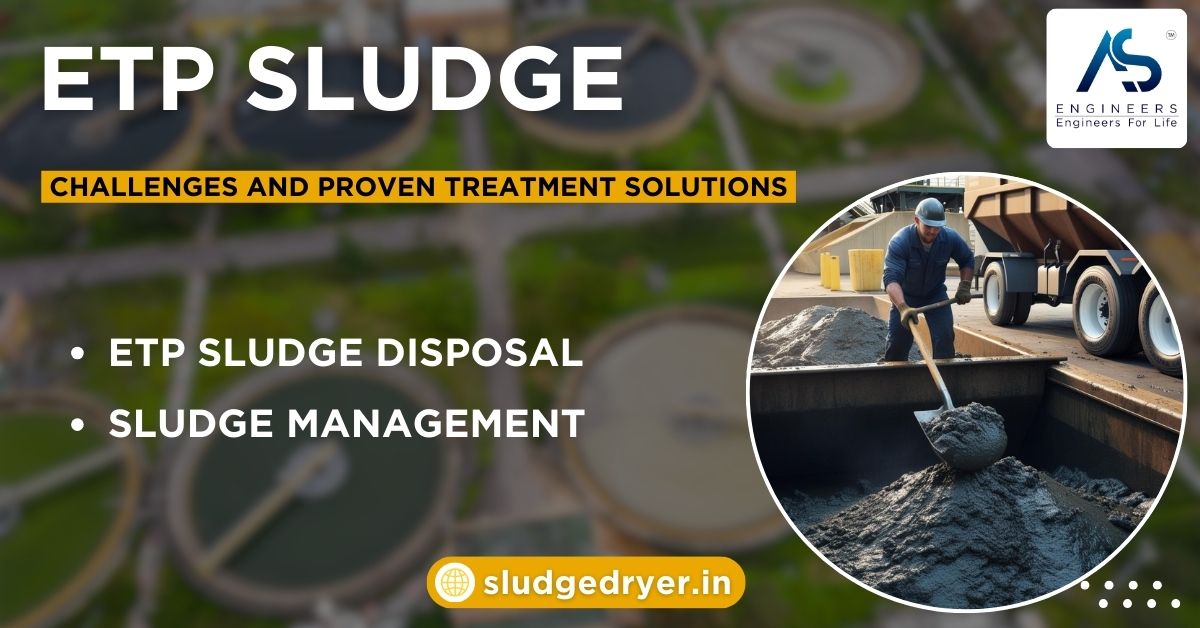
ETP sludge treatment starts with three practical steps: test the sludge, reduce free water, and choose an approved disposal or reuse route. For many industrial plants, mechanical dewatering followed by controlled thermal drying can reduce wet sludge handling, storage area, transport load and disposal burden. But drying does not automatically make hazardous sludge non-hazardous. The final route still depends on sludge composition, lab results, CPCB/SPCB requirements and the receiving facility’s approval.
This guide explains how to evaluate ETP sludge, compare treatment methods, and decide when a sludge dryer or paddle dryer makes sense for your plant.
For wider context, also read our industrial sludge disposal guide and sludge dewatering techniques guide.
What is ETP sludge?
ETP sludge is the solid or semi-solid residue generated during industrial wastewater treatment. It forms when suspended solids, chemicals, biological solids, precipitated contaminants, coagulants, flocculants, oils, dyes, metals, salts or organic residues are separated from wastewater.
The exact character of ETP sludge depends on the industry and process. Textile sludge is different from pharma sludge. Chemical sludge is different from food-processing sludge. CETP sludge is often more variable because it receives effluent from multiple units.
Common ETP sludge sources include:
| Industry | Typical sludge concern |
|---|---|
| Textile and dyeing | Colour, salts, chemicals, variable pH, possible heavy metals |
| Pharma and API | Organic residues, solvent traces, odour, corrosive or reactive chemistry |
| Chemical processing | Heavy metals, toxic compounds, high ash, corrosive pH |
| Food and beverage | High organic load, odour, biological instability |
| Paper and pulp | Fibrous sludge, high volume, variable moisture |
| CETP | Mixed industrial sludge, batch-to-batch variation |
The first mistake is treating all ETP sludge as the same material. It is not. A treatment route that works for one plant can be unsafe, uneconomical or non-compliant for another plant.
Why ETP sludge becomes difficult to dispose
ETP sludge is difficult because it carries both water and contaminants. Wet sludge increases transport weight, requires more storage space, creates handling problems and may generate odour. Contaminated sludge can also create soil, groundwater, worker-safety and compliance risks if it is stored or disposed incorrectly.
The most common ETP sludge challenges are:
| Challenge | What it means at plant level |
|---|---|
| High moisture | More weight, higher transport cost, poor storage stability |
| Sticky or pasty behaviour | Difficult feeding, bridging, clogging and poor discharge |
| Variable chemistry | Treatment method may change from batch to batch |
| Heavy metals or toxic compounds | Disposal route may require hazardous waste controls |
| Odour and VOC risk | Needs covered handling, ventilation or vapour management |
| High ash or salt | May restrict composting, land use or recovery options |
| Poor documentation | Creates compliance risk during audit or transport |
| Space requirement | Wet sludge pits and bags occupy valuable plant area |
From a plant manager’s point of view, sludge is not only a waste problem. It is a storage, logistics, maintenance, safety, compliance and cost problem.
Start with sludge testing before choosing treatment
Do not select a dryer, press, stabilizer or disposal vendor only from sludge quantity. The same tonnage can behave very differently depending on moisture, ash, pH, metal content and stickiness.
Before finalizing the treatment route, collect representative sludge samples and test the following:
| Test parameter | Why it matters |
|---|---|
| Moisture content | Defines dewatering and drying load |
| Total solids and volatile solids | Helps estimate organic content and drying behaviour |
| Ash content | Affects reuse, fuel value and final residue |
| pH | Influences corrosion, chemical stabilization and MOC |
| Heavy metals | Controls hazardous classification and reuse limits |
| Chlorides and sulphates | Important for corrosion and downstream use |
| Oil and grease | Can affect handling, odour and thermal behaviour |
| COD/BOD residue | Indicates organic load and possible biological instability |
| Calorific value | Needed if fuel or co-processing route is being evaluated |
| VOCs or solvent traces | Critical for enclosed drying, vapour handling and safety |
| Particle size and stickiness | Controls feeding, agitation, discharge and dryer selection |
For hazardous or mixed industrial sludge, testing and classification should be reviewed with the EHS team, consultant and authorized waste-handling route before treatment is finalized.
ETP sludge treatment methods compared
No single treatment method is best for every ETP sludge. The right route depends on sludge composition, moisture, site space, disposal fee, fuel availability, final use, regulatory classification and handling risk.
| Method | Best fit | Main limitation |
|---|---|---|
| Gravity thickening | Low-cost initial concentration | Limited moisture reduction |
| Mechanical dewatering | Filter press, screw press, belt press or centrifuge output | Removes free water, not bound moisture |
| Drying beds | Low-volume, low-risk sludge with available land | Weather-dependent, slow, high space requirement |
| Chemical stabilization | Odour, pH or pathogen control in selected sludge | Does not remove heavy metals |
| Thermal drying | Reducing moisture after dewatering | Needs heat source, vapour handling and correct dryer design |
| Composting | Low-contamination organic sludge | Not suitable for high heavy metals or toxic sludge |
| Co-processing or fuel route | Sludge with acceptable composition and calorific value | Needs authorization and acceptance from approved facility |
| Incineration | High-risk organic contaminants or volume reduction | Higher cost and emission-control requirement |
| Secure landfill or TSDF | Hazardous or non-reusable sludge | Disposal cost remains, documentation required |
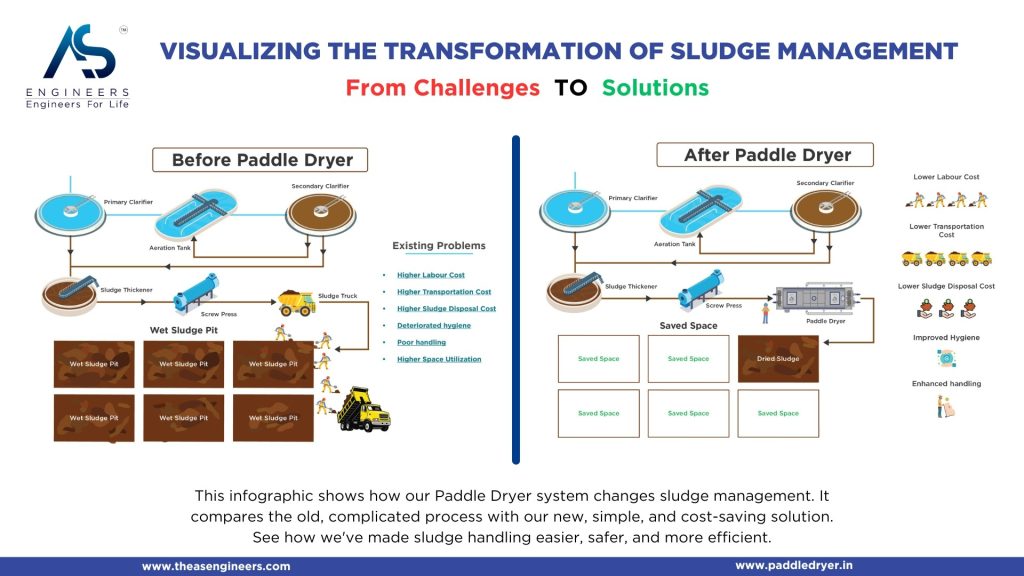
In many industrial plants, the strongest practical sequence is:
ETP sludge → thickening → mechanical dewatering → thermal drying → approved disposal, co-processing, recovery or reuse route
This sequence is especially useful where wet sludge transport, storage and disposal cost are major problems.
Where thermal drying fits in ETP sludge treatment
Mechanical dewatering removes free water. Thermal drying removes additional moisture by applying heat. This is why dewatering and drying should not be treated as the same step.
A filter press may convert slurry into cake, but the cake can still contain high moisture. Thermal drying is considered when the plant needs a drier, lighter, more manageable output.
Thermal drying may help when:
- Wet sludge transport cost is high.
- Sludge storage area is limited.
- Bags, pits or wet cake handling are creating hygiene issues.
- Final disposal is charged by weight or tonnage.
- The plant wants to evaluate approved co-processing, fuel, brick, cement or other recovery routes.
- The sludge is sticky and needs agitation during drying.
- ZLD or high-disposal-cost plants need better solid waste handling.
For a deeper dryer-level explanation, read our thermal sludge drying system guide.
Why paddle dryers are often considered for ETP sludge
A paddle dryer is an indirect heat transfer dryer. Heat is transferred through hollow shafts, paddles and jacketed surfaces. The heating medium does not directly mix with the sludge. This makes the system useful for sticky, pasty and high-moisture sludge where controlled agitation is required.
In an ETP sludge drying system, a paddle dryer can be placed after dewatering equipment such as a filter press, belt press, screw press or centrifuge.
A typical paddle dryer system may include:
| System area | Function |
|---|---|
| Feeding system | Moves dewatered sludge into the dryer through screw feeder, pump or conveyor |
| Paddle dryer body | Uses indirect heat and agitation to evaporate moisture |
| Hollow shafts and jacket | Transfer heat into sludge without direct flame contact |
| Wedge or hammer paddles | Mix, shear and move sticky sludge through the dryer |
| Vapour handling | Carries evaporated moisture and vapour away from dryer |
| Cyclone, scrubber or bag filter | Handles fines and exhaust stream depending on process need |
| Product handling | Discharges dry sludge through screw conveyor, bagging, silo or truck loading |
AS Engineers’ paddle dryer documentation includes indirect steam or thermal oil heating options, hollow shaft and jacket heat transfer, dual counter-rotating shafts, wedge-shaped self-cleaning paddles, plug-flow movement, and options such as standard, dual-zone and vacuum dryer configurations.
When a paddle dryer is a good fit
A paddle dryer may be suitable when the ETP sludge is sticky, pasty, high-moisture, difficult to handle, or costly to transport in wet form. It is also useful when the plant needs enclosed drying and better control over vapour and fines.
Good-fit conditions include:
- Dewatered ETP sludge cake from filter press or similar equipment.
- Sticky sludge that needs continuous agitation.
- Limited space compared with drying beds.
- High wet-sludge disposal cost.
- Requirement for controlled drying before approved disposal or reuse.
- Need for continuous operation.
- Available steam, thermic fluid, hot water or other suitable heating source.
- Requirement for MOC review because of corrosion or chemical load.
AS Engineers source material shows paddle dryers are used for industrial sludge, municipal sludge, paper sludge, bio-sludge and other process materials, with pilot trials available for material-specific evaluation.
When a paddle dryer may not be the right first step
A paddle dryer should not be selected blindly. It may not be the first recommendation when sludge chemistry is unknown, volume is too low for economic justification, or the final disposal route is not defined.
Review carefully when:
- Sludge is not tested for metals, solvents, pH or hazardous constituents.
- The plant cannot provide consistent feed data.
- The sludge contains volatile solvents or combustible components without safety review.
- There is no approved destination for dried output.
- Fuel or utility cost makes drying uneconomical.
- The plant only needs basic free-water removal, where mechanical dewatering is enough.
- The sludge has extreme corrosive, abrasive or scaling behaviour without pilot testing.
For sticky and variable sludge, a pilot trial is the safest way to confirm feeding, heat transfer, discharge behaviour, vapour load, final moisture and MOC suitability.
Disposal route decision flow for ETP sludge
Use this practical sequence before finalizing sludge treatment:
- Identify the sludge source
Note industry, process line, chemicals used, ETP stage and sludge generation rate. - Test and classify the sludge
Check moisture, pH, ash, metals, organics, solvents, salts, calorific value and hazardous characteristics. - Reduce free water
Use thickening and mechanical dewatering where suitable. - Check if additional drying is justified
Compare current disposal cost, transport distance, storage issue, handling difficulty and final moisture target. - Define the approved final route
Route may be TSDF, co-processing, incineration, landfill, fuel use, cement, brick or other approved utilization. - Match equipment to sludge behaviour
Sticky sludge, corrosive sludge, solvent-bearing sludge and high-ash sludge need different equipment design checks. - Document every movement
Maintain test reports, transport records, vendor approvals, manifests and disposal certificates where applicable.
In India, hazardous and other waste handling is controlled through CPCB/SPCB frameworks. CPCB lists the Hazardous and Other Wastes Rules and amendments, and CPCB’s specific utilization SOP page includes several ETP sludge utilization routes for different industries.
Compliance and safety checks before reuse or disposal
ETP sludge should not be reused only because it is dry. Drying reduces moisture. It does not remove metals, salts or toxic compounds unless a separate treatment route is used.
Before reuse or disposal, verify:
- Is the sludge hazardous or non-hazardous as per test results?
- Is the receiving facility authorized for this waste type?
- Is the intended use approved for this sludge category?
- Are transport and storage conditions documented?
- Are vapours, odours and fines controlled during drying?
- Is the operator trained for sludge handling and emergency response?
- Are leachate, spillage and stormwater pathways controlled?
- Are records maintained for audit and regulatory review?
CPCB guidance for hazardous and other waste co-processing states that utilization should be done after authorization from the State Pollution Control Board or Pollution Control Committee, based on CPCB SOPs or guidelines. CPCB’s storage guidance also emphasizes impervious flooring, spillage/leachate control, labelled containers, inspection, spill kits and emergency response planning for hazardous waste storage.
Plant-side RFQ checklist for ETP sludge dryer selection
When asking for a sludge dryer quotation, do not send only “we have 2 tons sludge per day.” That is not enough for correct selection.
Share these details:
| RFQ input | Required details |
|---|---|
| Sludge source | Industry, process, ETP stage, chemical sources |
| Quantity | kg/hr or ton/day, operating hours per day |
| Feed moisture | Current moisture after dewatering |
| Final moisture target | Disposal or reuse requirement |
| Sludge behaviour | Sticky, pasty, granular, fibrous, abrasive, corrosive |
| Lab report | pH, ash, metals, chloride, sulphate, VOC/solvent if applicable |
| Heating source | Steam, thermic fluid, hot water, electricity, fuel options |
| Site constraints | Space, height, access, foundation, utilities |
| Vapour handling | Odour, VOC, solvent, water vapour, scrubber requirement |
| MOC expectation | CS, SS304, SS316, duplex or special alloy if needed |
| Downstream handling | Bagging, screw conveyor, silo, truck loading |
| Final route | TSDF, co-processing, incineration, brick, cement, fuel, landfill |
| Automation need | Manual, semi-automatic or continuous operation |
| Service need | Spares, AMC, retrofitment, operator training |
This data helps avoid undersized dryers, wrong MOC, poor discharge, vapour handling gaps and unrealistic operating-cost estimates.
For equipment-level comparison, use our sludge dryer guide and how to choose sludge paddle dryer guide.
Common mistakes in ETP sludge treatment
Selecting equipment before testing sludge
Without testing, the plant may choose the wrong dryer, wrong MOC, wrong heating medium or wrong disposal route.
Treating drying as compliance approval
Drying helps handling and moisture reduction. It does not automatically approve land application, fuel use or disposal.
Ignoring vapour and odour load
ETP sludge may release odour, water vapour, fumes or solvent traces during drying. Vapour handling must be reviewed with the process condition.
Comparing only machine price
A low-cost machine can become expensive if it cannot handle sticky sludge, requires frequent cleaning, consumes more fuel or creates discharge blockage.
Not checking final disposal route
Dry sludge still needs an approved destination. Dryer selection and disposal strategy should be decided together.
Missing service and spare parts planning
Dryers, conveyors, rotary valves, gearboxes, bearings, seals and vapour-handling equipment need maintenance planning.
AS Engineers documentation lists support areas such as shaft, gearbox and bearing replacement, system repair and upgrades, retrofitment solutions and OEM spare parts for paddle dryer systems.
Practical treatment strategy for industrial plants
For most industrial ETPs, the practical strategy is not “choose one technology.” It is a treatment chain.
A sensible chain looks like this:
Sludge generation → characterization → thickening → dewatering → drying feasibility → dryer pilot/trial if needed → final disposal/reuse approval → documentation
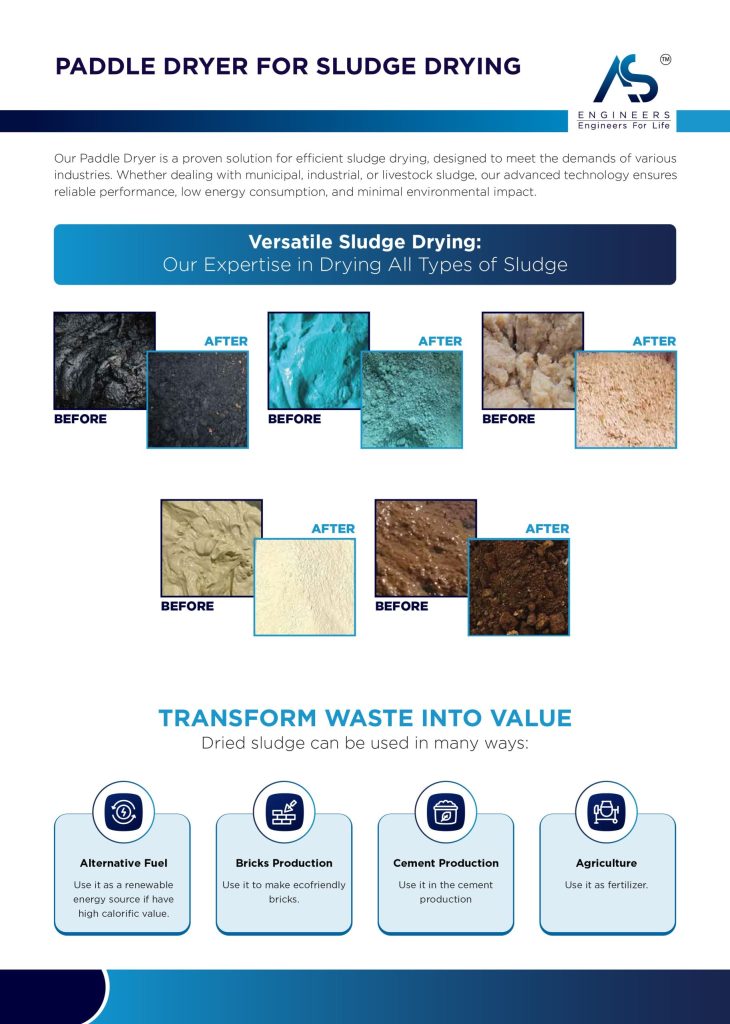
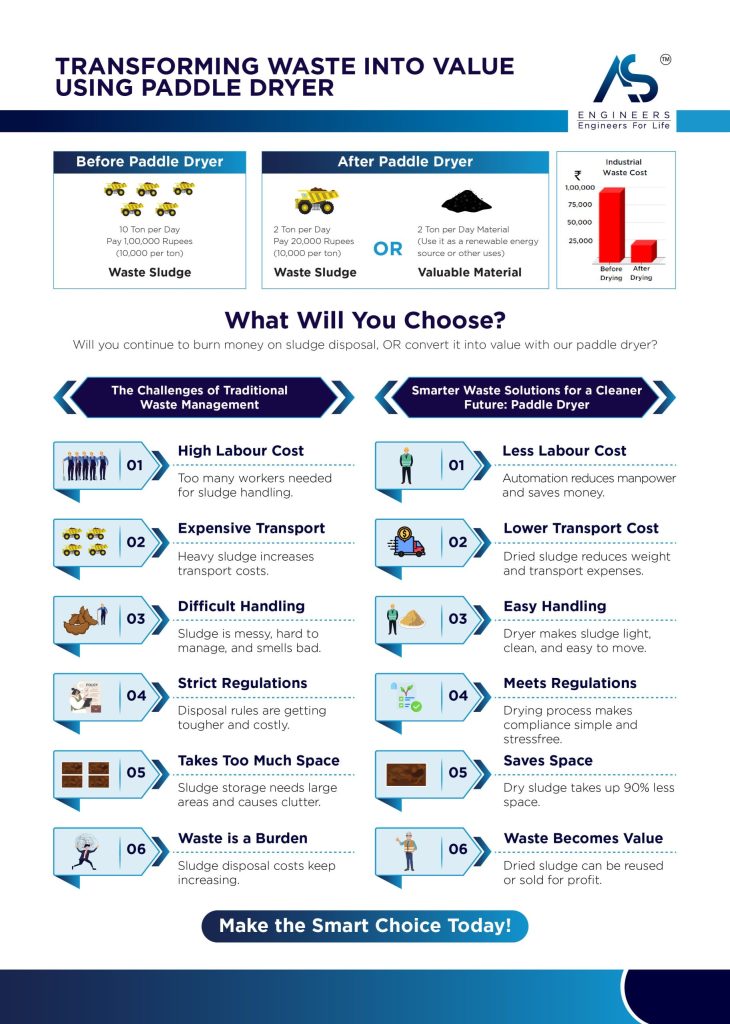
For a plant with high wet sludge disposal cost, a dryer may reduce the burden significantly. AS Engineers’ official sludge drying example shows a benchmark case where 10 tons per day wet sludge is reduced to 2 tons per day after drying, reducing disposal cost in proportion where disposal is charged per ton. This should be treated as an example for feasibility discussion, not a universal guarantee.
Conclusion
ETP sludge treatment should be testing-first, not equipment-first. The right solution depends on moisture, chemistry, hazardous classification, site space, fuel availability, handling difficulty, disposal cost and final approved route.
Mechanical dewatering is usually the first major reduction step. Thermal drying becomes useful when wet sludge remains expensive, difficult to handle or unsuitable for efficient transport. Paddle dryers are often considered for sticky and high-moisture ETP sludge because they use indirect heat transfer, continuous agitation and enclosed vapour handling options.
If you are evaluating ETP sludge drying for your plant, share sludge quantity, feed moisture, final moisture target, lab analysis, sludge behaviour, heating source, available space and disposal route. AS Engineers can review the application and suggest whether dewatering alone, thermal drying, paddle drying, pilot testing or another treatment path is more suitable.
FAQs
What is ETP sludge?
ETP sludge is the solid or semi-solid residue generated during industrial wastewater treatment. It may contain suspended solids, chemicals, biological matter, heavy metals, salts, oils, dyes or organic residues depending on the industry and process.
How can an industrial plant reduce ETP sludge volume?
The usual sequence is thickening, mechanical dewatering and, where justified, thermal drying. Dewatering removes free water, while thermal drying removes additional moisture to make sludge lighter and easier to handle.
Does sludge drying make hazardous ETP sludge non-hazardous?
No. Drying mainly reduces moisture and improves handling. Hazardous classification depends on sludge composition and lab results. Heavy metals, toxic compounds or hazardous constituents may remain after drying.
Is a paddle dryer suitable for ETP sludge?
A paddle dryer can be suitable for sticky, pasty or high-moisture ETP sludge after dewatering. Suitability depends on moisture, sludge chemistry, stickiness, vapour load, MOC requirement, final moisture target and disposal route.
What data is needed before asking for a sludge dryer quotation?
Share sludge source, quantity, operating hours, feed moisture, final moisture target, lab report, sludge behaviour, heating source, site constraints, vapour handling need, MOC expectation and final disposal or reuse route.