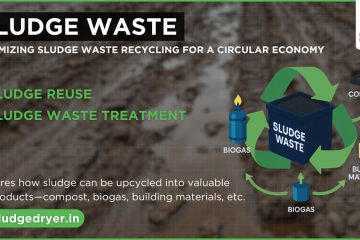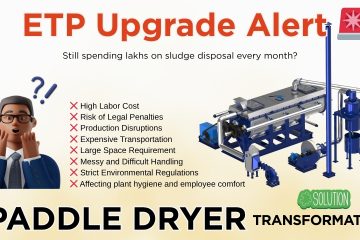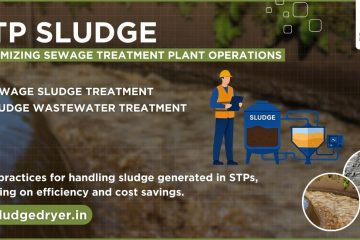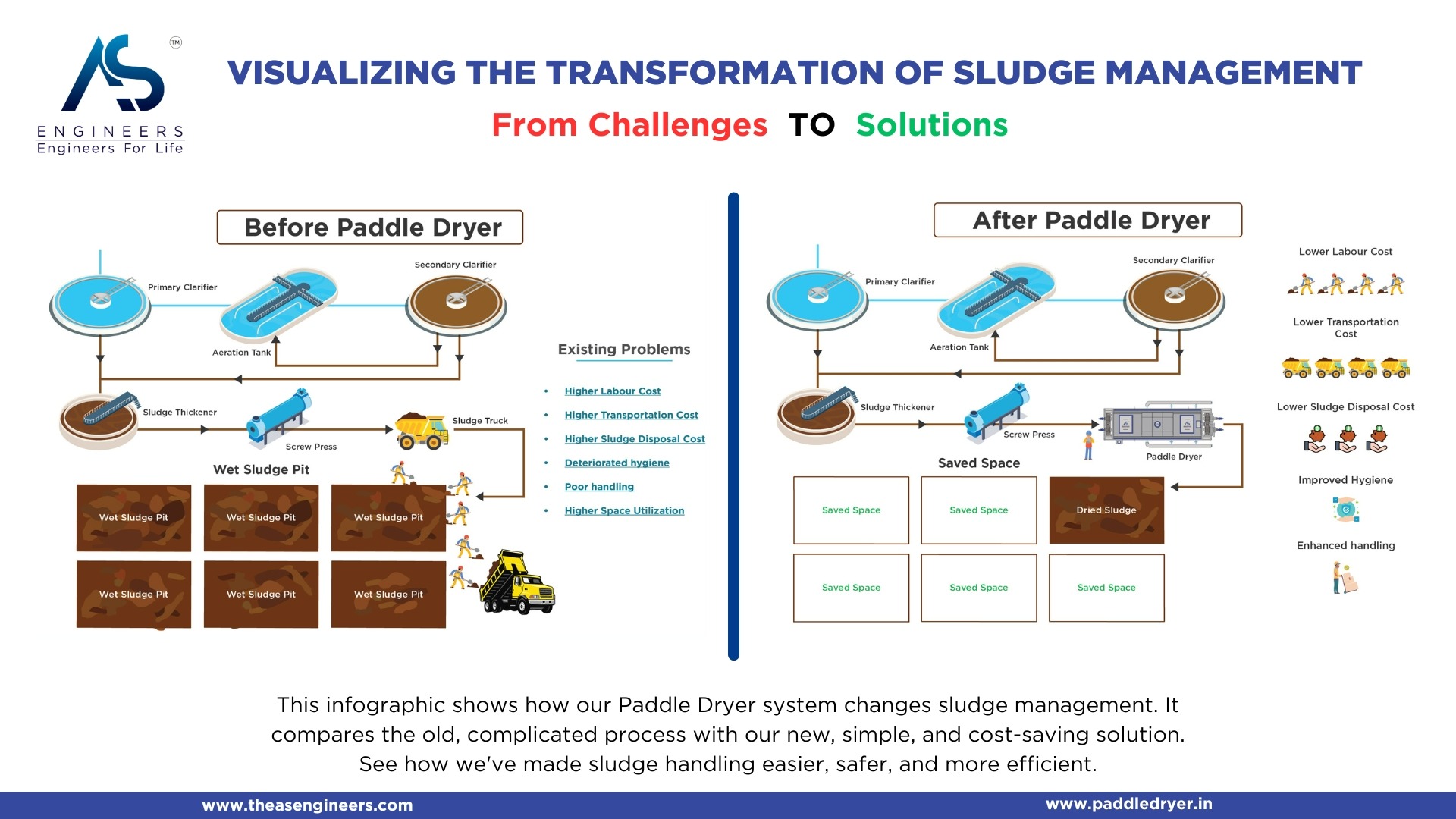
A sludge dryer is a thermal drying system used after mechanical dewatering to remove additional moisture from ETP, STP, CETP, municipal, chemical, pharma, textile, paper, food, refinery and ZLD sludge. The purpose is not only “drying.” It is to make sludge lighter, cleaner to handle, easier to store, and easier to send for approved disposal, reuse, co-processing or further treatment.
The right sludge dryer depends on feed moisture, final moisture target, stickiness, daily sludge quantity, heating medium, vapour handling, MOC, site space, operating hours and downstream use. For many sticky industrial sludge streams, an indirect paddle dryer is a strong option, but it still needs sludge-specific review before selection.
Quick answer: what does a sludge dryer do?
A sludge dryer removes water from dewatered sludge through thermal drying. Direct dryers expose sludge to hot gas or air. Indirect dryers transfer heat through heated metal surfaces, so the heating medium does not directly contact the sludge. Paddle sludge dryers are indirect dryers that use heated hollow shafts, jacketed troughs and rotating paddles to mix and dry sticky sludge with lower off-gas volume.
Before selecting any sludge drying system, first confirm what the sludge is, how wet it is, how sticky it is, how much needs to be dried per day, and what will happen to the dried output.
For basic sludge understanding before equipment selection, first review what sludge is and why it behaves differently in treatment plants.
Dewatering vs sludge drying
Sludge drying should not be confused with sludge dewatering. In most plants, dewatering comes first and drying comes after.
| Point | Sludge dewatering | Sludge drying |
|---|---|---|
| Main purpose | Remove free water mechanically | Remove additional moisture thermally |
| Common equipment | Screw press, belt press, filter press, centrifuge | Paddle dryer, belt dryer, rotary dryer, disc dryer, thin-film dryer, solar dryer |
| Energy type | Mechanical pressure, gravity, centrifugal force | Steam, thermic fluid, hot air, hot water, fuel-fired heating or solar heat |
| Output | Wet cake or semi-solid sludge | Lower-moisture dried sludge |
| Best use | Reduce water before drying or disposal | Reduce weight, volume, handling difficulty and disposal burden |
| Buyer risk | Poor cake solids increase dryer load | Wrong dryer selection increases energy, fouling and maintenance problems |
A dryer will perform better when the upstream dewatering system is stable. That is why sludge dryer selection should be connected with sludge dewatering techniques and not treated as a separate purchase decision.
Main types of sludge dryers
Different sludge dryers suit different sludge conditions. Do not compare only on price or name. Compare by material behavior, heat-transfer method, vapour handling, cleaning need, space, safety and maintenance.
| Sludge dryer type | Heat transfer method | Good fit | Watch-outs |
|---|---|---|---|
| Paddle dryer | Indirect heat through hollow shafts, paddles and jacket | Sticky ETP/STP sludge, chemical sludge, sludge cake, paste-like material, compact plant layouts | Needs correct torque, MOC, vapour handling and feed consistency |
| Belt dryer | Hot air through sludge layer on belt | Large continuous drying with controlled air flow | Requires more footprint and careful odour/dust control |
| Rotary dryer | Direct hot gas contact in rotating shell | Some granular or less-sticky materials | Higher off-gas volume and possible dust/temperature control issues |
| Disc dryer | Indirect heating through rotating discs | Sludge requiring enclosed indirect drying | Cleaning, wear and access need review |
| Thin-film dryer | Indirect heating with thin turbulent film | Pumpable sludges or slurries where rapid surface renewal is needed | More sensitive to feed rheology and mechanical design |
| Solar dryer | Solar heat and ventilation | Low-cost, low-energy drying where land and time are available | Weather-dependent, land-intensive, slower drying |
| Hybrid drying system | Combination of heat sources or stages | Plants needing staged moisture reduction | More control complexity and integration review |
For a broader comparison of sludge drying methods, see sludge drying methods, systems and best practices.
Where paddle sludge dryers fit
A paddle sludge dryer is useful when the sludge is wet, sticky, paste-like or cake-like and the plant needs enclosed indirect drying. In this design, heat is transferred through hollow shafts, paddles and jacketed surfaces while rotating paddles mix and move the sludge through the dryer.
In AS Engineers’ paddle dryer design, the system can be configured with steam, thermic fluid or hot water-based heating depending on the process requirement. The design may include standard dryer, dual-zone dryer or vacuum dryer configuration based on the duty condition.
A practical paddle sludge dryer system usually includes:
| System area | What it does |
|---|---|
| Feeding system | Receives sludge from silo, screw feeder, belt conveyor or sludge pump |
| Heating system | Supplies heat through steam, thermic fluid, hot water or site-specific heating arrangement |
| Paddle dryer body | Uses heated shafts, jacket and paddles for indirect drying and mixing |
| Scavenging system | Helps manage vapour movement and reduces condensation risk where required |
| Vapour / solvent handling | Sends vapour to chimney, condenser or recovery system depending on sludge and solvent condition |
| Pollution control system | Uses cyclone, scrubber or bag filter where fines, vapour or dust need treatment |
| Product handling system | Transfers dried sludge to screw conveyor, bagging system, silo, bucket elevator or truck disposal route |
For plant teams comparing configurations, the paddle dryer configuration guide is a useful next page.


Key sludge dryer selection criteria
When I review a sludge dryer requirement, I do not start with dryer capacity alone. I first look at the sludge source, feed moisture, material behavior, heating medium, vapour route and downstream disposal path.
| Selection factor | Why it matters |
|---|---|
| Sludge source | ETP, STP, CETP, ZLD, chemical, pharma, textile, paper, food and refinery sludge behave differently |
| Feed moisture | Higher feed moisture increases heat load and dryer size |
| Final moisture target | Very low final moisture may need more residence time, heat-transfer area and utility |
| Daily quantity | Capacity should match actual kg/hr or TPD duty, not only monthly sludge generation |
| Operating hours | A 24-hour plant and a single-shift plant need different dryer sizing |
| Stickiness and phase change | Sticky sludge can foul equipment if the dryer is not designed for paste-to-granule transition |
| pH, chloride, solvent and oil content | These affect MOC, corrosion risk, vapour treatment and EHS controls |
| Heating medium | Steam, thermic fluid, hot water, hot air or fuel availability changes system design |
| Vapour handling | Water vapour, solvent vapour, odour and fines need separate review |
| Pollution control | Cyclone, scrubber, bag filter, condenser or chimney selection depends on actual vapour and dust condition |
| Discharge route | Bagging, conveying, silo storage, truck disposal or reuse affects layout |
| Maintenance access | Shafts, paddles, bearings, gearbox, seals and internals need service access |
| Regulatory route | Disposal, reuse, TSDF, co-processing or land application must match local rules and sludge testing |
For ETP-specific buyer guidance, connect this page with sludge dryers for ETP manufacturers in India.
Sludge dryer RFQ checklist
Send these details before asking for a final sludge dryer quotation. Without this data, the quote may look simple but fail during operation.
| RFQ input | What to share |
|---|---|
| Sludge source | ETP, STP, CETP, ZLD, biological, chemical, paint, refinery, paper, food or other |
| Current dewatering method | Filter press, screw press, belt press, centrifuge or drying bed |
| Feed quantity | Kg/hr, TPD or batch quantity |
| Feed moisture | Actual lab-tested moisture, not only an estimate |
| Target final moisture | Required output moisture or dryness target |
| Operating hours | Hours per day and days per month |
| Sludge behavior | Sticky, fibrous, oily, abrasive, corrosive, lumpy, paste-like or granular |
| Chemical details | pH, chloride, sulphate, solvent, oil and grease, ash, heavy metals where applicable |
| Heating utility | Steam pressure, thermic fluid temperature, hot water availability, fuel preference |
| Vapour condition | Water vapour only or possible solvent/odour/fume load |
| Pollution control need | Cyclone, scrubber, bag filter, condenser, chimney or existing APC system |
| Site constraints | Available area, height, access, foundation, power, utility line routing |
| Discharge preference | Screw conveyor, bagging, silo, bucket elevator, truck loading |
| Disposal or reuse route | TSDF, co-processing, cement plant, incineration, land application, internal reuse or sale |
| Trial requirement | Whether pilot testing is needed before final order |
For a focused purchase-side checklist, use how to choose a sludge paddle dryer.
Why final moisture target must be realistic
A common mistake is asking for very low final moisture without checking sludge chemistry and drying behaviour. Some sludge dries cleanly. Some becomes sticky in the middle phase. Some forms lumps. Some releases odour or solvent vapour. Some becomes dusty when over-dried.
Final moisture should be decided from:
- Disposal requirement
- Transport cost target
- Storage need
- Reuse or co-processing route
- Dust risk
- Odour control
- Sludge calorific value, if fuel use is being considered
- Local regulatory acceptance
- Dryer energy cost
A lab test or pilot trial is safer than assuming that every sludge can reach the same final dryness at the same cost.
How sludge drying affects disposal cost
Sludge drying can reduce the weight and handling burden of wet sludge, but savings depend on the starting moisture, final moisture, fuel cost, disposal rate, operating hours and plant layout.
AS Engineers uses a sludge-disposal illustration where 10 T/day wet sludge at ₹10,000/T disposal cost becomes 2 T/day after drying. In that example, the disposal outflow changes from ₹1,00,000/day to ₹20,000/day before considering any approved reuse route.
Use this as a calculation format, not as a guaranteed result. Your actual result depends on sludge analysis, dryer operation, fuel cost, drying target and the approved disposal or reuse route.
| Fuel input basis | Approximate sludge drying yield |
|---|---|
| 1 kg wood | 5 kg sludge |
| 1 kg coal | 8.25 kg sludge |
| 1 Nm³ gas | 22.5 kg sludge |
| 1 kg LDO | 21 kg sludge |
Basis: AS Engineers’ reference FAQ for sludge drying from 80% wt/wt initial moisture to 20% final moisture. This is not a universal price quote and should be verified for the actual sludge sample and site utility cost.
For disposal-side planning, see industrial sludge disposal guide and hidden cost of landfilling wet sludge.
Sludge dryer and pollution control
A sludge dryer is not only a dryer body. The surrounding system matters.
Depending on the sludge, the dryer may need:
- Cyclone for dried fines separation
- Scrubber for vapour or odour treatment
- Bag filter for dust control
- Condenser for solvent or vapour recovery
- ID fan for vapour movement
- FD blower or heat exchanger arrangement for scavenging
- Chimney or approved discharge route
- Heat tracing where condensation is a concern
If the sludge contains solvent, oil, hazardous constituents or odorous vapour, do not finalize only the dryer. Review the vapour path, EHS controls, area classification, ventilation, fire risk, local permission and final disposal route.
For connected air-pollution equipment, AS Engineers also supports pollution control equipment such as cyclone, scrubber and bag filter systems.
Common mistakes when buying a sludge dryer
| Mistake | Why it causes problems |
|---|---|
| Buying only by TPD capacity | Two sludges with the same TPD may need different dryer size and heat duty |
| Ignoring upstream dewatering | Poor cake solids increase heat load and fuel use |
| Not testing sticky sludge | Sticky sludge can bridge, foul, overload or discharge unevenly |
| Asking for very low moisture without a trial | Over-drying can create dust, energy waste or product-handling issues |
| Ignoring vapour handling | Odour, solvent, water vapour and fines need proper treatment |
| Selecting wrong MOC | Chlorides, pH and corrosive content can damage equipment |
| Forgetting discharge handling | Dried sludge still needs conveying, cooling, storage or bagging |
| Treating drying as compliance | Drying helps handling, but final compliance depends on approved disposal or reuse route |
| Skipping maintenance access | Shaft, paddles, gearbox, bearings and seals need inspection access |
| Assuming dried sludge always has value | Reuse depends on sludge composition, calorific value, contamination and local approvals |
When a paddle sludge dryer is a good fit
A paddle sludge dryer is usually worth evaluating when:
- Sludge is sticky, paste-like, cake-like or difficult to handle
- The plant wants enclosed indirect drying
- Off-gas volume must be controlled
- Space is limited
- Continuous drying is preferred
- Final dried sludge needs controlled handling
- Steam, thermic fluid or suitable heating utility is available
- The plant wants scope for cyclone, scrubber, bag filter, condenser or product-handling integration
It may not be the best fit when:
- Sludge is extremely dilute and not mechanically dewatered first
- Large land and long drying time are acceptable, making solar drying practical
- The sludge needs only simple thickening or dewatering, not thermal drying
- Hazardous solvent vapour is present but the plant is not ready to invest in vapour control and EHS review
- Final disposal route is not defined
For technology comparison, see belt vs thin-film sludge dryer comparison and paddle dryer vs solar drying bed.
Maintenance checks for sludge dryer reliability
A sludge dryer is a mechanical and thermal system. Reliability depends on both design and routine checks.
Plant teams should monitor:
- Feed consistency and foreign material entry
- Shaft torque and motor load
- Paddle condition and buildup
- Bearing temperature
- Gearbox oil condition
- Seal condition
- Steam or thermic fluid temperature and pressure
- Vapour-line blockage or condensation
- Cyclone, scrubber or bag filter performance
- Discharge screw or bagging system condition
- Vibration, noise and alignment
- Cleaning frequency
AS Engineers also supports paddle dryer service areas such as shaft, gearbox, bearing replacement, repair, upgrades, retrofitment and OEM spare parts through its broader equipment support capability.
Compliance and EHS note
Sludge drying helps reduce moisture and improve handling, but it does not automatically make sludge safe, reusable or compliant. Final disposal or reuse still depends on sludge testing, local rules, hazardous-waste classification, SPCB/CPCB/GPCB requirements, TSDF acceptance, co-processing approval or end-use suitability.
For Indian hazardous-waste context, review the hazardous waste rules published by GPCB and the page on CPCB guidelines for hazardous waste disposal.
Practical selection summary
Use this table before shortlisting any sludge dryer.
| Buyer question | Practical answer |
|---|---|
| Is the sludge mechanically dewatered? | Drying should normally follow dewatering for better energy use |
| Is the sludge sticky? | Evaluate paddle dryer or other designs built for sticky feed |
| Is space limited? | Indirect paddle dryers often fit compact layouts better than large solar systems |
| Is vapour clean water only? | Vapour handling may be simpler but still needs review |
| Are solvents, odour or hazardous components present? | Add condenser, scrubber, bag filter, EHS and regulatory review |
| Is dried sludge going for reuse? | Confirm composition, calorific value, contamination and buyer acceptance |
| Is the RFQ based only on TPD? | Add moisture, utility, sludge behaviour and disposal route before final sizing |
Conclusion
A sludge dryer should be selected from the sludge outward, not from the machine catalogue inward. Start with sludge source, feed moisture, final moisture target, quantity, stickiness, utility, vapour handling, MOC, site layout and disposal route. Then compare dryer types.
For sticky ETP, STP, CETP and industrial sludge, an indirect paddle sludge dryer is often a practical option because it combines enclosed drying, heated shafts, jacketed heat transfer, paddle mixing, compact layout and integrated vapour/product handling possibilities.
If you are evaluating a sludge dryer for ETP, STP, CETP, ZLD or industrial sludge, share the feed moisture, target moisture, daily quantity, sludge source, available heating medium, current disposal route, site layout and vapour-control requirement. AS Engineers can review the duty condition and suggest a sludge-drying configuration based on actual material and site inputs.
FAQs
What is a sludge dryer used for?
A sludge dryer is used to reduce moisture from dewatered sludge so the sludge becomes lighter, easier to store, easier to transport and easier to send for approved disposal, reuse, co-processing or further treatment.
Which sludge dryer is best for ETP and STP sludge?
There is no single best dryer for every ETP or STP sludge. Paddle dryers are often suitable for sticky sludge cake and enclosed indirect drying, while belt dryers, solar dryers, rotary dryers, disc dryers or thin-film dryers may suit other conditions. Selection depends on feed moisture, stickiness, final moisture target, utility, site space and vapour handling.
What moisture data is needed before sludge dryer sizing?
At minimum, share feed moisture, target final moisture, sludge quantity per hour or day, current dewatering method and operating hours. Lab-tested moisture is better than an estimate because heat duty and dryer size depend heavily on actual water load.
Can dried sludge be reused or sold?
Dried sludge can sometimes be used for fuel, cement, bricks, agriculture or other approved routes, but only when sludge composition, calorific value, contamination level and local approvals allow it. Drying alone does not guarantee reuse value.
What should I include in a sludge dryer RFQ?
Include sludge source, feed moisture, final moisture target, daily quantity, operating hours, sludge behaviour, pH, chloride or solvent presence, heating utility, vapour-treatment need, site layout, discharge method and disposal or reuse route.