Industrial sludge dryer machine price cannot be judged from a public listing alone. For ETP, STP, chemical, pharma, textile, food, paper or municipal sludge, the final cost depends on sludge quantity, inlet moisture, target outlet moisture, material of construction, heating medium, automation level, vapour handling, pollution control system and site installation scope.
A cheaper dryer without the right feeding system, heat source, vapour treatment or service support can become expensive during operation. Before asking for a sludge dryer price, prepare your sludge data and compare the complete drying system, not only the machine body.
At AS Engineers, we review the process condition before suggesting a sludge dryer configuration. For serious RFQ discussion, the most useful question is not only “What is the price?” The better question is: “What will be the correct sludge drying system cost for my moisture, capacity, fuel and disposal-cost condition?”
What is included in an industrial sludge dryer machine price?
An industrial sludge dryer quotation may include only the dryer body, or it may include the full sludge drying system. This difference changes the price heavily.
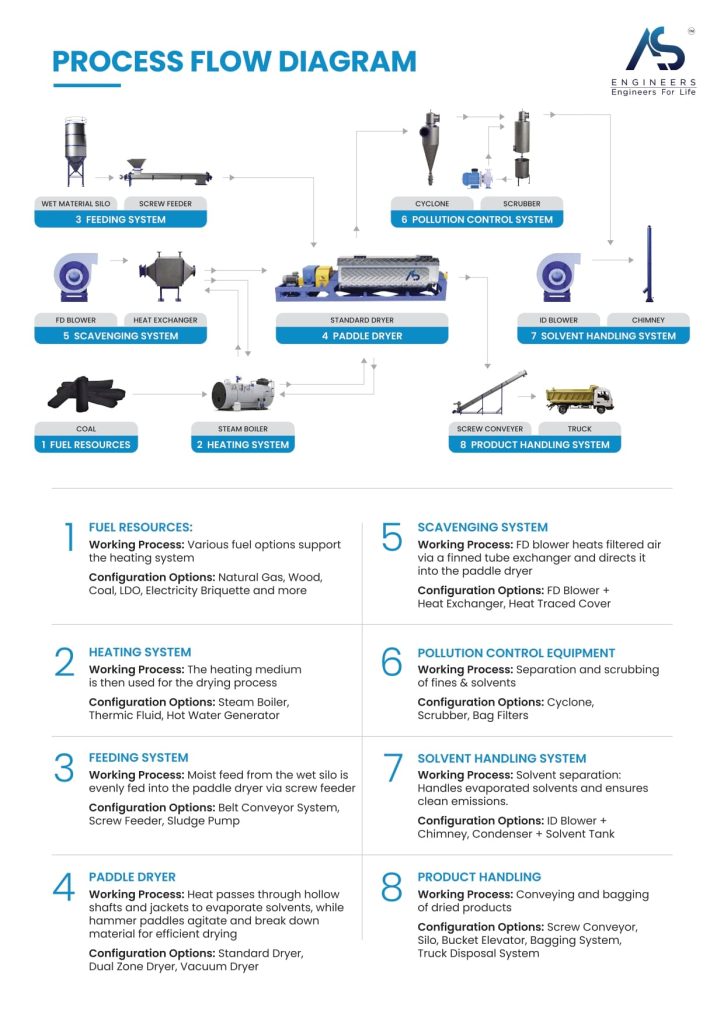
A practical sludge drying system may include:
| System area | What it does | Why it affects price |
|---|---|---|
| Feeding system | Transfers wet sludge into the dryer using screw feeder, belt conveyor or sludge pump | Sticky sludge may need stronger feeding and anti-bridging design |
| Heating system | Supplies heat through steam, thermic fluid, hot water or other source | Boiler, thermic fluid heater and heat exchangers change total project cost |
| Paddle dryer | Removes moisture through indirect heat transfer | Capacity, shaft design, heat transfer area and MOC drive the machine price |
| Vapour handling | Handles evaporated moisture, odour, solvent or fumes | Hazardous or odorous vapour needs stronger containment and treatment |
| Pollution control | Uses cyclone, scrubber, bag filter or condenser where required | Fines, odour, VOC and process safety requirements increase scope |
| Product handling | Moves dried sludge to bagging, silo, truck disposal or further use | Automation and dust control change the final system cost |
| Controls and automation | Manages temperature, feed rate, speed and safety interlocks | PLC, sensors, VFDs and instrumentation increase upfront cost but improve control |
| Installation and commissioning | Site erection, alignment, trial and training | Civil, electrical, ducting and utility readiness affect final budget |
This is why two sludge dryers with the same “kg/hr” capacity can have very different prices.
Why online sludge dryer prices are often misleading
Online marketplace prices are useful only for rough awareness. They usually do not confirm the real duty condition, complete scope, metallurgy, heating area, vapour treatment, installation, trial, documentation or after-sales support.
For example, a listing may show a low machine price, but the buyer may still need to pay separately for:
- Sludge feeding system
- Steam boiler or thermic fluid heater
- Heat exchanger
- Cyclone, scrubber or bag filter
- Condenser or chimney
- Electrical panel and automation
- Screw conveyor or bagging system
- Foundation, ducting, piping and erection
- Commissioning support
- OEM spare parts and service support
For industrial sludge, the lowest visible price is not always the lowest cost. Wrong sizing, wrong MOC or poor vapour handling can increase maintenance, downtime, odour complaints and disposal cost later.
Main factors that decide sludge dryer machine price
Wet sludge quantity
Capacity is the first cost driver. A plant generating 500 kg/day of sludge does not need the same system as a plant generating 10 tons/day. The dryer size depends on wet sludge feed rate, operating hours per day and peak load variation.
For RFQ, share both average and maximum sludge generation. Many plants quote only average sludge quantity and later discover that the dryer cannot handle peak load.
Feed moisture and final moisture target
Sludge dryer cost depends heavily on how much water must be evaporated.
Example:
If sludge enters at 80% moisture and the target is 20% moisture, the dryer must remove much more water than a case where sludge enters at 65% moisture and the target is 40% moisture.
A lower final moisture target usually means more heat transfer area, longer residence time, stronger vapour handling and higher fuel use.
Sludge type and behaviour
Industrial sludge is not one material. ETP sludge from a chemical plant behaves differently from STP sludge, pharma sludge, textile sludge, paper sludge, paint sludge or food-processing sludge.
Price can change if the sludge is:
- Sticky
- Abrasive
- Corrosive
- Odorous
- High in oil or grease
- High in salts
- High in organic load
- Variable in feed consistency
- Hazardous or solvent-bearing
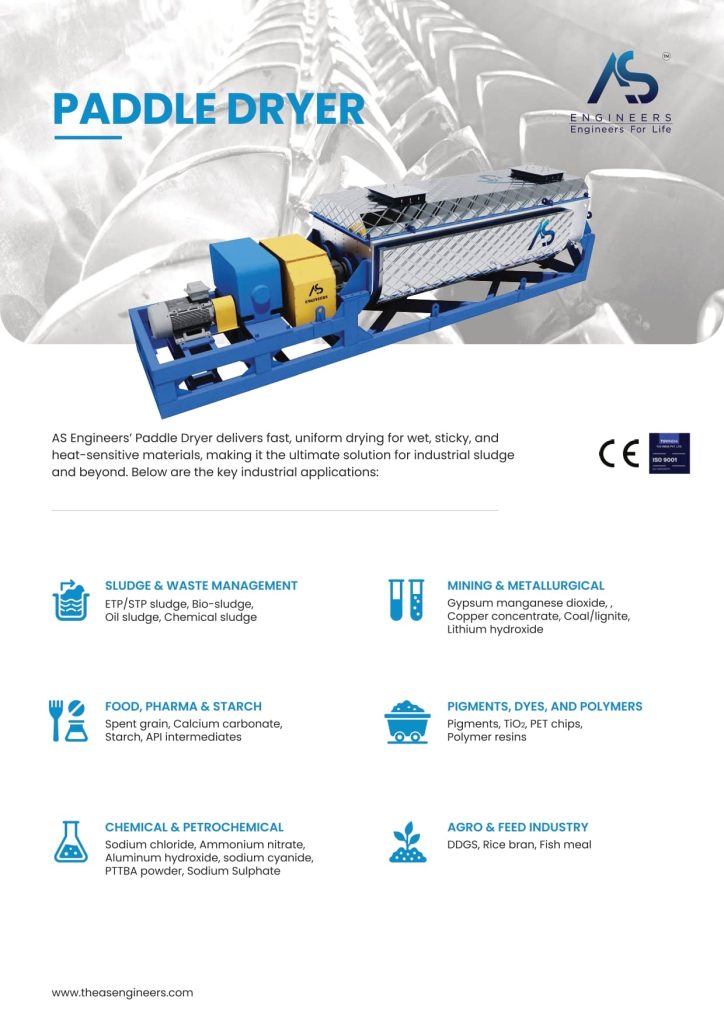
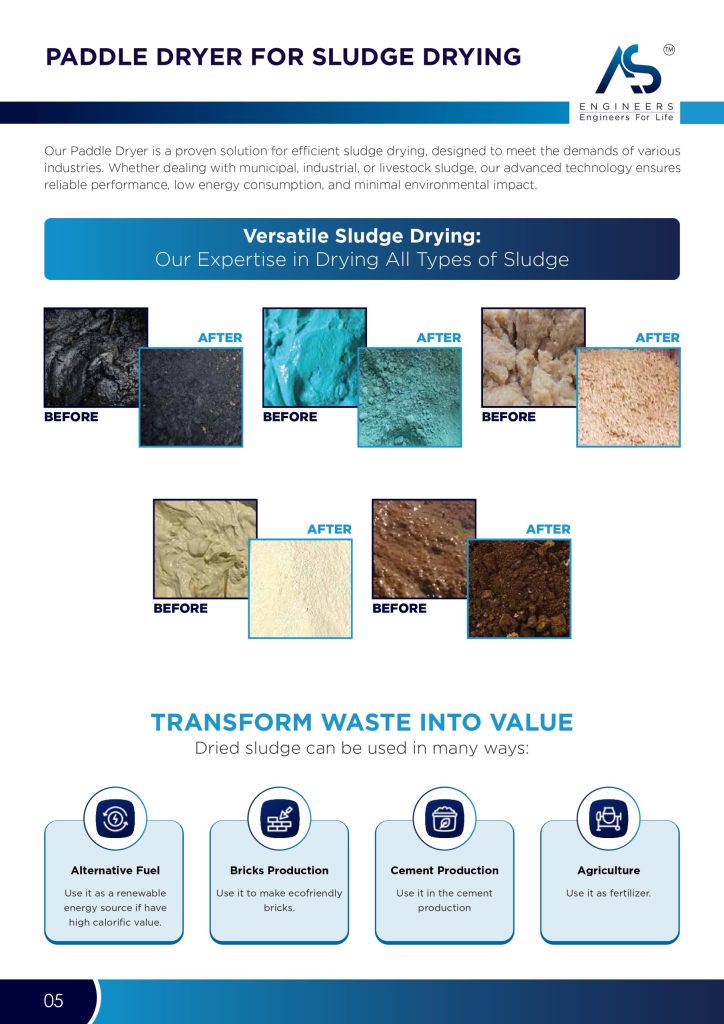
A paddle dryer is often preferred for sticky and pasty sludge because indirect heating, hollow shafts and wedge-shaped paddles help mix, break and expose sludge to heated surfaces.
Material of construction
MOC directly affects price and equipment life.
| Sludge condition | Possible MOC direction | Price impact |
|---|---|---|
| Low-corrosion sludge | Carbon steel or mild steel may be reviewed | Lower upfront cost |
| Chemical or pharma sludge | SS304 or SS316 may be required | Higher cost, better corrosion resistance |
| Highly corrosive sludge | Duplex steel or special alloy may be reviewed | Premium cost |
| Abrasive sludge | Hard-facing or wear-resistant design may be required | Higher fabrication cost |
| Food/pharma-sensitive process | Better finish and hygiene-friendly design may be needed | Higher cost |
Do not choose MOC only to reduce machine price. Wrong MOC can reduce equipment life and increase shutdown risk.
Heating medium
AS Engineers paddle dryers can be configured for indirect heating using steam or thermal oil, depending on the requirement. AS Engineers catalogue material states steam up to 14.06 kg/cm² and thermal oil up to 400°C as available heating references for paddle dryer design.
Common heating options include:
- Steam
- Thermic fluid
- Hot water generator
- Natural gas-based heating
- Coal, wood, LDO, briquette or site-specific fuel systems where suitable
- Electricity for selected cases
The dryer body price is only one part. The fuel source and heating system can significantly change the total installed cost.
Vapour handling and pollution control
When sludge is heated, moisture, odour, fines and sometimes solvent vapours may be released. The cost depends on how these vapours are handled.
A simple water-vapour application may need a different arrangement from chemical, pharma, hazardous, oily or solvent-bearing sludge. Depending on the process, the system may require cyclone, scrubber, bag filter, condenser, chimney, ID fan or heat-traced cover.
For industrial sludge, vapour handling should be discussed early, not added later as an afterthought.
Automation level
Manual systems cost less upfront but need more operator attention. Automatic systems cost more but can improve consistency, safety and monitoring.
Automation may include:
- Feed-rate control
- VFD-based drive control
- Temperature monitoring
- Motor load monitoring
- Level switches
- Safety interlocks
- Control panel
- PLC/HMI
- Alarm and trip logic
A plant running continuous sludge generation should compare automation cost against manpower, consistency and downtime risk.
Site installation scope
Two buyers may receive different prices for the same dryer because site conditions are different.
Check:
- Available space
- Foundation readiness
- Utility distance
- Steam or thermic fluid availability
- Electrical load
- Existing dewatering system
- Ducting route
- Chimney or scrubber location
- Material movement path
- Dried sludge storage or bagging requirement
- Local statutory and EHS requirements
A good RFQ should ask for both machine cost and complete installed project scope.
Sludge dryer price vs sludge drying cost
Machine price is capital cost. Drying cost is operating cost. A buyer should calculate both.
The main operating cost factors are:
- Fuel or heating cost
- Power consumption
- Labour
- Maintenance
- Spare parts
- Vapour treatment cost
- Dried sludge handling
- Disposal or reuse cost
- Downtime risk
A plant may pay more for the correct system but recover value through lower disposal volume, easier handling, lower transport load and better process control.
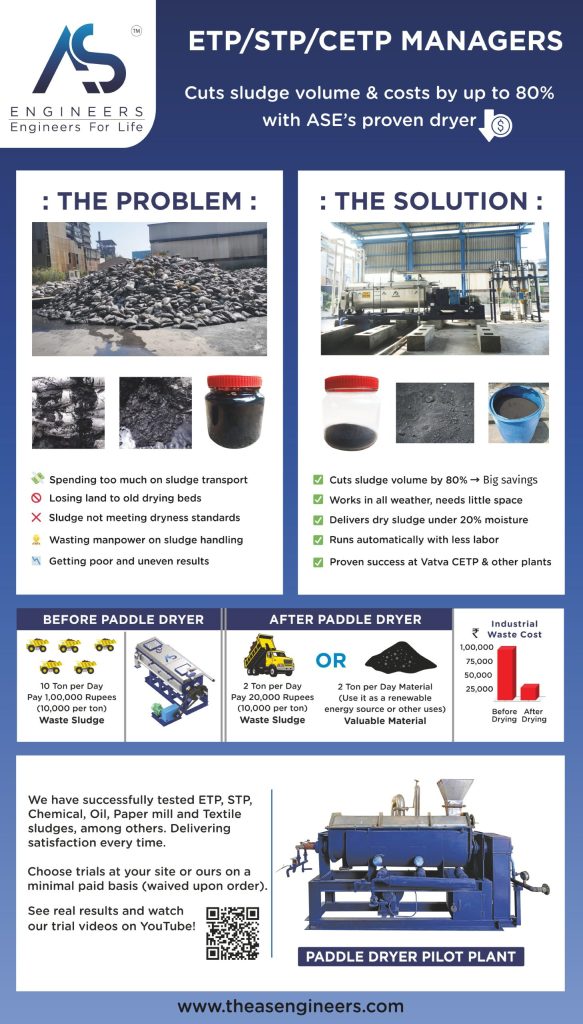
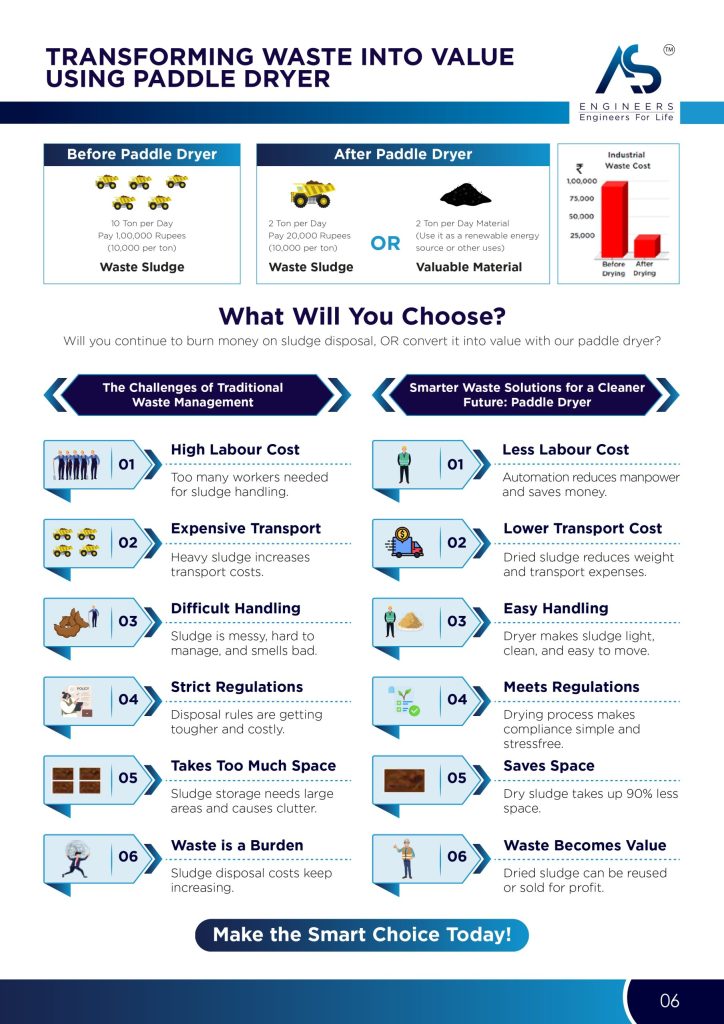
AS Engineers’ sludge drying material uses a practical example: 10 tons/day of wet sludge at ₹10,000/ton disposal cost becomes 2 tons/day after drying, reducing the disposal-cost example from ₹1,00,000/day to ₹20,000/day, or creating a route for value use where permitted. This is an example, not a universal guarantee. Actual savings depend on sludge type, moisture, local disposal rate, fuel cost and approved end-use route.
Fuel consumption reference for sludge drying
Fuel cost must be calculated before finalizing a sludge dryer machine price. AS Engineers’ internal paddle dryer FAQ basis gives the following reference for sludge drying from 80% initial moisture to 20% final moisture:
| Fuel reference | Approximate sludge drying yield |
|---|---|
| 1 kg wood | 5 kg sludge |
| 1 kg coal | 8.25 kg sludge |
| 1 Nm³ gas | 22.5 kg sludge |
| 1 kg LDO | 21 kg sludge |
Use this only as a preliminary discussion reference. Your actual operating cost depends on sludge moisture, heat losses, feed consistency, heating system efficiency, insulation, operating hours and outlet moisture target.
Which sludge dryer technology is right for your budget?
| Dryer type | Best fit | Budget note | Watch-out |
|---|---|---|---|
| Solar sludge drying | Low-cost drying where land is available and weather dependency is acceptable | Low running cost, but large footprint | Slower drying, weather-dependent, not ideal for many industrial hazardous sludges |
| Paddle sludge dryer | Sticky, pasty, ETP/STP and industrial sludge requiring compact indirect drying | Higher than basic drying systems, but strong for controlled industrial use | Needs correct sludge data, heat source and vapour handling |
| Rotary dryer | Large-scale bulk drying where direct hot gas contact is acceptable | Can be suitable for high volume | Higher off-gas volume, dust and odour treatment may increase scope |
| Belt dryer | Sludge cake drying with controlled low-temperature air drying | Useful in selected municipal/industrial cases | Footprint and air handling can be high |
| Vacuum dryer | Heat-sensitive or solvent-sensitive materials | Premium system | Higher capital cost and more complex operation |
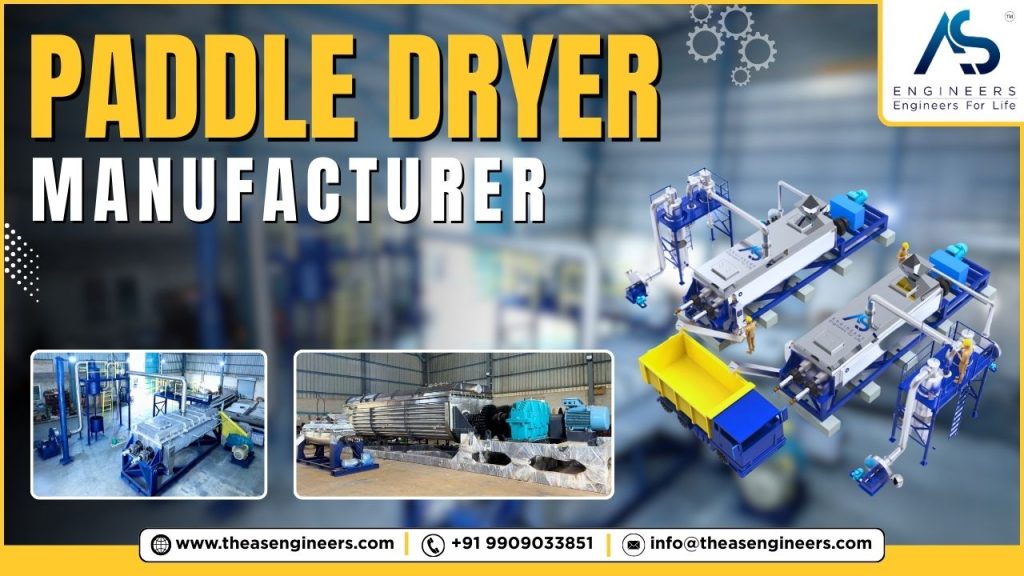
For AS Engineers’ sludge dryer discussions, paddle dryer selection is usually reviewed when the plant needs indirect heat transfer, compact layout, continuous operation, sticky sludge handling, controlled vapour management and reliable industrial operation.
When a paddle sludge dryer is worth the investment
A paddle sludge dryer is worth evaluating when:
- Dried sludge may have an approved reuse, fuel, co-processing or disposal route
- Wet sludge disposal cost is high
- Sludge quantity is generated daily
- Filter press or belt press output still carries high moisture
- Sludge is sticky, pasty or difficult to handle
- Land for drying beds is limited
- Transport cost is driven by weight
- The plant wants a compact drying system
- Vapour and odour containment are important
- The plant has steam, thermic fluid or usable heat source
When a sludge dryer may not be the right first investment
A dryer should not be purchased blindly. It may not be the first solution when:
- Sludge quantity is very low
- Dewatering performance is poor and should be corrected first
- Feed moisture changes too much without process control
- The plant has no clear dried sludge disposal or reuse plan
- Heat source cost is too high
- Space, utilities or EHS controls are not ready
- The buyer wants a fixed price without sharing sludge data
In many cases, improving dewatering before drying can reduce dryer size and fuel cost. Review your filter press, screw press, centrifuge or sludge transfer arrangement before final dryer sizing.
What data is needed to get an accurate sludge dryer quote?
Before requesting an industrial sludge dryer machine price, prepare this RFQ data:
| RFQ input | What to share |
|---|---|
| Sludge source | ETP, STP, CETP, ZLD, pharma, chemical, textile, food, paper, oil, paint or other |
| Wet sludge quantity | kg/day, tons/day or kg/hr |
| Operating hours | Batch or continuous, hours/day, days/month |
| Inlet moisture | Current moisture percentage after dewatering |
| Target outlet moisture | Required final moisture or dryness |
| Sludge behaviour | Sticky, pasty, granular, oily, abrasive, corrosive, odorous |
| Sludge analysis | pH, salts, organics, heavy metals, ash, calorific value if available |
| Existing dewatering system | Filter press, belt press, screw press, centrifuge or drying bed |
| Heating source | Steam, thermic fluid, gas, coal, wood, LDO, electricity, waste heat |
| Preferred MOC | CS, SS304, SS316, Duplex or to be selected by manufacturer |
| Vapour handling need | Water vapour, odour, solvent, VOC, hazardous fumes or dust |
| Product handling | Bagging, conveyor, silo, truck loading or manual collection |
| Site details | Space, utility distance, power, foundation, ducting route |
| Compliance context | Non-hazardous, hazardous, TSDF disposal, co-processing or permitted reuse route |
The more complete your RFQ, the more realistic the price will be.
How to compare sludge dryer quotations
Do not compare only the final number. Compare scope.
Use this checklist:
| Quotation item | Ask the supplier |
|---|---|
| Capacity basis | Is it based on wet sludge, water evaporation or dry output? |
| Moisture basis | What inlet and outlet moisture are assumed? |
| MOC | Which parts are CS, SS304, SS316 or special alloy? |
| Heating system | Is boiler, thermic fluid heater or heat exchanger included? |
| Pollution control | Are cyclone, scrubber, bag filter or condenser included? |
| Automation | Manual, semi-automatic or PLC-based? |
| Installation | Is erection and commissioning included? |
| Trial | Is pilot testing or material trial available? |
| Spares | Are OEM spare parts available? |
| Service | Is on-site support available after commissioning? |
| Documentation | Are drawings, inspection records and operating manuals included? |
| Exclusions | What is clearly not included in the price? |
A ₹20 lakh quotation and a ₹60 lakh quotation may not be comparable if one includes only the dryer body and the other includes a complete sludge drying system.
AS Engineers sludge dryer support
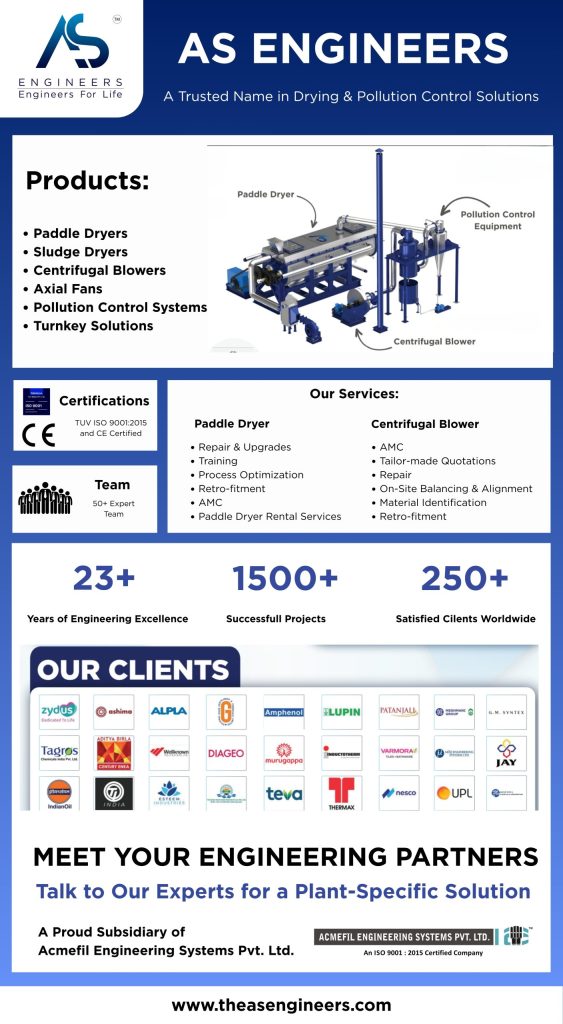
AS Engineers works with paddle dryers, sludge dryers, centrifugal blowers, pollution control equipment and turnkey drying-related systems. AS Engineers’ catalogue states 25+ years of industry experience, ISO 9001:2015 certification, 500+ clients and 1500+ projects.
For paddle dryer and sludge dryer systems, AS Engineers’ process flow includes feeding system, heating system, paddle dryer, scavenging system, pollution control, solvent or vapour management and product handling.
AS Engineers also offers paddle dryer pilot trials for selected material requirements, including a 50 kg/hr pilot trial machine for demonstrations, with trial objectives such as performance evaluation, issue identification, process optimization and feasibility assessment.
For service, AS Engineers supports shaft, gearbox and bearing replacement, system repair and upgrades, retrofitment solutions and OEM spare parts.
Practical price guidance before you send an inquiry
A serious sludge dryer price discussion should answer these five questions first:
- How much wet sludge do you generate per day?
- What is the current moisture after dewatering?
- What final moisture do you need and why?
- What heat source is available at your plant?
- What will happen to dried sludge after drying?
Once these are clear, the manufacturer can estimate dryer size, heat duty, MOC, feeding arrangement, vapour treatment, automation and installation scope.
If you are comparing multiple offers, ask each supplier to quote on the same basis. Without the same basis, a lower price can be misleading.
Conclusion
Industrial sludge dryer machine price depends on duty condition, not only machine size. The correct price comes after reviewing sludge type, moisture, capacity, heat source, MOC, vapour handling, pollution control and site scope.
For ETP, STP, chemical, pharma, textile, food, paper, ZLD or municipal sludge, avoid buying only from a visible online price. Share your sludge data and compare the complete drying system, including operating cost and disposal-cost impact.
For a practical quotation, share your sludge quantity, inlet moisture, target final moisture, heating source, material behaviour, disposal cost and site details with AS Engineers. The team can review the requirement and suggest a suitable sludge dryer configuration based on actual plant conditions.
FAQs
What is the price of an industrial sludge dryer machine in India?
Industrial sludge dryer machine price in India depends on wet sludge quantity, inlet moisture, final moisture target, sludge type, MOC, heating medium, automation, vapour handling and installation scope. For industrial buyers, a quote is more reliable than a general price list because sludge drying systems are usually customized.
Why do sludge dryer prices vary so much?
Prices vary because some offers include only the dryer body, while others include feeding system, heating system, cyclone, scrubber, condenser, controls, product handling, installation and commissioning. Capacity, material of construction and vapour treatment also change the cost.
What data is required to get an accurate sludge dryer quotation?
Share sludge source, wet sludge quantity, operating hours, inlet moisture, target outlet moisture, sludge behaviour, sludge analysis, existing dewatering system, heat source, preferred MOC, vapour handling requirement, product handling method and site details.
Does a low-cost sludge dryer reduce total project cost?
Not always. A low-cost dryer can become expensive if it is undersized, built with wrong MOC, lacks vapour handling, requires frequent maintenance or fails to achieve the required moisture. Compare total system scope and operating cost, not only machine price.
Can AS Engineers do a sludge dryer pilot trial?
Yes. AS Engineers’ catalogue mentions paddle dryer pilot trials with a 50 kg/hr pilot trial machine for demonstrations. Trial objectives include performance evaluation, issue identification, process optimization and feasibility assessment.