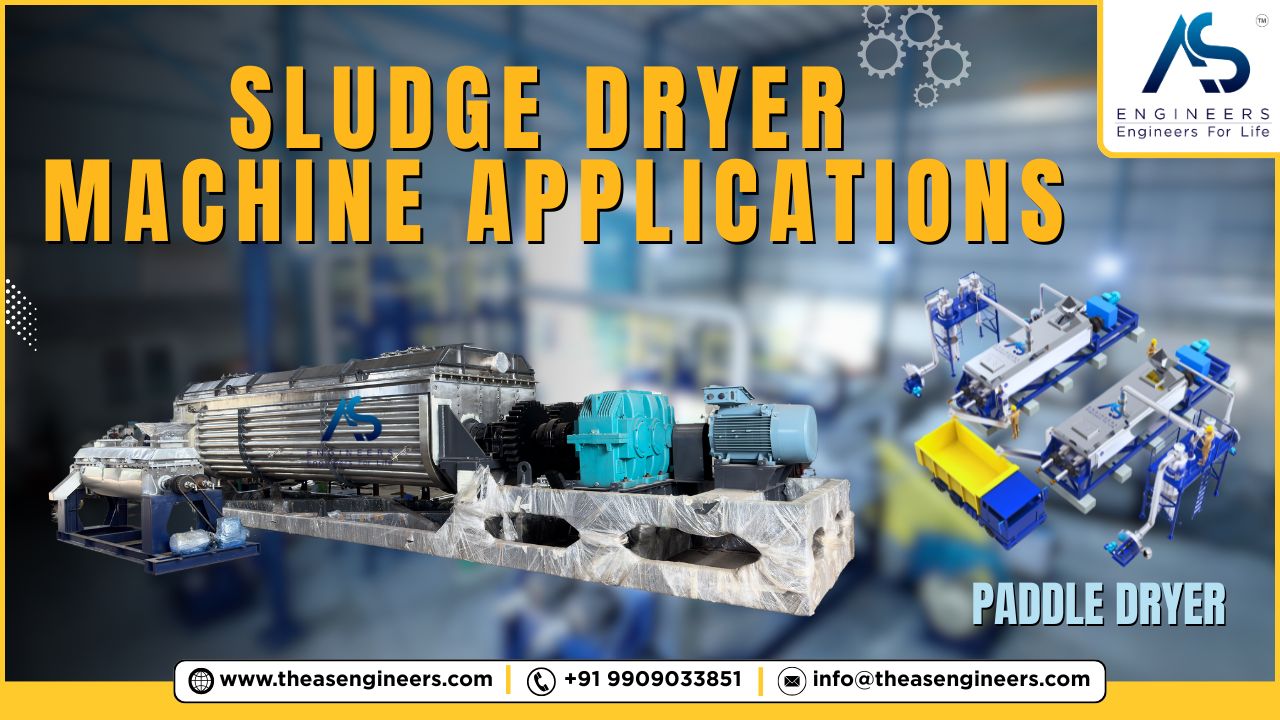
A sludge dryer machine is used to reduce moisture from dewatered sludge so the final output becomes easier to handle, store, transport, dispose of, or send for approved reuse. Its application scope includes ETP sludge, STP sludge, CETP sludge, municipal sewage sludge, paper mill sludge, chemical sludge, food processing sludge, bio-sludge, refinery sludge, textile sludge and selected industrial wet cakes.
The important point is simple: a sludge dryer is not selected only by machine capacity. It must be selected according to sludge type, inlet moisture, final moisture target, stickiness, heating medium, vapour handling requirement, disposal route, available space and site utilities.
At AS Engineers, we usually start by asking what the plant wants to solve first: disposal cost, wet sludge handling, storage load, transport weight, odour risk, downstream incineration, approved reuse, or integration with an ETP, STP, CETP or ZLD system.
What Does a Sludge Dryer Machine Do?
A sludge dryer machine removes moisture from mechanically dewatered sludge or wet cake using thermal energy. In many industrial plants, sludge first passes through thickening or dewatering equipment such as a filter press, screw press, centrifuge or belt press. After that, the sludge still contains significant moisture and remains heavy, sticky and difficult to handle.
A sludge dryer helps by converting this wet material into a drier, more stable output.
In practical plant operation, this can help with:
- Reducing sludge volume and weight
- Reducing storage area requirement
- Making sludge easier to convey, pack or load
- Lowering wet sludge transport dependency
- Preparing sludge for approved disposal or co-processing
- Supporting waste-to-value routes where sludge analysis and regulations allow it
- Improving hygiene and housekeeping compared with open wet sludge handling
A paddle-type sludge dryer is especially useful when the sludge is sticky, pasty, cake-like, semi-solid or difficult to dry uniformly by simple open drying methods.
For a broader foundation, read the complete guide to sludge dryers before comparing specific applications.
Main Application Scope of Sludge Dryer Machine
| Application area | Typical sludge or wet material | Why drying is considered |
|---|---|---|
| STP and municipal wastewater | Sewage sludge, digested sludge, mixed sludge | Volume reduction, handling improvement, disposal preparation |
| ETP and CETP plants | Industrial effluent sludge, chemical sludge, mixed treatment sludge | Reducing wet waste burden and improving downstream handling |
| Paper and pulp mills | Paper sludge, fibre-rich sludge, biological sludge | Reducing moisture and transport load |
| Textile and dyeing units | Dyeing sludge, colour-bearing ETP sludge, fibre sludge | Controlled handling and disposal preparation |
| Chemical and petrochemical plants | Neutralization sludge, salt sludge, catalyst-related wet cake, process sludge | Moisture removal, containment and controlled vapour handling |
| Pharmaceutical plants | ETP sludge, process sludge, API/intermediate-related residues | Controlled drying after application review and safety checks |
| Food and beverage plants | Organic sludge, starch waste, spent grain, dairy or process sludge | Moisture reduction and hygiene-aware handling |
| ZLD systems | MEE/ATFD residue, ETP concentrate sludge, salt-rich wet cake | Further moisture reduction and solid handling |
| Refineries and oil-related plants | Oily sludge, petroleum sludge, API separator sludge | Application-specific drying after fire, vapour and safety review |
| Livestock and bio-sludge applications | Livestock sludge, biological sludge, digestate solids | Moisture reduction where reuse or disposal route is approved |
STP and Municipal Sludge Drying
STP and municipal sludge drying is one of the most common application areas for sludge dryer machines. Sewage treatment plants generate sludge from primary treatment, biological treatment, secondary clarification and digestion processes.
The sludge may come as:
- Primary sludge
- Secondary biological sludge
- Digested sludge
- Mixed sewage sludge
- Dewatered STP cake
- Faecal sludge or septage after suitable treatment and dewatering
Drying helps municipal and STP teams reduce the wet sludge burden before disposal or further processing. The final dried material route depends on local rules, sludge test results, heavy metals, pathogen control, nutrient value and end-use approval.
A dryer should not be treated as a standalone compliance solution. It is one part of the sludge management chain. The plant still needs correct dewatering, feeding, vapour handling, pollution control, storage, testing and approved disposal or reuse planning.
Related reading: STP sludge sewage treatment guide and types of sewage sludge.
ETP and CETP Sludge Drying
ETP and CETP sludge drying is important for chemical, textile, pharma, dye, food, metal finishing, refinery, and other industrial plants where wastewater treatment generates sludge with high moisture and variable composition.
ETP sludge can be more complex than municipal sludge because it may contain:
- Inorganic salts
- Dyes and pigments
- Oil and grease
- Heavy metals
- Process chemicals
- Biological solids
- Neutralization residues
- Filter press cake
- ZLD residue or wet salts
For this reason, the dryer design must be based on actual sludge characteristics, not only the name of the industry.
Before selecting a sludge dryer machine for ETP sludge, share these inputs:
- Industry and process source
- Current dewatering method
- Wet sludge quantity per day
- Inlet moisture percentage
- Target final moisture or dryness
- Sludge pH, chloride, oil, solvent or chemical content
- Stickiness, abrasiveness and corrosiveness
- Heating medium available at site
- Required vapour handling and emission control
- Final disposal, co-processing or reuse plan
For industrial buyers, this is usually the most important step. A wrong dryer selection can lead to poor feeding, material buildup, vapour issues, corrosion, high maintenance, inconsistent outlet moisture or unsafe operation.
Related reading: ETP effluent treatment plant guide and CETP key concepts.
Paper Mill Sludge Applications
Paper and pulp mills generate sludge from fibre recovery, clarification, deinking, coating, wastewater treatment and biological treatment. This sludge can be bulky and difficult to transport when wet.
A sludge dryer machine may be used for paper sludge when the plant wants to:
- Reduce moisture from dewatered paper sludge
- Improve storage and handling
- Reduce truck movement
- Prepare dried sludge for approved disposal or possible co-processing
- Improve housekeeping compared with open wet sludge pits
Paper sludge can vary widely depending on fibre content, filler content, coating chemicals and dewatering performance. Trial drying is useful before finalizing dryer size, heating load and discharge arrangement.
Textile and Dyeing Sludge Applications
Textile and dyeing ETP sludge often contains colour, fibres, salts, chemicals and process residues. It can be sticky, odorous and difficult to store in wet form.
A sludge dryer machine can support textile sludge management by reducing moisture and improving solid handling. However, the dryer must be selected carefully because dyeing sludge may be corrosive, salt-rich or chemically variable.
Important selection checks include:
- Chloride and salt content
- pH variation
- Fibre content
- Stickiness during heating
- Potential odour or vapour load
- Required material of construction
- Pollution control requirement
- Approved disposal route
For textile sludge, do not finalize the dryer only from daily tonnage. Moisture load, corrosiveness and vapour handling decide the practical design.
Chemical and Petrochemical Sludge Applications
Chemical plants generate different sludge streams from neutralization, precipitation, filtration, washing, catalyst handling, product recovery, ETP and ZLD systems. Some streams may be simple wet cake, while others may be hazardous, corrosive, toxic, solvent-bearing or heat-sensitive.
A paddle-type indirect dryer is often considered for chemical sludge when controlled heat transfer, enclosed operation and lower off-gas volume are important. AS Engineers’ paddle dryer design supports indirect heating through hollow shafts and jacket heating, with options such as steam or thermal oil depending on the duty condition.
Chemical sludge application review should include:
- Material safety data
- Solvent or VOC presence
- Decomposition temperature
- Dusting risk
- Corrosion risk
- Abrasion risk
- Vapour treatment method
- Hazardous waste classification
- Final disposal route
For high-risk chemical sludge, drying should be finalized only after technical review, safety review and, where required, pilot testing.
Related reading: chemical sludge treatment and reuse and hazardous sludge.
Pharmaceutical Sludge Applications
Pharmaceutical plants can generate ETP sludge, biological sludge, process residue, API-related wet cake, formulation waste and cleaning-related sludge. These streams require careful handling because the material may contain active compounds, solvents, fine particles or contamination risk.
A sludge dryer machine may be considered when the goal is controlled drying, volume reduction and safer solid handling. However, the dryer should not be promoted as a guaranteed destruction or compliance device unless the process has been tested and approved.
For pharma sludge, the buyer should confirm:
- Source of sludge
- Active compound risk
- Solvent or VOC presence
- Required containment level
- Product contact MOC
- Cleaning access
- Dust and vapour management
- Regulatory disposal requirement
For these applications, a pilot trial or lab evaluation is strongly recommended before final selection.
Food and Beverage Sludge Applications
Food and beverage plants generate organic sludge from process wash water, starch handling, dairy processing, beverage production, grain processing and biological wastewater treatment.
The main challenge is that organic sludge may degrade quickly, smell bad, attract pests or become difficult to handle when stored wet.
Drying may help plants:
- Reduce moisture and wet weight
- Improve hygiene in sludge handling areas
- Reduce open storage dependency
- Prepare material for approved reuse or disposal
- Improve transport handling
However, reuse as fertilizer, animal feed, compost input or fuel depends on sludge composition, contamination risk and local approval. It should not be assumed automatically.
ZLD Sludge and Concentrate Drying Applications
In ZLD systems, sludge and wet residues can come from ETP, MEE, crystallizer, ATFD, filter press or salt recovery sections. These materials are often salt-rich, sticky, corrosive or scaling-prone.
A sludge dryer machine can be considered when the ZLD plant needs better solid handling or moisture reduction after primary concentration. But ZLD residues require careful dryer selection because high salts, chlorides and scaling behaviour can affect MOC, heat transfer, cleaning and maintenance.
Important ZLD sludge dryer inputs include:
- Salt content
- Chloride level
- pH
- Feed consistency
- Scaling tendency
- Heat sensitivity
- Final moisture target
- Discharge form required
- Vapour and condensate handling
Related reading: zero liquid discharge guide and top challenges for ZLD plants.
Refinery, Oil and Grease Sludge Applications
Refinery sludge, oily sludge and petroleum sludge can be difficult and high-risk because of hydrocarbons, odour, possible flammability and vapour control requirements. These applications need more caution than ordinary STP or paper sludge.
A dryer may be considered only after confirming:
- Oil and grease percentage
- Flash point and vapour risk
- Water content
- Solids content
- Sludge source
- Heating temperature limits
- Vapour treatment method
- Explosion and fire safety requirements
- Approved disposal route
For oil sludge, never finalize dryer selection only from “tons per day.” Safety data and vapour management decide whether drying is feasible and what configuration is required.
Related reading: petroleum sludge treatment and disposal.
Livestock, Bio-Sludge and Digestate Applications
Livestock sludge, bio-sludge and digestate solids are usually organic-rich and moisture-heavy. Drying may be considered where the plant wants better handling, lower wet volume, or a more stable solid output.
Possible applications include:
- Livestock sludge after dewatering
- Biological sludge from treatment plants
- Anaerobic digestate solids
- Poultry or animal waste streams after suitable pre-treatment
- Bio-sludge from food or agro-industrial plants
The final use may include composting, fertilizer route, fuel route or disposal, but only after testing and approval. Organic sludge can vary in pathogen load, nutrient value, odour and contamination risk, so drying should be part of a full treatment and reuse plan.
Related reading: biological sludge and bio-sludge waste to value guide.
Where a Paddle Dryer Fits Best
A paddle dryer is a strong fit for many sludge drying applications because it combines indirect heating and mechanical agitation inside a compact system. In AS Engineers’ paddle dryer design, heat is transferred through hollow shafts and the jacket, while the paddles help mix, break and move the wet material through the dryer.
A paddle dryer is usually worth evaluating when the sludge is:
- Sticky or pasty
- Cake-like after dewatering
- Difficult to handle manually
- Moisture-heavy but not pumpable like clear liquid
- Sensitive to direct hot air contact
- Requiring controlled vapour handling
- Needing enclosed drying
- Limited by plant space
- Linked to ETP, STP, CETP or ZLD operations
AS Engineers’ paddle dryer configurations include standard dryer, dual zone dryer and vacuum dryer options, depending on process requirement and material behaviour.
When a Sludge Dryer May Not Be the Right First Step
A sludge dryer machine is not always the first solution. In some cases, the plant should improve upstream dewatering, thickening or sludge segregation before investing in thermal drying.
A dryer may not be the right first step when:
- Sludge is too watery and not mechanically dewatered
- Feed quantity is too low for thermal drying economics
- Sludge composition changes every day without segregation
- The plant has no clear disposal or reuse route
- Vapour handling is not planned
- Hazardous characteristics are unknown
- Fuel or heating medium is not available
- The final moisture target is unrealistic without testing
- Open solar drying is sufficient and land is available
For many projects, the correct decision is not “dryer or no dryer.” It is “what sludge stream should be dried, after what dewatering step, to what final moisture, and for what final route?”
Complete Sludge Dryer System Scope
A sludge dryer project is not only the dryer body. A complete system may include several connected sections.
| System section | Role in sludge drying |
|---|---|
| Feeding system | Moves wet sludge from silo, hopper, screw feeder, belt conveyor or pump into the dryer |
| Heating system | Supplies steam, thermic fluid, hot water or other heating medium |
| Paddle dryer | Transfers heat through shafts and jacket while mixing and moving sludge |
| Scavenging or vapour support | Helps manage vapours and avoid condensation where required |
| Pollution control system | Can include cyclone, scrubber or bag filter depending on fines and vapour load |
| Solvent or vapour management | Handles evaporated water, solvent vapour or condensable vapours based on application |
| Product handling | Moves dried output through screw conveyor, bagging system, silo, bucket elevator or truck loading system |
| Controls and safety | Helps maintain controlled operation, temperature, feeding and discharge behaviour |
This system-level view is important because many sludge drying problems happen outside the dryer, especially in feeding, vapour handling, discharge, dust control and wet sludge storage.
Application Selection Checklist
Before choosing a sludge dryer machine, prepare this checklist.
| Input | Why it matters |
|---|---|
| Sludge source | STP, ETP, CETP, ZLD, paper, textile, chemical, food, pharma or refinery sludge behave differently |
| Wet sludge quantity | Determines dryer size and operating hours |
| Inlet moisture | Decides evaporation load |
| Final moisture target | Defines heat duty, residence time and discharge condition |
| Sludge consistency | Affects feeding, mixing and buildup risk |
| pH and corrosiveness | Decides MOC and surface protection |
| Oil, solvent or VOC content | Decides vapour handling and safety review |
| Abrasiveness | Affects paddle, shaft and liner wear |
| Available heating medium | Steam, thermic fluid, hot water or other source changes system design |
| Space available | Decides layout, access and maintenance planning |
| Final output route | Disposal, co-processing, incineration, fuel, brick, cement or agriculture require different dryness and approvals |
| Pollution control requirement | Decides cyclone, scrubber, bag filter, condenser or chimney arrangement |
| Automation level | Affects manpower, feeding consistency and operational control |
Common Buyer Mistakes in Sludge Dryer Applications
The most common mistake is selecting a dryer by capacity only. Capacity is important, but it is not enough.
Avoid these mistakes:
- Comparing dryers only by tons per day
- Ignoring inlet moisture variation
- Not testing sticky sludge behaviour
- Assuming all ETP sludge behaves the same
- Not defining the final moisture target
- Not planning vapour treatment
- Not checking corrosion and MOC
- Ignoring feeding system design
- Forgetting dried output handling
- Treating drying as automatic compliance
- Assuming dried sludge always has resale value
- Buying without an RFQ data sheet
A sludge dryer machine should be selected as a process system, not as a standalone box.
RFQ Inputs to Share With AS Engineers
For a practical dryer recommendation, share these details:
- Industry and plant location
- Sludge type and source
- Current sludge handling method
- Current dewatering equipment
- Wet sludge quantity per day
- Operating hours per day
- Inlet moisture percentage
- Target final moisture percentage
- Sludge pH and basic analysis
- Oil, solvent, chloride or hazardous content if present
- Heating medium available at site
- Space available for installation
- Dried output disposal or reuse plan
- Required pollution control or vapour handling
- Photos or videos of sludge consistency
- Preference for standard, dual-zone or vacuum configuration, if already known
When this data is clear, the technical discussion becomes much more accurate.
AS Engineers Support for Sludge Dryer Applications
AS Engineers works with paddle dryer and sludge dryer systems for industrial sludge drying, material drying and thermal processing applications. The paddle dryer design supports indirect heat transfer through hollow shafts and jacket heating, wedge-shaped/self-cleaning paddles, plug-flow-style movement, and configuration options such as standard dryer, dual zone dryer and vacuum dryer.
AS Engineers can also support related system sections such as feeding, heating, scavenging, pollution control, vapour management and dried product handling, depending on project scope.
For uncertain sludge behaviour, pilot trials are useful. AS Engineers’ source material mentions a 50 kg/hr paddle dryer pilot trial machine for demonstrations and feasibility evaluation. A pilot trial can help check drying behaviour, stickiness, moisture reduction, discharge quality and practical operating issues before final project selection.
FAQs
What are the main applications of a sludge dryer machine?
A sludge dryer machine is mainly used for ETP sludge, STP sludge, CETP sludge, municipal sewage sludge, paper sludge, textile sludge, chemical sludge, food processing sludge, bio-sludge, ZLD residue and selected industrial wet cakes. The exact suitability depends on sludge analysis, inlet moisture, target final moisture and disposal route.
Is a sludge dryer suitable for ETP sludge?
Yes, a sludge dryer can be suitable for many ETP sludge applications after dewatering. But ETP sludge can contain salts, chemicals, oil, heavy metals, dyes or process residues, so dryer selection should be based on actual sludge characteristics and not only industry name.
Is a sludge dryer useful for STP sludge?
Yes, STP sludge drying can help reduce moisture, storage load, transport weight and handling difficulty. The final dried sludge use or disposal route must follow applicable test results and local regulatory requirements.
Which dryer type is commonly used for sticky sludge?
A paddle dryer is commonly evaluated for sticky, pasty and cake-like sludge because it uses indirect heating with mechanical mixing. The heated shaft, jacket and paddles help transfer heat while moving and conditioning the sludge through the dryer.
What information is required before buying a sludge dryer machine?
The buyer should share sludge type, wet quantity, inlet moisture, target final moisture, current dewatering method, pH, corrosiveness, oil or solvent content, heating medium, disposal route, space availability and vapour handling requirement.
Conclusion
Sludge dryer machine applications are not limited to one industry. They cover STP, ETP, CETP, municipal wastewater, paper, textile, chemical, pharmaceutical, food, ZLD, bio-sludge, livestock and selected refinery or oil sludge applications.
But the correct dryer is not selected by industry name alone. It is selected by sludge behaviour, moisture load, heating medium, vapour handling, MOC, final output target and approved disposal or reuse route.
For AS Engineers, the practical approach is to review the sludge sample, site utilities, operating hours, final moisture requirement and downstream handling plan before recommending a paddle dryer configuration. This reduces the risk of wrong sizing, poor feeding, material buildup and unrealistic performance expectations.
If you are evaluating a sludge dryer machine for your plant, prepare the RFQ inputs above and share the actual sludge condition with the AS Engineers team for application-specific review.