A sludge drying facility is a complete sludge handling system used to reduce moisture in dewatered ETP, STP, CETP, municipal, or industrial sludge. It is not only a dryer. A practical facility includes sludge feeding, heating, drying, vapour handling, pollution control, dry product handling, controls, and disposal or approved reuse planning.
For plant teams, the main question is not “Which dryer is best?” The right question is, “What sludge condition, moisture target, heating source, vapour load, site layout, and disposal route must the facility handle?”
What Is a Sludge Drying Facility?
A sludge drying facility is a plant-side system that converts wet or dewatered sludge into a lower-moisture material for easier handling, storage, transportation, disposal, or approved reuse.
In wastewater and process industries, sludge usually comes after primary treatment, biological treatment, chemical treatment, thickening, or dewatering. Even after a filter press, centrifuge, screw press, or belt press, sludge can still contain high moisture. That remaining moisture increases weight, storage space, odour risk, handling difficulty, and disposal cost.
A well-designed sludge drying facility helps reduce that moisture in a controlled way.
Where a Sludge Drying Facility Fits in the Treatment Train
A sludge drying facility usually comes after sludge thickening and mechanical dewatering.
Typical flow:
- Wastewater treatment or process treatment
- Sludge collection
- Thickening
- Dewatering
- Sludge drying
- Dry sludge storage, bagging, transport, disposal, or approved reuse
Before selecting a drying system, first review the upstream sludge dewatering techniques because dryer sizing depends heavily on inlet moisture and sludge consistency.
Sludge Drying Facility Process Flow
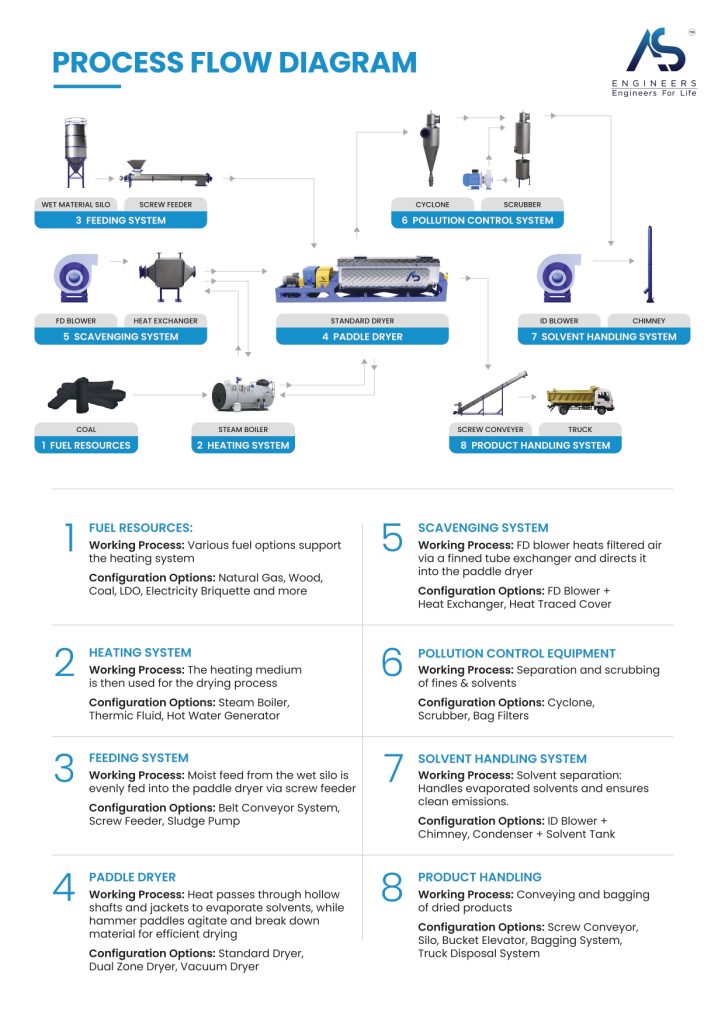
A practical sludge drying facility usually includes these systems:
| Stage | What Happens | Buyer Check |
|---|---|---|
| Sludge receiving | Dewatered sludge is collected from filter press, centrifuge, screw press, or storage pit | Daily sludge quantity, inlet moisture, sludge consistency |
| Feeding system | Sludge is transferred into the dryer through screw feeder, belt conveyor, pump, or customised feed arrangement | Sticky, pasty, pumpable, lumpy, fibrous, oily, or abrasive behaviour |
| Heating system | Heat is supplied through steam, thermic fluid, hot water, hot air, or site-specific fuel system | Available utility, temperature requirement, fuel cost, plant safety |
| Dryer section | Moisture evaporates inside the drying equipment | Final moisture target, residence time, heat-transfer area |
| Vapour handling | Evaporated water, vapour, odour, or solvent stream is routed safely | Condensation, scrubbing, ducting, ID fan, odour control |
| Pollution control | Cyclone, scrubber, bag filter, condenser, or other system is selected based on duty | Dust load, fumes, solvent, odour, regulatory requirements |
| Dry product handling | Dried sludge is discharged, cooled if required, conveyed, bagged, or stored | Dry material form, dusting tendency, disposal/reuse route |
| Controls and safety | Sensors, interlocks, motors, drives, panels, and operating logic manage the facility | Automation level, operator access, emergency stops, maintenance access |
For a wider view of available drying routes, see this guide on sludge drying methods and systems.
Why Paddle Dryer-Based Sludge Drying Is Often Considered
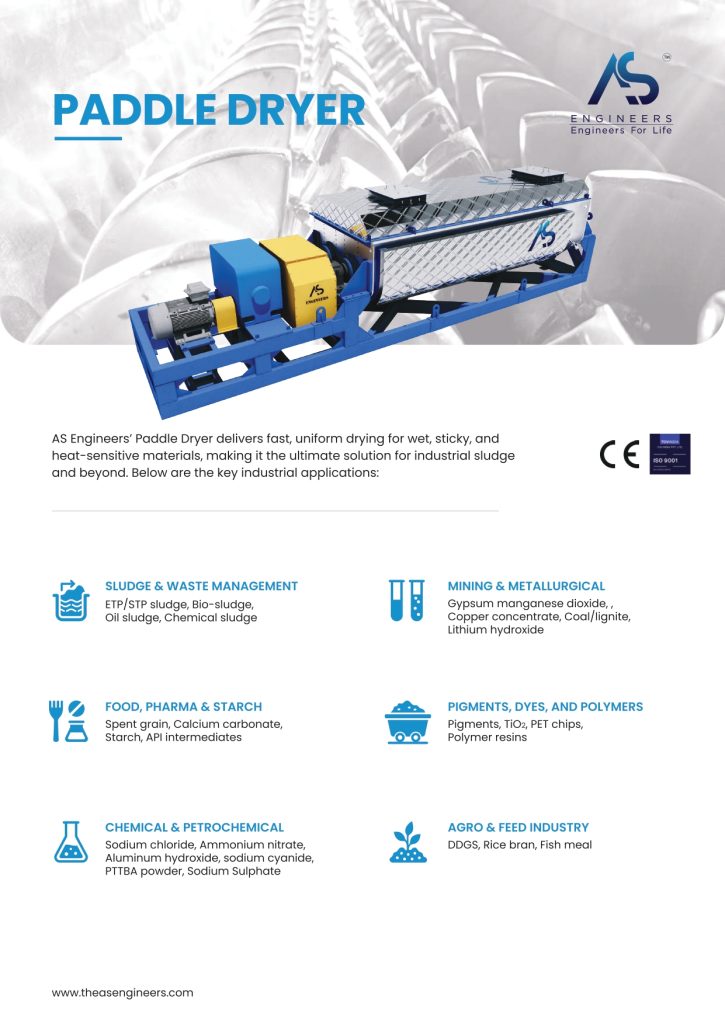
For many ETP and industrial sludge duties, a paddle dryer-based facility is considered because it uses indirect heat transfer. In an indirect dryer, heat is transferred through heated surfaces instead of exposing the sludge directly to flame or hot gas.
In a paddle dryer system, heat transfer takes place through hollow shafts, paddles, and the jacket. The paddles mix and move the sludge while moisture evaporates. This design can be useful for sticky, pasty, or difficult sludge when the feed needs continuous agitation.
A paddle dryer is especially relevant when the plant needs:
- Indirect heating
- Controlled drying
- Compact footprint
- Continuous operation
- Better handling of sticky wet cake
- Vapour collection and pollution-control integration
- Custom material of construction based on sludge chemistry
For equipment-level selection, link this page with the guide on how to choose a sludge paddle dryer and the paddle dryer configuration guide.
Key Design Inputs Before Selecting a Sludge Drying Facility
Do not request a quote only by saying “we need a sludge dryer.” A serious RFQ needs process data.
| Input | Why It Matters |
|---|---|
| Sludge type | ETP, STP, CETP, paper sludge, chemical sludge, pharma sludge, textile sludge, municipal sludge, oily sludge, or biological sludge behave differently |
| Daily quantity | Determines dryer capacity, feed system, discharge system, and operating hours |
| Inlet moisture | Affects evaporation load and fuel demand |
| Final moisture target | Changes dryer size, residence time, heating duty, and product handling |
| Sludge consistency | Pumpable sludge, wet cake, paste, lumpy sludge, and fibrous sludge need different feed arrangements |
| Chemical analysis | Helps decide MOC, corrosion risk, odour control, and disposal route |
| pH, chloride, solvent, oil, salts | Important for material selection and vapour handling |
| Heating medium | Steam, thermic fluid, hot water, gas, electricity, coal, wood, briquette, or other site fuel |
| Pollution-control need | Depends on odour, fumes, vapour, dust, solvent, and local compliance requirements |
| Space available | Impacts layout, access, maintenance, ducting, conveyors, and storage |
| Downstream plan | Disposal, TSDF, co-processing, cement, brick, composting, fuel use, or other approved route |
Benefits of a Sludge Drying Facility
A sludge drying facility should be evaluated on real operating data, not only brochure claims.
Lower sludge weight and transport load
Moisture is the main reason wet sludge becomes heavy and expensive to move. Drying reduces water content, so the final sludge quantity for transport or storage can reduce significantly depending on inlet and outlet moisture.
Better storage and handling
Wet sludge can create odour, leachate, hygiene issues, difficult loading, and poor housekeeping. Dried sludge is usually easier to convey, bag, store, and load, provided dust control and safe handling are planned properly.
Improved disposal planning
For industrial sludge, drying can make disposal logistics more manageable. It does not automatically make sludge non-hazardous. Sludge classification, lab analysis, local rules, and authorised disposal route must still be checked.
For disposal-side planning, connect this page with the industrial sludge disposal guide.
Better integration with pollution control
A well-planned facility can route vapour, odour, fines, and dust through suitable systems such as cyclone, scrubber, condenser, bag filter, ID fan, or chimney arrangement. This must be designed based on actual sludge chemistry and vapour load.
Possible reuse, only after testing and approval
Some dried sludge may be evaluated for use as alternative fuel, cement input, brick making, or agriculture-related use. This depends on calorific value, heavy metals, ash, toxicity, pathogen condition, local permissions, and buyer acceptance.
Do not assume every dried sludge has reuse value.
When a Sludge Drying Facility Is a Good Fit
A sludge drying facility may be a good fit when:
- The plant generates sludge daily or continuously
- Wet sludge transport cost is high
- Storage space is limited
- Sludge odour and hygiene are recurring issues
- Mechanical dewatering alone is not enough
- TSDF or disposal cost is driven by wet weight
- Final sludge needs controlled moisture
- The plant has steam, thermic fluid, hot water, or usable heat source
- Sludge has potential for approved co-processing or value recovery
- The plant wants a long-term sludge handling system instead of only manual disposal
When Drying May Not Be the First Step
Drying is not always the first solution. In some cases, the plant should first improve upstream treatment or dewatering.
Check these points before investing:
- Is the sludge too diluted before dewatering?
- Is the filter press or centrifuge underperforming?
- Is polymer dosing wrong?
- Is sludge feed inconsistent?
- Is the plant mixing incompatible sludge streams?
- Is the final disposal route already fixed by regulation?
- Is there enough power, steam, fuel, and space?
- Is the sludge hazardous, solvent-bearing, oily, or combustible?
For low-volume sludge or where land and sunlight are available, a sludge drying bed may still be evaluated. For higher control, continuous duty, or difficult industrial sludge, thermal systems are usually reviewed more seriously.
Sludge Drying Technology Comparison
| Technology | Best Fit | Main Caution |
|---|---|---|
| Paddle dryer | Sticky wet cake, ETP sludge, industrial sludge, controlled indirect drying | Requires correct feed design, MOC, vapour handling, and heating medium selection |
| Belt dryer | Large flow, lower-temperature drying, municipal sludge duties | Needs more footprint and careful air handling |
| Solar drying bed | Low-cost drying where land and climate support it | Slower, weather-dependent, less controlled |
| Disc dryer | Indirect drying with rotating heated discs | Selection depends on sludge behaviour and maintenance access |
| Rotary dryer | High-throughput drying for suitable solids | Direct contact and dust/vapour management need careful review |
For a deeper technical view, connect this article to the thermal sludge drying system guide and the sludge disc dryer guide.
RFQ Checklist for a Sludge Drying Facility
Use this checklist before contacting a manufacturer.
| RFQ Input | What to Share |
|---|---|
| Sludge source | ETP, STP, CETP, chemical, pharma, textile, paper, food, refinery, municipal, or other |
| Quantity | kg/hr or ton/day, including peak and average load |
| Inlet moisture | Lab-tested moisture percentage after dewatering |
| Final moisture target | Required dry solids or moisture percentage |
| Sludge form | Pumpable, paste, wet cake, sticky, fibrous, oily, granular, or lumpy |
| Operating hours | Batch, one shift, two shifts, or continuous |
| Heating source | Steam, thermic fluid, hot water, natural gas, wood, coal, LDO, electricity, briquette, or available waste heat |
| Site utilities | Power, steam pressure, fuel availability, water, compressed air |
| Chemical data | pH, chloride, sulphate, oil/grease, solvent, salts, heavy metals, ash, calorific value |
| Safety concerns | Odour, toxic vapour, explosive dust, solvent, flammability, high temperature |
| MOC expectation | CS, SS304, SS316, duplex, alloy, or manufacturer recommendation |
| Pollution control | Scrubber, cyclone, bag filter, condenser, ID fan, chimney, or existing APC system |
| Product handling | Conveyor, bagging, silo, truck loading, cooling, or storage |
| Disposal route | TSDF, landfill, co-processing, cement, brick, agriculture, fuel, or authorised vendor |
| Layout | Available footprint, height, access, maintenance clearance |
| Trial need | Pilot trial, lab test, or material behaviour test |
Common Mistakes in Sludge Drying Facility Planning
Selecting by dryer price only
The dryer is only one part of the facility. A low equipment price can become expensive if feeding, vapour handling, pollution control, MOC, automation, and service access are not planned.
Ignoring inlet moisture variation
Dryer performance depends on evaporation load. If inlet moisture keeps changing, the system needs enough design margin and control flexibility.
Assuming dried sludge is automatically reusable
Dried sludge reuse depends on chemical composition, local permission, market acceptance, and safety. Always test before planning reuse.
Missing vapour and odour treatment
Sludge drying creates vapour. Depending on sludge type, it may also create odour, fumes, solvent vapour, or fines. The facility must include the right vapour and air-pollution-control path.
Not planning maintenance access
A facility should allow access to shaft, drive, gearbox, bearing, seals, feeding system, discharge system, ducting, and cleaning points.
AS Engineers Support for Sludge Drying Facility Selection
AS Engineers works on paddle dryer and sludge dryer systems for industrial sludge drying applications. For paddle dryer-based facilities, the design review should start with actual sludge data, not only ton/day capacity.
AS Engineers can review:
- Sludge source and behaviour
- Feed moisture and final moisture target
- Heating medium availability
- MOC requirement
- Vapour handling and pollution-control requirement
- Feeding and discharge arrangement
- Pilot-trial need
- Retrofit or service requirement for existing systems
For practical selection, share sludge samples, lab analysis, moisture data, daily quantity, site utility details, and disposal plan before asking for final sizing.
FAQs
What is a sludge drying facility?
A sludge drying facility is a complete system that reduces moisture in sludge after treatment and dewatering. It usually includes feeding, heating, drying, vapour handling, pollution control, dry product handling, and controls.
Which sludge can be processed in a sludge drying facility?
ETP sludge, STP sludge, CETP sludge, municipal sludge, paper sludge, chemical sludge, textile sludge, pharma sludge, food sludge, biological sludge, and some oily sludge may be evaluated. Final suitability depends on sludge testing and system design.
Is a paddle dryer suitable for sludge drying?
A paddle dryer can be suitable for many sticky, pasty, and dewatered sludge applications because it uses indirect heat transfer through hollow shafts, paddles, and jacket surfaces. Suitability depends on sludge properties, moisture target, heating medium, and vapour handling requirement.
Does sludge drying reduce disposal cost?
Sludge drying can reduce wet weight and volume, which may reduce transport and disposal burden. Exact cost impact depends on inlet moisture, outlet moisture, fuel cost, disposal rate, labour, operation hours, and approved disposal route.
What data is needed to quote a sludge drying facility?
Share sludge type, kg/hr or ton/day quantity, inlet moisture, final moisture target, sludge analysis, sludge consistency, heating medium, available utilities, site layout, pollution-control requirement, and final disposal or reuse plan.
Conclusion
A sludge drying facility should be planned as a complete sludge handling system, not as a standalone dryer purchase. The right system depends on sludge source, moisture load, heating medium, material behaviour, vapour treatment, pollution control, dry product handling, and final disposal or reuse route.
For ETP, STP, CETP, and industrial plants, the best starting point is a practical RFQ with real sludge data. Share the sludge quantity, inlet moisture, final moisture target, heating source, site layout, and lab analysis so the AS Engineers team can review the duty condition and suggest a suitable sludge drying facility configuration.