Oil and grease trap oil skimmer selection should start with wastewater flow rate, FOG load, free oil thickness, solids content, temperature, pH, detergent use, tank layout, cleaning access, and downstream ETP or STP limits. A grease trap is a passive separator. An oil skimmer is an active removal device. Many industrial and commercial facilities need both, especially where floating oil or grease keeps entering the wastewater stream.
For plant teams, the right question is not only “Which equipment is cheaper?” The better question is: Will this system keep FOG out of the ETP, reduce blockages, protect downstream treatment, and make sludge handling easier?
What an Oil and Grease Trap Does
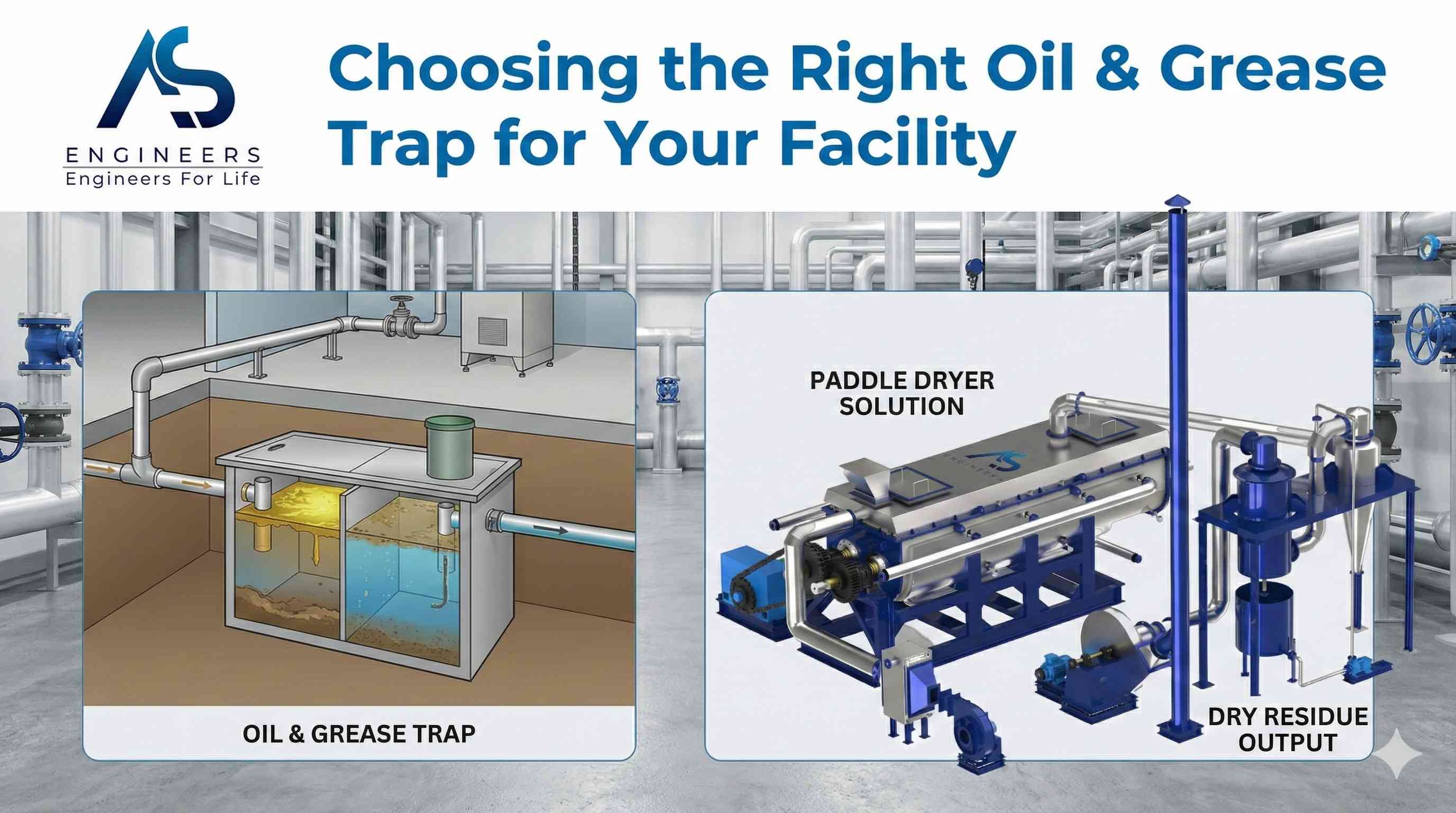
An oil and grease trap, also called a grease interceptor in many wastewater systems, slows down wastewater so fats, oils, and grease can rise to the surface while heavier solids settle at the bottom. The cleaner middle layer then moves forward to the next treatment stage.
This is useful in:
- Commercial kitchens and hotels
- Food processing plants
- Dairy and bakery units
- Meat and poultry processing
- Industrial canteens
- ETP pre-treatment systems
- Automobile washing and oily wastewater areas
- Chemical, pharma, and utility wastewater systems where free oil is present
A grease trap is most useful when the main issue is floating FOG before the wastewater enters a drain line, equalization tank, ETP, or municipal sewer connection. Grease traps commonly use baffles or tees to reduce turbulence and help floating grease stay inside the trap instead of escaping with the outlet water.
What an Oil Skimmer Does
An oil skimmer actively removes free-floating oil or grease from the water surface. Instead of waiting for manual cleaning, the skimmer continuously collects the separated oil and transfers it to a collection container.
Common oil skimmer types include:
| Oil skimmer type | Best fit | Watch point |
|---|---|---|
| Belt oil skimmer | Sumps, tanks, ETP pre-treatment chambers, medium oil loading | Belt material must match oil type, temperature, and chemicals |
| Disc oil skimmer | Smaller tanks, stable water level, light to moderate oil | Less suitable where heavy floating debris is present |
| Drum oil skimmer | Wider surface collection and thicker oil layers | Needs enough tank width and access |
| Tube oil skimmer | Irregular tanks, pits, and changing water levels | Tube routing and maintenance access matter |
| Weir skimmer | Higher oil volume and thicker floating layers | Can collect more water with oil if not adjusted well |
For many ETP plants, belt or drum skimmers are practical because they remove floating oil before it reaches biological treatment, pumps, aeration systems, filters, or sludge handling equipment.
Oil and Grease Trap vs Oil Skimmer
| Selection point | Oil and grease trap | Oil skimmer |
|---|---|---|
| Main role | Separates and holds FOG by gravity | Mechanically removes floating oil from surface |
| Operation | Passive | Active |
| Moving parts | Usually none | Yes |
| Best for | Intercepting grease before drain/ETP | Continuous removal from tank or sump |
| Maintenance need | Manual cleaning and sludge removal | Routine inspection, wiper/belt checks, collection bin emptying |
| Limitation | Can overflow or pass grease if not cleaned | Cannot solve emulsified oil alone |
| Best use | First-stage FOG control | Add-on for continuous oil removal |
A trap without proper cleaning becomes a storage problem. A skimmer without proper separation time may not get enough free oil to collect. The strongest system is often a correctly sized trap or oil-water separator with a skimmer installed where oil naturally accumulates.
Where This Fits in Wastewater Treatment
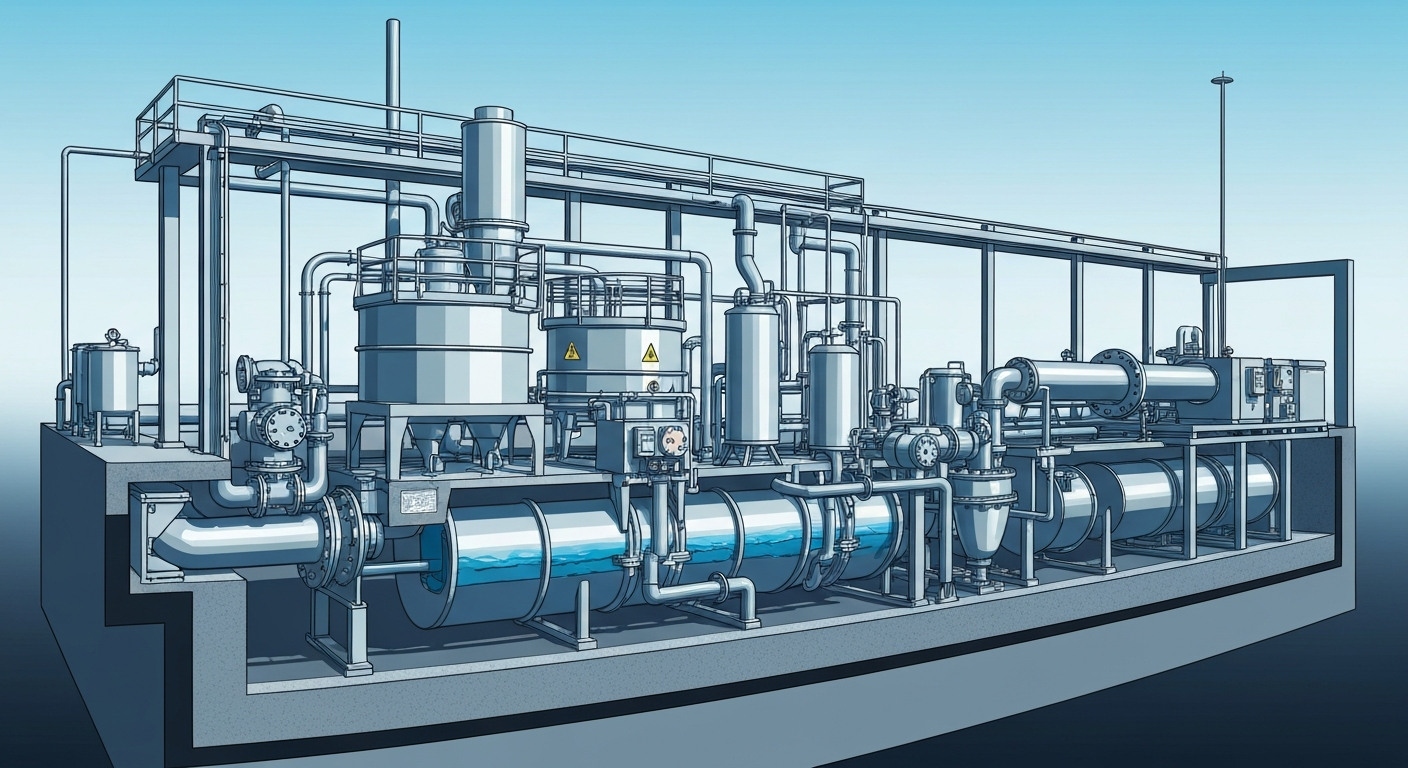
Oil and grease removal usually belongs in the pre-treatment stage, before equalization, biological treatment, filtration, or sludge dewatering. For a broader process view, connect this page with the wastewater treatment process and the ETP effluent treatment plant guide.
A practical treatment flow may look like this:
- Screening to remove large solids
- Oil and grease trap or oil-water separator
- Oil skimmer for floating oil removal
- Equalization tank
- Chemical or biological treatment
- Clarification or settling
- Sludge dewatering
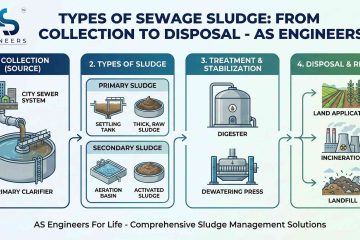
- Sludge drying or final disposal planning
For oily wastewater, do not send heavy floating oil directly to downstream treatment. It can disturb pumps, aeration, tank surfaces, sensors, biological treatment, and sludge quality. FOG management is widely treated as a sewer and wastewater operating concern, especially for food service and industrial wastewater streams.
Selection Checklist for Plant Teams
Use this checklist before selecting an oil and grease trap, oil skimmer, or combined system.
| Input required | Why it matters |
|---|---|
| Daily wastewater flow | Helps size the trap, retention time, and skimmer capacity |
| Peak flow rate | Prevents FOG carryover during high-load hours |
| Oil/grease type | Animal fat, vegetable oil, mineral oil, lubricating oil, cutting oil, and petroleum oil behave differently |
| Free oil vs emulsified oil | Skimmers remove free-floating oil, not stable emulsions |
| Solids load | Food solids, grit, sludge, and debris can reduce trap capacity |
| Temperature | Hot water may carry grease forward before it cools and separates |
| pH and chemicals | Detergents, caustics, solvents, and surfactants can affect separation |
| Available space | Underground, above-ground, indoor, outdoor, and tank-mounted designs differ |
| Access for cleaning | Poor access creates maintenance failure even if the system is correctly sized |
| Downstream ETP/STP requirement | Discharge route and consent limits decide treatment target |
| Sludge/oil disposal method | Collected grease, oily sludge, and settled solids still need legal disposal or reuse review |
India’s general effluent standards list oil and grease limits by discharge route, but the final applicable limit depends on the industry, state pollution control board, consent condition, and discharge location. Treat this as a compliance checkpoint, not a universal design guarantee.
Fit/No-Fit Guide
| Situation | Recommended direction |
|---|---|
| Small commercial kitchen with low FOG load | Grease trap with scheduled manual cleaning |
| Hotel, large canteen, or food processing unit | Larger grease interceptor with cleaning log and possibly automatic skimming |
| ETP sump with visible floating oil | Oil skimmer installed at oil accumulation zone |
| Automobile wash or workshop wastewater | Oil-water separator plus skimmer, with grit/solids control |
| Refinery or petroleum wastewater | Duty-specific oil separation system, skimmer, and hazardous sludge handling review |
| Wastewater with emulsified oil | Chemical treatment, DAF, coalescer, or process-specific treatment may be needed before skimming works |
| High solids with FOG | Screening and solids removal before the trap/skimmer |
| Variable flow and frequent shock loads | Equalization and controlled flow are important before final treatment |
For refinery and petroleum wastewater, connect this topic with petroleum sludge treatment and disposal and refinery sludge management challenges.
Common Mistakes in Oil and Grease Removal
The most common mistake is installing a trap or skimmer without understanding the actual wastewater. A plant may have good equipment but still face oil carryover if the flow is too fast, the oil is emulsified, or the tank has poor access for cleaning.
Avoid these mistakes:
- Selecting only by tank size without checking peak flow
- Ignoring solids before the grease trap
- Using hot water or chemicals in a way that pushes grease downstream
- Assuming all oil can be removed by a skimmer
- Forgetting collection bin capacity
- Installing the skimmer where oil does not naturally collect
- Not keeping inspection and cleaning records
- Sending oily sludge to the wrong disposal route
- Treating grease trap sludge as harmless without testing or local approval
- Selecting equipment without considering downstream ETP load
For upstream solids control, support this page with bar screens in wastewater treatment, coarse screens, and fine screens.
Maintenance Planning
Oil and grease systems fail more often from poor maintenance than from poor concept. A basic maintenance plan should include:
| Frequency | Activity |
|---|---|
| Daily/shift-wise | Visual check for floating grease, odor, overflow, and unusual carryover |
| Weekly | Check skimmer belt/disc/drum, wiper blades, oil collection bin, and sludge buildup |
| Monthly | Inspect inlet/outlet baffles, clean accessible solids, and verify flow path |
| As required | Pump out settled solids and grease layer before capacity is lost |
| After process change | Recheck loading when production, menu, chemical use, or wastewater flow changes |
Keep a log of cleaning, oil collection, sludge removal, complaints, blockages, and ETP upset events. The log helps plant, EHS, purchase, and service teams understand whether the selected system is actually working.
What Happens After Oil and Grease Separation?
Oil and grease separation does not end the waste problem. It changes the waste form. You may still have:
- Collected oil
- Brown grease
- Settled solids
- Oily sludge
- ETP sludge with higher organic/oil content
- Filter cake after dewatering
Some recovered oils may be recyclable, but this depends on the oil type, contamination level, local acceptance, and legal disposal route. EPA training material distinguishes cleaner yellow grease from brown grease retained in interceptors and traps, which is more contaminated because it includes floatable FOG, settled solids, and wastewater.
For final sludge handling, review sludge dewatering techniques, sludge pumps for wastewater treatment, and industrial sludge disposal.
Connection With Sludge Drying
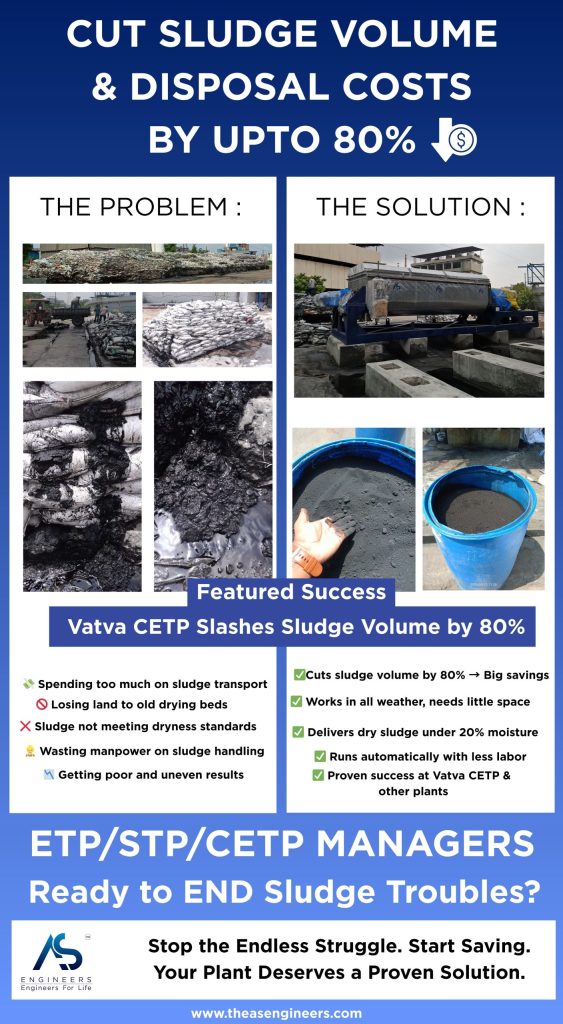
After oil and grease are removed, the remaining ETP sludge may still have high moisture and disposal difficulty. This is where sludge dewatering and drying become important.
A paddle dryer is not a replacement for an oil and grease trap. It is a downstream sludge drying solution used after wastewater treatment or dewatering, when the plant needs to reduce moisture, improve handling, and reduce wet sludge volume. AS Engineers’ verified paddle dryer documentation describes indirect heat transfer through hollow shafts and jacket, self-cleaning wedge-shaped paddles, dual counter-rotating shafts, and process options such as drying, heating, solvent stripping, cooling, and sludge drying.
For dryer-side selection, connect this page to how to choose a sludge paddle dryer, paddle dryer configuration guide, and paddle dryer manufacturer in India.
RFQ Inputs to Share Before Final Selection
For oil and grease trap or oil skimmer selection, share:
- Industry and process source
- Wastewater flow rate, average and peak
- Working hours per day
- Oil/grease type
- Free oil layer thickness, if visible
- Approximate oil and grease concentration, if tested
- Temperature of wastewater
- pH and chemical/detergent use
- Solids load and particle size
- Tank/sump dimensions
- Available installation space
- Indoor or outdoor installation
- Existing ETP/STP flow diagram
- Current problem, such as odor, overflow, blockages, oil carryover, or biological treatment upset
- Cleaning frequency and waste disposal method
- Applicable consent condition or discharge requirement
For sludge drying review, also share sludge type, feed moisture, final moisture target, daily sludge quantity, dewatering method, heating medium availability, and final disposal or reuse plan.
FAQs
What is the difference between an oil and grease trap and an oil skimmer?
An oil and grease trap passively separates FOG by slowing wastewater and allowing oil to float. An oil skimmer actively removes floating oil from the water surface using a belt, disc, drum, tube, or weir mechanism.
Do I need both a grease trap and an oil skimmer?
Use both when the wastewater has continuous floating oil or grease loading. The trap provides separation time, while the skimmer removes collected oil before it escapes downstream or reduces trap capacity.
Can an oil skimmer remove emulsified oil?
No. A standard oil skimmer is mainly for free-floating oil. If oil is emulsified because of detergents, chemicals, or process conditions, the plant may need chemical treatment, DAF, coalescing media, or another process-specific treatment step.
How often should an oil and grease trap be cleaned?
Cleaning frequency depends on flow, FOG load, solids, and trap size. High-load kitchens and food plants may need frequent checks, while industrial systems should use inspection logs and clean before grease or solids reduce working volume.
How does oil and grease removal affect sludge drying?
Good oil and grease removal reduces avoidable load on the ETP and can make downstream sludge handling more predictable. Sludge drying comes later, after treatment or dewatering, when the plant needs to reduce wet sludge moisture and improve disposal handling.
Conclusion
Oil and grease trap oil skimmer selection should be based on real wastewater conditions, not only on equipment price or tank size. Start with flow, FOG load, oil type, solids, temperature, chemicals, space, cleaning access, and downstream ETP requirements.
Use a grease trap when the first need is gravity separation and FOG interception. Use an oil skimmer when free oil keeps collecting on the water surface and needs continuous removal. Use both when the facility has regular FOG loading and wants to protect the ETP, reduce blockages, and improve sludge handling.
For sludge drying after ETP treatment, share your sludge quantity, feed moisture, final moisture target, dewatering method, heating medium, and disposal route. The AS Engineers team can review sludge drying requirements and suggest the right dryer-side direction based on actual plant conditions.