Best available technology for sludge drying is not one fixed machine. It is the most suitable drying system for a specific sludge type, moisture level, site layout, fuel source, vapour load, disposal route, and compliance risk.
For many industrial ETP, CETP, STP, and ZLD plants, an enclosed indirect paddle dryer becomes a strong BAT candidate because it can handle wet cake, sticky sludge, pastes, and difficult residues with controlled heat transfer and lower open handling risk. But it should still be selected only after checking the sludge sample, dewatering stage, final moisture target, and downstream disposal plan.
What BAT Means in Sludge Drying
BAT means Best Available Technology or Best Available Techniques, depending on the regulatory context. In sludge drying, BAT does not simply mean the newest dryer or the most expensive machine.
A sludge drying BAT should help the plant achieve these practical goals:
| BAT requirement | What it means for sludge drying |
|---|---|
| Moisture reduction | Removes enough water to reduce handling, transport, storage, and disposal burden |
| Process control | Gives predictable output moisture instead of weather-dependent drying |
| Emission control | Manages vapour, odour, dust, and fumes through enclosed handling and suitable pollution-control equipment |
| Energy practicality | Uses steam, thermic fluid, hot water, fuel, or waste heat in a practical way for the plant |
| Site fit | Works within available footprint, layout, utility, and operator skill level |
| Disposal alignment | Matches TSDF, co-processing, landfill, incineration, composting, reuse, or internal handling requirements |
| Safety boundary | Avoids unsafe assumptions for hazardous, solvent-bearing, oily, biological, or combustible sludge |
A good BAT decision starts with the sludge, not the brochure.
Why BAT Selection Matters for Indian ETP, STP, CETP, and ZLD Plants
Wet sludge is expensive because most of the weight is water. That water increases transport cost, storage area, smell, hygiene problems, and disposal frequency.
For industrial plants, the decision is more serious because sludge may include salts, heavy metals, oils, solvents, chemicals, biological solids, or process residues. A drying system that works for municipal sewage sludge may not work for chemical ETP sludge. A solar bed that works in a low-risk municipal site may not suit a compact pharma, textile, dye, refinery, ceramic, agrochemical, or ZLD plant.
Before selecting any sludge dryer, the plant team should confirm:
- Sludge source: ETP, STP, CETP, ZLD, refinery, chemical, pharma, food, textile, paper, or municipal
- Feed form: slurry, paste, wet cake, sticky sludge, filter press cake, centrifuge cake, or mixed residue
- Initial moisture and target final moisture
- Whether the sludge is hazardous or non-hazardous
- Whether it contains oil, solvent, salt, chloride, sulphate, abrasive solids, or corrosive compounds
- Daily sludge quantity and peak generation
- Available fuel or heating medium
- Vapour treatment requirement
- Dried sludge disposal or reuse route
For hazardous or regulated sludge, drying should not be treated as a shortcut to disposal. Classification, storage, transport, manifest, and final disposal route must be checked with the applicable SPCB/PCC, TSDF, or environmental consultant.
For related compliance reading, connect this page with the article on CPCB guidelines for hazardous waste disposal and TSDF site standards.
Main Sludge Drying Technologies Compared for BAT Selection
| Technology | Better fit | Main limitation | BAT interpretation |
|---|---|---|---|
| Open sludge drying bed | Low-risk sludge, low land cost, small plants, non-urgent drying | Weather-dependent, large land area, odour and leachate risk | Can fit where time, land, climate, and sludge risk are acceptable |
| Solar or greenhouse drying | Municipal/STP sludge, warm climate, available land | Seasonal variation, slower drying, odour control required | Can be suitable for low-risk sludge with land and time |
| Belt sludge dryer | Large continuous municipal or industrial sludge flow | More air handling, larger layout, feed preparation needed | Useful when lower-temperature air drying and continuous operation fit the plant |
| Paddle sludge dryer | Sticky, pasty, wet cake, industrial ETP/CETP/ZLD sludge | Needs correct sizing, heating medium, vapour handling, and feed control | Strong BAT candidate when enclosed, indirect, compact, controlled drying is needed |
| Thin film dryer / ATFD | Concentrated slurry, viscous residue, ZLD reject, heat-transfer-sensitive duties | Feed consistency and film formation are critical | Strong for selected ZLD and concentrated residues, not every sludge cake |
| Drum or rotary dryer | Granular, free-flowing, high-volume solids | Higher gas contact and air handling in many designs | Can fit mineral and bulk solids, but needs emission-control review |
For a deeper internal comparison, link this page to advanced sludge drying technologies, thermal sludge drying systems, and paddle dryer vs solar bed.
Where Paddle Dryer Fits as a BAT Candidate
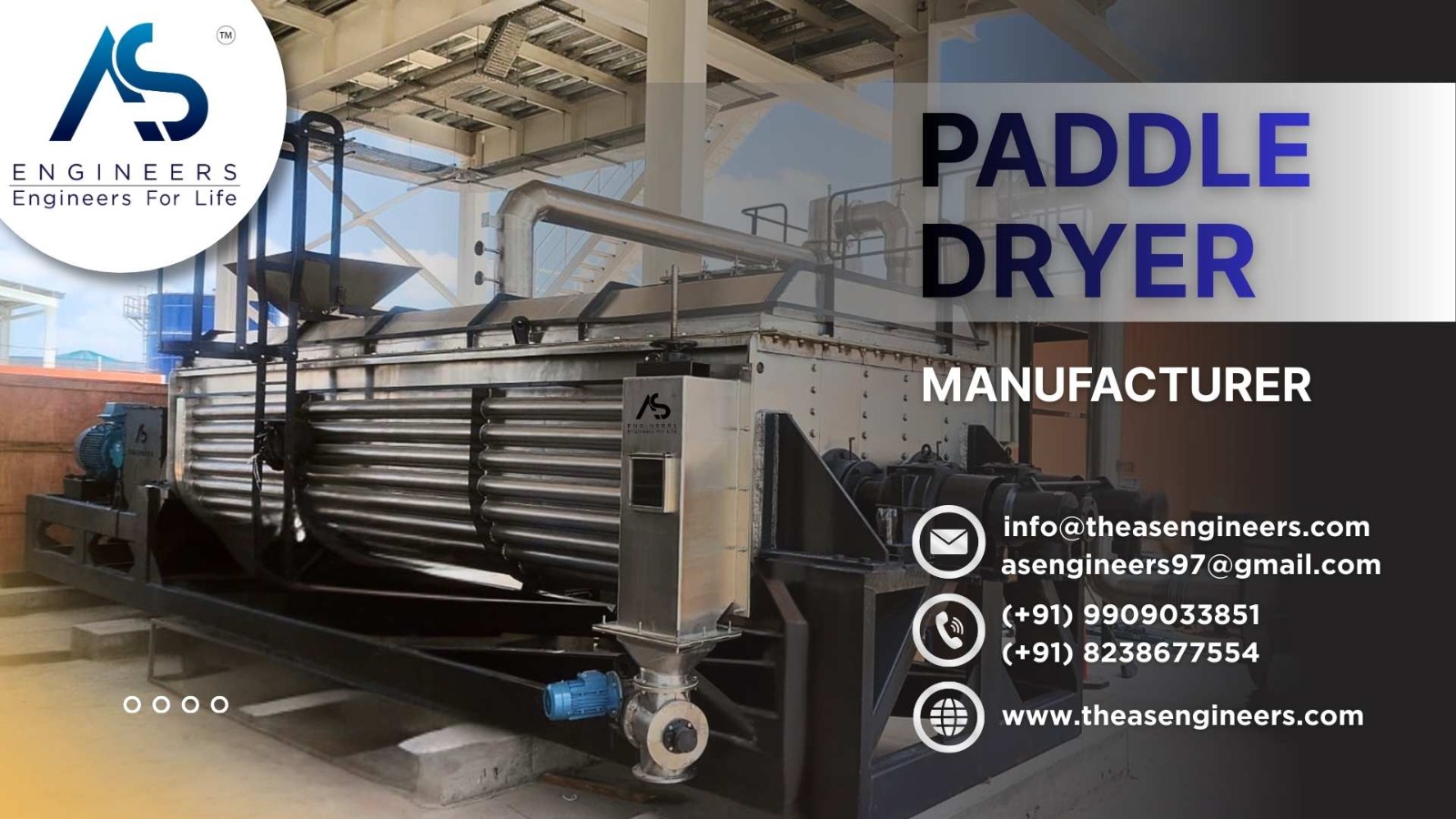
A paddle dryer is usually considered when the plant needs controlled thermal drying after mechanical dewatering. It is especially useful when sludge behaves like sticky cake, paste, semi-solid residue, or difficult industrial sludge.
In a paddle dryer, heat is transferred indirectly through heated surfaces such as hollow shafts, paddles, and jacketed body. The sludge is continuously agitated, mixed, and conveyed through the dryer. This helps expose wet material to heated surfaces while reducing direct hot-air contact.
A paddle dryer becomes a strong BAT candidate when the plant needs:
- Enclosed sludge drying
- Controlled final moisture
- Lower open handling of wet sludge
- Compact equipment footprint
- Indirect heat transfer
- Continuous operation
- Lower off-gas volume compared with many direct hot-air systems
- Better handling of sticky, pasty, and wet cake materials
- Integration with cyclone, scrubber, bag filter, condenser, ID fan, or chimney where required
At AS Engineers, paddle dryer configurations may include feeding system, heating system, scavenging system, pollution-control equipment, solvent/vapour management, and dried product handling. AS Engineers source documents also describe paddle dryer variants such as standard dryer, dual-zone dryer, and vacuum dryer, along with heating options such as steam, thermic fluid, and hot water generator support.
For equipment-level context, connect this page to paddle dryer manufacturer in India and sludge treatment with conductive paddle dryers.
When Paddle Dryer May Not Be the Best BAT
Paddle dryer is not automatically the best answer for every sludge drying project.
It may not be the right first option when:
- The sludge is extremely dilute and has not been mechanically dewatered
- Free water can still be removed more cheaply by filter press, centrifuge, screw press, or thickening
- The plant has enough land, time, and climate support for solar drying
- The sludge is low-risk and final moisture control is not critical
- The feed is too inconsistent without equalization or preconditioning
- The sludge contains solvents, explosive dust, toxic vapours, or combustible components without a proper safety and vapour-control design
- The project has no clear disposal route for dried sludge
Thermal drying should normally follow mechanical water removal. A dryer should not be forced to do the job of a dewatering system. For upstream selection, use sludge dewatering techniques and sludge dewatering machine guide as supporting pages.
BAT Selection Checklist for Sludge Drying
Use this checklist before finalizing any sludge drying technology.
| Selection input | What to ask before RFQ |
|---|---|
| Sludge source | Is it ETP, STP, CETP, ZLD, refinery, pharma, chemical, textile, food, paper, or municipal sludge? |
| Feed consistency | Is it slurry, paste, wet cake, sticky sludge, filter cake, or mixed residue? |
| Moisture data | What is the initial moisture and required final moisture? |
| Quantity | What is daily generation and peak load? |
| Variability | Does the sludge change by batch, product campaign, pH, chemical dosing, or season? |
| Hazard classification | Is the sludge hazardous, non-hazardous, biological, oily, solvent-bearing, corrosive, or abrasive? |
| Heating source | Steam, thermic fluid, hot water, natural gas, biomass, coal, LDO, electricity, or waste heat? |
| Vapour handling | Is condenser, scrubber, cyclone, bag filter, ID fan, chimney, or odour control required? |
| Material of construction | Is CS, SS304, SS316, duplex, alloy, hard-facing, or special finish required? |
| Dried output | Will dried sludge go to TSDF, co-processing, landfill, incineration, internal reuse, composting, bricks, cement, or fuel route? |
| Site constraints | What space, height, foundation, access, utilities, and discharge arrangement are available? |
| Maintenance plan | Who will handle cleaning, seals, bearings, gearbox, shafts, paddles, and spares? |
When I review a sludge drying requirement, I do not start with dryer capacity alone. I first check the sludge behaviour, upstream dewatering, heating medium, vapour load, expected outlet moisture, and disposal route. Without these inputs, even a good dryer can be wrongly selected.
BAT Design Elements in an Industrial Paddle Dryer System
A paddle dryer should not be evaluated only as a dryer body. For industrial sludge, the full system matters.
Feeding system
The feed system must deliver wet sludge uniformly. Depending on sludge behaviour, the plant may need a screw feeder, sludge pump, belt conveyor, wet material silo, hopper, or controlled feed arrangement.
Poor feeding creates surging, uneven drying, high torque, discharge inconsistency, and unnecessary operator intervention.
Indirect heating system
Indirect heating allows heat transfer through surfaces rather than direct flame contact with sludge. Depending on the application, heating may come from steam, thermic fluid, or hot water.
AS Engineers documentation lists steam and thermal oil options for paddle dryer heating, with construction and operating design selected as per application.
Agitation and mixing
Paddles should break, mix, and move the sludge through the dryer. Sticky feed needs enough agitation to expose wet material to heat-transfer surfaces, but excessive mechanical stress or wrong residence time can create operating problems.
Vapour and fine handling
Drying generates vapour. Some sludge may also generate odour, fumes, solvent vapour, or fine particles. BAT selection must include vapour handling, not only moisture evaporation.
Typical support equipment may include:
- Cyclone
- Scrubber
- Bag filter
- ID fan
- Chimney
- Condenser
- Solvent or condensate collection system
- Heat-traced cover where required
AS Engineers process-flow material includes pollution-control and solvent-management system options such as cyclone, scrubber, bag filter, ID blower with chimney, and condenser with solvent tank depending on process need.
Dried product handling
The dryer discharge should match the final disposal or reuse route. Dried sludge may need screw conveyor, bagging, silo, bucket elevator, truck loading, cooling, or sealed transfer depending on dust, odour, hazard level, and plant layout.
BAT Decision Matrix: Which Sludge Dryer Should You Shortlist?
| Plant condition | Better shortlist |
|---|---|
| Sticky industrial ETP sludge after filter press | Paddle dryer |
| Compact plant with high disposal cost | Paddle dryer or thin film dryer |
| Municipal/STP sludge with land and slow drying acceptance | Solar/greenhouse drying or drying bed |
| Large continuous sludge flow with lower-temperature drying preference | Belt dryer |
| ZLD concentrated slurry or salt-rich residue | ATFD, thin film dryer, or specialized sludge dryer after sample review |
| Hazardous sludge with odour or fumes | Enclosed thermal dryer with vapour and pollution-control system |
| Low-risk sludge with very limited budget | Improve dewatering first, then evaluate drying bed or solar route |
| Sludge with changing feed composition | Pilot trial or lab test before final dryer selection |
Cost and ROI: What to Calculate Before Calling Any System BAT
A sludge dryer is not BAT only because it reduces moisture. It should also make economic and operational sense.
Calculate these items before final selection:
- Current wet sludge generation per day
- Current sludge disposal cost per ton
- Current transport frequency
- Storage area requirement
- Labour used for sludge handling
- Initial moisture and target final moisture
- Expected dry solids quantity
- Fuel or utility cost
- Power load
- Consumables and spares
- Vapour treatment cost
- Dried sludge acceptance cost at final disposal route
- Maintenance cost
- Operator requirement
- Downtime risk
AS Engineers internal material gives a typical sludge drying comparison where 10 ton/day wet sludge becomes 2 ton/day dry sludge in an example disposal-cost scenario, but this should be used as a project illustration, not a guaranteed result for every sludge.
For buying-stage users, link here to industrial sludge dryer machine price and hidden cost of landfilling wet sludge.
Compliance and Safety Boundaries
Sludge drying can support easier handling and disposal-volume reduction, but it does not automatically make sludge non-hazardous or reusable.
Before deciding the final dried sludge route, confirm:
- Hazardous or non-hazardous classification
- Lab analysis for heavy metals, salts, organics, oil, solvents, moisture, ash, and calorific value where relevant
- TSDF or co-processing acceptance criteria
- SPCB/PCC authorization requirements
- Storage and transport requirements
- Dust, odour, vapour, fire, explosion, and worker-exposure risks
- Whether dried sludge is suitable for reuse, fuel, cement, bricks, composting, or only disposal
Do not claim fertilizer, fuel, cement, or brick use without lab testing and route approval. Dried sludge may become easier to handle, but final use depends on composition and regulatory acceptance.
For disposal planning, use industrial sludge disposal guide and methods to reduce hazardous waste weight as support pages.
RFQ Inputs to Share for BAT Sludge Dryer Selection
Send these details when asking AS Engineers or any supplier for sludge drying equipment:
- Industry and plant location
- Sludge source: ETP, STP, CETP, ZLD, process residue, or mixed stream
- Daily sludge quantity in kg/day or ton/day
- Initial moisture percentage
- Desired final moisture percentage
- Feed form: slurry, paste, wet cake, sticky cake, powder, granule, or mixed
- Bulk density and particle behaviour, if available
- pH, chloride, salt, oil, solvent, metal, or corrosive content
- Hazardous waste classification, if applicable
- Current dewatering equipment
- Available heating medium: steam, thermic fluid, hot water, gas, LDO, electricity, biomass, coal, or waste heat
- Vapour treatment requirement
- Required MOC: CS, SS304, SS316, duplex, alloy, hard-facing, or special finish
- Site space and layout limitations
- Dried sludge disposal or reuse route
- Automation, bagging, conveying, and truck-loading requirement
- Required pilot trial or sample testing support
Common Mistakes While Selecting BAT for Sludge Drying
Choosing dryer type before sludge testing
Sludge behaviour changes everything. Sticky sludge, oily sludge, solvent-bearing sludge, biological sludge, and salt-rich sludge do not dry the same way.
Comparing only capital cost
A cheaper system can become expensive if it needs more land, more labour, more fuel, more cleaning, or frequent disposal.
Ignoring upstream dewatering
Mechanical dewatering is usually cheaper than evaporating free water thermally. Improve dewatering before increasing dryer size.
Treating dried sludge as automatically reusable
Reuse depends on lab results and regulatory acceptance. Drying reduces moisture; it does not erase contamination.
Forgetting vapour handling
Odour, fumes, solvent vapour, and fine particles must be planned early. The dryer body alone is not the full BAT system.
Oversizing or undersizing based on wet weight only
Sizing must consider evaporation load, feed moisture, final moisture, residence time, sludge behaviour, heating medium, and heat-transfer area.
AS Engineers Approach to BAT-Based Sludge Drying Review
AS Engineers manufactures paddle dryer / sludge dryer systems and related support equipment for industrial drying applications. The company’s documentation describes work across paddle dryer / sludge dryer, centrifugal blower, pollution-control equipment, and turnkey solutions, with ISO 9001:2015 certification stated in the official catalogue.
For sludge drying BAT review, the practical approach should be:
- Understand the sludge and process source
- Review upstream dewatering
- Define final moisture target
- Check heating medium and site utilities
- Decide vapour and pollution-control route
- Select MOC and surface finish
- Plan product discharge and disposal route
- Consider pilot trial where sludge behaviour is uncertain
- Finalize dryer configuration only after technical review
AS Engineers documentation also refers to a 50 kg/hr paddle dryer pilot trial machine for demonstrations and application feasibility checks. Use this route when feed behaviour or final moisture target is uncertain.
For project discussion, share your sludge sample details, moisture data, daily generation, heating medium, site layout, and disposal route with the AS Engineers team.
FAQs
What is the best available technology for sludge drying?
The best available technology for sludge drying is the drying approach that best fits the sludge type, moisture target, disposal route, energy source, site footprint, vapour treatment need, and compliance risk. It is not always one fixed machine. For sticky industrial sludge, an enclosed indirect paddle dryer is often a strong BAT candidate after mechanical dewatering.
Is a paddle dryer always the BAT for sludge drying?
No. A paddle dryer is a strong BAT candidate for many industrial ETP, CETP, STP, and ZLD sludge applications, especially when the plant needs enclosed, compact, controlled thermal drying. But solar drying, belt drying, thin film drying, ATFD, or drying beds may be better for some sludge types and site conditions.
What data is required before selecting a sludge dryer?
You should share sludge source, daily quantity, initial moisture, target final moisture, feed behaviour, hazardous classification, heating medium, vapour-control requirement, material of construction preference, site layout, and final disposal or reuse route.
Should sludge be dewatered before thermal drying?
Yes, in most cases. Mechanical dewatering should remove free water before thermal drying. A dryer should mainly remove bound and remaining moisture. Sending very dilute sludge directly to a thermal dryer usually increases energy cost and equipment size.
Can dried sludge be reused as fuel, fertilizer, bricks, or cement material?
Only if lab analysis and the final disposal or reuse authority accept it. Drying reduces moisture and improves handling, but it does not automatically make sludge safe or reusable. Composition, contaminants, calorific value, and regulatory acceptance must be checked.
Conclusion
Best available technology for sludge drying should be selected by application, not by generic claims. The right BAT depends on sludge behaviour, dewatering level, final moisture target, energy source, vapour handling, footprint, MOC, operator skill, and final disposal route.
For many industrial plants handling sticky ETP, CETP, STP, and ZLD sludge, an enclosed indirect paddle dryer is a practical BAT candidate because it supports controlled moisture reduction, compact layout, enclosed operation, and integration with vapour and pollution-control systems. But final selection should be made only after sludge data, site conditions, and disposal route are reviewed.
If you are evaluating sludge drying for your plant, share your sludge quantity, moisture level, heating medium, sludge sample details, and final disposal requirement. AS Engineers can review the duty condition and suggest a suitable sludge drying configuration based on actual process needs.