Fine screens in wastewater treatment remove smaller solids that pass through coarse screens. They help protect pumps, aeration systems, clarifiers, membranes, sludge pumps, and downstream dewatering equipment. In practical ETP and STP operation, the choice is usually between a rotary drum fine screen and a static fine screen, depending on flow, solids load, cleaning needs, site layout, and maintenance capacity.
Screening is part of preliminary treatment, but its impact continues through the full plant. The Water Environment Federation explains that screens remove objects that may damage influent pumps, block flow, or affect sensitive downstream equipment.
What Is a Fine Screen in Wastewater Treatment?
A fine screen is a mechanical or passive screening unit used to remove smaller solids from wastewater. It is normally installed after coarse screening, and before more sensitive treatment stages such as equalization, biological treatment, membrane treatment, clarifiers, sludge pumping, or sludge dewatering.
In wastewater plants, fine screens typically handle materials such as:
- Hair and fibres
- Food particles
- Plastic fragments
- Textile lint
- Small rags
- Paper particles
- Organic solids
- Process residues from industrial effluent
Fine screens are different from filters. A fine screen removes solids mainly by physical size separation through slots, perforations, mesh, or wedge wire. A filtration system may use media, membranes, or deeper separation layers for much finer removal.
For a complete upstream context, read our guide on coarse screens in wastewater treatment.
Where Fine Screens Fit in an ETP or STP
Fine screens are not the full treatment process. They are the protection stage before deeper treatment.
A practical wastewater line may look like this:
| Stage | Main role | Why it matters |
|---|---|---|
| Coarse screen | Removes large solids | Protects pumps and channels |
| Fine screen | Removes smaller solids | Reduces clogging and downstream load |
| Grit / oil handling | Removes grit, sand, oil, grease | Prevents abrasion, floating scum, and screen blinding |
| Equalization | Stabilizes flow and load | Protects biological or chemical treatment |
| Biological / chemical treatment | Reduces pollution load | Produces treated water and sludge |
| Dewatering | Reduces sludge water content | Improves sludge handling |
| Drying | Further reduces sludge moisture | Reduces volume and disposal burden |
Fine screening should be selected with the full treatment chain in mind. A screen that looks correct on paper can still fail if the actual wastewater contains oil, sticky solids, fibres, high peak flow, or irregular operator attention.
For full process understanding, also review the wastewater treatment process.
Rotary Drum Fine Screen Working Principle
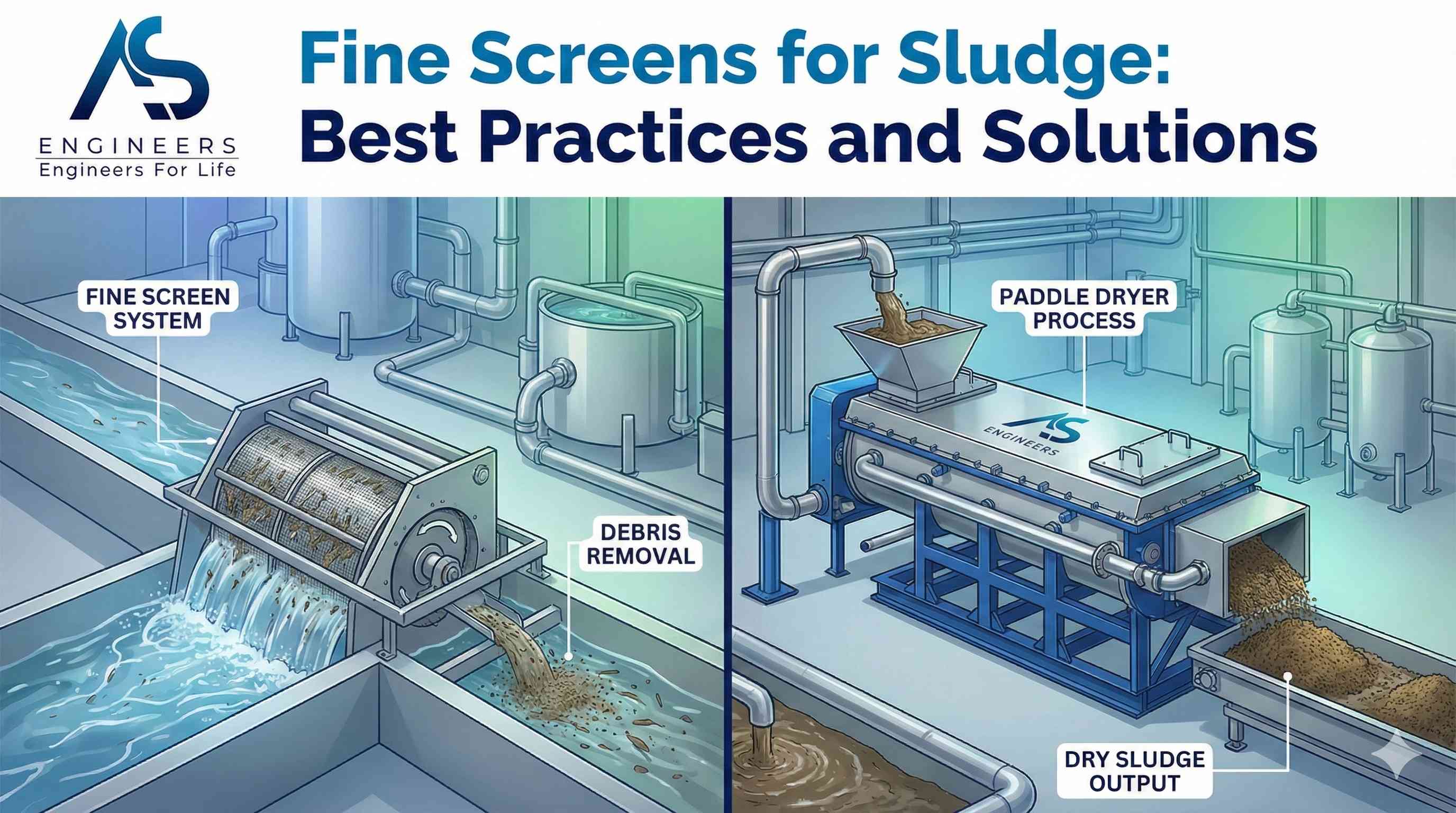
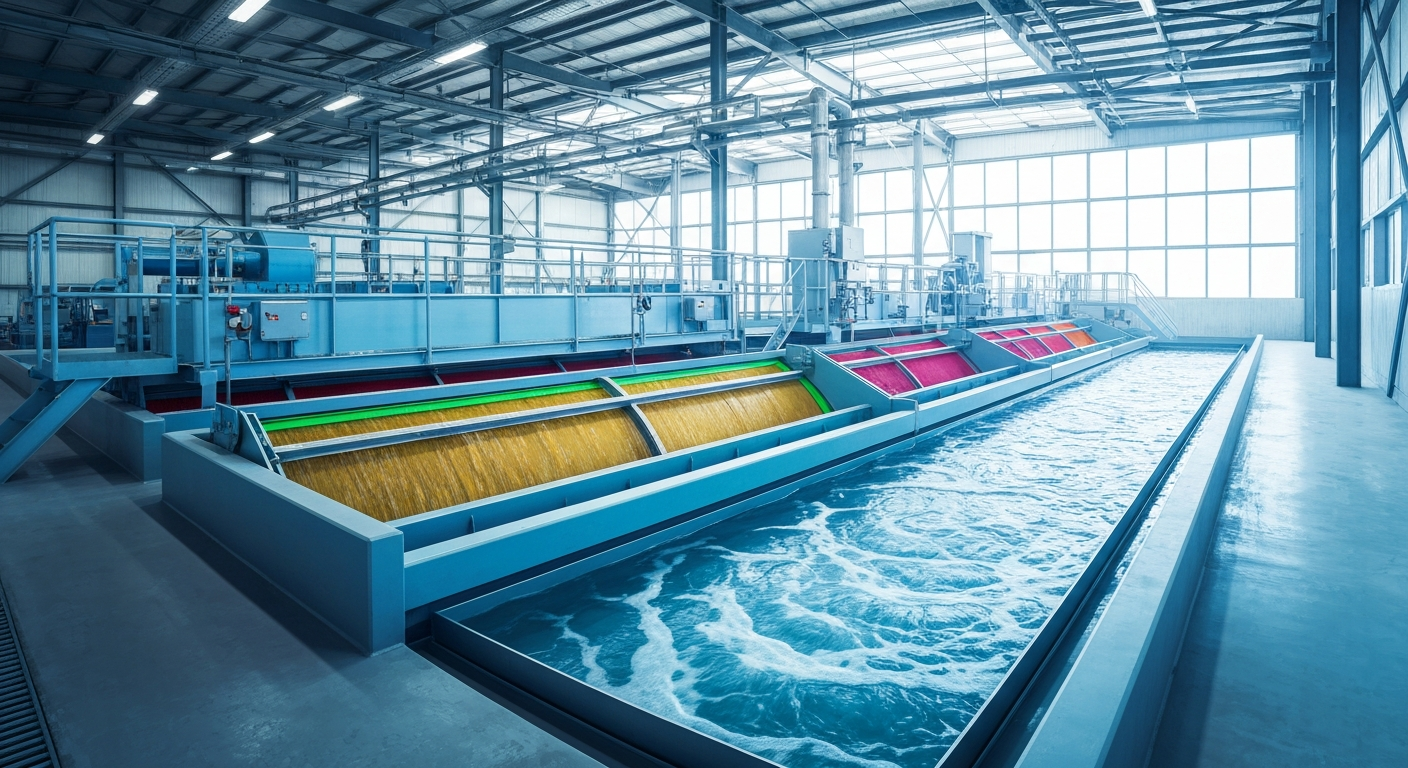
A rotary drum fine screen uses a rotating cylindrical screen surface. Wastewater passes through the drum surface, while solids are retained on the screen. As the drum rotates, captured solids are lifted, washed, scraped, or discharged into a collection area.
The main parts usually include:
- Cylindrical screen drum
- Perforated plate, mesh, or wedge wire surface
- Drive motor and gearbox
- Spray nozzles or cleaning system
- Solids discharge trough
- Frame or tank
- Optional compaction or screenings handling system
Rotary drum screens are useful where wastewater has variable flow, continuous operation, fibrous solids, or higher solids loading. The self-cleaning action helps reduce manual cleaning, but the equipment still needs maintenance of spray nozzles, seals, bearings, drives, and screen surface.
Static Fine Screen Working Principle
A static fine screen has no rotating drum or drive motor. Wastewater flows over an inclined or fixed screen surface. Liquids pass through the openings, while solids are retained and move downward by gravity.
Static screens are simpler and can be suitable for:
- Lower flow applications
- Steady wastewater characteristics
- Limited power availability
- Simple ETP layouts
- Plants with regular operator attention
- Pre-screening before another treatment step
The main limitation is cleaning. If solids are sticky, oily, fibrous, or variable, the screen surface can blind quickly. Once blinding starts, flow bypass, upstream level rise, odour, and manual cleaning problems can appear.
Rotary Drum Screen vs Static Fine Screen
| Selection point | Rotary drum fine screen | Static fine screen |
|---|---|---|
| Movement | Rotating drum | Fixed screen |
| Cleaning | Usually spray, brush, scraper, or self-cleaning system | Gravity-assisted, often needs manual cleaning |
| Best for | Higher flow, variable solids, continuous duty | Lower flow, steady solids load |
| Power use | Requires motor and controls | Very low or no motor power |
| Maintenance focus | Drive, nozzles, bearings, seals, drum surface | Screen blinding, manual cleaning, surface wear |
| Operator dependency | Lower, if automation works properly | Higher |
| Space and layout | Needs mechanical installation space | Compact and simple |
| Capital cost | Usually higher | Usually lower |
| Risk if wrongly selected | Mechanical downtime, wrong opening, spray failure | Frequent choking, overflow, manual cleaning load |
| Best buyer logic | Choose when reliability and continuous solids removal matter | Choose when simplicity and low load matter |
Which Fine Screen Should You Choose?
Do not select a fine screen only by opening size or price. A smaller opening is not automatically better. Smaller openings can improve solids capture, but they can also increase head loss, cleaning frequency, blinding risk, and operator workload.
Use a rotary drum fine screen when:
- Flow is continuous or variable.
- Solids load changes through the day.
- Wastewater contains fibres, food solids, textile lint, or process particles.
- Manual cleaning is not reliable.
- Downstream equipment is sensitive.
- The plant has enough space, power, and maintenance support.
Use a static fine screen when:
- Flow is low or predictable.
- Solids load is moderate.
- The plant has operators available for routine cleaning.
- Capital budget is limited.
- The treatment line is simple.
- The screen is used as a pre-screen, not the only protection stage.
Use extra caution when:
- Wastewater contains oil and grease.
- Wastewater has sticky sludge-like solids.
- The plant receives batch discharge from production.
- Peak flow is much higher than average flow.
- Chemical cleaning or pH variation can attack screen material.
- Screenings handling and disposal are not planned.
For oily wastewater, first review oil and grease trap and oil skimmer selection, because oil and grease can blind screen surfaces and disturb downstream treatment.

Fine Screen Opening Size: What to Check
Fine screen opening size depends on the treatment goal and downstream equipment. The Water Environment Federation notes that fine screens commonly use smaller openings than coarse screens, often around 3 to 6 mm in wastewater facilities, with types including perforated plate, wire mesh, and wedge wire.
Before fixing the opening size, check:
- Downstream equipment sensitivity
- Average and peak flow
- Solids size distribution
- Fibrous material level
- Oil and grease level
- Head loss allowance
- Screen cleaning method
- Bypass arrangement
- Screenings washing or compaction need
- Maintenance skill at site
For MBR or membrane-protected systems, finer screening may be required, but this should be confirmed with the membrane or process designer. For conventional ETP/STP lines, the correct opening depends on actual wastewater behaviour, not only catalogue data.
Industry-Wise Fine Screen Selection Notes
| Industry / plant type | Common screening concern | Practical note |
|---|---|---|
| Municipal STP | Rags, hair, plastics, sanitary waste | Coarse screen plus fine screen is often needed for stable downstream operation |
| Food processing ETP | Food particles, skins, fibres, grease | Rotary drum screen often suits variable organic solids load |
| Textile ETP | Fibres, lint, colour-bearing solids | Check blinding risk and cleaning arrangement |
| Pharma / chemical ETP | Process residues, variable pH, batch discharge | MOC and chemical compatibility are critical |
| Dairy / beverage ETP | Organic solids, fats, cleaning chemicals | Oil/grease and CIP discharge behaviour must be reviewed |
| Paper and pulp | Fibres and suspended solids | Screen opening and spray cleaning need careful selection |
| CETP | Mixed influent from many units | Peak flow, unknown solids, and bypass design become important |
Common Mistakes in Fine Screen Selection
Selecting only by lowest price
A low-cost screen can become expensive if it causes frequent choking, overflow, pump problems, or manual cleaning issues.
Choosing too fine an opening without checking head loss
Very fine openings may capture more solids, but they can also blind faster. Always check hydraulic capacity and cleaning arrangement.
Ignoring peak flow
Average flow is not enough. Many ETPs and STPs fail at peak flow, batch discharge, rainy inflow, or shift-change discharge.
Mixing screenings with sludge
Screenings are not the same as biological or chemical sludge. Screenings may contain rags, plastics, hair, grit, and trash. These should not be treated as normal sludge dryer feed unless reviewed and separated properly.
Forgetting screenings disposal
Every screen creates captured solids. If washing, compaction, storage, odour control, and disposal are not planned, the screening system becomes a housekeeping problem.
No bypass or emergency plan
A fine screen can choke, trip, or need cleaning. The plant should have safe bypass, standby, or isolation logic designed by the wastewater consultant or plant engineer.
Maintenance Checklist for Fine Screens
Use this as a practical plant-side checklist.
| Maintenance point | What to check | Why it matters |
|---|---|---|
| Screen surface | Blinding, wear, broken perforations, corrosion | Maintains separation and flow |
| Spray nozzles | Blockage, pressure, spray pattern | Prevents choking in rotary drum screens |
| Drive system | Motor, gearbox, chain, belt, alignment | Avoids unexpected stoppage |
| Bearings and seals | Noise, heat, leakage, vibration | Prevents mechanical failure |
| Discharge area | Solids build-up, odour, overflow | Keeps screenings handling reliable |
| Upstream level | Rising water level before screen | Indicates blinding or undersizing |
| Bypass condition | Whether bypass is open or leaking | Prevents untreated solids from moving forward |
| Housekeeping | Solids storage and removal | Reduces odour and safety risk |
A fine screen is a small unit compared with the whole treatment plant, but when it fails, pumps, tanks, biological systems, membranes, and sludge systems can feel the impact.
What Happens After Fine Screening?
After fine screening, wastewater usually moves toward equalization, biological treatment, chemical treatment, clarification, filtration, or membrane treatment, depending on the plant design.
The captured screenings go for separate handling and disposal. They are not the same as sludge.
The sludge that comes later from primary clarification, biological treatment, chemical treatment, or dewatering may need further moisture reduction. That is where sludge dewatering techniques, sludge transfer pumps, and sludge drying become important.
A sludge dryer should be selected only after understanding:
- Sludge type
- Feed moisture
- Final moisture target
- Daily quantity
- Material stickiness
- Heating medium
- Vapour handling
- Pollution control requirement
- Product handling method
- Disposal or reuse route
For drying-stage planning, read sludge dryer machine applications and scope and industrial sludge disposal guide.
RFQ Checklist for Fine Screen and Downstream Sludge Planning
Before discussing a fine screen or downstream sludge treatment system, prepare this data:
| RFQ input | Why it is needed |
|---|---|
| Average flow and peak flow | Determines hydraulic sizing |
| Operating hours per day | Defines duty cycle |
| Wastewater source | Helps identify solids behaviour |
| TSS and particle size | Supports screen opening selection |
| Fibres, rags, plastics, hair | Determines blinding and cleaning risk |
| Oil and grease level | Affects screen surface performance |
| pH and temperature | Affects MOC selection |
| Existing channel size | Affects installation feasibility |
| Available head loss | Prevents overflow and bypass issues |
| Power and wash water availability | Important for rotary drum cleaning |
| Screenings disposal method | Avoids odour and housekeeping issues |
| Downstream equipment | Defines protection level required |
| Sludge quantity and moisture | Needed for dewatering or drying planning |
Practical AS Engineers Note
Fine screening improves the reliability of the wastewater treatment line, but it does not finish the sludge problem. In most ETP and STP plants, sludge still needs thickening, dewatering, transfer, storage, drying, or disposal planning after treatment.
At AS Engineers, sludge drying discussions should start only after the plant shares sludge quantity, feed moisture, final moisture target, heating medium, sludge behaviour, and vapour-handling requirement. This avoids wrong dryer sizing and unrealistic expectations.
For the dryer stage, review paddle dryer manufacturer in India only after you have clear sludge data from your plant.
FAQs
What is a fine screen in wastewater treatment?
A fine screen is a screening unit used to remove smaller solids from wastewater before sensitive downstream treatment. It helps protect pumps, biological systems, membranes, clarifiers, and sludge-handling equipment from clogging and solids overload.
Is a rotary drum screen better than a static fine screen?
A rotary drum screen is better for higher flow, variable solids, fibrous material, and continuous operation. A static fine screen is better for simpler, lower-flow applications where solids load is predictable and manual cleaning is manageable.
What screen opening should be used for fine screening?
There is no universal opening size. Many wastewater fine screens are selected in the small millimetre range, but the final opening depends on flow, solids size, downstream equipment, head loss, and cleaning method. For membrane systems, the process designer may require finer screening.
Can fine screens reduce sludge volume?
Fine screens remove screenings and suspended solids before treatment, but they are not a sludge volume reduction system by themselves. Sludge volume reduction usually needs thickening, dewatering, drying, or other sludge treatment methods.
Should screenings go into a sludge dryer?
Generally, screenings should not be mixed with normal sludge dryer feed without review. Screenings may contain plastics, rags, hair, grit, and trash. Sludge dryer feed should be reviewed based on actual sludge composition, moisture, stickiness, and handling behaviour.
Conclusion
Fine screens in wastewater treatment are important because they protect the plant before the main treatment work begins. Rotary drum screens are suitable for continuous and variable solids loads, while static fine screens can work for simpler and steadier applications. The right choice depends on flow, solids, screen opening, oil and grease, head loss, maintenance capacity, and downstream equipment sensitivity.
For ETP and STP plants, fine screening should be planned as part of the full sludge-management chain. Once screening, treatment, and dewatering are clear, the next question is how to handle wet sludge economically and safely. For that stage, share your sludge quantity, moisture level, material behaviour, and disposal route with the AS Engineers team for a practical sludge drying review.