Petroleum sludge treatment and disposal starts with lab testing, oil-water-solid separation, volume reduction, drying or thermal conditioning, and final disposal through authorized recovery, co-processing, incineration, or TSDF routes. For refinery sludge, tank-bottom sludge, oily ETP sludge, and drilling mud residue, the safest approach is not one machine alone. It is a controlled treatment train based on sludge composition, oil content, moisture, solids, VOC risk, heavy metals, and disposal acceptance criteria.
Petroleum sludge is usually difficult because it can contain oil, water, solids, emulsions, sand, corrosion products, hydrocarbons, sulphur compounds, and sometimes hazardous contaminants. This is why plant teams should treat it as a technical and compliance-sensitive waste stream, not as normal wet sludge.
For a broader comparison of oily sludge routes, you can also read our guide on oil sludge treatment and drying methods.
What Is Petroleum Sludge Treatment and Disposal?
Petroleum sludge treatment and disposal is the process of separating recoverable oil, reducing water and sludge volume, stabilizing or drying the remaining solids, controlling vapours and fines, and sending the final residue to an authorized disposal or reuse route.
In simple terms, the goal is to:
| Goal | Why It Matters |
|---|---|
| Recover usable oil where possible | Reduces waste load and may recover value |
| Reduce moisture and volume | Lowers handling, transport and storage burden |
| Improve handling | Converts sticky, semi-liquid sludge into a more manageable form |
| Control vapours, odour and fines | Supports safer plant operation and pollution-control requirements |
| Meet disposal acceptance criteria | Helps route residue to authorized TSDF, co-processing, incineration or other approved channels |
The correct treatment route depends on test results. A tank-bottom sludge from crude storage will not behave exactly like refinery API separator sludge, DAF oily sludge, drilling mud waste, or oil-contaminated ETP sludge.
Common Sources of Petroleum Sludge
Petroleum sludge can be generated at several points in oil, gas, refinery, petrochemical, and tank farm operations.
| Source | Typical Sludge Condition |
|---|---|
| Crude oil storage tanks | Tank-bottom sludge with oil, water, sand, rust and settled solids |
| Refinery API separators | Oily sludge with emulsified oil, grit and suspended solids |
| ETP and DAF systems | Oil-contaminated sludge with water, chemicals and biological/chemical treatment solids |
| Desalter and process units | Salt, oil, water and process residue mixture |
| Pipeline pigging and cleaning | Oil-coated deposits, waxy solids and corrosion products |
| Drilling and upstream operations | Oil-contaminated mud, cuttings or sludge depending on process |
| Maintenance shutdowns | Mixed sludge from cleaning, washing and equipment maintenance |
For refinery-specific waste handling issues, connect this page with refinery sludge management.
Why Petroleum Sludge Needs Separate Handling
Petroleum sludge is not only wet sludge. It may be oily, sticky, odorous, combustible under some conditions, difficult to pump, difficult to dry, and sensitive to disposal rules.
Important risk factors include:
| Risk Factor | Plant-Side Impact |
|---|---|
| High oil content | Can make sludge sticky, hydrophobic and difficult to dewater |
| Stable oil-water emulsion | Reduces separation efficiency |
| VOCs and odour | Requires vapour-control planning |
| Heavy metals or hazardous constituents | Affects final disposal route |
| Sand, grit and rust | Increases wear on pumps, conveyors and dryers |
| Variable feed quality | Makes sizing and performance prediction difficult |
| High moisture | Increases transport cost and disposal volume |
Before selecting any treatment system, the plant should test representative sludge samples. A single grab sample from the surface of a tank or pit may not represent the full sludge profile.
Minimum Testing Before Treatment Selection
Petroleum sludge treatment should start with characterization. Without this, equipment selection becomes guesswork.
Recommended test inputs include:
| Test Input | Why It Is Needed |
|---|---|
| Feed quantity per day or batch | Defines treatment capacity |
| Moisture percentage | Impacts drying load and energy demand |
| Oil and grease / TPH | Shows oil recovery potential and disposal risk |
| Total solids | Helps estimate final residue quantity |
| Free oil vs emulsified oil | Decides separation approach |
| Viscosity and flowability | Impacts pump, feeder and dryer selection |
| Particle size, sand and grit | Affects abrasion and equipment wear |
| Flash point / VOC profile where relevant | Needed for safety and vapour handling review |
| Heavy metals | Impacts landfill, co-processing or incineration acceptance |
| Sulphur, chloride and ash | Important for thermal route and co-processing review |
| pH and chemical additives | Affects corrosion and treatment chemistry |
| Leachability testing where required | Helps determine disposal acceptance |
For hazardous streams, do not assume reuse or landfill suitability without authorized testing and approval. For broader waste route planning, use this with industrial sludge disposal and hazardous sludge.
Petroleum Sludge Treatment Train
A practical treatment train usually includes several stages. The exact sequence depends on sludge type and site objective.
| Stage | Purpose | Common Equipment or Method |
|---|---|---|
| 1. Sludge collection and segregation | Avoid mixing incompatible wastes | Tank cleaning, pit collection, sealed transfer |
| 2. Free oil recovery | Recover separable oil before drying | Skimmer, decanter, centrifuge, heating, settling |
| 3. Emulsion breaking | Separate stable oil-water mixtures | Demulsifier, pH adjustment, heat, mixing |
| 4. Dewatering | Reduce water before thermal treatment | Filter press, centrifuge, screw press, decanter |
| 5. Drying or thermal conditioning | Reduce moisture and improve handling | Indirect dryer, paddle dryer, thermal desorption, other thermal systems |
| 6. Vapour and fines control | Control odour, VOCs, mist and particulates | Condenser, scrubber, cyclone, bag filter, ID fan |
| 7. Final disposal or reuse route | Route treated output safely | TSDF, co-processing, incineration, authorized recycler |
A dryer should normally come after oil recovery and primary dewatering, not before basic separation. Sending highly oily, free-flowing sludge directly to a dryer can increase vapour load, safety review requirements and operating difficulty.
Treatment Methods for Petroleum Sludge
Different petroleum sludge treatment methods solve different problems. A plant may need a combination.
| Method | Best Used For | Main Limitation |
|---|---|---|
| Gravity settling | Free oil and water separation | Slow and weak for stable emulsions |
| Oil skimming | Recovering floating oil | Does not treat settled solids |
| Centrifugation | Oil-water-solid separation | Performance depends on feed consistency |
| Chemical demulsification | Breaking stable emulsions | Requires chemical trials and dose control |
| Solvent extraction | Recovering oil from sludge | Solvent handling and recovery must be controlled |
| Bioremediation | Lower contamination loads under controlled conditions | Slow and not suitable for every hazardous stream |
| Thermal desorption | Volatilizing hydrocarbons from solids | Needs strong vapour control and specialist design |
| Incineration | Destruction of unsuitable hazardous residue | Higher compliance, emission and cost burden |
| Indirect paddle drying | Moisture reduction and handling improvement after separation/dewatering | Not a legal disposal method by itself |
For petroleum sludge, drying is a volume-reduction and handling-improvement step. It does not automatically make the sludge non-hazardous. Final classification depends on lab results and applicable acceptance criteria.
Where a Paddle Dryer Fits in Petroleum Sludge Treatment
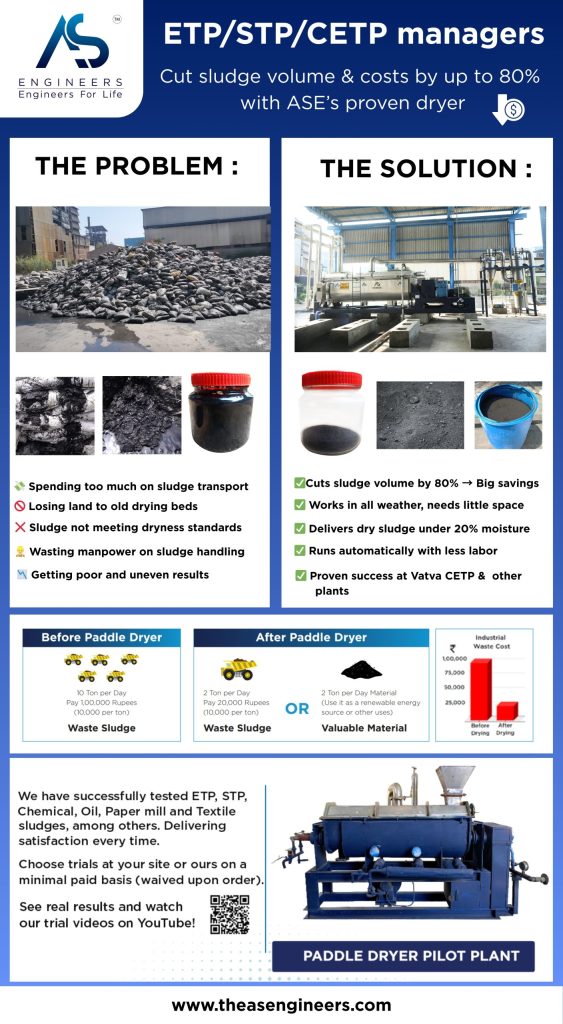
An indirect paddle dryer can be evaluated when petroleum sludge has already gone through primary oil recovery and dewatering, but the remaining cake or semi-solid residue is still wet, sticky, heavy, and expensive to transport.
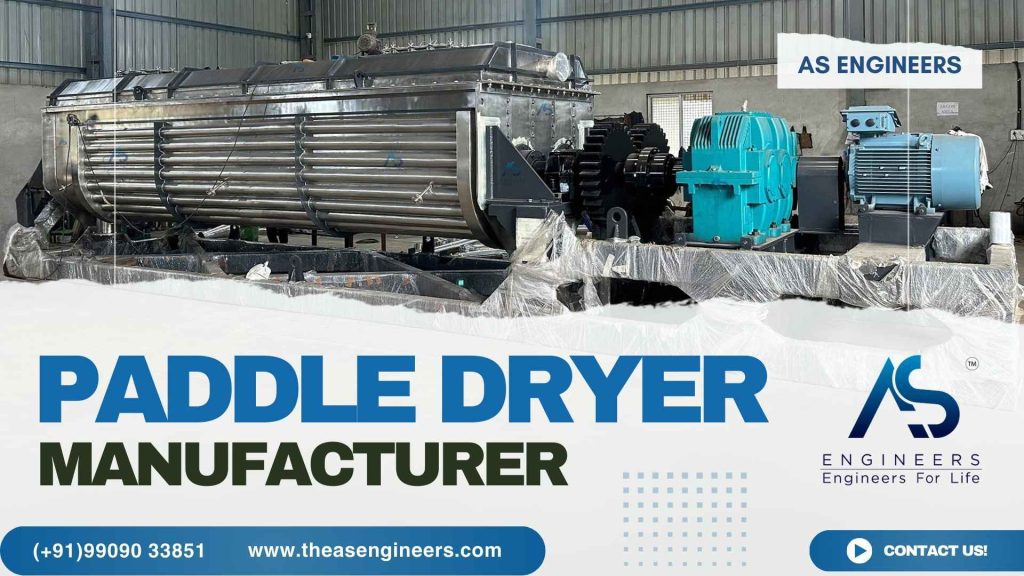
A paddle dryer is useful for sludge drying because it transfers heat indirectly through hollow shafts and a jacket. The material is continuously mixed by paddles, which helps expose wet sludge to the heated surface. AS Engineers’ paddle dryer design includes indirect heating, dual counter-rotating shafts, wedge-shaped self-cleaning paddles, plug-flow movement, and options for vapour handling through downstream systems.
In a petroleum sludge application, the dryer package must be reviewed with the full system:
| System Area | What Must Be Reviewed |
|---|---|
| Feeding | Sludge pump, screw feeder, conveyor or customized feed system |
| Heating medium | Steam, thermic fluid or other site-approved heating source |
| Dryer body and MOC | Compatibility with sludge chemistry and temperature |
| Vapour handling | Condenser, scrubber, cyclone, bag filter or approved treatment route |
| Safety review | VOCs, odour, flash point, pressure, temperature and site EHS constraints |
| Product discharge | Dried residue handling, cooling, bagging, binning or truck disposal |
| Final outlet route | TSDF, co-processing, incineration, or authorized recycler acceptance |
For technical selection, connect this page with thermal sludge drying systems and how to choose the right sludge paddle dryer.

Fit / No-Fit Guide for Paddle Drying
| Situation | Paddle Dryer Fit? | Reason |
|---|---|---|
| Dewatered petroleum sludge cake still has high moisture | Strong fit for evaluation | Drying can reduce moisture and improve handling |
| Sludge is sticky and difficult to convey | Possible fit | Paddle mixing and indirect heating may help, subject to trial |
| Sludge has significant recoverable free oil | Not first-stage equipment | Recover oil before dryer selection |
| Sludge has high VOC / low flash point risk | Needs detailed EHS review | Vapour control and safety design become critical |
| Final residue must meet TSDF acceptance | Fit depends on test data | Dryer helps volume reduction but does not replace approval |
| Plant wants guaranteed non-hazardous output | No | Dryer cannot legally reclassify waste without testing |
| Feed composition changes every batch | Trial required | Dryer sizing and performance depend on actual feed behaviour |
For petroleum sludge, I would not recommend finalizing dryer size based only on “tons per day.” Feed moisture, oil content, solids, viscosity, heat sensitivity, vapour load and final disposal target matter more than a simple capacity number.
Disposal and Reuse Routes After Treatment
Final disposal depends on the treated residue, lab report, and approval from the accepting facility or authority.
| Route | When It May Apply | Important Caution |
|---|---|---|
| Authorized oil recovery / recycling | When oil quality and contamination level are acceptable | Must go through approved recycler or reuse route |
| TSDF landfill | For treated hazardous residue accepted by TSDF | Moisture, leachability and packaging requirements must be met |
| Cement kiln co-processing | When calorific value and contaminant profile are acceptable | Requires pre-processing and cement plant acceptance |
| Incineration | For residue unsuitable for recovery or co-processing | Requires approved facility and emission control |
| Stabilization / solidification | When residue needs immobilization before disposal | Must be validated through testing |
| Construction material route | Only for approved, tested, non-risk residue | Do not assume suitability for oily hazardous sludge |
CPCB has issued guidelines for pre-processing and co-processing of hazardous and other wastes in cement plants under the Hazardous and Other Wastes Rules framework, but acceptance is not automatic. The waste must meet the facility’s technical and regulatory requirements.
Use internal supporting pages on CPCB hazardous waste disposal guidelines and TSDF site standards when planning disposal content clusters.
India Compliance Checklist for Petroleum Sludge
Petroleum sludge handling in India should be planned with the Hazardous and Other Wastes framework, CPCB guidance, SPCB requirements, and authorized disposal/recovery partners.
A practical checklist:
| Compliance Area | What to Confirm |
|---|---|
| Waste classification | Confirm whether the sludge falls under applicable hazardous waste category |
| Sampling and lab testing | Use representative sample and approved test parameters |
| SPCB authorization | Confirm generator authorization and permitted handling method |
| Storage | Use safe, labelled, compatible storage with spill control |
| Transport | Use authorized transporter and manifest system where applicable |
| Recycler / co-processor / TSDF | Confirm facility authorization and acceptance criteria |
| Emission control | Review dryer vapour, condenser, scrubber, bag filter or stack requirement |
| Wastewater handling | Treat condensate or separated water as per site and regulatory requirement |
| Records | Maintain quantity, testing, transport, disposal and return records |
| Emergency plan | Keep spill, fire, VOC and exposure response plan ready |
This page should not be treated as legal advice. Final compliance route must be confirmed with the plant’s EHS team, authorized consultant, SPCB and disposal facility.
RFQ Inputs for Petroleum Sludge Dryer Selection
For a realistic technical proposal, share these inputs with the dryer manufacturer.
| RFQ Input | Details to Share |
|---|---|
| Sludge source | Tank bottom, refinery API, DAF, ETP, drilling mud, pipeline cleaning, mixed source |
| Feed quantity | kg/hr, ton/day, batch size and operating hours |
| Moisture content | Initial moisture and target final moisture |
| Oil content | Free oil, emulsified oil, TPH or oil and grease report |
| Solids content | Ash, grit, sand, carbon, corrosion products |
| Feed behaviour | Pumpable, sticky, thixotropic, paste-like, lumpy or cake form |
| Temperature sensitivity | Any risk of fumes, odour, decomposition or ignition |
| VOC / flash point data | Required for vapour and safety review |
| Heavy metals and contaminants | Needed for MOC and final disposal planning |
| Heating utility | Steam, thermic fluid, hot water, electricity or other source |
| Vapour handling requirement | Condenser, scrubber, cyclone, bag filter, chimney, ID fan |
| Final disposal route | TSDF, co-processing, incineration, recovery or other approved route |
| Trial requirement | Sample quantity and pilot trial objective |
AS Engineers can evaluate sludge dryer configuration based on actual feed behaviour, moisture target, heating medium, vapour handling and final residue handling requirement. For equipment-level selection, visit paddle dryer manufacturer in India.
Common Mistakes in Petroleum Sludge Treatment
| Mistake | Why It Creates Risk |
|---|---|
| Treating petroleum sludge like normal sewage sludge | Oily sludge may need oil recovery, vapour control and hazardous waste review |
| Skipping representative sampling | Wrong data leads to wrong equipment sizing |
| Drying sludge before recovering free oil | Increases vapour load and may waste recoverable oil |
| Ignoring flash point and VOC data | Can create serious safety and EHS risk |
| Assuming drying makes sludge non-hazardous | Hazard classification depends on testing, not moisture alone |
| Sending variable sludge without trials | Feed variation can affect drying time, discharge and vapour load |
| Not planning final disposal before buying equipment | Dryer output still needs an approved outlet |
| Selecting only by lowest equipment price | Poor system design can increase operating cost and compliance risk |
Petroleum Sludge Treatment Decision Matrix
| Plant Objective | Better Starting Point |
|---|---|
| Recover maximum oil | Oil separation, heating, centrifuge, demulsification or extraction trial |
| Reduce transport cost | Dewatering plus drying evaluation |
| Improve sticky sludge handling | Indirect drying and discharge system trial |
| Prepare for TSDF disposal | Moisture reduction plus lab acceptance check |
| Explore cement kiln co-processing | Calorific value, contaminant profile and co-processor approval |
| Reduce odour and vapour issues | Closed handling and vapour-control system review |
| Handle refinery sludge regularly | Dedicated treatment train with oil recovery, drying and disposal integration |
Frequently Asked Questions
What is the best treatment method for petroleum sludge?
There is no single best method for every petroleum sludge. The right method depends on oil content, moisture, solids, emulsion stability, VOC risk, heavy metals and final disposal route. Many plants use a combination of oil recovery, demulsification, dewatering, drying and authorized disposal.
Is petroleum sludge hazardous waste?
Petroleum sludge can fall under hazardous waste categories depending on its source and composition. Refinery sludge, tank cleaning sludge, oily residues and oil-contaminated sludge should be tested and classified before treatment or disposal.
Can a sludge dryer make petroleum sludge non-hazardous?
No. A sludge dryer can reduce moisture and improve handling, but it does not automatically make petroleum sludge non-hazardous. Final status depends on lab testing, contaminant levels and regulatory acceptance.
Where does a paddle dryer fit in oil sludge treatment?
A paddle dryer fits after primary oil recovery and dewatering when the remaining sludge cake is still wet, sticky and difficult to transport or dispose. It helps reduce moisture and volume, but vapour handling, MOC, safety and final disposal must be reviewed.
What data is needed for a petroleum sludge dryer quotation?
Share sludge source, feed quantity, moisture, oil content, solids, viscosity, VOC or flash point data, heavy metals, heating utility, target moisture, vapour handling requirement and final disposal route. A pilot trial is recommended for variable or sticky oily sludge.
Conclusion
Petroleum sludge treatment and disposal should be planned as a complete system, not as a single disposal activity. The correct route starts with testing, followed by oil recovery, dewatering, drying or thermal conditioning, vapour control, and authorized final disposal.
For refinery sludge, tank-bottom sludge, oily ETP sludge and drilling mud residue, the most practical approach is to reduce uncertainty before equipment selection. Confirm the sludge composition, recover free oil where possible, reduce moisture, control vapours, and verify the final acceptance route with the authorized facility.
If your plant is evaluating petroleum sludge drying, share the feed analysis, daily quantity, moisture target, oil content, heating utility and disposal route. AS Engineers can review whether an indirect sludge dryer or paddle dryer configuration is technically suitable for your actual sludge condition.