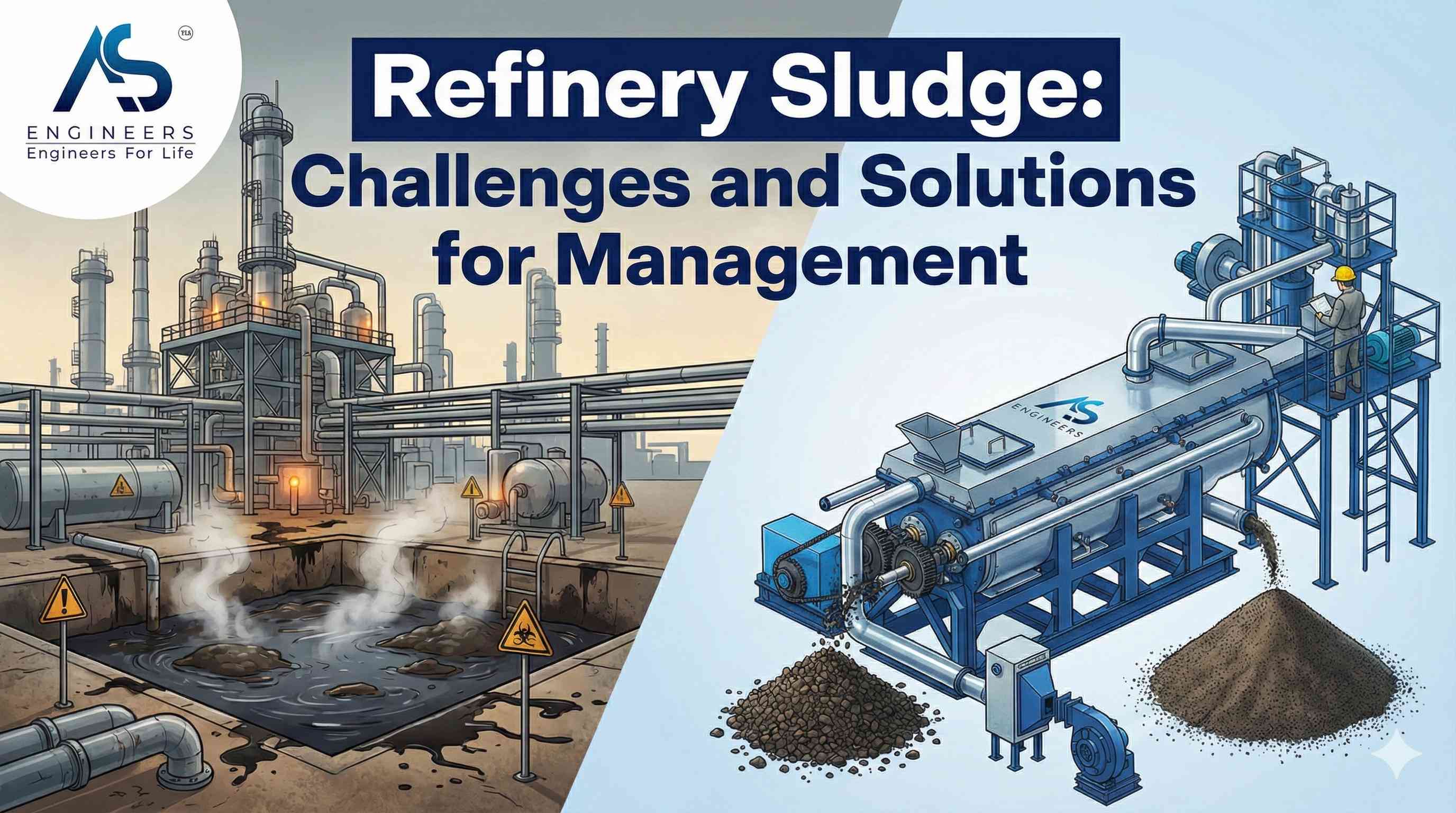
Refinery sludge treatment is the controlled handling, separation, drying, recovery and disposal of oily sludge generated from crude oil tanks, refinery processes, oil-water separators, ETP systems and tank cleaning activity. The practical goal is not only drying. Refinery teams must first understand oil content, moisture, solids, VOCs, flash point, heavy metals, sludge consistency and the approved disposal or recovery route.
A paddle dryer can be useful after primary oil-water-solid separation when the remaining sludge cake needs moisture reduction, controlled drying, volume reduction or preparation for approved disposal, co-processing, incineration or further treatment.
What Is Refinery Sludge?
Refinery sludge is a mixture of oil, water and solids generated during petroleum refining, storage, cleaning and wastewater treatment. It may come from:
- Crude oil storage tank bottoms
- API separators and oil-water separators
- Slop oil systems
- ETP sludge from refinery wastewater treatment
- Desalter sludge
- Tank cleaning and maintenance activity
- Used oil reprocessing or petroleum handling areas
- Drilling mud and oil-contaminated waste streams in connected oil and gas operations
In Indian hazardous waste classification, petroleum refining and petroleum oil storage tank cleaning are specifically associated with oily sludge and sludge containing oil. That is why refinery sludge treatment should be planned with waste characterization, safety controls and approved disposal routes, not only with equipment selection.
Why Refinery Sludge Is Difficult to Manage
Refinery sludge is difficult because it is not a simple wet solid. It can behave like a sticky, oily, abrasive and sometimes volatile material.
| Challenge | Why It Matters in Treatment |
|---|---|
| High oil content | Free oil should usually be separated or recovered before thermal drying is considered. |
| Emulsified water-oil mixture | Stable emulsions make separation slower and may need conditioning. |
| Sticky and viscous texture | Feeding, pumping and discharge can become difficult. |
| Sand, rust and grit | Abrasive solids affect pumps, screws, dryer internals and handling equipment. |
| VOC and odour risk | Vapours must be captured, condensed, scrubbed or treated as per site requirement. |
| Flash point and flammability | Thermal treatment needs careful safety review before design. |
| Batch variation | Tank-bottom sludge can vary strongly from one cleaning cycle to another. |
| Hazardous waste handling | Storage, transport, treatment and disposal must follow applicable authorization and documentation. |
When I review a refinery sludge drying requirement, I do not start with dryer size. I first look at the sludge source, oil percentage, water percentage, solids percentage, flash point, VOC risk, grit load, pH, chloride level, heating medium, final disposal route and vapour treatment requirement. Without these inputs, any dryer selection will remain incomplete.
Practical Refinery Sludge Treatment Flow
A safer refinery sludge treatment plan usually follows a staged approach.
1. Waste identification and sample testing
Start with lab testing and site data. Key parameters include oil and grease, total petroleum hydrocarbons, moisture, solids, ash, pH, chlorides, sulphur, heavy metals, flash point, calorific value, viscosity and particle size.
2. Safe collection and temporary storage
Sludge should be collected in a controlled system with attention to odour, spill control, vapour risk, fire safety, worker exposure and authorized storage limits.
3. Free oil separation
If the sludge contains recoverable free oil, primary oil separation should be considered before drying. This may involve gravity separation, heating, skimming, centrifuging, decanting or other site-specific methods.
4. Oil-water-solid separation
After free oil removal, the refinery may use mechanical separation or conditioning to reduce liquid load. This improves the stability of downstream drying and reduces unnecessary heating of free liquid.
5. Dewatering or conditioning
Dewatering can reduce moisture before thermal treatment. Chemical conditioning may also help break emulsions, depending on the sludge chemistry.
6. Thermal drying or paddle drying
Thermal sludge drying is considered when the remaining sludge cake still contains moisture and needs controlled drying for handling, disposal, co-processing, incineration or further processing. For indirect drying, the heating medium does not directly contact the sludge, which can help reduce off-gas volume compared with direct hot-air systems.
7. Vapour and off-gas handling
Refinery sludge drying must not ignore vapours. Depending on sludge analysis and operating temperature, vapour handling may need condensers, scrubbers, cyclones, bag filters, ID fans, chimneys or other approved treatment systems.
8. Final disposal, reuse or recovery decision
The final dried material can only be sent for disposal, co-processing, incineration, recovery or reuse if the analysis, receiver acceptance and regulatory route allow it. Drying improves handling, but it does not automatically make refinery sludge non-hazardous.
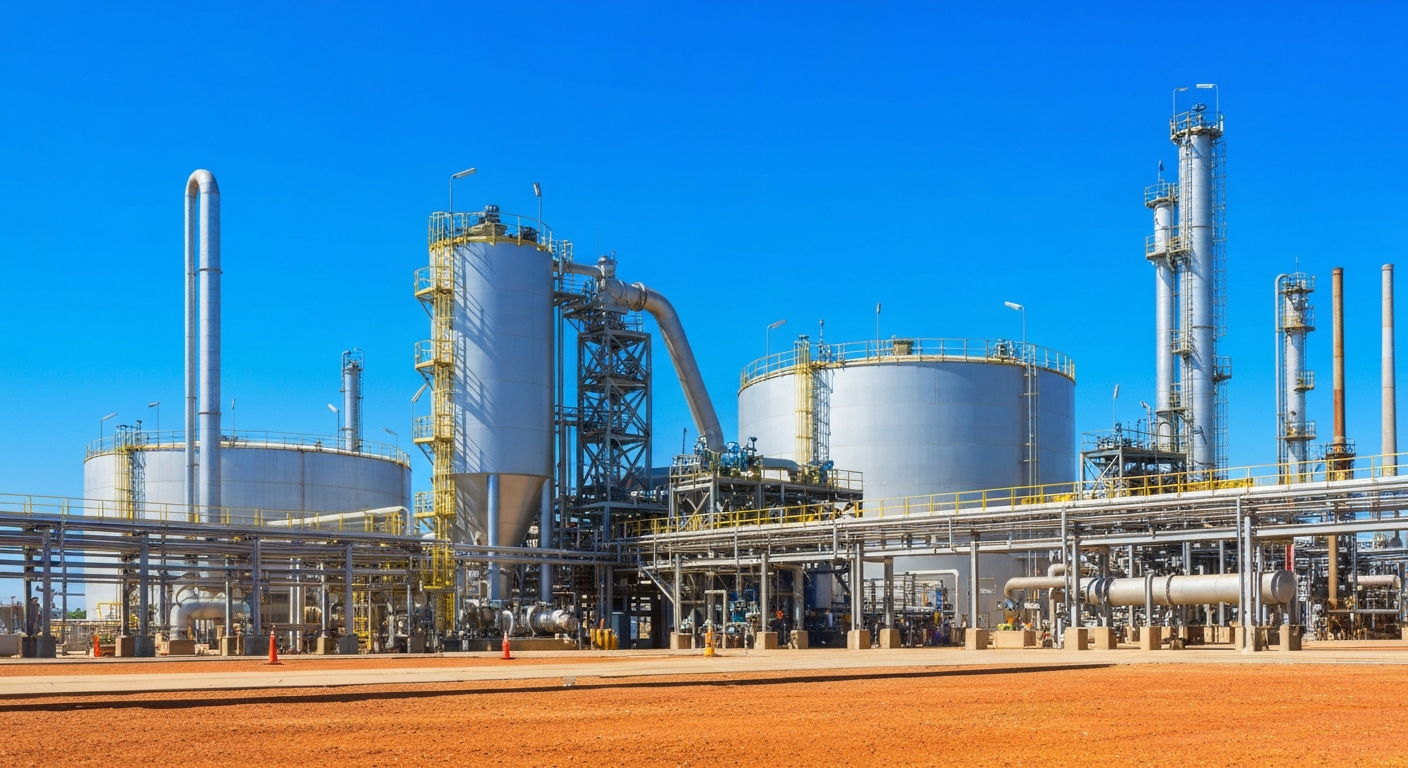
Refinery Sludge Treatment Methods Compared
| Method | Where It Fits | Strength | Limitation |
|---|---|---|---|
| Gravity separation / skimming | Free oil and water separation | Simple first-stage recovery | Limited for emulsified sludge |
| Centrifuge / decanter | Oil-water-solid separation | Useful for reducing liquid load | Performance depends on sludge consistency |
| Chemical demulsification | Stable oil-water emulsions | Helps break emulsions | Requires chemical compatibility testing |
| Filter press / mechanical dewatering | Sludge cake formation | Reduces moisture before drying | Oily sticky sludge may blind media |
| Bioremediation / landfarming | Selected hydrocarbon-contaminated sludge | Can reduce hydrocarbons over time | Needs time, land, control and approval |
| Incineration / co-processing | High calorific waste or final disposal route | Can reduce waste volume | Requires approved facility and emission controls |
| Thermal desorption / drying | Oily sludge with recoverable/evaporable liquid fraction | Can remove moisture and volatile fractions under controlled design | Vapours must be treated; safety review is critical |
| TSDF disposal | Authorized hazardous waste disposal | Clear route for non-recoverable waste | Transport and disposal cost can be high |
Where a Paddle Dryer Fits in Refinery Sludge Treatment
A paddle dryer fits best after the refinery has already evaluated sludge composition, separated free oil where practical, and defined the final disposal or recovery route.
AS Engineers’ paddle dryer works on indirect heat transfer through hollow shafts and a jacket. The wedge-shaped paddles agitate and move the feed while helping expose wet material to heated surfaces. The dryer can be planned with feeding, heating, scavenging, vapour handling, pollution control and product handling systems based on the duty condition.
For refinery sludge, the paddle dryer should not be treated as a universal solution for every oily sludge. It is more relevant when:
- The sludge has been tested and is suitable for thermal treatment
- Free liquid oil has been reduced where practical
- The material can be fed into the dryer consistently
- The target moisture is defined
- Vapour and condensate handling are planned
- Final disposal, co-processing or recovery route is already known
- MOC is selected for corrosion, abrasion and sludge chemistry
- Site safety review has covered VOC, flash point and operating temperature
For more detail on dryer selection, read our guide on selecting a sludge paddle dryer and conductive paddle dryer sludge treatment.
When a Paddle Dryer May Be Suitable
| Condition | Why It Supports Paddle Dryer Selection |
|---|---|
| Sludge is pumpable or feedable after conditioning | Stable feeding improves dryer operation. |
| Free oil is already separated or controlled | Dryer is not overloaded with recoverable liquid oil. |
| Moisture reduction is a clear objective | Dryer duty can be designed around inlet and outlet moisture. |
| Vapour treatment is planned | Off-gas, odour and condensate risks are addressed. |
| Heating medium is available | Steam, thermic fluid or other heating arrangement can be evaluated. |
| Final route is defined | Drying target depends on disposal, co-processing or recovery requirement. |
| Lab data is available | MOC, temperature and safety controls can be selected more responsibly. |
When a Paddle Dryer Should Not Be Selected Without Further Review
| Risk Condition | Why It Needs Caution |
|---|---|
| Unknown flash point or VOC profile | Thermal treatment can create serious vapour safety risk. |
| Very high free oil content | Primary oil recovery may be needed before drying. |
| Large stones, grit or metal pieces | Feeding and internal wear risks increase. |
| No final disposal or reuse route | Drying alone does not solve waste responsibility. |
| Highly variable tank-bottom sludge | Trial and process margin may be needed. |
| No vapour treatment plan | Odour, condensate and emission risks remain uncontrolled. |
| No lab analysis | Dryer design becomes guesswork. |
Key RFQ Data for Refinery Sludge Dryer Selection
Before asking for a refinery sludge dryer quotation, prepare these inputs:
| RFQ Input | Why It Matters |
|---|---|
| Sludge source | Tank bottom, API separator, ETP, desalter or mixed sludge behaves differently. |
| Daily or monthly quantity | Defines dryer capacity and operating schedule. |
| Inlet moisture | Determines evaporation load. |
| Oil and grease / TPH | Affects recovery, vapour handling and final route. |
| Solids and ash content | Affects discharge, abrasiveness and dried residue. |
| Flash point and VOC profile | Critical for thermal safety review. |
| pH, chloride and sulphur | Helps MOC and corrosion review. |
| Heavy metals | Impacts disposal and reuse acceptance. |
| Particle size and grit load | Affects feeding, wear and maintenance. |
| Viscosity / pumpability | Determines feeding system design. |
| Heating medium available | Steam, thermic fluid, hot water or other site utility. |
| Target final moisture | Defines dryer duty and residence time. |
| Vapour handling expectation | Condenser, scrubber, cyclone, bag filter, ID fan or chimney planning. |
| Final disposal or recovery route | Dryer output target depends on the approved route. |
| Trial sample availability | Helps evaluate feed behaviour before final sizing. |
For upstream and connected petroleum sludge topics, you can also refer to petroleum sludge treatment and disposal and oil sludge treatment and drying methods.
Refinery Sludge, Hazardous Waste and Compliance Boundaries
Refinery sludge often falls under hazardous waste management because it may contain hydrocarbons, oily residues, heavy metals and other regulated contaminants. In India, CPCB and hazardous waste rules define responsibilities for safe handling, storage, transport, treatment and disposal.
Drying can reduce moisture and improve handling, but it does not automatically remove hazardous classification. The final classification depends on waste analysis, applicable law, treatment route, receiver criteria and authorization.
For Indian plants, also read our page on hazardous waste disposal rules in India and TSDF site standards.
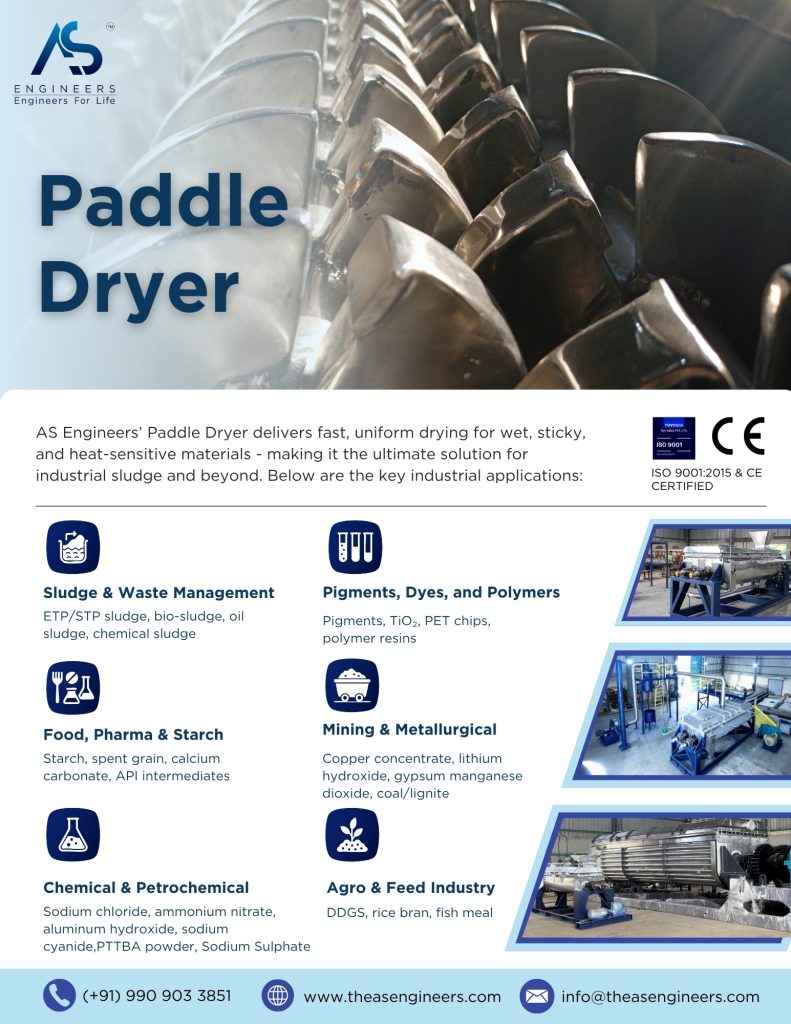
AS Engineers’ Approach to Refinery Sludge Drying
At AS Engineers, we review refinery sludge drying requirements based on actual duty data instead of recommending a dryer only by tonnage. The review should include feed source, moisture, oil content, solids, vapour risk, heating medium, MOC, final moisture target and discharge requirement.
AS Engineers’ sludge drying systems can be planned with:
- Feeding system
- Indirect paddle dryer
- Heating system
- Scavenging or vapour handling arrangement
- Cyclone, scrubber or bag filter where required
- Solvent or condensate management where applicable
- Product discharge and handling system
- Site-specific service and spare support
AS Engineers also offers paddle dryer pilot trials for selected materials, with a 50 kg/hr pilot trial machine available for demonstrations at AS Engineers’ facility or the client’s site, subject to trial scope and material suitability.
Common Mistakes in Refinery Sludge Dryer Selection
Selecting by tonnage only
Two sludge streams with the same tonnage can have completely different oil, water, solids, VOC and grit profiles.
Ignoring free oil recovery
Drying free oil-heavy sludge without primary recovery can increase heating load and vapour handling complexity.
Treating drying as compliance
Drying improves handling and can reduce moisture, but compliance depends on approved waste handling and disposal routes.
Forgetting vapour handling
Refinery sludge may release odour, VOCs or condensable vapours during thermal treatment. Vapour handling must be part of the system design.
Skipping trial or feed behaviour review
Sticky oily sludge can bridge, smear, agglomerate or discharge poorly. Trial or sample evaluation helps reduce design risk.
Conclusion
Refinery sludge treatment should be planned as a complete waste-handling and process-engineering decision. The right solution depends on sludge composition, oil recovery potential, moisture level, VOC risk, solids load, final disposal route and site safety controls.
A paddle dryer can be a practical option for selected refinery sludge streams after oil-water-solid separation and dewatering, especially when the goal is controlled moisture reduction, better handling and preparation for approved disposal or further treatment. It should not be selected without lab data, vapour handling planning and EHS review.
If you are evaluating a refinery sludge dryer, share the sludge source, quantity, inlet moisture, oil content, solids, flash point, VOC profile, heating medium, target moisture and final disposal route. The AS Engineers team can review the duty condition and suggest a suitable drying configuration based on actual site requirements.
FAQs
Is refinery sludge hazardous waste?
Refinery sludge can fall under hazardous waste depending on its source and composition. Oily sludge from petroleum refining, oil storage tank cleaning and similar activities needs proper identification, handling, treatment and disposal as per applicable rules and authorization. Drying does not automatically make it non-hazardous.
Can a paddle dryer treat refinery sludge?
A paddle dryer can be considered for selected refinery sludge after sample testing and primary separation. It is most useful when the sludge is feedable, free oil is controlled, moisture reduction is required, vapour handling is planned and the final disposal or recovery route is defined.
Should oil be recovered before drying refinery sludge?
In many cases, recoverable free oil should be separated before thermal drying. This can reduce heating load and make the downstream drying step more stable. The practical route depends on the sludge composition and the refinery’s recovery objective.
What data is needed before selecting a refinery sludge dryer?
Key data includes sludge source, quantity, moisture, oil and grease, TPH, solids, ash, flash point, VOC profile, heavy metals, pH, chlorides, grit load, viscosity, heating medium, target moisture and final disposal or reuse route.
Can dried refinery sludge be reused as fuel or construction material?
Only if laboratory analysis, calorific value, contaminant profile, receiver acceptance and regulatory approval allow it. Dried sludge should not be marketed as reusable material without verified testing and an approved end-use route.