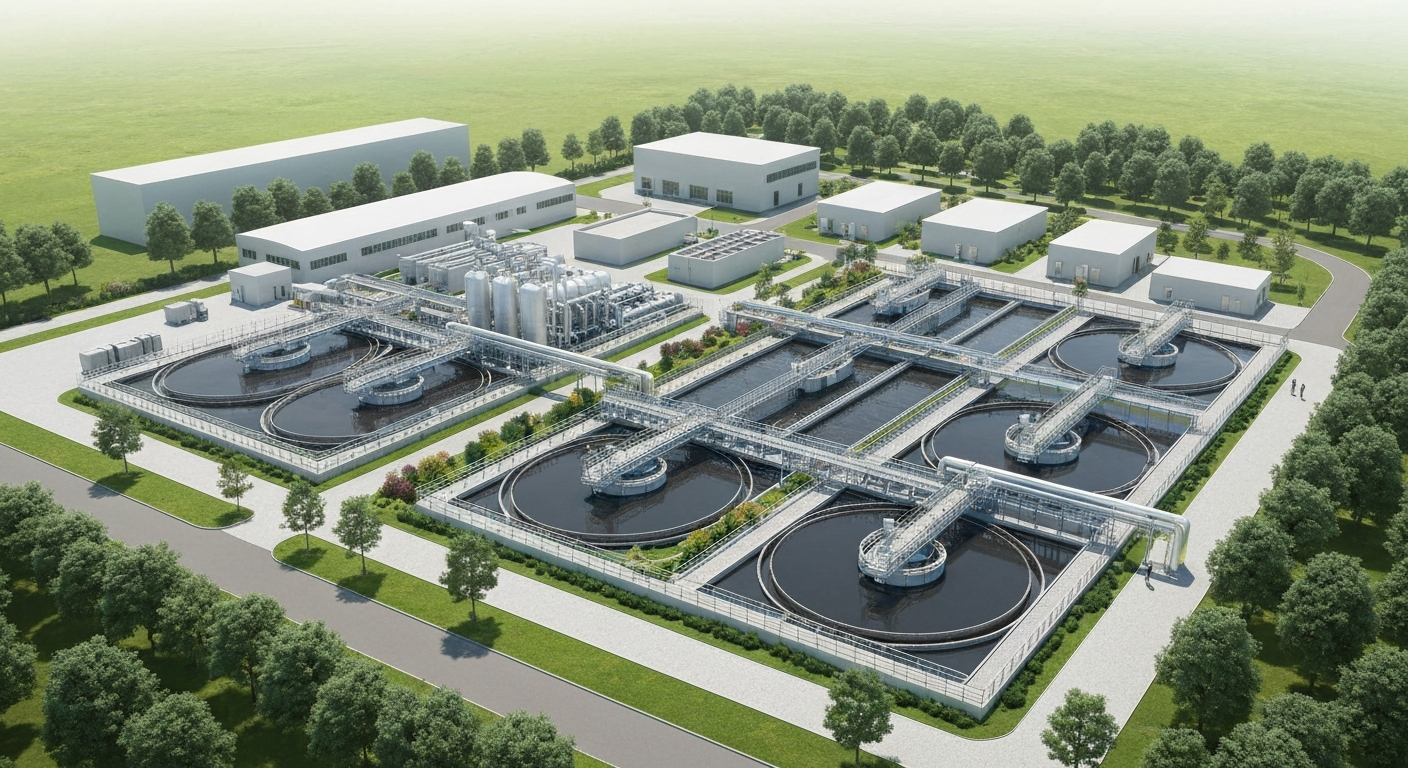
Industrial ETP volume reduction means reducing both the wastewater load entering the treatment plant and the wet sludge volume left after treatment. For most industrial plants, the biggest disposal pain is not only liquid effluent. It is the heavy, wet, odorous sludge cake that must be stored, transported, sent to TSDF, co-processed, reused, or disposed of through an approved route.
A practical volume reduction plan connects source control, stream segregation, thickening, sludge dewatering techniques, thermal drying, vapour handling, and final disposal planning. The right solution depends on sludge type, moisture, salts, oil, metals, organics, daily generation, energy source and compliance route.
What Volume Reduction Means in an Industrial ETP
In an industrial effluent treatment plant, volume reduction has two meanings.
The first is liquid effluent volume reduction. This reduces the amount of wastewater entering or leaving the ETP through water conservation, reuse, process correction, segregation, RO, MEE, evaporators, or ZLD systems.
The second is sludge volume reduction. This reduces the mass and volume of sludge generated after chemical, biological, physical or advanced treatment. For many plants, this is where the daily cost pressure becomes visible because wet sludge is heavy, difficult to handle and expensive to move.
Both are important, but they are not the same. A plant can reduce liquid discharge and still struggle with concentrated sludge. A plant can dry sludge well and still have poor wastewater reuse. A serious ETP upgrade needs to study both sides.
Why Industrial Plants Are Taking Volume Reduction Seriously
Industrial ETP teams are moving toward volume reduction because wet waste is becoming harder to manage on cost, space and compliance fronts.
The common plant-side pressures are simple:
| Pressure | What it means for the plant |
|---|---|
| High wet sludge quantity | More storage area, more handling, more transport trips |
| Variable sludge moisture | Unstable disposal weight and unpredictable drying load |
| Rising disposal burden | TSDF, landfill, co-processing or approved disposal cost can increase with weight and logistics |
| ETP overload | Hydraulic and organic load variations can disturb treatment stability |
| ZLD pressure | Concentrated reject streams need better final solids handling |
| Documentation pressure | Plants need better records for sludge generation, disposal route, moisture and handling |
This is why volume reduction should not be treated as only an environmental topic. It is also a plant reliability, handling, logistics and procurement topic.
Where the Biggest Reduction Usually Happens
A good ETP volume reduction plan should check each stage before selecting equipment.
| Stage | Main purpose | Common equipment or action | Buyer caution |
|---|---|---|---|
| Source control | Reduce wastewater at origin | Process water optimization, leak control, counter-current rinsing | Do not overload ETP with avoidable water |
| Stream segregation | Keep difficult streams separate | Separate high-TDS, high-COD, oily, acidic or solvent-bearing streams | Mixed effluent is harder and costlier to treat |
| Equalization | Stabilize flow and load | Equalization tank, mixers, transfer pumps | Poor equalization affects downstream treatment |
| Thickening | Increase sludge solids before dewatering | Gravity thickener, mechanical thickener, DAF sludge handling | Thin sludge increases dewatering and drying load |
| Dewatering | Remove free water | Filter press, screw press, centrifuge, belt press | Dewatered cake may still contain high moisture |
| Thermal drying | Remove additional moisture | Paddle dryer, disc dryer, belt dryer, ATFD for selected streams | Dryer selection depends on sludge behaviour |
| Vapour and odour control | Manage evaporated moisture and fumes | Condenser, cyclone, scrubber, bag filter, ID fan | Must match sludge chemistry and site rules |
| Final handling | Prepare reduced output | Screw conveyor, bagging, silo, truck loading | Disposal route should be decided before equipment selection |
For deeper sludge-side planning, refer to the ETP sludge treatment and disposal guide and the thermal sludge drying system guide.
Liquid Volume Reduction vs Sludge Volume Reduction
Many plants confuse wastewater volume reduction with sludge volume reduction. This creates wrong equipment expectations.
| Question | Liquid volume reduction | Sludge volume reduction |
|---|---|---|
| Main target | Reduce wastewater discharge or recycle water | Reduce wet sludge mass, moisture and handling burden |
| Typical technologies | UF, RO, MEE, evaporator, crystallizer, ZLD | Thickener, filter press, screw press, centrifuge, sludge dryer |
| Main output | Treated/recovered water and concentrated reject | Dewatered cake or dried sludge |
| Key risk | Scaling, fouling, high TDS, energy cost | Stickiness, odour, vapour, corrosion, disposal classification |
| Best first input | Water balance and effluent analysis | Sludge moisture, total solids, ash, pH, salts, oil and metals |
| Buyer mistake | Buying ZLD equipment without sludge planning | Buying dryer without dewatering and final disposal planning |
If your plant is studying zero liquid discharge, do not stop the discussion at RO, MEE or ATFD. ZLD also creates concentrated solids or sludge that must be dried, handled and documented properly.
How a Paddle Dryer Fits in ETP Sludge Volume Reduction
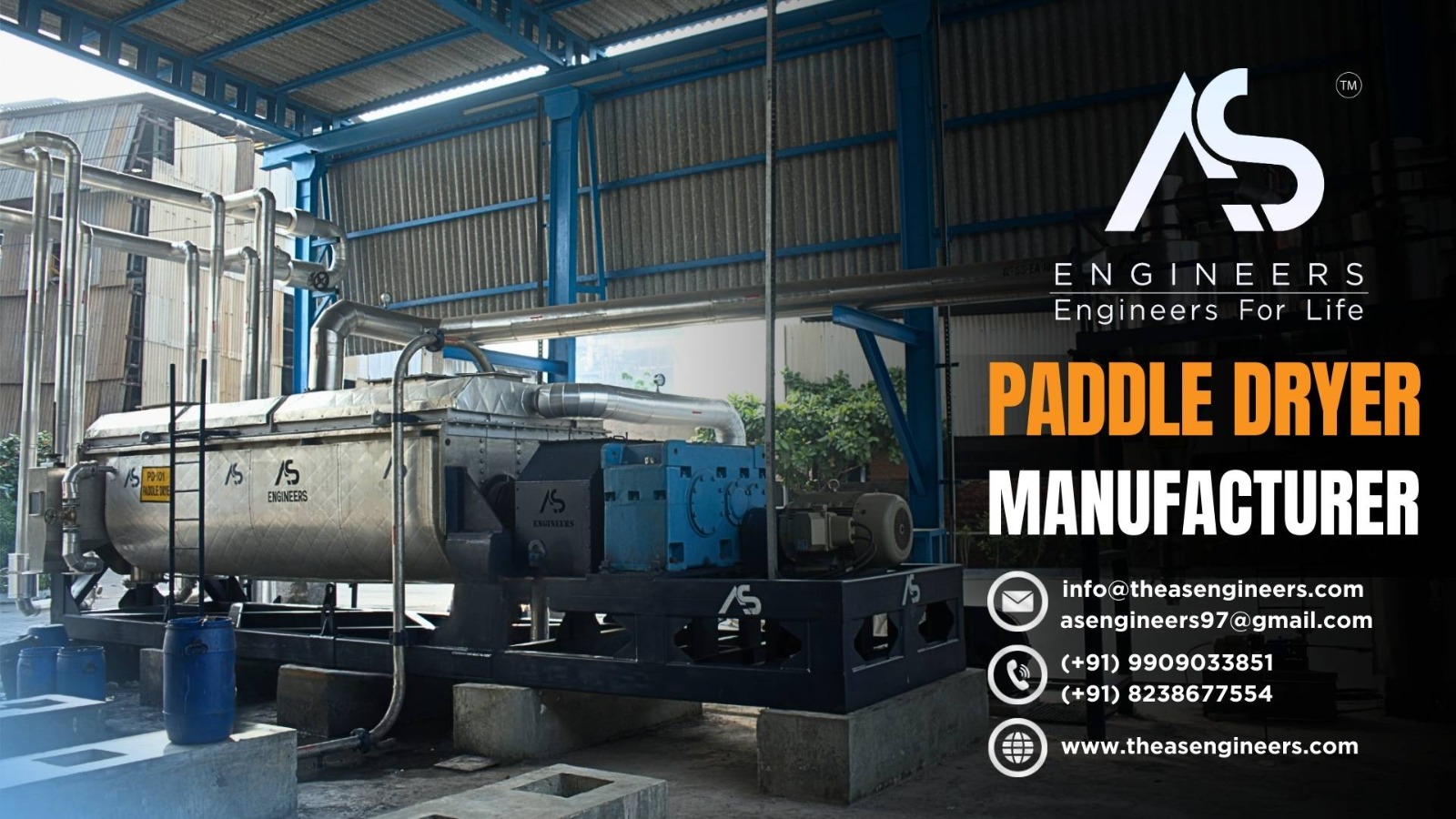
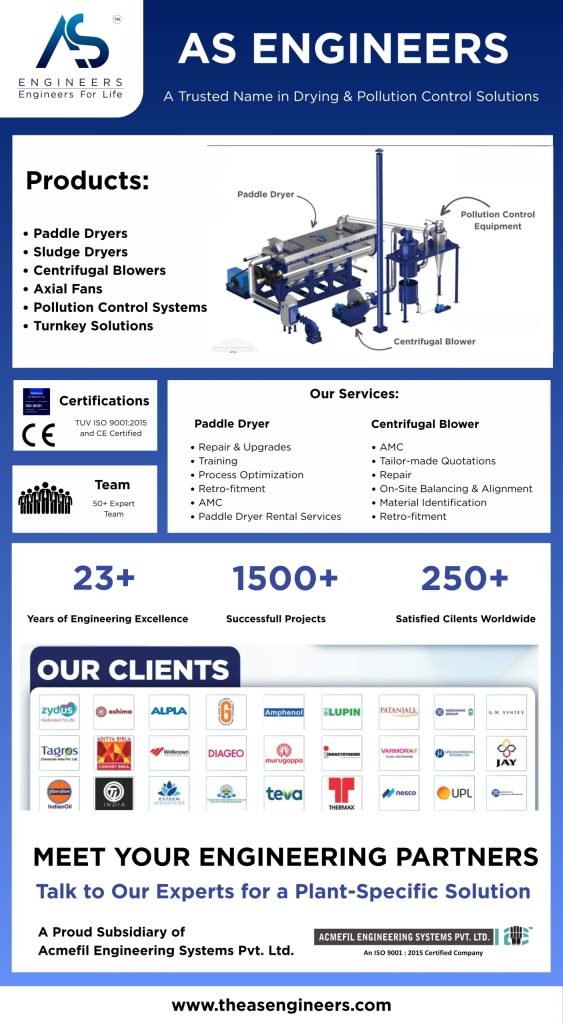
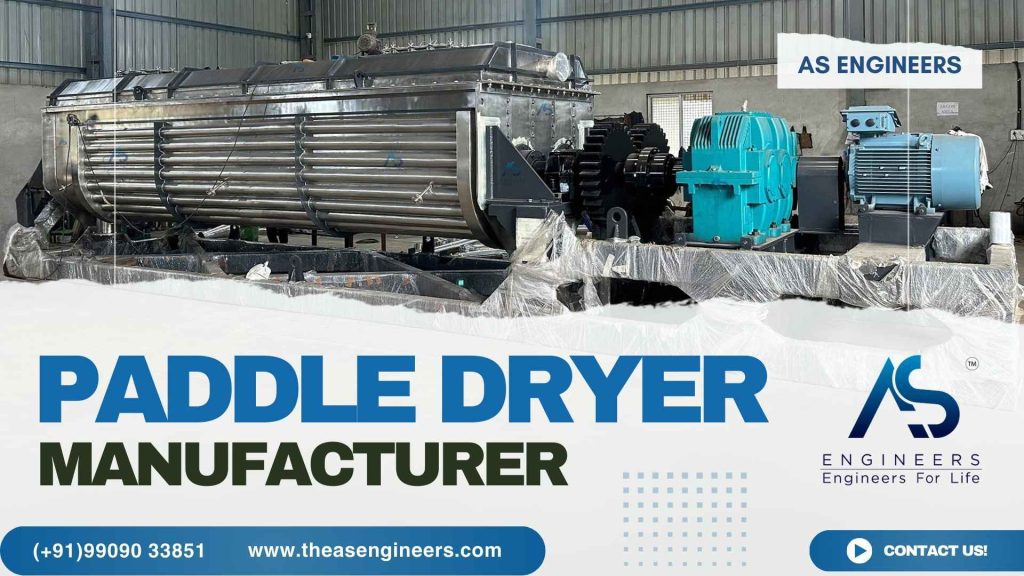
A paddle dryer usually fits after thickening and mechanical dewatering. The purpose is to remove additional moisture from sludge cake so the final material becomes lighter, smaller in volume and easier to store, transport, bag, co-process, or dispose of through an approved route.
In an indirect paddle dryer, heat is transferred through hollow shafts, paddles and a jacketed body. The heating medium does not directly contact the sludge. This is useful for many industrial ETP sludges because the feed may be sticky, pasty, odorous, chemically loaded, or difficult to expose to direct hot air.
AS Engineers paddle dryer design references include hollow shafts and jacket heating, dual counter-rotating shafts, wedge-shaped paddles, plug-flow movement, self-cleaning paddle action, and configurations such as standard dryer, dual-zone dryer and vacuum dryer. These details are useful when the buyer needs controlled sludge drying instead of open handling.
Practical Sludge Volume Reduction Example
A simple planning model helps plant teams understand the economics.
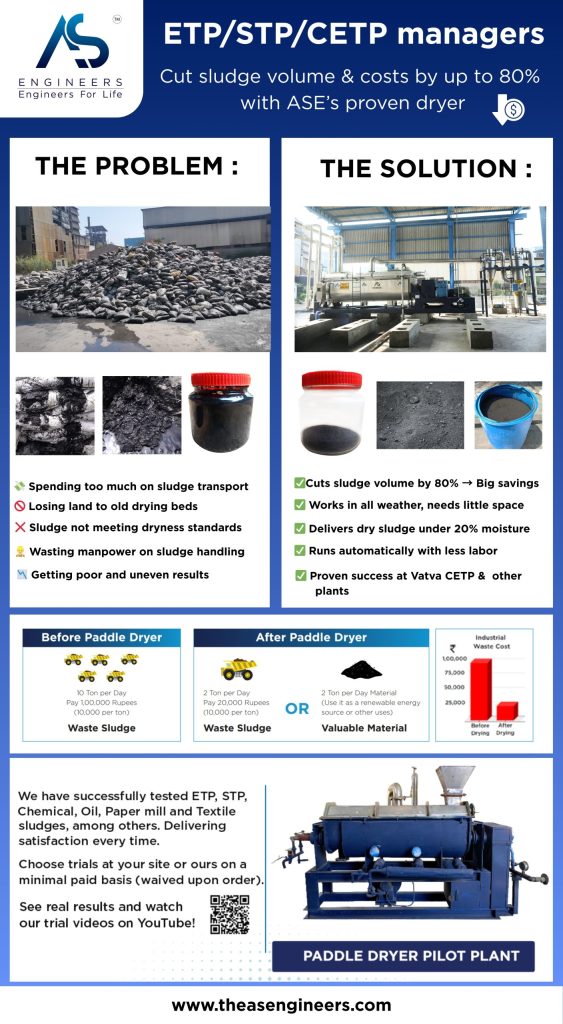
AS Engineers’ sludge drying example shows:
| Condition | Sludge quantity | Disposal cost basis | Daily disposal cost |
|---|---|---|---|
| Before drying | 10 ton/day wet sludge | ₹10,000/ton | ₹1,00,000/day |
| After drying | 2 ton/day dried sludge | ₹10,000/ton | ₹20,000/day |
| Alternative route | 2 ton/day reduced material | Depends on approved reuse or disposal route | Must be verified case by case |
This example should be used as a discussion model, not as a universal guarantee. Actual reduction depends on inlet moisture, outlet moisture target, dry solids, volatile solids, ash, oil, salts, bound water, sludge chemistry and operating discipline.
For commercial planning, connect this with the industrial sludge dryer machine price guide so the buyer compares total cost of ownership, not only machine price.
Technology Map for Industrial ETP Volume Reduction
| Technology | Where it helps | Strength | Limitation |
|---|---|---|---|
| Source reduction | Before ETP | Lowest-cost reduction when process water use is wasteful | Needs production-side discipline |
| Stream segregation | Before equalization | Prevents difficult streams from disturbing the full ETP | Needs piping and operator control |
| Thickening | Sludge line | Reduces volume before dewatering | Not enough for final dry handling |
| Mechanical dewatering | Sludge line | Removes free water and reduces wet sludge quantity | Cake can still be heavy and wet |
| Paddle dryer | After dewatering or selected wet feed | Reduces moisture further with indirect heat transfer | Needs heat source, vapour handling and feed testing |
| RO/UF | Water recovery line | Supports reuse and reduces discharge | Fouling and reject management need attention |
| MEE/evaporator | High-TDS or ZLD stream | Concentrates difficult liquid streams | Energy and scaling must be evaluated |
| ATFD/crystallizer | Concentrated reject or salts | Converts final reject into dry/semi-dry solids in selected ZLD flows | Not a universal sludge dryer replacement |
| Scrubber/cyclone/bag filter | Vapour and dust handling | Controls fines, odour or vapour-side burden | Must match gas chemistry and dust load |
For buyer comparison, use the sludge dryer machine applications guide and best available technology choices for sludge drying.
When ETP Sludge Drying Is a Good Fit
ETP sludge drying is usually worth evaluating when:
- Wet sludge disposal cost is high.
- Sludge transport distance is long.
- Sludge storage area is limited.
- Dewatered cake still has high moisture.
- Sludge creates odour, hygiene or handling problems.
- The plant wants a more stable output for disposal or approved reuse.
- ZLD or high-recovery wastewater treatment is increasing concentrated solids.
- The plant needs better documentation of moisture, weight and disposal quantity.
A sludge dryer is not selected only by ton/day capacity. It should be selected after checking feed moisture, final moisture target, heat duty, sludge stickiness, MOC, vapour load, pollution control need and final route.
When Drying May Not Be the First Step
Drying is not always the first correction. In some plants, the better first move is to improve the ETP or dewatering stage.
Drying may need more review when:
- Sludge generation is not measured correctly.
- Feed moisture changes heavily every shift.
- Sludge contains unknown solvents or hazardous constituents.
- Existing dewatering is poor or inconsistent.
- Final disposal or reuse route is not decided.
- The plant has no clear heat source.
- Vapour handling and odour control have not been studied.
- Operators are not trained for thermal equipment.
For these cases, start with the sludge management guide and sludge dewatering machine guide before finalizing a dryer.
Industry-Wise Selection Notes
| Industry | Common ETP sludge issue | Volume reduction caution |
|---|---|---|
| Chemical | Salts, solvents, pH variation, hazardous constituents | Check MOC, vapour route and disposal classification |
| Pharmaceutical | Complex organics, batch variation, odour | Avoid generic sizing without feed testing |
| Textile and dyeing | Colour, salts, fibers, sticky sludge | Check fouling tendency and final co-processing acceptance |
| Food and beverage | High organic load, biological sludge, odour | Dewatering quality strongly affects drying cost |
| Paper and pulp | Fibrous sludge, high moisture, variable ash | Feeding and paddle action must suit fibrous cake |
| Petrochemical and refinery | Oil, hydrocarbons, odour, safety risks | Needs strict SME review and vapour safety study |
| CETP | Mixed sludge from multiple industries | Do not assume one drying behaviour for all member streams |
For hazardous or chemically complex sludge, also review CPCB guidelines for hazardous waste disposal and confirm the plant’s current authorisation and approved disposal route.
Compliance and Documentation Caution
Industrial ETP compliance should not be written using one generic BOD, COD, TSS or nitrogen number for every plant. Actual discharge limits depend on industry category, consent conditions, discharge route, state board requirements and applicable standards.
For volume reduction planning, the plant should maintain:
- Daily wastewater flow records.
- Sludge generation records.
- Dewatered cake moisture records.
- Dryer feed and output weight.
- Dryer outlet moisture where measured.
- Disposal challans or authorised route records.
- Lab analysis for sludge classification where required.
- Energy and fuel consumption.
- Maintenance and shutdown records.
- Any online monitoring or regulatory reporting data applicable to the site.
This protects the plant from relying only on marketing claims. It also helps engineering teams calculate the real benefit of volume reduction.
RFQ Checklist for Industrial ETP Sludge Volume Reduction
Before asking for a sludge dryer quotation, keep these details ready:
| Input | Why it matters |
|---|---|
| Sludge source | Chemical, pharma, textile, food, paper, STP, CETP or mixed sludge behaves differently |
| Daily generation | Required for dryer capacity and operating schedule |
| Feed moisture | Main input for evaporation load |
| Final moisture target | Defines drying duty and handling output |
| Total solids and volatile solids | Helps estimate dry matter and thermal behaviour |
| pH, chlorides, salts and metals | Important for MOC and disposal route |
| Oil and grease | Affects drying, odour and vapour handling |
| Stickiness and particle behaviour | Affects feeding, paddles and discharge |
| Current dewatering equipment | Filter press, screw press, centrifuge or other stage |
| Heating medium available | Steam, thermic fluid, hot water, gas, LDO, electricity or other |
| Vapour route | Chimney, condenser, scrubber, cyclone, bag filter or combined system |
| Final disposal or reuse route | TSDF, landfill, cement co-processing, bricks, fuel, fertilizer or other approved route |
| Available footprint | Impacts dryer layout, feeding and product handling |
| Automation expectation | Manual, semi-automatic or PLC-based operation |
You can also review the paddle dryer configuration guide before preparing the RFQ.
Common Mistakes in ETP Volume Reduction Projects
The biggest mistakes are usually made before equipment purchase.
| Mistake | Why it creates risk |
|---|---|
| Treating all sludge as the same | ETP sludge chemistry changes by industry and process |
| Buying only by machine price | Energy, maintenance, vapour handling and disposal route decide real cost |
| Ignoring dewatering quality | Poor cake moisture increases dryer load |
| Not testing sludge | Stickiness, oil, salts and bound moisture can change dryer performance |
| Assuming drying guarantees reuse | Reuse or co-processing depends on lab analysis and approval |
| Forgetting vapour handling | Moisture, odour, fumes and fines need a controlled route |
| Using generic compliance claims | Actual compliance depends on consent and local regulatory conditions |
| Not planning product handling | Dried sludge still needs conveying, bagging, storage or loading |
Conclusion
Industrial ETP volume reduction is strongest when the plant treats wastewater reduction and sludge reduction as two connected but separate engineering problems. Liquid reuse technologies reduce discharge. Sludge thickening, dewatering and drying reduce the wet solids burden that creates transport, storage, odour and disposal pressure.
For many industrial plants, the practical sequence is clear: reduce water at source, segregate difficult streams, stabilize ETP operation, improve dewatering, then evaluate thermal sludge drying where the disposal burden justifies it.
If your plant is evaluating ETP sludge volume reduction, share feed moisture, final moisture target, daily sludge generation, sludge analysis, dewatering output, available heating medium, vapour handling requirement and final disposal route. AS Engineers can review the duty condition and suggest a sludge drying configuration based on actual plant data.
FAQs
What is industrial ETP volume reduction?
Industrial ETP volume reduction means lowering the amount of wastewater and sludge that must be treated, discharged, stored, transported, or disposed of. It can include source control, water reuse, stream segregation, sludge thickening, dewatering, drying and ZLD support systems.
Does sludge drying reduce liquid effluent volume?
Not directly. Sludge drying reduces moisture from wet sludge cake after treatment. Liquid effluent volume reduction is handled through source reduction, reuse, RO, evaporators, MEE, ZLD and process changes. Both sides should be planned together.
How much can ETP sludge volume reduce after drying?
It depends on inlet moisture, outlet moisture, dry solids, volatile solids, ash, sludge chemistry and dryer operation. Some AS Engineers planning examples show major reduction from wet sludge to dried output, but final reduction must be calculated from actual sludge data.
Is a paddle dryer suitable for all ETP sludge?
No. A paddle dryer is useful for many wet, sticky and pasty sludge applications, but suitability depends on moisture, stickiness, pH, salts, oil, metals, hazardous classification, vapour handling and final disposal route. Testing and engineering review are required.
What data is needed for an ETP sludge dryer RFQ?
Minimum RFQ data includes sludge type, daily quantity, feed moisture, final moisture target, sludge analysis, current dewatering method, heating medium, MOC concerns, vapour handling need, available space and disposal or reuse route.