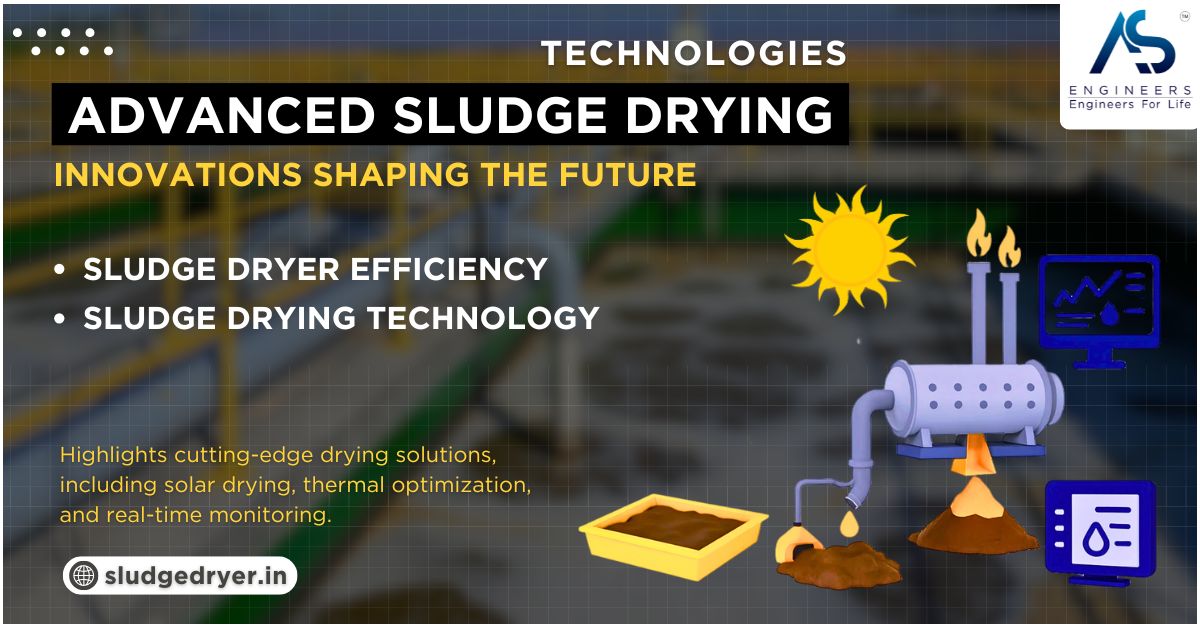
Advanced sludge drying technologies help plants reduce sludge moisture, transport weight, storage burden, odour risk, and disposal dependency. The right technology may be an indirect paddle dryer, thermal drying system, solar drying setup, waste-heat-assisted dryer, or hybrid drying line. The correct choice depends on sludge type, inlet moisture, final moisture target, fuel availability, vapour handling, site space, compliance route, and daily sludge quantity.
In my experience, the mistake is not choosing an “advanced” dryer. The mistake is choosing a dryer without understanding the sludge. Two sludges with the same moisture percentage can behave very differently inside a dryer. One may flow and discharge easily. Another may become sticky, pasty, corrosive, dusty, or difficult to convey.
For a wider foundation, first read this guide on sludge drying methods and best practices. This page goes deeper into advanced technology selection and RFQ readiness.
What makes a sludge drying technology advanced?
A sludge drying technology becomes advanced when it improves control, consistency, heat transfer, vapour handling, footprint, safety, or operating economics compared with basic drying beds or uncontrolled disposal.
In sludge drying, “advanced” does not automatically mean complicated. A well-selected indirect paddle dryer can be more practical than a high-automation system if the plant needs continuous drying, enclosed vapour handling, compact footprint, and stable discharge.
The main features to look for are:
- Controlled heat transfer.
- Consistent residence time.
- Ability to handle wet cake, paste, sticky sludge, or granular output.
- Suitable material of construction.
- Vapour, odour, and fines control.
- Safe discharge and product handling.
- Energy source flexibility.
- Maintenance access.
- Pilot trial validation before large investment.
For industrial buyers, the best question is not “Which is the latest technology?” The better question is “Which sludge drying technology fits my sludge, my site, my disposal route, and my operating cost?”
Main types of advanced sludge drying technologies
| Technology | How it works | Best fit | Main caution |
|---|---|---|---|
| Indirect paddle dryer | Heat transfers through hollow shafts, jacket, and heated surfaces while paddles mix the sludge | Sticky ETP sludge, STP sludge, biosludge, chemical sludge, wet cake | Needs correct feed study, MOC, vapour handling, and discharge planning |
| Thermal sludge dryer | Uses heat to evaporate moisture through direct, indirect, or hybrid heat transfer | Plants needing faster and controlled drying | Fuel cost and emissions control must be reviewed |
| Solar sludge drying | Uses solar heat and greenhouse-style drying, sometimes with mechanical turning | Large land area, favourable climate, low urgency | Weather, humidity, land requirement, and seasonal variation |
| Belt dryer | Sludge is spread over a moving belt and dried using controlled air flow | More flowable sludge and controlled low-temperature drying | Feed distribution and odour control are important |
| Disc dryer / thin film dryer | Uses heated rotating surfaces for indirect drying | Specific industrial sludge or heat-transfer applications | Feed consistency and maintenance access matter |
| Vacuum or low-temperature dryer | Lowers evaporation temperature under vacuum or low-temperature conditions | Heat-sensitive, odorous, or selected process sludges | Higher system complexity and sealing/control needs |
| Waste-heat-assisted dryer | Uses available waste heat from boiler, furnace, process, or CHP system | Plants with steady recoverable heat source | Waste heat must match dryer duty and operating hours |
| Hybrid drying system | Combines dewatering, thermal drying, solar, waste heat, or polishing stages | Complex plants with varied sludge or energy sources | More integration planning and controls required |
For many industrial ETP and STP plants, the most practical advanced drying route is still a properly sized indirect paddle dryer, supported by feeding, heating, vapour handling, pollution control, and product handling systems.
Indirect paddle dryer technology for sludge drying
An indirect paddle dryer dries sludge through conduction. Heat is transferred through heated metal surfaces instead of sending large volumes of hot gas directly through the sludge.
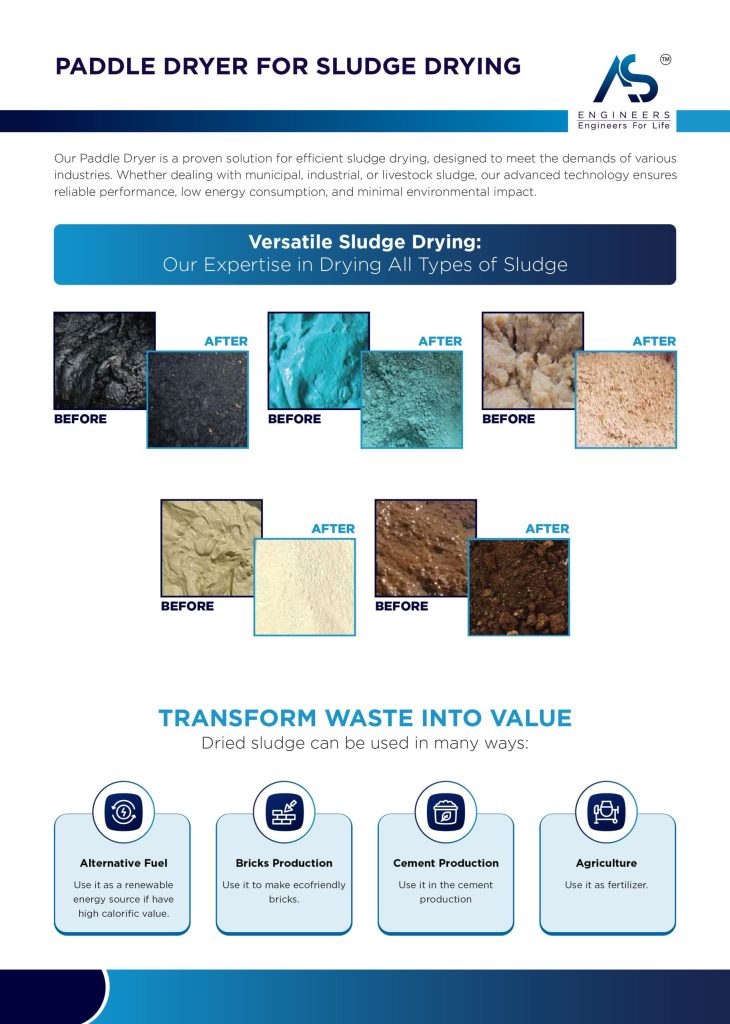
In AS Engineers’ paddle dryer configuration, heat transfer occurs through hollow shafts and a jacket. Wedge-shaped paddles agitate the sludge, break down wet lumps, improve surface renewal, and help move the material forward. Depending on the application, the system may use steam, thermic fluid, hot water, or another suitable heating source.
This makes paddle drying useful for many ETP and STP plants because wet sludge is often sticky, heavy, odorous, and difficult to move. A direct hot-air system may create more exhaust volume and dust-control load. An indirect dryer usually gives better control over vapour routing and lower off-gas volume.
For more on the specific indirect drying principle, read sludge treatment with conductive paddle dryers.
Where paddle dryer technology fits best
A paddle dryer becomes a strong option when:
- Wet sludge disposal cost is high.
- Sludge is generated daily or continuously.
- The plant wants enclosed drying instead of open drying beds.
- Site space is limited.
- Sludge remains costly even after mechanical dewatering.
- A defined outlet moisture is needed for disposal or approved reuse.
- Vapour and odour need controlled handling.
- The plant wants a continuous sludge drying system.
It is commonly considered for ETP sludge, STP sludge, CETP sludge, biosludge, paper sludge, textile sludge, chemical sludge, pigment sludge, pharma sludge, food-processing sludge, and ZLD-related residue where the material behaviour allows drying.
At AS Engineers, we do not recommend finalizing a sludge dryer only from tonnage. We need feed moisture, final moisture target, sludge source, chemical composition, heating medium, daily operating hours, handling route, vapour-control needs, and site layout.
Thermal sludge drying technology
Thermal sludge drying uses heat to evaporate water from sludge after thickening or mechanical dewatering. It is usually stronger than natural drying when the plant needs predictable output, faster drying, lower transport weight, or controlled disposal preparation.
Thermal drying can be direct, indirect, or hybrid.
Direct thermal drying brings hot gas into contact with sludge. It can be fast, but it may create larger exhaust volume and stronger odour, dust, and emissions-control requirements.
Indirect thermal drying transfers heat through a surface, as in paddle dryers, disc dryers, and thin film dryers. This can reduce exhaust volume and improve vapour containment.
Hybrid drying combines more than one heat-transfer method or uses staged drying. For example, a plant may dewater sludge first, dry it thermally to a practical moisture level, and then use the dried output for approved disposal, co-processing, or another permitted route.
For a detailed buyer guide, see thermal sludge drying system guide.
Solar sludge drying technology
Solar sludge drying uses sunlight, greenhouse heating, ventilation, and sometimes mechanical turning to reduce moisture. It can be useful where land is available and climate conditions support evaporation.
Solar drying is not a universal replacement for thermal drying. It depends heavily on:
- Solar radiation.
- Ambient temperature.
- Humidity.
- Rainfall pattern.
- Land availability.
- Odour control.
- Drying time.
- Seasonal variation.
- Sludge loading rate.
Solar drying can be attractive where operating cost must be low and time is not critical. But for industrial plants with daily sludge generation, space constraints, monsoon impact, or strict handling needs, a controlled thermal or indirect drying system may be more dependable.
For a practical comparison, read solar drying of wastewater sludge and paddle dryer vs solar bed.
Waste heat recovery in sludge drying
Waste heat recovery is one of the most useful upgrades in advanced sludge drying, but only when the heat source is steady and suitable.
Possible sources include:
- Boiler flue gas heat.
- Thermic fluid systems.
- Hot water loops.
- CHP systems.
- Furnace or process exhaust.
- Condenser heat.
- Hot air generator systems.
The engineering question is whether the available heat matches the drying duty. A plant may have waste heat, but it may not be available at the right temperature, flow, timing, or cleanliness.
Before using waste heat for sludge drying, check:
- Heat source temperature.
- Heat source availability during dryer operation.
- Corrosion or fouling risk.
- Heat exchanger requirement.
- Safety isolation.
- Backup heat source.
- Control stability.
- Maintenance access.
For deeper reading, use waste heat recovery in sludge drying plants.
Vapour, odour, and fines handling in advanced sludge dryers
A sludge dryer is not only a dryer body. It is a drying system. Vapour and fines handling can decide whether the installation works smoothly or becomes a site problem.
A complete sludge drying system may include:
- Feeding system.
- Paddle dryer or other dryer body.
- Heating system.
- FD blower or scavenging arrangement.
- ID fan or vapour movement system.
- Cyclone separator.
- Scrubber.
- Bag filter.
- Condenser where required.
- Chimney or permitted discharge route.
- Screw conveyor, bagging system, silo, or truck loading arrangement.
If sludge contains odorous compounds, solvents, fine solids, or hazardous constituents, vapour handling must be reviewed carefully. Drying reduces moisture, but it does not automatically make sludge safe for reuse or disposal. The final route depends on testing, classification, and regulatory approval.
Where air pollution control is part of the scope, AS Engineers’ broader support around pollution control equipment can be relevant for cyclone, scrubber, and bag filter integration.
Advanced monitoring and automation
Automation can improve sludge drying, but it cannot correct poor dryer selection.
Useful monitoring points include:
- Feed rate.
- Inlet moisture trend.
- Heating medium temperature.
- Dryer body temperature.
- Shaft speed.
- Motor load.
- Vapour temperature.
- Discharge moisture checks.
- Bearing temperature.
- Vibration.
- ID fan and FD blower performance.
- Pressure or draft condition.
- Scrubber or bag filter status.
A practical control system should help the operator maintain stable drying, not hide process problems. If feed moisture changes sharply, if sludge becomes sticky, or if discharge begins to bridge, operators still need clear inspection access and troubleshooting discipline.
This is why plant-side sampling and pilot testing remain important even when automation is available.
How to select the right advanced sludge drying technology
Use this selection framework before issuing an RFQ.
| Selection factor | Why it matters | What to confirm |
|---|---|---|
| Sludge source | STP, ETP, CETP, ZLD, paper, chemical, textile, food, pharma, and oil sludge behave differently | Source process and contaminants |
| Inlet moisture | Dryer duty depends heavily on water load | Average and peak moisture |
| Final moisture target | Lower final moisture usually needs more heat and residence time | Disposal, storage, reuse, or fuel target |
| Sludge behaviour | Sticky, pasty, fibrous, granular, abrasive, or corrosive feed changes dryer design | Pilot trial or sample testing |
| Heating medium | Steam, thermic fluid, hot water, waste heat, gas, coal, wood, briquette, or electricity affect economics | Availability and cost |
| MOC | Corrosion and abrasion risk affect service life | CS, SS304, SS316, duplex, or alloy requirement |
| Vapour route | Odour, water vapour, solvent, and fines need control | Cyclone, scrubber, bag filter, condenser, chimney |
| Space | Solar drying and drying beds need more area than compact thermal systems | Available layout |
| Operation | Continuous and batch duties need different planning | Hours/day and days/month |
| Maintenance | Access, cleaning, shafts, bearings, gearbox, and spares matter | Service plan and OEM support |
| Compliance route | Drying is not automatic permission for reuse | Testing and approval route |
When advanced sludge drying may not be the right first step
A dryer may not be the first investment when:
- Sludge quantity is very low.
- Disposal cost is already manageable.
- Mechanical dewatering has not been optimized.
- Sludge composition is unknown.
- The plant has no permitted route for dried output.
- Fuel or heat source is unreliable.
- The site cannot manage vapour, odour, or fines.
- The RFQ does not define final moisture target.
- The sludge is hazardous and classification is incomplete.
In many plants, dewatering should be improved before thermal drying. A dryer should not be forced to remove water that a filter press, screw press, belt press, or centrifuge could remove more economically.
For upstream comparison, read sludge dewatering techniques and sludge press machine.
Compliance and reuse caution
Dry sludge is easier to handle than wet sludge, but dry sludge is not automatically safe sludge.
Internationally, the U.S. EPA explains that sewage sludge management routes include land application, landfilling, and incineration, and biosolids for land application must meet applicable requirements. In India, the Ministry of Jal Shakti has listed National Guidelines on Sewage Sludge Management as a 2026 publication, which signals stronger attention to safe handling, treatment, utilization, and disposal.
For industrial ETP sludge, hazardous waste classification must be checked before any reuse or disposal plan. If the sludge falls under hazardous waste rules, the plant must follow the applicable authorization, storage, transport, manifest, and disposal route.
For India-specific disposal context, connect this page with CPCB guidelines for hazardous waste disposal and TSDF site standards.
Representative business case: why drying becomes attractive
Sludge drying becomes commercially attractive when the plant is paying to transport and dispose of water.
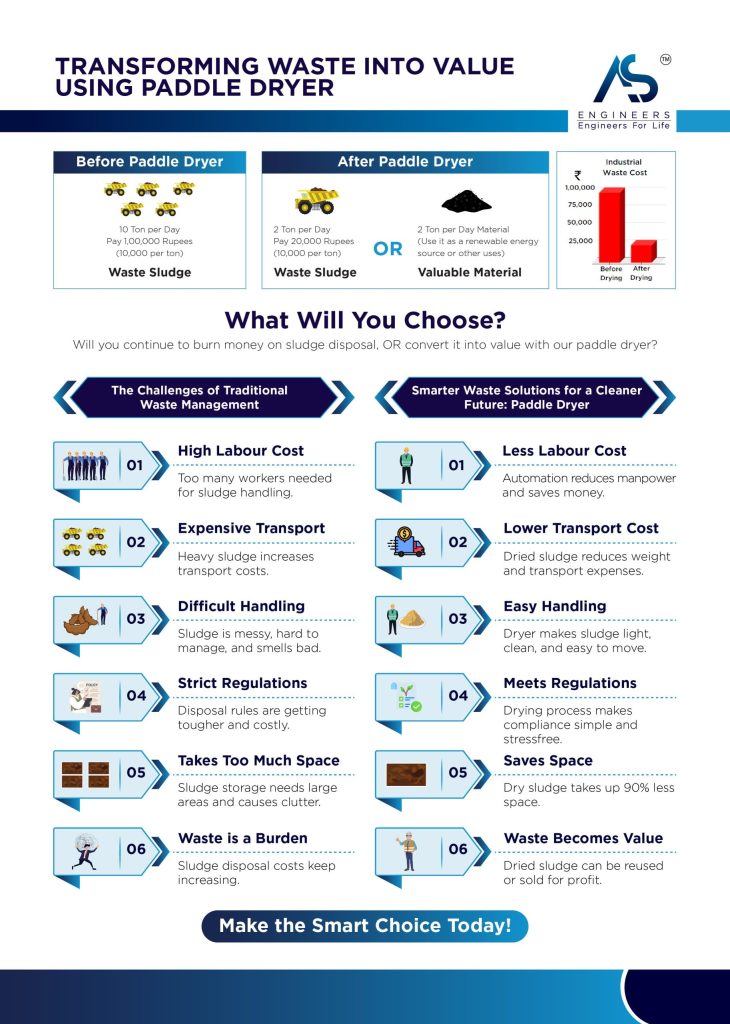
AS Engineers’ own sludge dryer material uses a representative example where 10 ton/day wet sludge becomes 2 ton/day dried sludge, reducing the disposal quantity in that example. This should be treated as a calculation example, not a universal guarantee. Actual savings depend on inlet moisture, final moisture, fuel cost, electricity cost, disposal rate, operating hours, labour, maintenance, and whether the dried output has an approved route.
Before investing, calculate:
- Current wet sludge quantity per day.
- Current disposal cost per ton.
- Current transport cost.
- Current storage space requirement.
- Expected inlet and outlet moisture.
- Fuel and power cost for drying.
- Maintenance and manpower requirement.
- Approved route for dried sludge.
- Payback based only on verified plant data.
For commercial planning, see industrial sludge dryer machine price and hidden cost of landfilling wet sludge.
RFQ checklist for advanced sludge drying technologies
Before asking for a sludge dryer quote, share these inputs:
| RFQ input | Required detail |
|---|---|
| Sludge type | STP, ETP, CETP, biological, chemical, paper, textile, pharma, food, oil, ZLD, or mixed |
| Daily sludge quantity | kg/day or ton/day, average and peak |
| Inlet moisture | Lab-tested moisture percentage |
| Final moisture target | Required outlet moisture or dryness |
| Feed form | Slurry, paste, wet cake, filter cake, sticky mass, granule, powder |
| Current dewatering system | Filter press, screw press, belt press, centrifuge, drying bed, or none |
| Heating medium | Steam, thermic fluid, hot water, waste heat, gas, coal, wood, LDO, briquette, electricity |
| Sludge chemistry | pH, chlorides, solvents, organics, heavy metals, oil/grease, salts, corrosive load |
| MOC preference | CS, SS304, SS316, duplex, or alloy requirement |
| Vapour handling | Condenser, scrubber, cyclone, bag filter, chimney, odour control |
| Site conditions | Available space, foundation, utilities, operating hours, manpower |
| Discharge handling | Screw conveyor, bagging, silo, truck loading, storage |
| Compliance route | Disposal, TSDF, co-processing, cement, fuel, agriculture, bricks, or other approved route |
For equipment configuration, use paddle dryer configuration guide and how to choose a sludge paddle dryer.
Why pilot trials matter
Pilot trials are important because sludge drying is behaviour-driven.
A lab report can show moisture, pH, ash, solids, and chemical composition. But it may not fully show how the sludge behaves when heated, mixed, sheared, and discharged. Some sludge passes through a plastic phase before becoming granular. Some sludge sticks to surfaces. Some forms lumps. Some creates fines. Some releases strong vapour or odour.
AS Engineers supports pilot trial evaluation for paddle dryer applications. The purpose is to check drying behaviour, process feasibility, discharge quality, vapour load, and practical operating issues before full-scale selection.
For buyers, a pilot trial can reduce uncertainty in:
- Residence time.
- Discharge condition.
- Heating medium suitability.
- Material sticking tendency.
- Vapour and odour handling.
- Feed and discharge equipment selection.
- Final moisture practicality.
- MOC concerns.
This is especially important for chemical sludge, pharma sludge, textile sludge, pigment sludge, agrochemical sludge, ZLD sludge, and mixed ETP sludge.
Conclusion
Advanced sludge drying technologies should be selected by sludge behaviour, not by brochure language. For many ETP, STP, CETP, and industrial plants, the strongest practical route is a complete drying system that combines dewatering, indirect heat transfer, controlled feeding, vapour handling, pollution control, product discharge, and pilot-trial validation.
A paddle dryer is often a strong fit when the sludge is wet, sticky, heavy, space-consuming, and expensive to transport or dispose of. Solar drying may fit sites with land and favourable climate. Belt, disc, thin film, vacuum, and hybrid systems can fit specific process conditions. Waste heat recovery can improve economics when heat availability is steady and suitable.
Before selecting any dryer, define the sludge type, moisture load, final moisture target, heating source, MOC, vapour route, disposal or reuse pathway, and RFQ inputs. That is how advanced sludge drying becomes an engineering decision instead of a keyword decision.
For a practical equipment discussion, review AS Engineers’ paddle dryer capability or compare related sludge dryer resources on sludgedryer.in.
FAQs
What are advanced sludge drying technologies?
Advanced sludge drying technologies are controlled drying systems that reduce sludge moisture using indirect heat, direct heat, solar heat, waste heat, low-temperature drying, or hybrid drying. They are used to reduce sludge volume, improve handling, lower transport weight, and prepare sludge for approved disposal or reuse.
Which sludge drying technology is best for ETP sludge?
For many ETP sludge applications, an indirect paddle dryer is a strong option because it can handle wet, sticky, pasty, and difficult sludge with controlled heat transfer and enclosed vapour routing. The final selection depends on sludge composition, inlet moisture, outlet moisture target, heating medium, and compliance route.
Is solar sludge drying better than thermal sludge drying?
Solar sludge drying can be economical where land, sunlight, and drying time are available. Thermal sludge drying is usually stronger when the plant needs predictable output, compact footprint, continuous operation, or faster moisture reduction. The better option depends on site conditions and sludge generation rate.
Does sludge drying make sludge safe for reuse?
No. Drying reduces moisture and improves handling, but it does not automatically make sludge safe for agriculture, fuel, cement, bricks, or any reuse route. The dried sludge must be tested, classified, and approved under the applicable regulatory pathway.
What information is needed for a sludge dryer quotation?
A proper sludge dryer quotation needs sludge type, daily quantity, inlet moisture, final moisture target, feed behaviour, heating medium, operating hours, sludge chemistry, MOC requirement, vapour handling needs, discharge method, site layout, and disposal or reuse route.