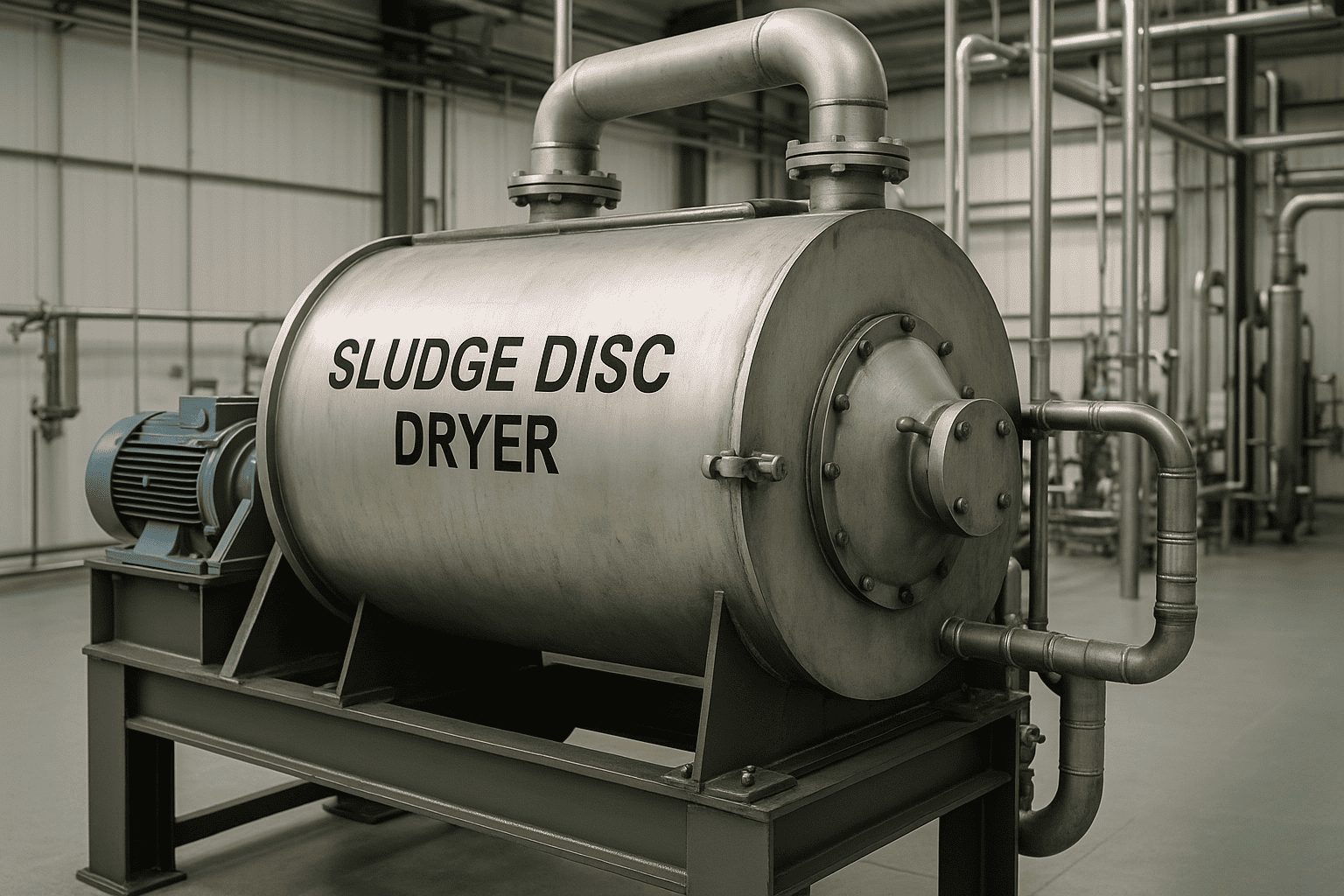
A sludge disc dryer is an indirect thermal drying system used to reduce moisture in dewatered sludge. It uses heated rotating discs inside a drying chamber to transfer heat into sludge, evaporate water, and produce a more manageable dried solid.
For plant teams, the main question is not only “Does a disc dryer work?” The better question is: is a disc dryer the right drying technology for this sludge, moisture target, heating utility, vapour condition, disposal route, and site layout?
This guide explains how a sludge disc dryer works, where it fits, where it may not fit, and what data you should prepare before asking for a technical quotation.
What Is a Sludge Disc Dryer?
A sludge disc dryer is a type of conductive or indirect sludge dryer. Heat is not applied by blowing large volumes of hot air directly through the sludge. Instead, heat is transferred through metal surfaces, usually hollow rotating discs connected to a heated shaft.
The wet or dewatered sludge comes into contact with the heated disc surfaces. As the discs rotate, they help move, mix, and expose the sludge to heat. Moisture evaporates from the sludge, vapour is collected and treated, and the dried or partially dried sludge is discharged from the system.
Sludge disc dryers are commonly evaluated for:
- Municipal sewage sludge
- ETP sludge
- CETP sludge
- Industrial wastewater sludge
- Chemical sludge
- Paper sludge
- Biological sludge
- Organic sludge
- Sludge intended for incineration, co-processing, disposal, or further treatment
A disc dryer should be selected only after checking sludge behaviour. Moisture percentage alone is not enough. Stickiness, fibre content, oil content, ash, salts, corrosive components, odour, vapour load, and final disposal route can all change the dryer design.
How Does a Sludge Disc Dryer Work?
A sludge disc dryer works by indirect heat transfer, controlled residence time, mechanical movement, vapour removal, and dried sludge discharge.
Step-by-Step Working Principle
| Stage | What Happens | Why It Matters |
|---|---|---|
| Sludge feeding | Dewatered sludge is fed into the dryer through a screw conveyor, pump, or controlled feed system. | A steady feed prevents choking, uneven residence time, and unstable drying. |
| Indirect heating | Steam, thermic fluid, or another heating medium heats the hollow discs or shaft. | Heat reaches sludge through metal surfaces, reducing the need for direct hot gas contact. |
| Disc rotation | Heated discs rotate through the sludge bed. | Rotation exposes fresh sludge surface to heat and helps move material toward discharge. |
| Moisture evaporation | Water or volatile moisture evaporates from the sludge. | Evaporation load controls heating duty, vapour handling, and energy demand. |
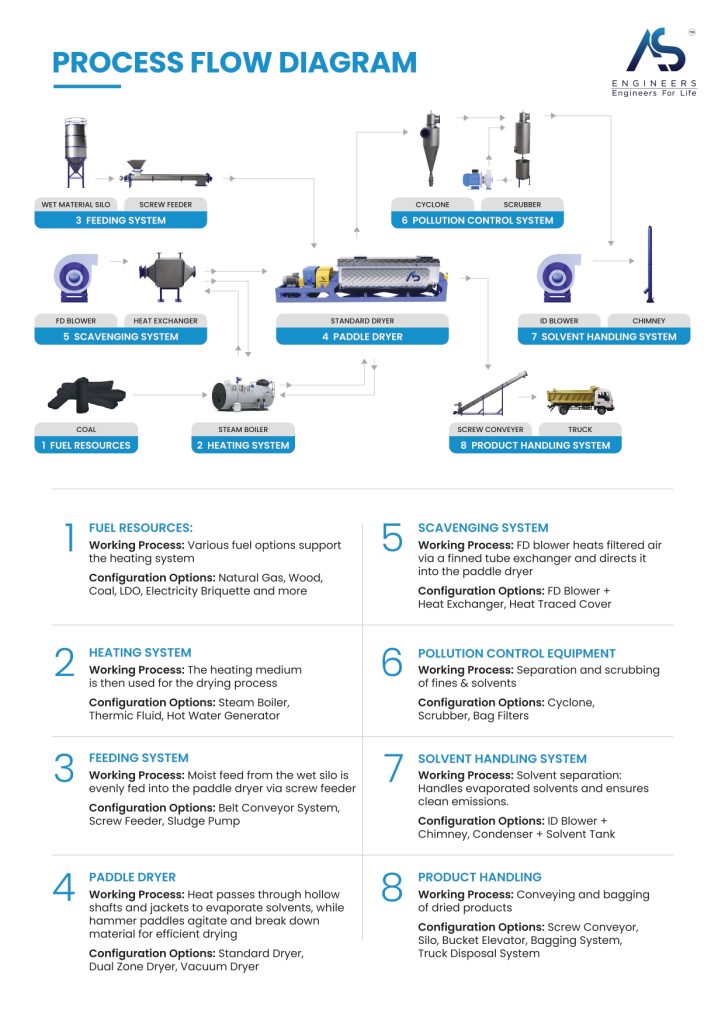
| Vapour collection | Vapour is routed to a condenser, scrubber, cyclone, bag filter, chimney, or treatment system depending on duty. | Odour, moisture, solvent, and fines must be handled safely. |
| Dried sludge discharge | Dried or partially dried sludge exits through a discharge system. | Final form affects bagging, conveying, truck loading, incineration, or disposal. |
In many sludge drying projects, the surrounding systems are as important as the dryer body. Feeding, vapour handling, pollution control, discharge handling, and maintenance access must be designed together.
For a broader view of dryer types, read the guide on sludge drying methods and systems.
Why the Disc Design Matters
The disc design increases heated surface area inside a compact dryer body. This can be useful where a plant needs continuous drying but has limited space.
A disc dryer is generally evaluated when the plant needs:
- Indirect heat transfer
- Enclosed sludge drying
- Continuous operation
- Controlled vapour collection
- Compact heat transfer surface
- Partial or controlled drying before incineration or disposal
- A drying system integrated with sludge handling and vapour treatment
However, the disc dryer is not automatically the best choice for every sludge. Some sticky sludge may need back-mixing, recycle of dried product, or a different agitated drying system. Some feed materials may be better suited to a paddle dryer, thin film dryer, belt dryer, or solar drying bed depending on behaviour and final moisture target.
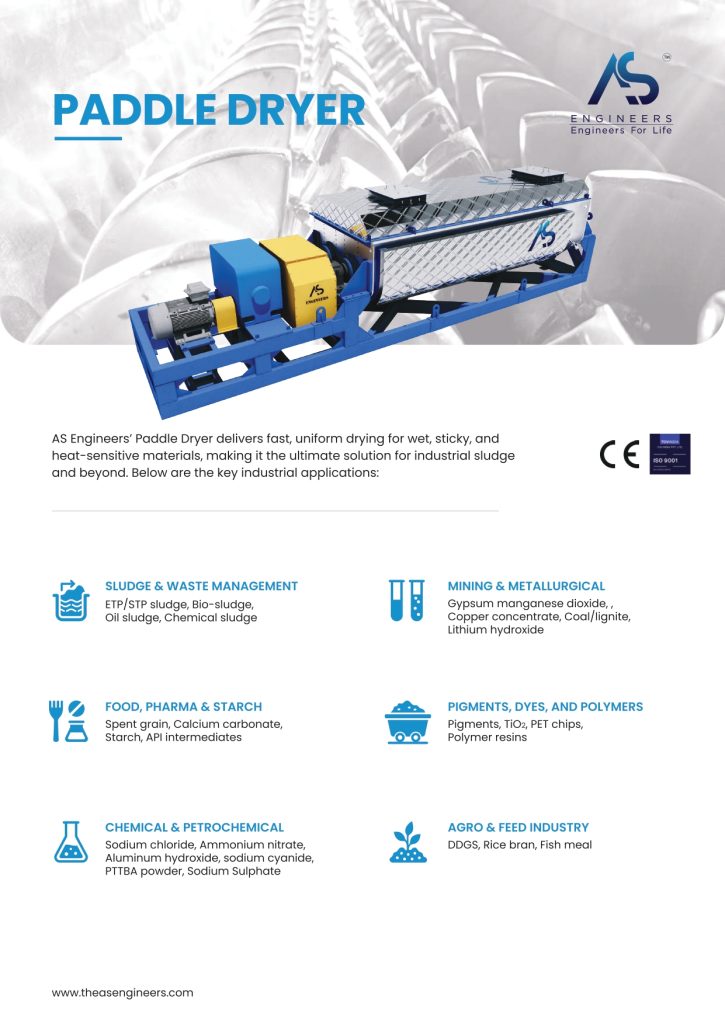
Sludge Disc Dryer vs Paddle Dryer
Disc dryers and paddle dryers are both indirect conductive dryers, but the internal material movement is different.
| Point | Sludge Disc Dryer | Paddle Dryer / Sludge Paddle Dryer |
|---|---|---|
| Main heated parts | Hollow discs or rings on rotating shaft | Heated jacket, hollow shafts, and paddles |
| Material movement | Disc rotation and peripheral elements move sludge forward | Paddles mix, shear, break, and move material through the dryer |
| Feed behaviour | Often used for dewatered sludge and partial drying applications | Strong fit for sticky, pasty, wet cake, slurry, and sludge-like feed |
| Sticky phase control | May require recycle or process control depending on sludge behaviour | Paddle agitation and self-cleaning design can help reduce buildup risk |
| Vapour handling | Needs vapour condensation, odour control, or exhaust treatment | Needs vapour path through cyclone, scrubber, condenser, ID fan, chimney, or bag filter depending on duty |
| Selection basis | Dry solids target, sludge consistency, incineration/disposal route, utility availability | Moisture load, stickiness, MOC, heating medium, residence time, vapour handling, discharge form |
AS Engineers’ verified sludge drying source material supports paddle dryer/sludge dryer systems using indirect heating through hollow shafts and jacket, with options such as standard dryer, dual zone dryer, vacuum dryer, cyclone, scrubber, bag filter, condenser, solvent tank, screw conveyor, silo, bagging system, and truck disposal arrangement.
For sludge that behaves like paste, wet cake, slurry, or sticky semi-solid waste, start with the practical selection guide on how to choose a sludge paddle dryer.
Main Benefits of a Sludge Disc Dryer
1. Indirect Drying With Controlled Heat Transfer
A disc dryer heats sludge through metal surfaces instead of direct flame contact. This helps when the plant wants enclosed operation, controlled vapour handling, and lower direct air contact with odorous or contaminated sludge.
This does not mean energy savings are guaranteed. Energy demand depends on feed moisture, final moisture target, sludge composition, heating medium, vapour recovery, insulation, and operation discipline.
2. Compact Drying Surface
The heated discs provide a large contact surface inside the dryer body. This can make disc dryers attractive for plants where footprint is limited but thermal drying is required.
Space planning should still include:
- Feed system
- Maintenance access
- Vapour outlet
- Condenser or scrubber
- Cyclone or bag filter
- Discharge conveyor
- Electrical panel
- Platform and safety access
A compact dryer body does not mean the full sludge drying system is automatically compact.
3. Continuous Sludge Processing
Disc dryers are commonly used in continuous sludge drying lines. Continuous operation can help plants reduce day-to-day wet sludge storage pressure when feeding, heating, vapour removal, and discharge are stable.
For plants generating sludge daily, continuous drying may be more practical than relying only on open drying beds, especially during monsoon, high humidity, or space-constrained operation.
Compare alternatives in sludge drying bed selection before finalizing a dryer route.
4. Better Vapour Collection Than Open Drying
Because the drying chamber is enclosed, vapour can be routed toward condensation, scrubbing, dust separation, or safe discharge treatment. This is important for sludge with odour, volatile components, solvent traces, or fine carryover.
For industrial sludge, vapour handling should not be treated as an accessory. It should be part of the base design discussion.
5. Reduced Sludge Weight and Disposal Burden
Thermal drying reduces moisture. Lower moisture usually means lower wet weight, easier handling, and reduced transport load. But the real disposal benefit depends on the final moisture, permitted disposal route, sludge classification, and local regulatory requirements.
Do not assume dried sludge can be reused automatically. It may require testing for contaminants, calorific value, ash, heavy metals, salts, pathogen risk, or other parameters depending on the intended use.
For disposal planning, connect this topic with industrial sludge disposal methods.
Where Sludge Disc Dryers Are Used
Municipal Sewage Sludge
Municipal STPs generate large quantities of dewatered sludge. A disc dryer may be evaluated when the plant wants controlled partial drying before incineration, thermal utilization, or further treatment.
For a wider treatment-chain view, read sewage sludge treatment.
ETP and CETP Sludge
ETP and CETP sludge can vary heavily because the inlet wastewater depends on industry type. Textile, chemical, dye, pharma, food, metal, and mixed industrial effluent sludge may behave differently in a dryer.
Before selection, the plant should check:
- Moisture percentage
- Organic and inorganic load
- Stickiness
- pH and corrosive components
- Salt content
- Solvent or oil presence
- Hazardous waste classification
- Disposal route
For industrial sludge challenges, see ETP sludge challenges and treatment solutions.
Chemical and Pharma Sludge
Chemical and pharma sludge may contain solvents, salts, reaction residues, or hazardous components. In these cases, vapour handling, MOC, sealing, condensate treatment, and safety review become critical.
A disc dryer, paddle dryer, vacuum dryer, or another indirect dryer may be considered depending on the material. Do not finalize based only on the machine name.
Paper and Pulp Sludge
Paper sludge may contain fibre and high moisture. Drying can improve handling and may support energy recovery where permitted and technically suitable. However, fibre behaviour, calorific value, ash, and final disposal route must be tested.
Food and Organic Sludge
Food-processing sludge may have organic load, odour, fat, protein, starch, or biological instability. Drying can improve storage and handling, but reuse as feed, compost, fuel, or soil conditioner must follow testing and applicable approval.
Oil and Refinery Sludge
Oil sludge is more complex. Thermal drying may involve vapour, odour, flammability, and residue risks. It should be reviewed with process safety, EHS, vapour control, and disposal specialists before equipment selection.
For this topic, review oil sludge drying and disposal methods.
When a Sludge Disc Dryer May Not Be the Right Fit
A sludge disc dryer may not be the best first choice when:
- Sludge is extremely sticky through the drying range
- Feed is inconsistent and not pre-conditioned
- The plant cannot control feed rate
- Vapour handling is not defined
- Final moisture target is unrealistic
- Space is available but low-cost slow drying is acceptable
- The sludge is better suited to paddle drying, thin film drying, belt drying, or solar drying
- The disposal route does not justify thermal drying cost
- Lab data is available but pilot behaviour is unknown
For technology comparison, see belt vs thin film sludge dryer comparison and thermal sludge drying system guide.
Disc Dryer Selection Checklist for Plant Teams
Before asking any manufacturer or engineering team for a sludge disc dryer quotation, prepare these inputs.
| RFQ Input | Why It Matters |
|---|---|
| Sludge source | STP, ETP, CETP, chemical, pharma, food, paper, refinery, municipal |
| Feed form | Sludge, cake, paste, slurry, fibrous sludge, oily sludge, granular residue |
| Feed rate | kg/hr or ton/day |
| Operating hours | Batch or continuous, hours/day |
| Initial moisture | Defines evaporation load |
| Final moisture target | Controls residence time and heat duty |
| Dry solids percentage | Helps compare partial vs full drying requirement |
| Stickiness behaviour | Critical for buildup, recycle, and agitation strategy |
| Bulk density | Affects dryer volume and conveying |
| Particle/fibre content | Affects movement and discharge |
| pH and corrosive components | Affects MOC selection |
| Chlorides/salts/heavy metals | Affects material compatibility and disposal |
| Oil/solvent content | Affects vapour handling and safety review |
| Heating utility | Steam, thermic fluid, hot water, electricity, gas, waste heat |
| Vapour treatment | Condenser, scrubber, cyclone, bag filter, ID fan, chimney |
| Discharge plan | Bagging, screw conveyor, silo, truck loading, incineration feed |
| Compliance route | TSDF, co-processing, incineration, land application, reuse, or disposal |
| Site layout | Footprint, height, foundation, maintenance access |
| Pilot trial need | Required when feed behaviour is uncertain |
For material evaluation, pilot testing can be more reliable than only lab moisture data. AS Engineers’ approved source material supports a 50 kg/hr paddle dryer pilot trial program for material testing and feasibility review. Use this only for paddle dryer evaluation, not as a false claim for disc dryer testing.
Common Buyer Mistakes
Mistake 1: Selecting by Dryer Name Instead of Sludge Behaviour
“Disc dryer,” “paddle dryer,” “belt dryer,” or “thin film dryer” is not enough. The real selection starts with sludge behaviour during heating.
Some sludge becomes granular. Some becomes sticky. Some cakes onto surfaces. Some releases odour or vapour. Some needs a specific MOC. The dryer must be selected around this behaviour.
Mistake 2: Ignoring the Sticky Phase
Many sludges pass through a sticky phase while drying. If the dryer design does not handle this phase properly, the plant may face buildup, unstable discharge, high torque, or cleaning issues.
Mistake 3: Treating Vapour Handling as Optional
Vapour from sludge drying may contain water vapour, odour, fine particles, solvent traces, or volatile components depending on the sludge. Condensers, scrubbers, cyclones, bag filters, ID fans, and chimneys should be discussed early.
Mistake 4: Assuming Dried Sludge Has Automatic Value
Dried sludge can sometimes be used as fuel, cement input, brick input, fertilizer base, or other recovery material. But this depends on sludge composition and regulatory permission. Testing and approval decide the route.
Mistake 5: Comparing Only Machine Price
The right comparison is total system cost, not only dryer body cost.
Include:
- Feeding equipment
- Heating system
- Vapour treatment
- Pollution control
- Electrical and controls
- Installation
- Maintenance access
- Civil work
- Spares
- Operator training
- Disposal cost after drying
For budget planning, review industrial sludge dryer machine price.
Safety and Compliance Notes
Sludge drying can involve odour, dust, vapour, condensate, hazardous residues, pathogen risk, corrosion, and combustible or toxic components depending on sludge type. Industrial plants should verify classification, storage, transport, treatment, reuse, and disposal requirements with applicable pollution-control and EHS authorities.
A dryer can reduce moisture and improve handling, but it does not automatically make sludge non-hazardous or reusable. Final classification depends on sludge testing and regulatory route.
For Indian hazardous waste context, read CPCB guidelines for hazardous waste disposal before final disposal planning.
Practical Selection Rule
Use this rule before shortlisting a sludge disc dryer:
If the sludge is dewatered, consistent, suitable for indirect heating, and the plant needs controlled partial or full drying with vapour capture, a disc dryer may be worth evaluating.
If the sludge is sticky, pasty, semi-solid, difficult to move, or needs strong mechanical agitation and shearing, evaluate a paddle dryer or another agitated indirect dryer before finalizing.
If the plant has space, time, and climate support, solar drying or drying beds may still be considered for lower-cost applications, but they are less predictable in monsoon or space-constrained operation.
What to Share for AS Engineers Review
If you are comparing sludge drying technologies, share these inputs with AS Engineers:
- Sludge source and industry
- Feed rate in kg/hr or ton/day
- Initial moisture and final moisture target
- Dewatering method before drying
- Sludge behaviour: sticky, fibrous, oily, abrasive, corrosive, biological, chemical
- Available heating utility
- Vapour, odour, or solvent concern
- Required MOC
- Expected discharge form
- Disposal or reuse route
- Site layout and available footprint
- Pollution control requirement
- Whether pilot testing is needed
For AS Engineers’ paddle dryer and sludge dryer route, also review the paddle dryer configuration guide and paddle dryer manufacturer in India.
Frequently Asked Questions
What is a sludge disc dryer?
A sludge disc dryer is an indirect conductive dryer that uses heated rotating discs to transfer heat into dewatered sludge. The heat evaporates moisture, while vapour is collected and routed for condensation, scrubbing, filtration, or safe discharge treatment depending on sludge duty.
How does a sludge disc dryer work?
Wet or dewatered sludge enters the dryer, contacts heated rotating discs, and moves slowly through the drying chamber. The discs transfer heat into the sludge, moisture evaporates, vapour exits through a defined vapour path, and dried or partially dried sludge is discharged.
Is a disc dryer better than a paddle dryer for sludge?
Not always. A disc dryer may fit some dewatered sludge and partial drying applications. A paddle dryer is often stronger for sticky, pasty, wet cake, slurry, and semi-solid sludge because paddles provide stronger agitation, shearing, and movement. The correct choice depends on feed behaviour, moisture target, utility, vapour handling, and disposal route.
Can dried sludge be reused?
Sometimes, but not automatically. Dried sludge may be evaluated for fuel, cement, brick, agriculture, or other approved recovery routes only after testing composition, calorific value, contaminants, ash, salts, heavy metals, and applicable compliance requirements.
What information is required before selecting a sludge disc dryer?
Prepare sludge source, feed rate, initial moisture, final moisture target, dry solids percentage, stickiness, bulk density, corrosive components, oil or solvent content, heating utility, vapour handling requirement, discharge plan, site layout, and final disposal or reuse route.
Conclusion
A sludge disc dryer can be useful when a plant needs indirect sludge drying, continuous operation, compact heat transfer surface, and controlled vapour handling. It is especially relevant when dewatered sludge must be partially or fully dried before disposal, incineration, co-processing, or further treatment.
But it should not be selected only because the term sounds technically advanced. Sludge behaviour decides the dryer. Moisture, stickiness, vapour load, MOC, final moisture target, disposal route, heating utility, and maintenance access must be reviewed before selecting a disc dryer, paddle dryer, thin film dryer, belt dryer, or solar drying system.
For AS Engineers evaluation, share your sludge data, moisture target, heating utility, vapour condition, and discharge requirement. The team can help review whether an indirect sludge drying route such as a paddle dryer is technically practical for your plant conditions.