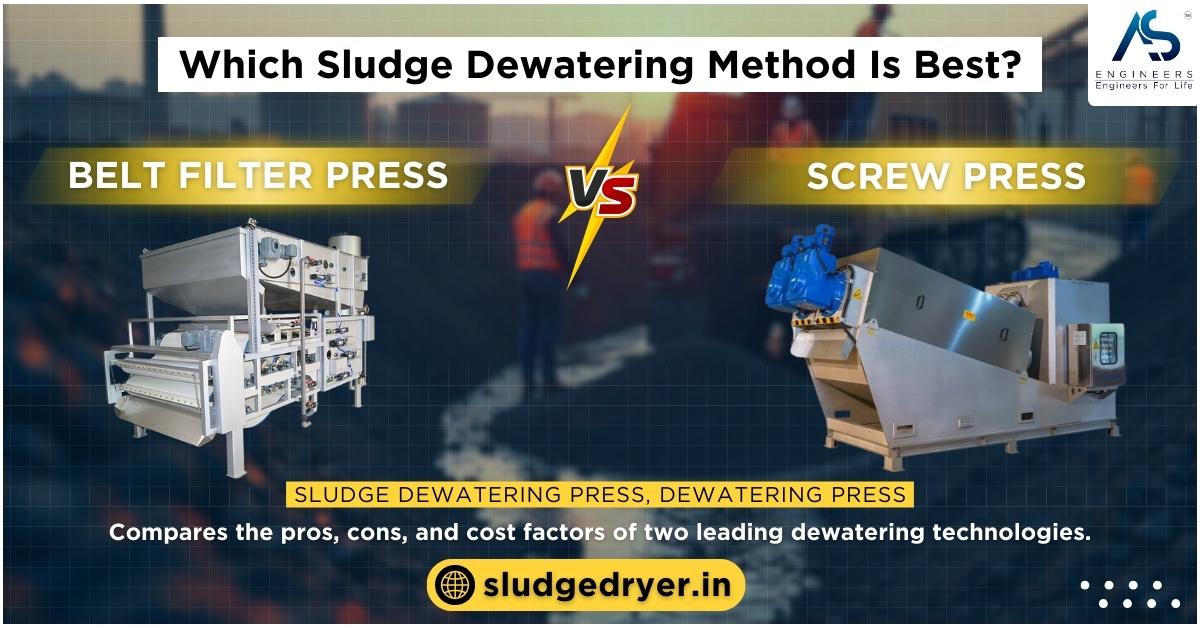
Belt filter press vs screw press selection depends on sludge type, feed solids, throughput, wash water availability, operator attention, cake moisture, and the next step after dewatering. A belt filter press usually suits high-throughput municipal or fibrous sludge duties. A screw press is often better for compact industrial ETPs, biological sludge, oily sludge, lower wash water use, and lower operator involvement. The final decision should be based on actual sludge testing, not only brochure cake dryness.
For plants planning a sludge drying system, this choice matters even more. Every extra percentage of moisture in press cake becomes extra evaporation load in the dryer.
Quick Answer: Which Is Better?
| Plant Condition | Better Starting Choice | Why |
|---|---|---|
| Large municipal STP with continuous high sludge volume | Belt filter press | Higher single-machine throughput and established municipal use |
| Compact industrial ETP with limited floor space | Screw press | Compact layout, enclosed design, lower wash water demand |
| Oily, greasy, dairy, food, or fine biological sludge | Screw press | Lower belt-blinding risk because there is no moving fabric belt |
| Textile, paper, pulp, or fibrous sludge | Belt filter press | Fibrous sludge can drain well across a belt surface |
| Limited skilled operators on site | Screw press | Lower tracking and wash-system attention |
| Water-scarce industrial zone | Screw press | Much lower wash water dependency than belt systems |
| Existing belt press already installed and performing well | Optimize first | Polymer, feed solids, belt condition, and wash pressure may improve cake dryness |
| Press cake will feed a thermal dryer | Test both | Dryer load depends on actual cake solids, not machine name |
The strongest answer is not “belt is best” or “screw is best.” The correct answer is the machine that gives stable cake solids, acceptable filtrate quality, manageable maintenance, and the lowest total cost across dewatering, handling, transport, disposal, and drying.
What Is a Belt Filter Press?
A belt filter press is a continuous sludge dewatering machine that squeezes conditioned sludge between two moving porous belts. Sludge is first mixed with polymer, then spread onto the belt for gravity drainage. It then passes through wedge compression and roller pressure zones before the cake is scraped from the belt.
A typical belt press has:
- Polymer mixing and flocculation system
- Gravity drainage zone
- Upper and lower porous belts
- Wedge compression zone
- Roller pressure zone
- Belt tracking and tensioning system
- Scraper blades
- High-pressure belt wash system
- Filtrate collection and return system
For a deeper supporting reference, see the U.S. EPA belt filter press fact sheet. For AS Engineers ecosystem context, you can also review this guide on belt filter press wastewater treatment and sludge dewatering.
Where Belt Filter Press Works Well
A belt filter press can be a strong choice when the plant has high sludge volume, continuous operation, enough floor area, enough wash water, and operators who can monitor belt tracking and wash pressure.
It is commonly considered for:
- Municipal STP sludge
- Primary and mixed sewage sludge
- Paper and pulp sludge
- Textile sludge with fibrous content
- Large ETP/CETP sludge streams
- Sites where high throughput matters more than compact footprint
Main Limitation of Belt Filter Press
The main weakness is not the pressing principle. The main weakness is dependency on belt condition, wash water, belt tracking, polymer conditioning, and operator discipline.
When belt washing is poor, the belt blinds. When the belt tracks poorly, edge wear starts. When polymer dosing is under-optimized, flocs break and cake moisture rises. A belt press can perform well, but it must be operated like a process machine, not just a sludge conveyor.
What Is a Screw Press?
A screw press is a continuous sludge dewatering machine where polymer-conditioned sludge moves through a cylindrical screen or ring assembly using a slow rotating screw. As the screw pitch reduces and back pressure builds near the outlet, water drains through the screen while solids move toward cake discharge.
A typical screw press has:
- Flocculation tank
- Slow-speed screw or auger
- Perforated screen, wedge wire, or fixed/moving ring assembly
- Filtrate collection tray
- Back-pressure plate or cone
- Cake discharge outlet
- Intermittent or low-water cleaning arrangement
- Control panel for screw speed and operation
Modern screw press selection should be based on pilot testing and hydraulic/solids loading, not only nameplate capacity. The Water Environment Federation’s screw press sizing paper discusses the importance of pilot testing and flux-based sizing for screw press comparison.
Where Screw Press Works Well
A screw press is usually considered when the plant wants compact layout, enclosed operation, lower wash water use, and lower operator attendance.
It is commonly useful for:
- Small and medium industrial ETPs
- Biological sludge from activated sludge systems
- Food and dairy sludge with oil and grease risk
- Pharmaceutical ETP sludge, subject to material behavior
- Chemical ETP sludge, subject to corrosiveness and solids character
- Sites with limited operator availability
- Retrofit projects where the dewatering room is small
For sludge-type background, see the related guides on activated sludge and biological sludge.
Main Limitation of Screw Press
A screw press is not automatically better for every plant. Single-machine throughput can be lower than a large belt press. Larger screw presses also need careful sizing because residence time, screen area, screw geometry, and loading rate affect performance.
The safe approach is simple: test actual sludge with the intended polymer, feed solids, and operating hours before freezing the model.
Belt Filter Press vs Screw Press Comparison
| Factor | Belt Filter Press | Screw Press | Selection Note |
|---|---|---|---|
| Working principle | Sludge squeezed between moving porous belts and rollers | Slow screw compresses sludge inside screen or ring drum | Both need polymer conditioning |
| Best fit | Large STP/CETP, fibrous sludge, high flow | Compact ETP/STP, oily/biological sludge, lower operator attention | Sludge behavior is the first filter |
| Cake dryness | Depends strongly on sludge type, polymer, belt condition, and pressure zones | Depends on sludge type, polymer, feed solids, screen/ring condition, and back pressure | Do not compare brochure values only |
| Throughput | Strong for high continuous volumes | Modular, multiple units may be needed for large duty | Check kg dry solids per hour, not only m³/hr |
| Wash water | High, because belts need continuous cleaning | Low to moderate, usually intermittent | Important in water-scarce industrial zones |
| Operator attention | Needs belt tracking, wash pressure, belt inspection | Lower routine attendance, but still needs inspection | Do not ignore maintenance skill |
| Footprint | Larger press body and wash water system | Compact and enclosed | Screw press helps retrofit layouts |
| Odor exposure | More open unless hooded | More enclosed | Relevant for STP, food, dairy, and nearby plant areas |
| Maintenance focus | Belts, rollers, bearings, tracking, spray nozzles | Screw, rings/screens, bushings, back pressure, filtrate drainage | Both need planned maintenance |
| Filtrate quality | Depends on floc strength and belt condition | Depends on floc strength and screen/ring gap | Return load to ETP must be checked |
| Dryer impact | Higher moisture means more evaporation load | Drier cake, where achieved, reduces dryer load | Test actual cake solids before sizing dryer |
The Most Overlooked Point: Dewatering and Drying Are One Decision
Many plants treat dewatering and drying as separate projects. That is a mistake.
Mechanical dewatering removes free and interstitial water. Thermal drying removes additional moisture that mechanical pressure cannot economically remove. When press cake goes to a thermal sludge drying system, the inlet moisture of that cake directly affects:
- Dryer evaporation load
- Heating medium requirement
- Residence time
- Dryer size
- Off-gas handling
- Fuel or steam consumption
- Dried sludge handling
- Final disposal or reuse economics
At AS Engineers, we review press cake moisture before discussing dryer sizing. A sludge dryer cannot be selected properly from “sludge quantity” alone. The dryer vendor needs the solids balance.
Simple Mass Balance: Why Cake Dryness Changes Dryer Load
This example is only for understanding. Actual performance depends on sludge characteristics, bound moisture, heating medium, dryer design, and target final moisture.
Assumption: plant has 1,000 kg/day dry solids and wants dried sludge at 90% dry solids.
| Dewatered Cake Dry Solids | Wet Cake Sent to Dryer | Water in Press Cake | Water Left at 90% DS | Water to Evaporate |
|---|---|---|---|---|
| 20% DS | 5,000 kg/day | 4,000 kg/day | 111 kg/day | 3,889 kg/day |
| 25% DS | 4,000 kg/day | 3,000 kg/day | 111 kg/day | 2,889 kg/day |
| 30% DS | 3,333 kg/day | 2,333 kg/day | 111 kg/day | 2,222 kg/day |
This is why a press improvement from 20% DS to 25% DS can reduce the dryer’s evaporation duty sharply. The press may look like a small part of the project, but it controls how much water the dryer must remove every day.
For the downstream thermal stage, review AS Engineers’ paddle dryer configuration guide and sludge treatment using conductive paddle dryers.
Choose Belt Filter Press When These Conditions Fit
A belt filter press can be the better selection when the plant has:
- High sludge throughput
- Good operator availability
- Reliable wash water supply
- Enough space for press, wash system, filtrate handling, and maintenance access
- Fibrous sludge that drains well on belts
- Existing belt press infrastructure
- Preventive maintenance culture
- Large STP or CETP duty where continuous volume matters
Before replacing an existing belt press, first check polymer conditioning, feed solids, belt condition, belt tension, spray nozzles, wash pressure, roller condition, and filtrate return load. Many belt press problems start from operation and conditioning, not from the machine type alone.
Related AS Engineers ecosystem guide: filter presses in wastewater treatment and sludge dewatering.
Choose Screw Press When These Conditions Fit
A screw press can be the better starting point when the plant has:
- Limited floor space
- Limited operator availability
- Water scarcity or high wash water concern
- Oily, greasy, biological, or fine sludge
- Odor-control concerns
- Small to medium ETP/STP duty
- Need for enclosed and cleaner operation
- Retrofit requirement inside an existing dewatering room
However, do not finalize a screw press only from a catalogue. Ask for pilot results, expected feed solids, polymer dose, kg dry solids per hour, filtrate quality, and cake solids from your actual sludge.
For broader equipment selection, see how to choose the right sludge dewatering equipment and the sludge dewatering machine guide.
Sludge Type Should Decide the First Shortlist
| Sludge Type | Belt Filter Press Fit | Screw Press Fit | Practical Note |
|---|---|---|---|
| Primary municipal sludge | Good | Good | Test mixed sludge behavior |
| Waste activated sludge | Moderate | Good | Biological sludge can be difficult to dewater |
| Mixed primary and secondary sludge | Good | Good | Blend ratio changes performance |
| Food and dairy sludge | Moderate to weak | Good | Oil and grease can blind belts |
| Textile sludge | Good | Moderate | Fibrous content may support belt drainage |
| Paper sludge | Good | Moderate to good | Fiber content and ash matter |
| Chemical ETP sludge | Case-specific | Case-specific | pH, salts, corrosiveness, and particles matter |
| Paint or pigment sludge | Case-specific | Case-specific | Abrasion and stickiness must be tested |
| Petroleum or oily sludge | Weak to moderate | Moderate to good | Oil content needs pilot testing |
| Septic or faecal sludge | Case-specific | Case-specific | Screening, grit, and feed consistency matter |
For upstream understanding, see sludge thickener fundamentals and gravity vs mechanical sludge thickener comparison.
Do Not Compare Only Cake Dryness
Cake dryness is important, but it is not the only selection criterion. A press giving slightly drier cake may still be a poor choice if it creates unstable filtrate quality, high polymer cost, frequent downtime, or difficult maintenance.
Compare these together:
| Parameter | Why It Matters |
|---|---|
| Feed solids | Dilute feed increases hydraulic load and reduces cake consistency |
| Polymer dose | Overdosing raises chemical cost and can damage downstream performance |
| Filtrate quality | Poor filtrate returns solids/COD load to ETP head |
| Cake solids | Controls handling, transport, disposal, and drying load |
| Wash water | Adds hydraulic load back to the ETP |
| Operator time | Affects consistency during real operation |
| Maintenance parts | Belts, rollers, rings, bushings, screws, nozzles, bearings |
| Downtime risk | Impacts sludge storage and plant hygiene |
| Dryer inlet moisture | Controls thermal dryer duty and energy requirement |
Common Mistakes in Belt Press and Screw Press Selection
Selecting by capital cost only
The cheapest press can become expensive when it produces wetter cake, consumes more polymer, needs constant attention, or increases dryer load.
Ignoring feed solids from thickening
Dewatering performance changes significantly when feed solids fluctuate. A weak thickening stage can make both belt press and screw press look bad. Before blaming the press, check the thickener.
Not doing polymer jar testing
Polymer selection and dose can change cake dryness more than many operators expect. Test polymer with actual sludge, not only vendor assumptions.
Treating filtrate as “free return”
Filtrate goes back to the ETP. If it carries too much suspended solids, COD, oil, or polymer, it can disturb upstream treatment.
Giving only wet sludge quantity to dryer vendor
A dryer manufacturer needs dry solids, moisture, sludge type, target final moisture, operating hours, heating medium, and handling requirement. Wet tonnage alone is incomplete.
Assuming one plant’s result will repeat at another plant
Even two ETPs in the same industry can produce different sludge because chemicals, pH, biological health, oil content, upstream treatment, and production schedule differ.
Maintenance Comparison
| Maintenance Area | Belt Filter Press | Screw Press |
|---|---|---|
| Daily visual check | Belt alignment, belt wash, cake release, spray nozzles | Feed flow, floc formation, filtrate drainage, cake discharge |
| Weekly checks | Belt tracking, belt damage, roller condition, wash pressure | Ring/screen cleanliness, screw movement, back pressure |
| Wear parts | Belts, scraper blades, nozzles, rollers, bearings | Rings/screens, bushings, screw, back-pressure components |
| Cleaning concern | Belt blinding and spray blockage | Screen/ring gap blockage or uneven drainage |
| Operator skill | Higher for tracking and wash control | Lower routine attention, but process understanding still needed |
| Downtime risk | Belt tear, tracking failure, nozzle blockage | Ring/screen wear, screw wear, back-pressure malfunction |
RFQ Checklist for Dewatering and Dryer Planning
Before selecting a belt filter press, screw press, or downstream dryer, collect these inputs:
| RFQ Input | What to Share |
|---|---|
| Sludge source | ETP, STP, CETP, primary, secondary, chemical, biological, mixed |
| Industry | Pharma, chemical, textile, food, dairy, paper, municipal, refinery, paint, etc. |
| Daily sludge generation | kg/day or m³/day wet sludge |
| Dry solids load | kg DS/day or kg DS/hr |
| Feed solids before press | % DS after thickening |
| Existing press cake moisture | % moisture or % DS, with sample basis |
| Target final moisture | After dewatering and after drying |
| Polymer details | Type, dose, preparation system, jar test result |
| Sludge behavior | Sticky, oily, fibrous, abrasive, corrosive, odorous |
| Chemistry | pH, TDS/salts, oil and grease, volatile solids, hazardous classification where applicable |
| Utilities | Power, wash water, steam, thermic fluid, fuel availability |
| Space | Available floor area and height |
| Operating hours | Batch, single shift, two shifts, continuous |
| Disposal route | TSDF, co-processing, land application, incineration, reuse, internal handling |
| Dryer requirement | Inlet moisture, outlet moisture, material handling, vapour/off-gas route |
For ETP-side context, see ETP sludge challenges and disposal solutions and industrial sludge disposal guide.
How AS Engineers Looks at This Selection
AS Engineers’ core role is not to force one dewatering press choice. The practical role is to connect dewatering output with sludge drying performance.
When I review a sludge dryer requirement, I first ask:
- What dewatering equipment is installed now?
- What is the actual cake moisture?
- Is that value stable across seasons and production cycles?
- Is the sludge biological, chemical, oily, fibrous, or mixed?
- Has polymer conditioning been optimized?
- What final moisture is expected after drying?
- How will dried sludge be stored, conveyed, bagged, or disposed?
A paddle dryer or sludge dryer manufacturer cannot be sized responsibly without this information. The press and dryer are one sludge-management chain.
AS Engineers’ paddle dryer system can include feeding, indirect heating through hollow shafts and jacket, drying, scavenging, pollution-control support, vapour handling, and product handling. For wastewater-specific drying context, see paddle dryer for wastewater treatment and Acmefil’s related page on paddle dryers in wastewater treatment.
FAQs
Which is better, belt filter press or screw press?
A belt filter press is better for high-throughput duties and fibrous sludge where wash water, space, and operator attention are available. A screw press is better for compact ETP/STP sites, biological or oily sludge, lower wash water use, and lower routine operator attention. The final choice should be confirmed with actual sludge testing.
Which machine gives drier sludge cake?
Neither machine guarantees drier cake in every plant. Cake dryness depends on sludge type, feed solids, polymer, operating settings, machine condition, and maintenance. Screw presses often perform well on biological and oily sludge, while belt presses can perform well on fibrous and high-throughput sludge. Compare pilot results, not only brochure claims.
Does screw press use less wash water than belt filter press?
Generally, yes. A belt filter press needs continuous belt washing to prevent belt blinding. A screw press usually uses much less wash water because there is no moving fabric belt, although cleaning requirements still depend on sludge behavior and machine design.
Can dewatering remove the need for a sludge dryer?
Usually no, if the plant needs major weight reduction, lower disposal quantity, cleaner handling, or a much lower final moisture target. Dewatering reduces free water, while thermal drying removes additional moisture from the press cake. The need for a dryer depends on disposal cost, regulatory route, reuse plan, storage, and moisture target.
What should I share with AS Engineers before discussing a sludge dryer?
Share sludge type, daily sludge quantity, feed moisture, press cake moisture, target final moisture, dry solids load, operating hours, heating medium availability, sludge behavior, and disposal route. A representative sludge sample or test report helps avoid wrong dryer sizing.
Conclusion
The belt filter press vs screw press decision should be made from sludge behavior, operating reality, and downstream drying cost, not from a single cake-dryness number. A belt filter press is often suitable for high-volume and fibrous sludge duties. A screw press is often more practical for compact industrial ETPs, biological sludge, oily sludge, lower wash water use, and lower operator attention.
For plants planning thermal drying, the most important input is actual press cake moisture. A few percentage points of extra moisture can add a large evaporation load to the dryer. Before finalizing a press or sludge dryer, test the sludge, confirm dry solids, check polymer performance, and review the full sludge chain from thickening to dewatering, drying, conveying, storage, and disposal.
To review a sludge drying requirement, share your sludge type, press cake moisture, daily sludge quantity, final moisture target, operating hours, and available heating medium with AS Engineers.