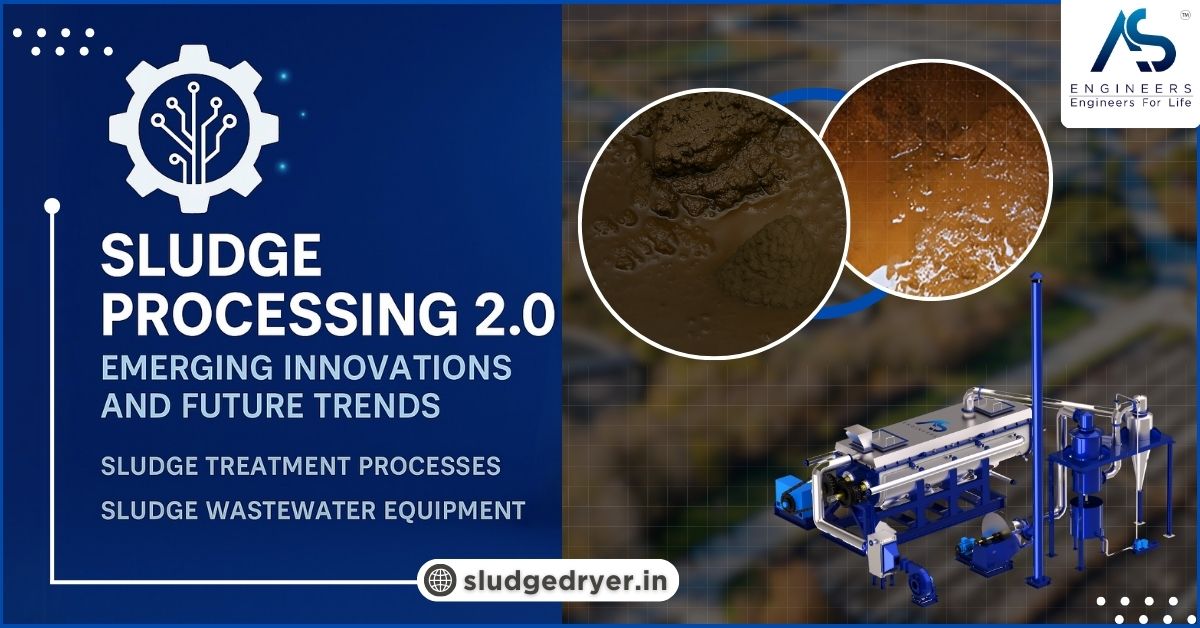
Sludge processing technology is moving from disposal-only sludge handling toward volume reduction, safer drying, automation, heat recovery, and resource recovery. For ETP, STP, CETP, ZLD, and industrial wastewater plants, the best upgrade is not the newest technology by name. It is the technology that fits the sludge type, moisture level, contaminants, fuel or steam availability, emission-control requirement, discharge route, and maintenance capacity.
In practical plant terms, sludge processing technology includes thickening, dewatering, drying, digestion, stabilization, automation, vapour handling, pollution control, and final reuse or disposal planning.
When I review a sludge processing requirement, I do not start with the equipment name. I first look at the sludge source, feed moisture, final moisture target, daily quantity, stickiness, odour, contamination risk, heating medium, available footprint, manpower, and disposal route. These inputs decide whether a plant needs better dewatering, a thermal sludge dryer, a conductive paddle dryer, automation, ZLD integration, or a combination of systems.
What sludge processing technology means today
Sludge processing technology is the group of mechanical, biological, thermal, chemical, and digital methods used to reduce sludge volume, improve handling, recover value where possible, and prepare sludge for safe disposal or reuse.
For plant teams, the goal is usually simple:
| Plant objective | What the technology must achieve |
|---|---|
| Reduce disposal quantity | Remove water and reduce wet sludge weight |
| Reduce transport cost | Produce drier, easier-to-handle sludge |
| Improve hygiene | Reduce open wet sludge storage and manual handling |
| Support compliance | Prepare sludge for approved disposal or reuse route |
| Improve plant reliability | Reduce choking, odour, inconsistent feed, and downtime |
| Recover value | Explore fuel, cement, brick, compost, fertilizer, or energy routes where testing allows |
| Reduce operating uncertainty | Use monitoring, automation, and better process control |
This is why modern sludge processing is not one machine. It is a complete decision chain from sludge generation to final disposal or reuse.
Why sludge processing is changing
Older sludge management was often based on thickening, dewatering, open storage, transport, and disposal. That approach becomes expensive when sludge contains high moisture, has poor handling properties, or travels long distances to disposal sites.
The newer direction is different. Wastewater and sludge are increasingly viewed as resource streams, not only as waste. International wastewater guidance now discusses treated wastewater and sludge systems in terms of water, energy, nutrients, and recoverable materials. This does not mean every sludge can be reused. It means plants must evaluate value recovery only after sludge testing, contamination review, regulatory review, and end-use approval.
For industrial buyers, this shift creates a practical question:
Should the plant invest in disposal-only handling, or should it design a sludge processing system that reduces moisture, reduces volume, improves safety, and keeps future recovery options open?
Innovation map: which sludge processing technologies matter?
Not every new technology is useful for every plant. A textile ETP, pharma ETP, food wastewater plant, municipal STP, refinery sludge system, and ZLD plant may all need different treatment logic.
| Technology area | Where it helps | Practical caution |
|---|---|---|
| Sludge thickening | Reduces free water before dewatering | Does not achieve high dryness alone |
| Mechanical dewatering | Reduces sludge volume before drying | Final cake may still be heavy and costly to transport |
| Thermal sludge drying | Reduces moisture after dewatering | Requires heat source, vapour handling, and safety review |
| Conductive paddle drying | Useful for sticky, pasty, wet sludge where indirect heating is preferred | Feed behaviour, MOC, vapour path, and heating medium must be checked |
| Anaerobic digestion | Useful for organic sludge and biogas recovery | Works best when sludge characteristics support biological digestion |
| Lime stabilization | Useful for pH adjustment and pathogen control in some cases | Adds mass and may not solve disposal cost if moisture remains high |
| Solar drying | Useful where land, climate, and time are available | Slow and weather-dependent compared to enclosed mechanical drying |
| ZLD-linked sludge handling | Important where wastewater concentration creates high-solid waste streams | Needs integrated evaporator, ATFD, dryer, and disposal planning |
| Automation and sensors | Improves monitoring of feed, moisture, temperature, torque, and alarms | Does not correct poor equipment selection |
| Resource recovery | Supports fuel, cement, brick, agriculture, or nutrient routes | Only possible after testing and regulatory approval |
For a deeper base before final technology selection, read the guide on sludge dewatering techniques and the thermal sludge drying system guide.
The most important shift: from wet sludge disposal to moisture-controlled handling
The biggest hidden cost in sludge management is usually water.
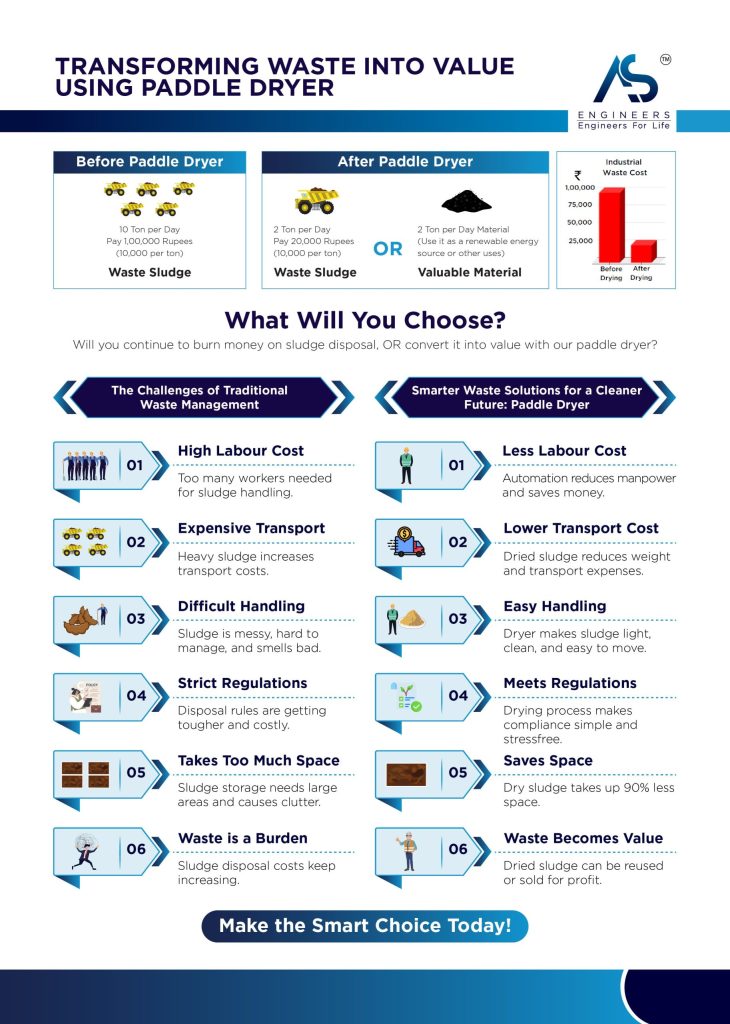
Wet sludge is expensive because it increases transport load, storage area, odour risk, handling difficulty, and disposal quantity. Mechanical dewatering removes part of the water, but many plants still send a wet cake for disposal. That wet cake may still contain enough moisture to keep transport and handling costs high.
Thermal drying becomes important when the plant needs lower final moisture, better handling, lower disposal quantity, or a stable dried material for further use.
A practical sequence often looks like this:
| Stage | Purpose |
|---|---|
| Thickening | Increase solids concentration before dewatering |
| Dewatering | Convert dilute sludge into cake |
| Drying | Remove additional moisture from cake |
| Vapour and fines handling | Control evaporated water, odour, fines, and emissions |
| Cooling or discharge handling | Prepare dried material for bagging, silo, truck, or reuse route |
| Testing and disposal planning | Confirm whether dried sludge is waste, fuel, raw material, or restricted material |
For plants comparing dryer options, the sludge dryers guide gives the base selection context.
Where conductive paddle dryers fit in sludge processing technology
A conductive paddle dryer is a practical technology for many wet, sticky, pasty, or cake-type sludge streams because it uses indirect heat transfer rather than direct hot gas contact.
In a paddle dryer, heat is transferred through hollow shafts and jacketed surfaces. Wedge-shaped paddles agitate the sludge, break the wet mass, expose more surface area, and support uniform drying. Dual counter-rotating shafts improve mixing and heat transfer. The self-cleaning paddle arrangement helps reduce material build-up, especially where sludge has sticky behaviour.
AS Engineers’ paddle dryer system can be configured as a standard dryer, dual-zone dryer, or vacuum dryer depending on duty conditions. Heating can be through steam or thermal oil, and the correct configuration depends on feed moisture, final moisture target, sludge chemistry, temperature sensitivity, vapour handling, MOC, and site utility availability.
Read more on sludge treatment with conductive paddle dryers and the paddle dryer configuration guide before preparing an RFQ.
What makes indirect drying useful for sludge?
Indirect drying is often preferred when the plant wants controlled heat transfer, lower off-gas volume, enclosed processing, and better integration with vapour handling equipment.
A conductive paddle dryer may be useful when:
| Condition | Why it matters |
|---|---|
| Sludge is sticky or pasty | Paddles help shear and move the material |
| Moisture target is lower than dewatering can achieve | Thermal drying removes additional moisture |
| Off-gas volume must be controlled | Indirect drying generally reduces exhaust volume compared to direct gas drying |
| Plant has steam or thermic fluid | Existing utilities can support heating medium selection |
| Dried sludge must be conveyed or bagged | Controlled discharge improves product handling |
| Space is limited | Compact dryer layouts can reduce open sludge storage needs |
| Disposal is expensive | Reducing moisture can reduce weight and transport burden |
This does not mean every plant should directly buy a dryer. In some cases, the first upgrade should be better dewatering, better sludge pumping, better equalization, or better feed consistency. A dryer performs best when the upstream system provides a stable feed.
Resource recovery: useful, but not automatic
Many articles make sludge reuse sound simple. In real plants, reuse depends on the sludge composition.
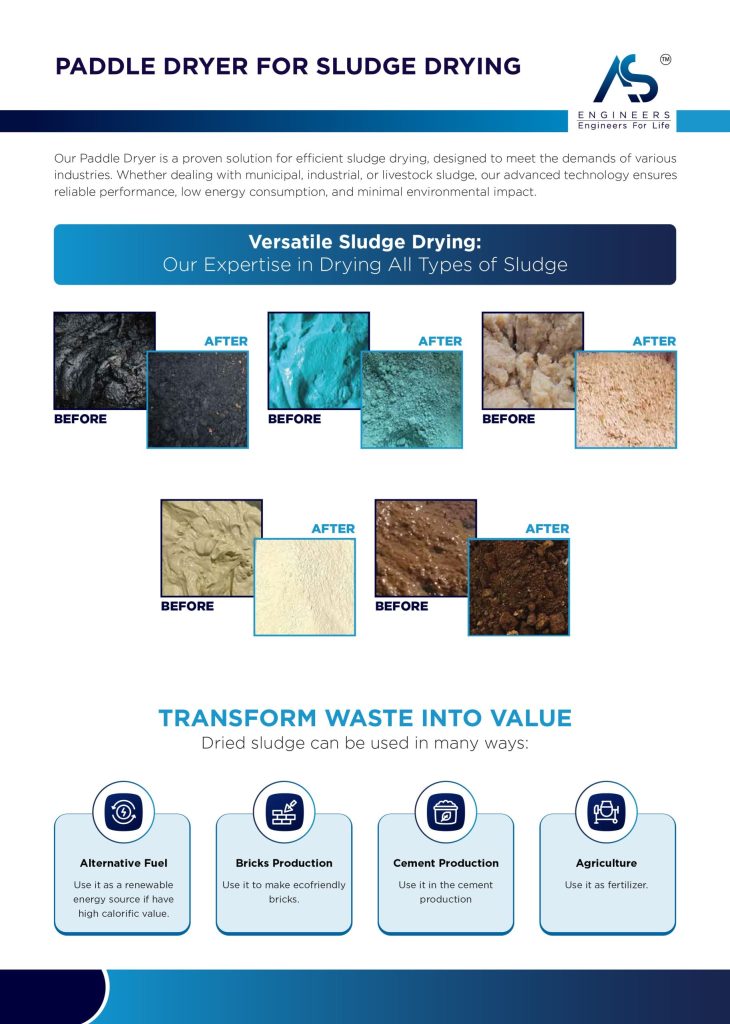
Dried sludge may be considered for alternative fuel, cement production, brick manufacturing, composting, fertilizer, or other value routes. But this is only practical when laboratory testing, calorific value, ash content, heavy metals, pathogens, persistent contaminants, local regulations, and end-user acceptance support the route.
For example:
| Recovery route | Key checks before considering it |
|---|---|
| Alternative fuel | Calorific value, ash, chlorine, sulphur, heavy metals, handling safety |
| Cement plant use | Moisture, ash chemistry, metals, transport, receiving plant acceptance |
| Brick making | Ash content, plasticity, contaminants, firing behaviour |
| Agriculture or fertilizer | Nutrients, pathogens, heavy metals, PFAS or emerging contaminants, local rules |
| Biogas | Organic content, biodegradability, digestion stability, gas yield |
A drying system can improve handling and reduce moisture, but it does not automatically make sludge safe for reuse. The reuse route must be verified separately.
For broader circular-economy context, see the guide on sludge waste recycling. For compliance-heavy disposal topics, also review the CPCB hazardous waste disposal guidelines guide.
Automation in sludge processing: useful when it controls real operating problems
Automation is one of the strongest trends in sludge processing technology, but it should not be treated as a decoration. Sensors and automation are useful only when they improve process control, safety, maintenance, or reporting.
Useful monitoring points in a sludge drying system may include:
| Monitoring point | Why it matters |
|---|---|
| Feed rate | Prevents overloading and uneven drying |
| Feed moisture trend | Helps stabilize dryer operation |
| Dryer torque/load | Indicates sticky feed, build-up, or overload |
| Heating medium temperature and pressure | Confirms heat input stability |
| Product discharge temperature | Helps protect downstream handling |
| Vapour line temperature | Reduces condensation and choking risk |
| Cyclone or bag filter pressure drop | Shows dust/fines loading |
| Scrubber parameters | Supports vapour and odour control |
| ID/FD fan performance | Maintains correct airflow and draft |
| Energy per kg water evaporated | Helps track operating efficiency |
| Bearing, gearbox, and vibration trend | Supports preventive maintenance |
The mistake is to add dashboards without solving feed variation, sludge pumping, vapour condensation, or poor equipment sizing. A useful automation system should tell the operator what is changing and what action is needed.
For this topic, read the wastewater automation guide.
ZLD integration and sludge processing
Zero Liquid Discharge plants create concentrated streams, salt-rich residues, and sludge that need careful handling. In ZLD projects, sludge processing cannot be separated from the evaporator, crystallizer, ATFD, dryer, filtration, and disposal strategy.
A ZLD-linked sludge processing plan should define:
| Input | Why it matters |
|---|---|
| Source of sludge or residue | ETP, RO reject, evaporator concentrate, ATFD cake, filter press cake |
| Moisture level | Decides dryer load and heat duty |
| Salt and chemical composition | Impacts MOC, corrosion, fouling, and disposal route |
| Heat sensitivity | Decides temperature control and vacuum requirement |
| Vapour characteristics | Decides condenser, scrubber, cyclone, bag filter, or ID fan route |
| Final disposal route | TSDF, reuse, co-processing, landfill, or internal recovery |
| Operating schedule | Batch, continuous, one-shift, or 24-hour operation |
For connected reading, use the zero liquid discharge guide and the AS Engineers article on paddle dryer use in ZLD plants.
How to choose sludge processing technology for your plant
Use this practical selection table before shortlisting equipment.
| Plant condition | Best first question | Likely technology direction |
|---|---|---|
| Sludge is very dilute | Can solids be increased before dewatering? | Thickener or better dewatering |
| Filter press cake is still costly to dispose | What final moisture is needed? | Thermal dryer or paddle dryer |
| Sludge is sticky and difficult to convey | Does the dryer handle sticky paste? | Conductive paddle dryer evaluation |
| Disposal cost is high | How much weight is water? | Dewatering + drying economics |
| Plant has steam available | Can steam support indirect drying? | Steam-heated paddle dryer |
| Plant has thermic fluid system | Is temperature control suitable? | Thermic-fluid-heated dryer |
| Sludge has solvent or odour | How will vapour be handled? | Enclosed dryer + condenser/scrubber |
| Sludge has hazardous contaminants | What does testing show? | Human review, compliance route, controlled disposal |
| Plant has limited space | Can sludge storage be reduced? | Compact enclosed drying system |
| Plant wants reuse | Is reuse legally and chemically acceptable? | Drying + lab testing + end-user approval |
Fit and no-fit guidance for paddle dryer selection
A paddle dryer can be a strong fit when the sludge is wet, sticky, pasty, or cake-like and the plant needs controlled indirect drying. It is also useful when the plant wants compact equipment, enclosed operation, and lower off-gas volume compared with some direct drying approaches.
It may not be the first choice when the sludge is extremely dilute and should be thickened first, when the plant lacks heating utility, when the final moisture target is not clear, or when reuse/disposal rules have not been checked.
| Paddle dryer is usually worth evaluating when | Recheck before selecting when |
|---|---|
| Sludge comes as cake, paste, wet powder, or sticky mass | Sludge is mostly liquid and not dewatered |
| Final moisture target is defined | Buyer only asks for “dryer capacity” without moisture data |
| Steam, thermal oil, or heating system is available | No heating medium is finalized |
| Vapour handling route is planned | Odour, solvent, or fumes are ignored |
| MOC can be selected from sludge chemistry | Chlorides, pH, solvents, or corrosives are unknown |
| Space and handling improvement matter | There is enough land and slow solar drying is acceptable |
| Disposal or transport cost is high | Disposal cost is low and drying does not create economic value |
For project-level decision-making, the sludge paddle dryer selection guide is the next internal page to read.
Sludge dryer RFQ checklist
Before requesting a quotation, share the following data. This saves time and reduces the risk of wrong sizing.
| RFQ input | What to provide |
|---|---|
| Sludge source | ETP, STP, CETP, ZLD, pharma, chemical, textile, food, refinery, paper, municipal |
| Feed quantity | kg/hr, TPD, or batch quantity |
| Feed moisture | Initial moisture percentage or lab report |
| Final moisture target | Required outlet moisture or dryness |
| Feed form | Slurry, paste, cake, sticky mass, granule, powder |
| Bulk density | Wet and expected dried material density if available |
| Sludge chemistry | pH, chlorides, solvents, oil, salts, metals, hazardous markers |
| Heating medium | Steam, thermic fluid, hot water, gas, coal, briquette, wood, electricity |
| Utility availability | Steam pressure, thermic fluid temperature, power, compressed air |
| Vapour handling need | Water vapour, odour, solvent, fumes, condensation, scrubber, condenser |
| Pollution control need | Cyclone, scrubber, bag filter, ID fan, chimney |
| MOC preference | CS, SS304, SS316, duplex, alloy, hard facing, lining |
| Operating schedule | Hours per day, days per month, batch or continuous |
| Discharge plan | Screw conveyor, bagging, silo, truck, bucket elevator |
| Final route | TSDF, landfill, fuel, cement, brick, agriculture, internal reuse |
| Site constraints | Footprint, height, access, existing foundation, safety zoning |
AS Engineers can review sludge dryer requirements when these inputs are available. For sludge drying projects, the team can evaluate the dryer configuration, heating medium, vapour handling route, product handling system, and pollution-control support based on actual duty conditions.
Common mistakes in sludge processing technology selection
Mistake: choosing technology by trend name
“Digital twin,” “AI,” “resource recovery,” or “advanced drying” sounds attractive, but the plant still needs correct feed data, mass balance, moisture target, and disposal route. A basic system with correct design often performs better than an advanced system selected without duty clarity.
Mistake: ignoring feed variation
ETP and STP sludge does not always behave the same every day. Chemical dosing, production batches, biological upset, seasonal flow, and upstream process change can affect sludge moisture, stickiness, and drying behaviour.
Mistake: treating drying as a standalone machine
A sludge dryer needs feeding, heating, vapour handling, pollution control, discharge handling, instrumentation, and maintenance access. The dryer is the core machine, but the system around it decides reliability.
Mistake: assuming dried sludge is automatically reusable
Drying reduces moisture. It does not remove every contaminant. Reuse should be based on testing, regulations, and acceptance from the end user.
Mistake: asking only for price
A low-cost dryer quotation without moisture data, vapour handling, MOC, and discharge design can become expensive later. Compare quotations on scope, duty assumptions, heating medium, MOC, automation, pollution-control equipment, service access, spares, and performance basis.
What AS Engineers considers before recommending a sludge dryer
At AS Engineers, sludge dryer selection is reviewed around the actual duty condition, not only around tonnage. Important points include:
- Feed moisture and final moisture target
- Sludge source and composition
- Material behaviour during heating
- Heating medium availability
- Required operating pressure condition
- MOC and surface finish requirement
- Vapour, solvent, odour, and fines handling
- Pollution-control equipment need
- Feeding and discharge arrangement
- Maintenance access and spare support
- Whether a pilot trial is needed before final sizing
AS Engineers’ paddle dryer platform is used for drying, solvent stripping, heating, calcining, roasting, and cooling applications, depending on duty and material behaviour. For sludge drying, the system can be configured with feeding, heating, paddle dryer, scavenging, pollution-control, solvent/vapour management, and product-handling sections.
Where the material is uncertain, a pilot trial may help evaluate drying behaviour, feasibility, process issues, and moisture reduction before full-scale selection.
FAQs
What is sludge processing technology?
Sludge processing technology includes the methods and equipment used to thicken, dewater, dry, stabilize, digest, monitor, recover, reuse, or safely dispose of sludge from wastewater, ETP, STP, CETP, ZLD, and industrial processes.
Which sludge processing technology is best?
There is no single best technology for every plant. The right choice depends on sludge type, moisture level, solids content, contaminants, heating medium, space, disposal route, reuse target, emission-control requirement, and operating budget.
Is sludge drying better than sludge dewatering?
Sludge dewatering removes part of the water mechanically. Sludge drying removes additional moisture using heat. Many plants use both: dewatering first to reduce load, then drying to achieve lower moisture and better handling.
Can dried sludge be reused?
Dried sludge can sometimes be used as fuel, cement input, brick material, compost, fertilizer, or other value stream. This is not automatic. It depends on sludge composition, calorific value, contaminants, pathogens, heavy metals, persistent chemicals, local rules, and end-user acceptance.
What information is needed for a sludge dryer quotation?
A sludge dryer RFQ should include sludge source, feed quantity, initial moisture, final moisture target, sludge form, bulk density, pH, contaminants, heating medium, vapour handling requirement, MOC preference, operating hours, discharge plan, and final disposal or reuse route.
Conclusion
Sludge processing technology is becoming more practical, integrated, and resource-aware. The strongest plants will not be the ones that simply install the newest technology name. They will be the plants that understand their sludge, control moisture, reduce disposal burden, plan vapour and pollution control, use automation where it improves reliability, and choose reuse only when testing and regulations support it.
For ETP, STP, CETP, industrial wastewater, and ZLD plants, the most useful upgrade path is usually a staged one: improve dewatering, define the final moisture target, evaluate thermal drying, plan vapour handling, verify disposal or reuse, and then select the equipment package.
If your plant is evaluating sludge drying or sludge processing upgrades, prepare the feed moisture, final moisture target, daily quantity, sludge composition, heating medium, vapour handling requirement, and disposal route. These inputs help AS Engineers review the correct sludge dryer configuration for real operating conditions.