A gravity vs mechanical sludge thickener decision should not be made by asking which one is “best.” The better question is: which thickener matches your sludge type, available space, operator skill, downstream equipment, and final disposal or drying goal?
Gravity thickeners suit simple, settleable sludge and plants with enough area. Mechanical thickeners suit biological sludge, space-limited plants, higher control requirements, and sites that need consistent feed for dewatering or sludge drying.
For ETP and STP teams, thickening is not the final solution. It is a preparation step before digestion, dewatering, drying, transport, disposal, or reuse.
Quick Answer: Gravity vs Mechanical Sludge Thickener
| Selection Point | Gravity Sludge Thickener | Mechanical Sludge Thickener |
|---|---|---|
| Best fit | Primary sludge, heavier mixed sludge, simple plant operation | Waste activated sludge, mixed sludge, space-limited plants |
| Footprint | Larger | Smaller |
| Energy use | Lower | Higher |
| Polymer use | Often lower, but depends on sludge | Often required for good performance |
| Operator attention | Lower | Higher |
| Process control | Limited | Better control through speed, loading, polymer, wash water, and operating settings |
| Odor containment | More difficult if open and long retention | Easier when enclosed |
| Downstream impact | Can work well when output consistency is acceptable | Better where dewatering or drying needs stable feed concentration |
| Main risk | Large area, odor, weak performance on biological sludge | Higher maintenance, polymer dependency, power use, operator skill requirement |
There is no universal winner. The right thickener depends on the actual sludge sample and the complete sludge handling route.
What Is Sludge Thickening?
Sludge thickening is the process of increasing solids concentration by removing free water from liquid sludge. The output is still usually pumpable, but it has lower volume than raw dilute sludge.
Thickening normally comes before:
- sludge digestion
- sludge dewatering
- sludge drying
- transport and disposal
- thermal processing
- co-processing or reuse evaluation
This is why a thickener should not be selected in isolation. A plant may get good thickener performance but still face poor dewatering, pump choking, odor issues, or inconsistent feed to a sludge dryer if the complete sludge line is not reviewed.
The EPA describes gravity thickening as a process that produces a concentrated solids product and relatively solids-free supernatant, with the purpose of reducing residual volume and improving downstream handling. For technical background, see the EPA’s gravity thickening fact sheet.
How a Gravity Sludge Thickener Works
A gravity sludge thickener uses settling. Sludge enters a tank, heavier solids settle at the bottom, clarified liquid overflows from the top, and thickened sludge is withdrawn from the bottom.
A typical gravity thickener includes:
- circular tank
- feed well
- slow-moving rake or scraper
- overflow weir
- bottom sludge withdrawal point
- sludge blanket monitoring arrangement
Gravity thickening is simple, but it needs the sludge to settle well. It is usually stronger for primary sludge because primary solids are heavier and settle more easily than biological flocs from activated sludge systems.
When Gravity Thickening Makes Sense
Gravity thickening is usually a practical option when the plant has available space and the sludge settles naturally without heavy conditioning.
It can be suitable for:
- primary sludge from municipal sewage treatment
- mixed sludge with a higher primary sludge fraction
- small and medium plants with limited operator availability
- plants where low power consumption is a strong priority
- sites where simple mechanical maintenance is preferred
- facilities where large civil tanks already exist and can be reused or upgraded
When I review sludge handling problems, I do not treat gravity thickening as outdated by default. In many plants, a simple gravity thickener can still be reliable if the sludge is settleable, the tank is correctly sized, and sludge withdrawal is controlled.
Limits of Gravity Sludge Thickeners
Gravity thickeners become weak when the sludge is light, biological, oily, septic, or slow-settling.
Main limitations include:
- larger land requirement
- longer retention time
- possible odor generation
- weak performance with waste activated sludge
- lower process control compared with mechanical systems
- risk of poor supernatant quality if sludge blanket control is weak
- weather exposure if the tank is open
- possible septic conditions if sludge stays too long
For STP plants with high waste activated sludge content, gravity thickening may not produce the consistency needed for efficient dewatering or drying. In that case, mechanical thickening or another conditioning step may be needed.


How Mechanical Sludge Thickeners Work
A mechanical sludge thickener uses driven equipment to accelerate water separation. The word “mechanical” does not mean every system works the same way. It can include several technologies.
Common mechanical thickener types include:
| Mechanical Thickener Type | Basic Working Principle | Typical Use Case |
|---|---|---|
| Gravity belt thickener | Sludge drains through a moving porous belt | Biological and mixed sludge where continuous thickening is needed |
| Rotary drum thickener | Sludge passes through a rotating porous drum | Compact thickening with polymer conditioning |
| Dissolved air flotation thickener | Fine air bubbles lift solids to the surface | Light biological sludge, oily sludge, or low-settling sludge |
| Centrifugal thickener | High-speed rotation separates solids and liquid | Higher control, compact layout, higher power acceptance |
A useful detail: a gravity belt thickener still uses gravity drainage, but it is considered mechanical because it uses a moving belt, wash system, drive, and controlled operation.
The EPA describes centrifuge thickening and dewatering as a high-speed process using rapid bowl rotation to separate wastewater solids from liquid. For reference, see the EPA’s centrifuge thickening and dewatering fact sheet.
When Mechanical Thickening Makes Sense
Mechanical thickening is usually stronger when the plant needs more control in less space.
It can be suitable for:
- waste activated sludge
- biological sludge from STP plants
- mixed ETP sludge with poor settling behavior
- space-constrained plants
- enclosed odor-controlled installations
- plants feeding belt press, screw press, centrifuge, or sludge dryer systems
- projects where consistent feed concentration matters
- high-throughput facilities with controlled operating teams
Mechanical thickening can also help when downstream equipment is sensitive to feed variation. A sludge dryer, for example, performs better when feed moisture, feed rate, particle behavior, and sludge consistency are predictable.
Limits of Mechanical Sludge Thickeners
Mechanical systems give more control, but they also add mechanical and operating responsibility.
Main limitations include:
- higher power consumption
- polymer dependency in many applications
- higher maintenance requirement
- belt, screen, drum, nozzle, bearing, and drive wear
- need for skilled operator attention
- wash water requirement in belt/drum systems
- higher sensitivity to wrong polymer dosing
- possible odor and housekeeping issues if enclosure and ventilation are poor
A mechanical thickener should not be selected only because it is compact. If the operator team cannot maintain polymer dosing, wash water pressure, belt cleaning, alignment, and routine inspection, performance can drop quickly.
Gravity vs Mechanical Sludge Thickener: Practical Selection Table
| Plant Condition | Better Direction | Reason |
|---|---|---|
| Primary sludge with good settling | Gravity thickener | Lower energy, simpler operation, good natural settling |
| Waste activated sludge | Mechanical thickener | Biological flocs often need mechanical assistance and conditioning |
| Limited land area | Mechanical thickener | Compact skid or packaged layout is easier to fit |
| Low operator availability | Gravity thickener | Simpler day-to-day operation if sludge settles well |
| Need enclosed odor control | Mechanical thickener | Enclosed designs are easier to connect to ventilation or odor control |
| Existing circular tank available | Gravity thickener | Reuse may reduce civil cost if condition and sizing are suitable |
| Need stable feed to dryer or press | Mechanical thickener | Better control of throughput and outlet consistency |
| Very low power priority | Gravity thickener | Lower motorized load |
| Sludge has oil, grease, light biological solids | Mechanical or DAF review | Settling may be poor; flotation or mechanical separation may work better |
| Plant is expanding capacity | Mechanical thickener or hybrid | Space and control may become more important |
Thickening Is Not Dewatering, and It Is Not Drying
Many plants mix these three words, but they are different stages.
| Stage | What It Does | Output Condition |
|---|---|---|
| Thickening | Removes free water and increases solids concentration | Concentrated, usually pumpable sludge |
| Dewatering | Removes more water mechanically | Sludge cake or semi-solid material |
| Drying | Uses heat or solar energy to reduce moisture further | Drier sludge, granules, powder, or handled solids depending on process |
This distinction matters because a thickener does not replace a dewatering machine or a sludge dryer. It only reduces the hydraulic load going forward.
If your plant’s final challenge is transport cost, odor, wet sludge storage, disposal burden, or moisture reduction, then thickening alone may not solve the problem. You may need dewatering and thermal drying after thickening.
For the drying stage, AS Engineers’ sludge dryer guide explains how sludge drying fits into the larger sludge treatment chain.
How Thickener Choice Affects Sludge Drying
A sludge dryer is downstream of thickening and dewatering in many treatment lines. If the thickener output is unstable, the dryer feed also becomes unstable.
Important feed-side issues include:
- moisture variation
- sludge stickiness
- feed pumpability
- solids percentage
- fiber or grit content
- oil and grease
- polymer carryover
- odor load
- daily sludge generation
- required final moisture target
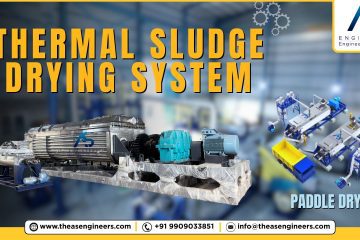
AS Engineers’ paddle dryer process uses indirect heat transfer from hollow shafts and jacket, with feeding, heating, drying, pollution control, solvent or vapor handling, and product handling systems considered as part of the drying line. The AS Engineers catalog also documents standard, dual-zone, and vacuum paddle dryer configurations, along with fuel and heating medium options.
For a plant planning to install a dryer after thickening, the thickener should be selected with the dryer feed requirement in mind, not only the thickener outlet percentage.
Gravity Thickener: Good Fit and Poor Fit
| Gravity Thickener Is a Good Fit When | Gravity Thickener Is a Poor Fit When |
|---|---|
| Sludge settles quickly in testing | Sludge remains light, floating, or slow-settling |
| Site has enough area | Plant has tight layout |
| Low power operation is important | Output consistency must be tightly controlled |
| Operators need a simple system | Plant can manage mechanical systems and polymer dosing |
| Odor risk is manageable | Long sludge retention may create odor or septic conditions |
| Primary sludge is dominant | Waste activated sludge is dominant |
Mechanical Thickener: Good Fit and Poor Fit
| Mechanical Thickener Is a Good Fit When | Mechanical Thickener Is a Poor Fit When |
|---|---|
| Waste activated sludge is difficult to settle | Plant cannot maintain polymer dosing |
| Space is limited | Wash water is unreliable |
| Stable downstream feed is important | Operators are not trained for mechanical inspection |
| Enclosed operation is preferred | Power availability is weak |
| Higher control is needed | Maintenance support is limited |
| Future expansion is expected | Sludge characteristics are simple and land is already available |
Common Mistakes in Thickener Selection
Selecting by capital cost only
The lowest-cost thickener may become expensive if it creates odor, inconsistent sludge, poor supernatant, higher downstream load, or frequent operator intervention.
Ignoring sludge type
Primary sludge, waste activated sludge, chemical sludge, biological sludge, oily sludge, and mixed sludge behave differently. A thickener that works for one sludge may fail on another.
Assuming polymer will fix everything
Polymer can improve thickening, but wrong polymer selection or overdosing can create downstream problems. It may affect filtrate quality, pumpability, dryer behavior, and disposal characteristics.
Treating thickening as final volume reduction
Thickening reduces water load, but it does not create dry sludge. For major volume reduction, dewatering and drying must be considered.
Not testing actual sludge
Selection should be based on actual sludge testing, not only brochure data. Settling tests, polymer trials, sample analysis, and pilot testing reduce project risk.
RFQ Checklist for Gravity or Mechanical Sludge Thickener Selection
Before asking for a thickener recommendation, prepare these inputs:
| RFQ Input | Why It Matters |
|---|---|
| Sludge source | ETP, STP, CETP, primary, secondary, biological, chemical, or mixed sludge behaves differently |
| Daily sludge volume | Helps estimate hydraulic loading |
| Total solids percentage | Defines feed concentration |
| Target outlet solids | Helps select thickening method |
| Sludge settling behavior | Critical for gravity thickener feasibility |
| pH and temperature | Affects conditioning, corrosion, odor, and biological behavior |
| Oil and grease | Can reduce settling and screen drainage |
| Grit or fiber content | Affects wear, blockage, and maintenance |
| Polymer trial data | Important for belt, drum, DAF, and centrifuge systems |
| Available area | Major factor in gravity vs mechanical choice |
| Power and water availability | Important for mechanical systems |
| Odor control requirement | Impacts enclosure and ventilation design |
| Downstream process | Digester, press, centrifuge, dryer, transport, or disposal route changes selection |
| Operating hours | Batch vs continuous operation affects equipment sizing |
| Maintenance team skill | Mechanical systems need more routine care |
If drying is planned after thickening or dewatering, also share feed moisture, final moisture target, sludge stickiness, daily throughput, heating medium preference, and discharge handling requirement. For this stage, the AS Engineers team can review the sludge paddle dryer selection guide with your actual sludge data.
Where AS Engineers Fits in the Sludge Treatment Chain
AS Engineers should be involved when the plant is evaluating sludge drying after thickening and dewatering. Thickening prepares sludge. Dewatering makes it more manageable. Drying reduces moisture further for handling, storage, transport, disposal, or possible reuse assessment.
AS Engineers’ sludge drying systems are relevant for:
- ETP sludge drying
- STP sludge drying
- industrial sludge drying
- municipal sludge drying
- biological sludge drying
- sludge volume reduction projects
- plants evaluating paddle dryer systems after dewatering
For a broader sludge treatment route, read the sludge treatment plant guide and the sludge dewatering techniques guide.
FAQs
Which is better, gravity or mechanical sludge thickener?
Neither is universally better. A gravity sludge thickener is better for settleable sludge, simple operation, low energy use, and sites with enough area. A mechanical sludge thickener is better for biological sludge, limited space, higher control, odor containment, and consistent downstream feed.
Does a mechanical thickener always give drier sludge?
Not always. Mechanical thickening often gives better control, but output depends on sludge type, polymer selection, loading rate, screen or belt condition, operator settings, and maintenance. Actual sludge testing is required before fixing a guaranteed outlet solids value.
Is gravity thickening suitable for waste activated sludge?
Gravity thickening is often weaker for waste activated sludge because biological flocs can settle slowly and hold water. Some plants may still use gravity thickening for mixed sludge, but WAS-heavy sludge usually needs mechanical thickening, flotation, or other conditioning review.
Does sludge thickening replace sludge dewatering?
No. Thickening increases solids concentration but the sludge usually remains pumpable. Dewatering removes more water and produces cake or semi-solid sludge. Drying goes further by reducing moisture thermally or by solar methods.
What thickener should be used before a sludge dryer?
The best thickener before a sludge dryer is the one that gives stable, predictable feed to the dewatering and drying line. Mechanical thickening may help where feed consistency and space are important, while gravity thickening can work where sludge settles well and the plant has enough area.
Conclusion
The right answer in a gravity vs mechanical sludge thickener comparison depends on sludge behavior and downstream goals.
Choose a gravity thickener when sludge settles easily, land is available, energy use must stay low, and simple operation is more important than tight process control. Choose a mechanical thickener when sludge is biological or difficult to settle, space is limited, odor containment matters, or the plant needs more consistent feed for dewatering and drying.
For plants planning sludge drying after thickening and dewatering, do not finalize the thickener alone. Review the full line: sludge generation, thickening, dewatering, drying, vapor handling, pollution control, discharge handling, and disposal or reuse route.
If your plant is evaluating sludge drying after thickening, share feed moisture, sludge type, daily quantity, dewatering output, final moisture target, heating medium, and discharge plan. AS Engineers can review the sludge drying requirement based on actual operating conditions.