Bio sludge is biological wastewater sludge generated during sewage, ETP, STP or industrial biological treatment. In wet form, it is heavy, difficult to handle, odorous and expensive to store or transport. With the right treatment chain, bio sludge can be dewatered, stabilized and dried into a safer, lower-volume material that may support disposal reduction, composting, fuel use, cement co-processing, brick making or other reuse routes after testing and approval.
The important point is simple: bio sludge does not become “valuable” only because it is dried. It becomes useful only when its moisture, organic content, calorific value, contaminants, pathogen risk and final reuse route are properly checked.
What Is Bio Sludge?
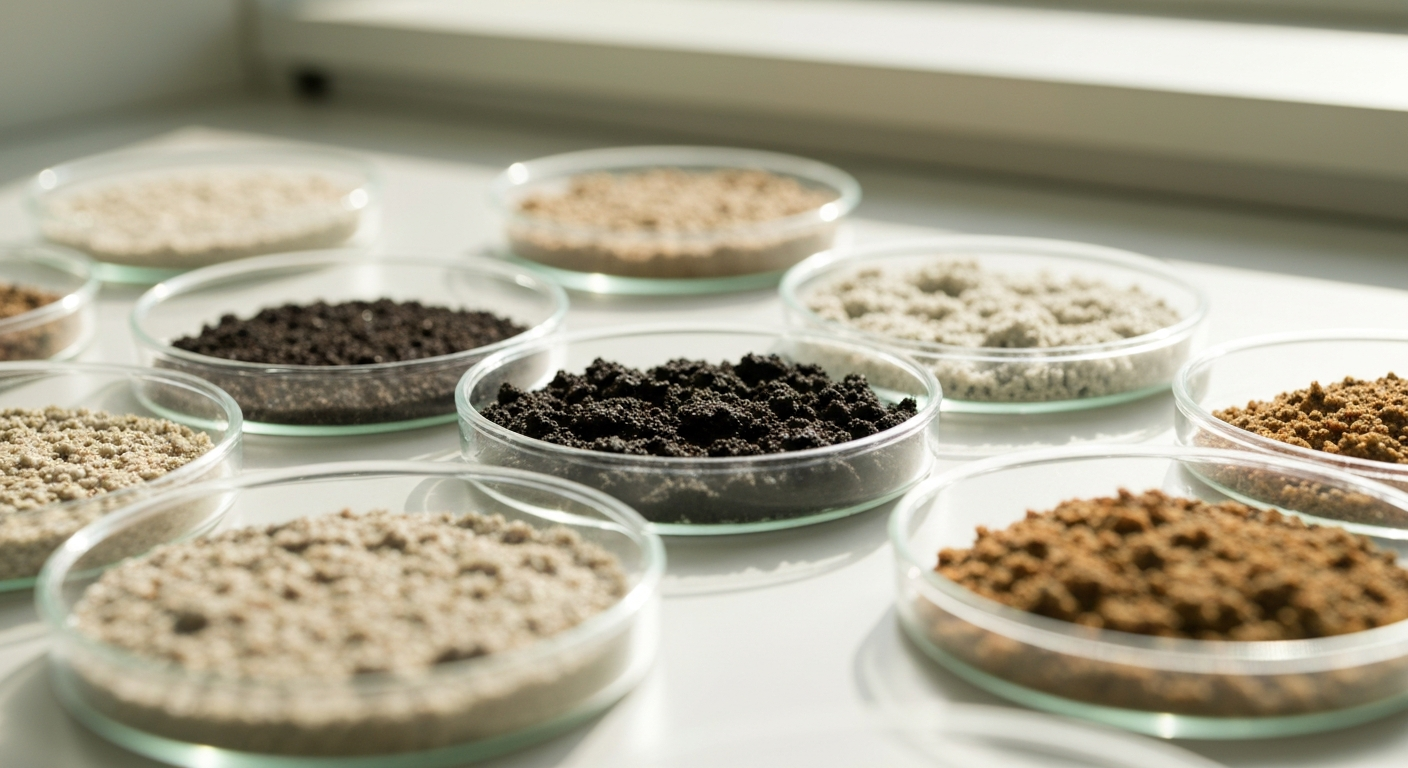
Bio sludge, also called biological sludge, is the semi-solid material produced when microorganisms break down organic pollutants in wastewater treatment. It is common in STP, ETP, CETP, activated sludge systems, biological reactors and other wastewater treatment plants.
A typical bio sludge stream may contain:
- Microbial biomass
- Organic matter
- Water
- Nutrients such as nitrogen and phosphorus
- Inert solids
- Salts or dissolved solids
- Possible contaminants, depending on wastewater source
For municipal sewage, the sludge may be mainly biological and organic. For industrial wastewater, the same term can cover very different material behavior because chemicals, dyes, heavy metals, oils, salts, pharma residues or process-specific contaminants may be present.
For a wider base understanding, read the internal guide on biological sludge.
Bio Sludge vs Biosolids
Bio sludge and biosolids should not be used as the same term without context.
| Term | Meaning | Reuse status |
|---|---|---|
| Bio sludge | Raw or partially treated biological sludge from wastewater treatment | Not automatically reusable |
| Dewatered bio sludge | Sludge after mechanical water removal by filter press, centrifuge, screw press or belt press | Easier to handle, but still high moisture |
| Dried bio sludge | Sludge after thermal or solar drying | Lower moisture and volume |
| Biosolids | Treated sludge that meets required quality and safety criteria for a defined beneficial use | Reuse depends on applicable standards and testing |
The U.S. EPA explains that “biosolids” generally refers to sewage sludge treated to meet requirements for land application, while sewage sludge use/disposal options include land application, landfilling and incineration. For India and industrial plants, the safe approach is to use “biosolids” only when the material has been tested and approved for the intended route.
Why Wet Bio Sludge Becomes a Problem
Wet bio sludge creates cost and compliance pressure because most of the material is water. Even after dewatering, sludge from filter presses, screw presses or belt presses may still contain high moisture. This affects the full sludge management chain.
Common plant-side problems include:
- Higher transportation weight
- More storage space requirement
- Odour and hygiene concerns
- Poor handling during monsoon or humid weather
- Sticky filter cake movement problems
- Higher landfill or TSDF load
- Difficulty in feeding downstream systems
- Inconsistent disposal cost planning
A dewatering system is usually the first step. A dryer becomes important when the plant needs further moisture reduction after dewatering. For this upstream stage, refer to sludge dewatering techniques.
Where Bio Sludge Comes From
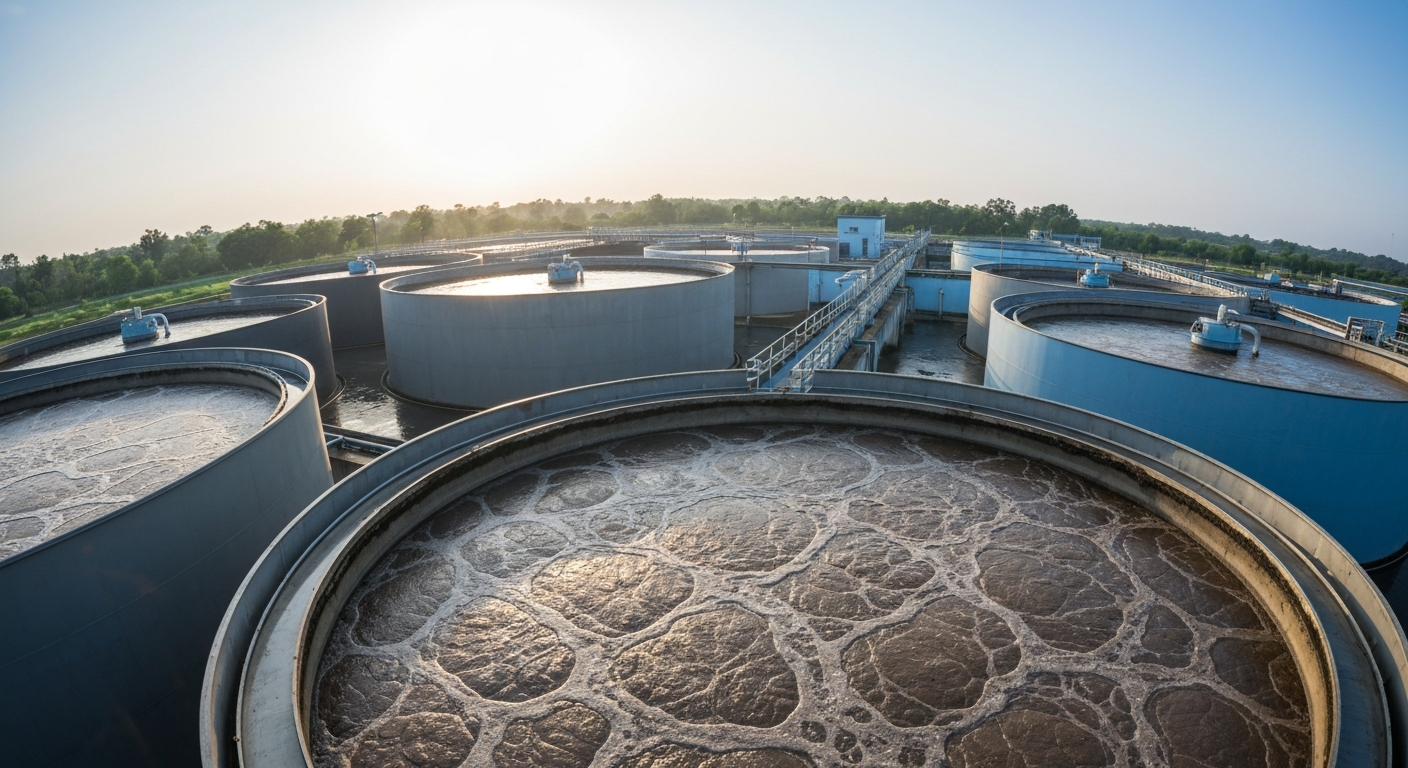
Bio sludge can come from different wastewater sources, and each source changes the treatment decision.
| Source | Common sludge behavior | Selection concern |
|---|---|---|
| Municipal STP | Organic, variable moisture, possible pathogen risk | Stabilization and safe disposal/reuse |
| Industrial ETP | May contain salts, chemicals, metals or process residues | Composition testing before reuse |
| CETP | Mixed industrial waste stream | Variability and hazardous classification risk |
| Food and beverage wastewater | Organic and often high moisture | Odour, biological stability and drying load |
| Pharma or chemical wastewater | May contain regulated contaminants | EHS and disposal route verification |
| Textile or dye wastewater | Possible color, salts and chemical residues | Reuse restrictions and MOC selection |
If the sludge source is mixed or changing, do not size or select a dryer only from TPD capacity. Material behavior during drying must be checked.
Conventional Bio Sludge Treatment Methods
Bio sludge treatment usually combines multiple stages. No single method solves every plant condition.
| Treatment method | What it does | Limitation |
|---|---|---|
| Thickening | Increases solids concentration before dewatering | Does not make sludge dry |
| Dewatering | Removes free water mechanically | Final cake often still wet |
| Stabilization | Reduces biological activity and odour potential | Does not necessarily reduce volume enough |
| Composting | Can convert suitable organic sludge into soil conditioner | Needs carbon source, land area, time and quality control |
| Anaerobic digestion | Can generate biogas from suitable organic sludge | Requires biological control and suitable feed |
| Solar drying | Uses sun/greenhouse effect for moisture reduction | Needs area and climate-dependent time |
| Thermal drying | Removes moisture using controlled heat | Needs correct dryer selection and vapour handling |
For a method-level overview, use the internal guide on sludge drying methods and best practices.
Why Drying Changes the Economics of Bio Sludge
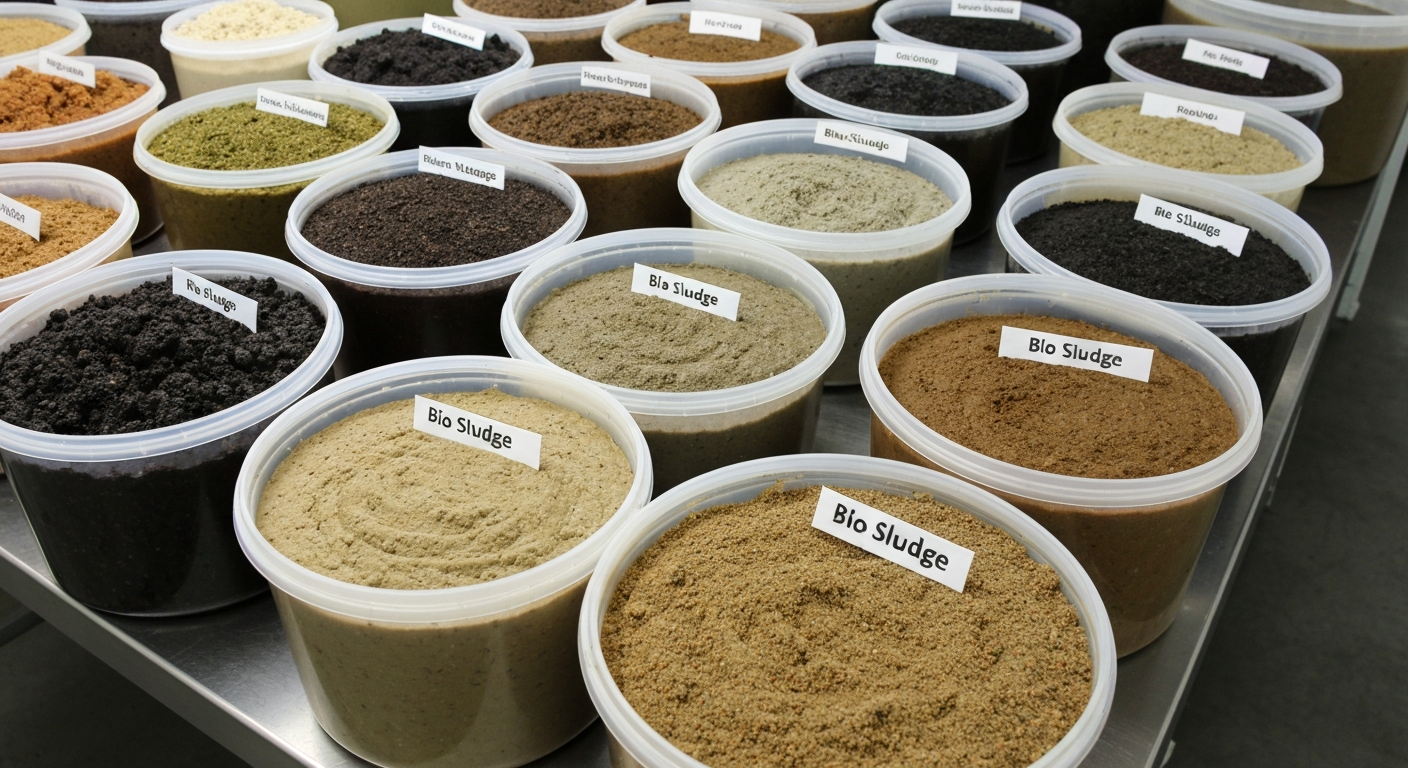
Drying helps because the biggest hidden cost in wet sludge is moisture. When water is removed, the plant can reduce handling volume, transport weight and storage pressure.
Drying can support:
- Lower disposal load
- Better bagging or conveying
- Easier storage
- Cleaner handling
- Improved fuel or co-processing potential, if calorific value supports it
- Lower odour risk compared with wet sludge
- Better downstream use planning
But drying alone does not remove all risk. Contaminants, heavy metals, pathogens, salts, ash content and final moisture still need testing.
For disposal planning, connect this article with the industrial sludge disposal guide.
Paddle Dryer for Bio Sludge Treatment
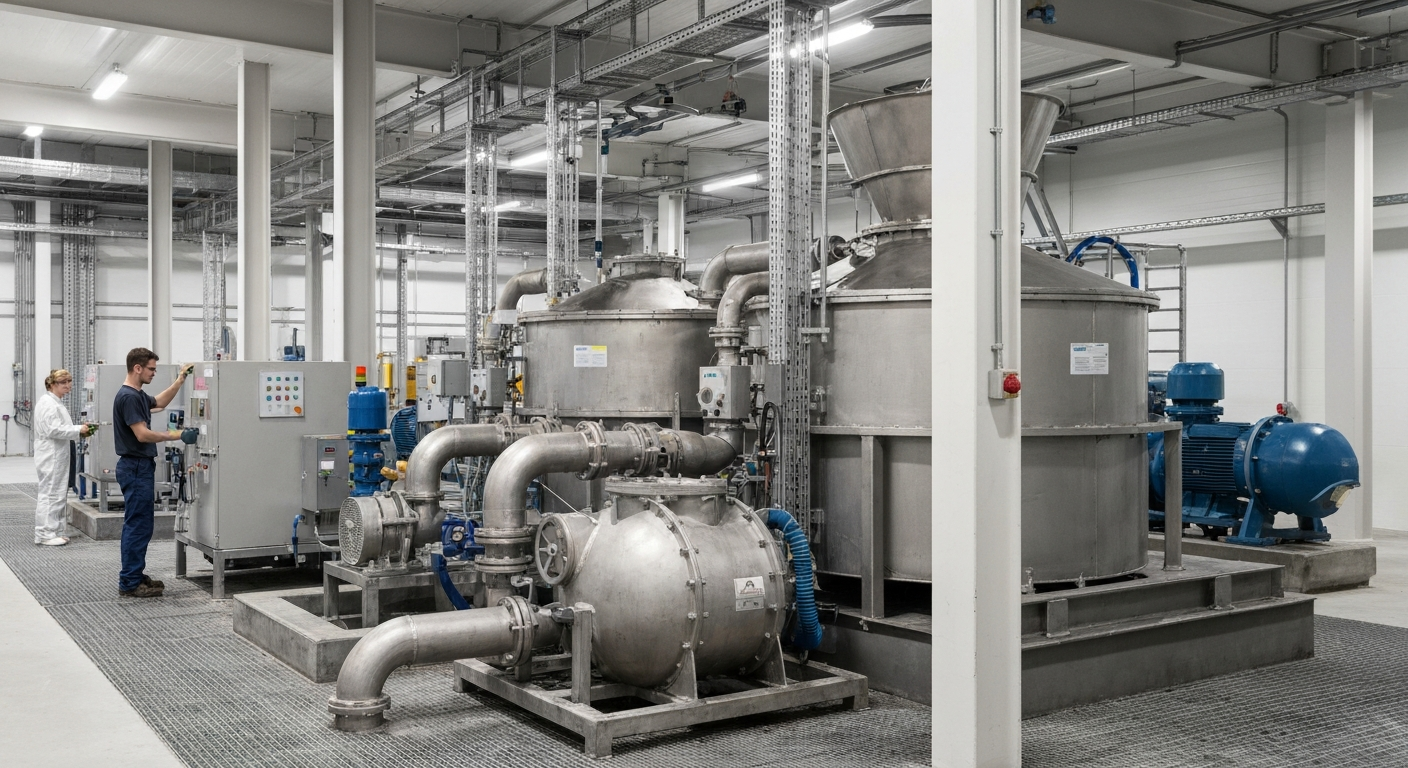
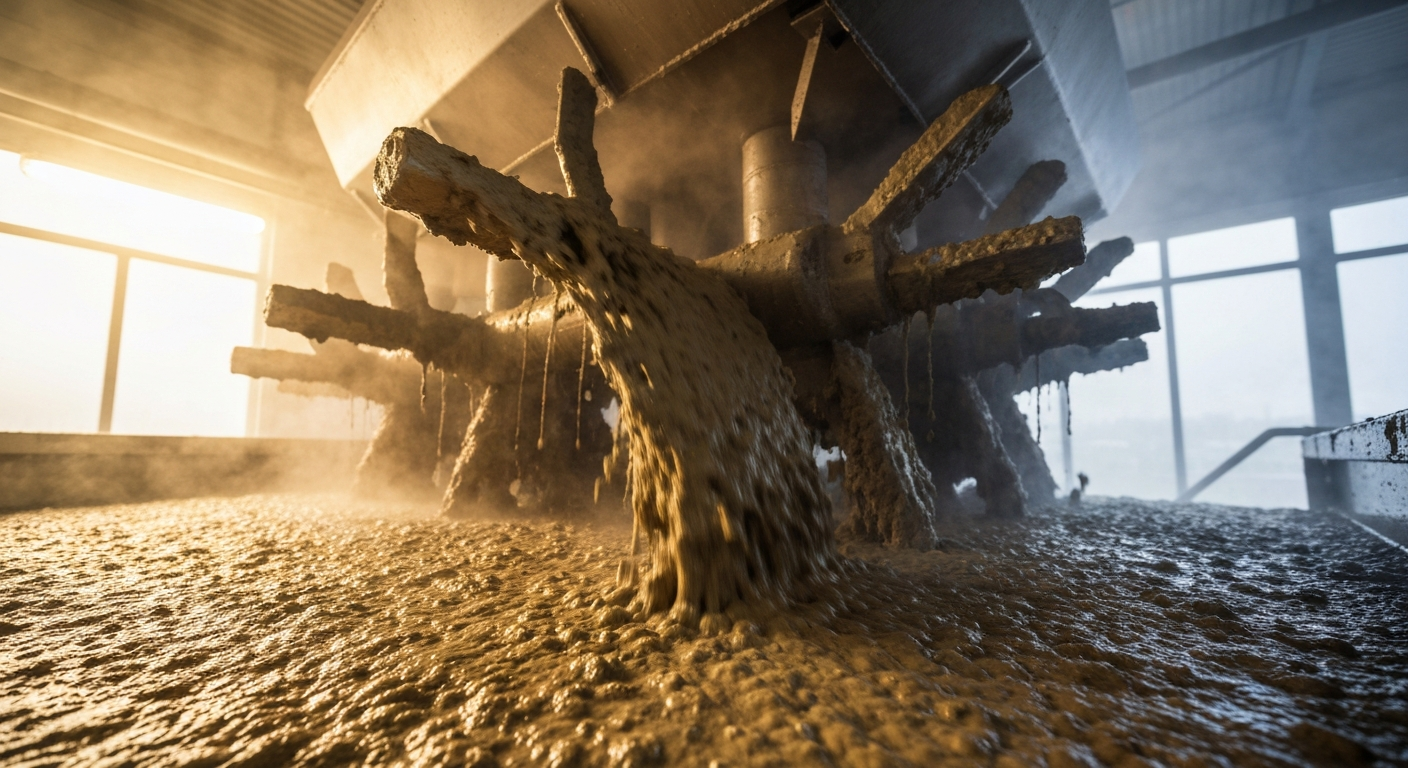
A paddle dryer is a strong fit when a plant needs controlled thermal drying of wet, sticky or paste-like sludge after dewatering. It uses indirect heat transfer, where the heating medium does not directly contact the sludge.
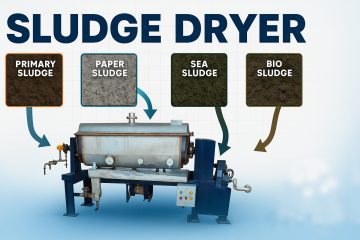
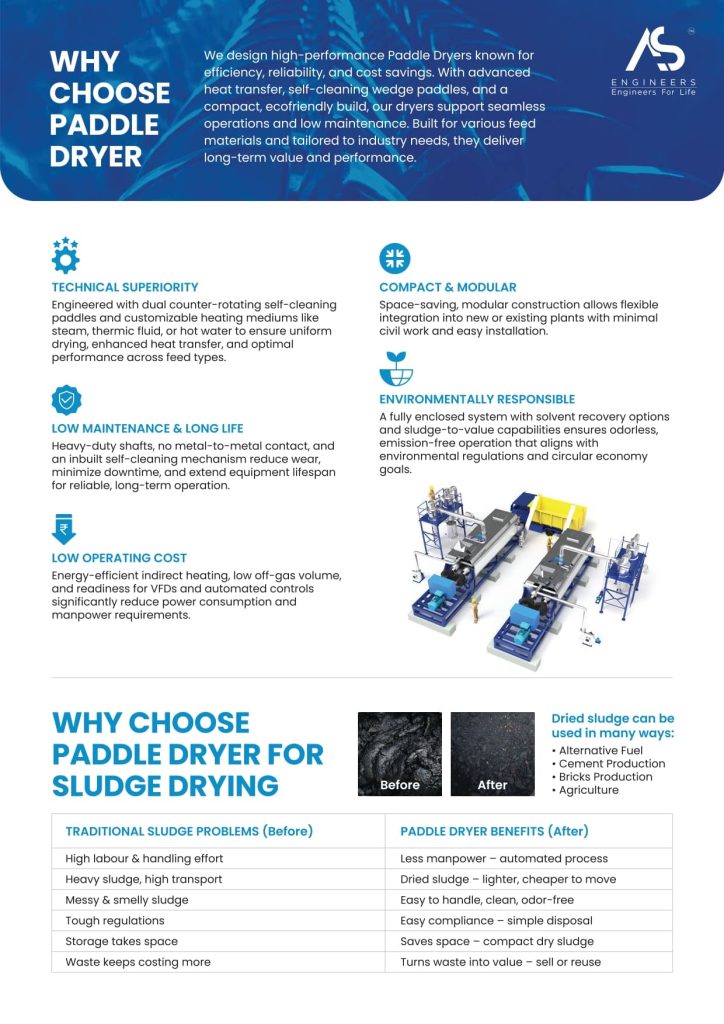
In an AS Engineers-style paddle dryer system, heat is transferred through hollow shafts and jacketed surfaces. Wedge-shaped paddles agitate the sludge, expose more surface area and help the material pass through sticky phases as moisture reduces. The design can be configured with feeding, heating, vapour handling, pollution control and dried product handling systems.
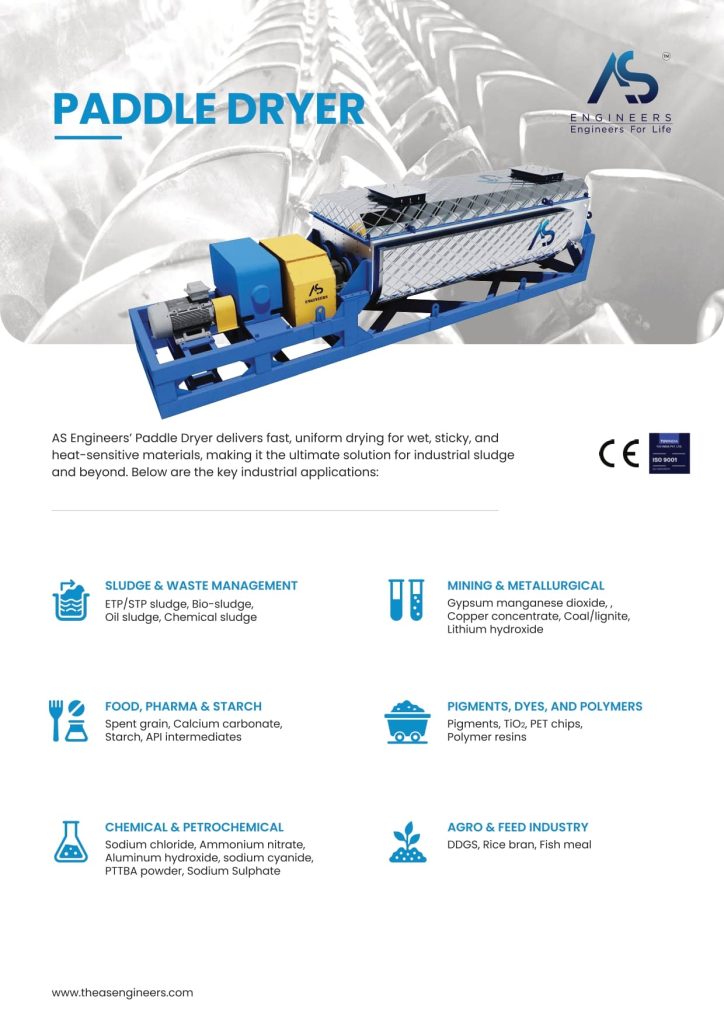
AS Engineers’ catalogue describes paddle dryer features such as indirect heating with steam or thermal oil, self-cleaning wedge-shaped paddles, dual counter-rotating shafts, plug-flow movement, low off-gas volume, MOC options and configurations for different feed materials.
For a deeper technical page, internally link to conductive paddle dryers for sludge treatment.
How the Bio Sludge Drying Process Works
A typical bio sludge drying chain looks like this:
- Sludge collection: Sludge is collected from clarifiers, biological treatment units, digesters or dewatering systems.
- Dewatering: Filter press, screw press, belt press or centrifuge reduces free water.
- Feed handling: Dewatered sludge cake is moved through screw feeder, pump or conveyor depending on flowability.
- Indirect drying: Heat from the hollow shaft and jacket evaporates moisture.
- Agitation and mixing: Paddles break lumps, renew contact surfaces and support uniform drying.
- Vapour handling: Moisture vapour is removed and sent through suitable vapour, condenser, scrubber, cyclone or bag filter arrangement where required.
- Dried product discharge: Dried sludge is discharged for cooling, bagging, silo storage, disposal or approved reuse.
The dryer should not be selected only by “tons per day.” Share feed moisture, target final moisture, sludge source, stickiness, salts, pH, contaminants, operating hours and final disposal route before sizing.
Use the internal sludge paddle dryer selection guide for the buyer-side checklist.
Possible Waste-to-Value Routes for Dried Bio Sludge
Dried bio sludge may support value recovery, but every route depends on testing and permission.
| Possible route | When it may work | What must be checked |
|---|---|---|
| Compost or soil conditioner | Organic municipal or suitable biological sludge | Pathogens, metals, stability, local rules |
| Alternative fuel | Sludge has useful calorific value after drying | Moisture, ash, chlorine, sulphur, emissions |
| Cement co-processing | Composition fits cement plant acceptance | Ash chemistry, contaminants, calorific value |
| Brick or construction use | Material behavior and ash/mineral content support it | Leachability, strength, local approval |
| Controlled disposal | Reuse is not permitted or not economical | Final moisture, classification, handling route |
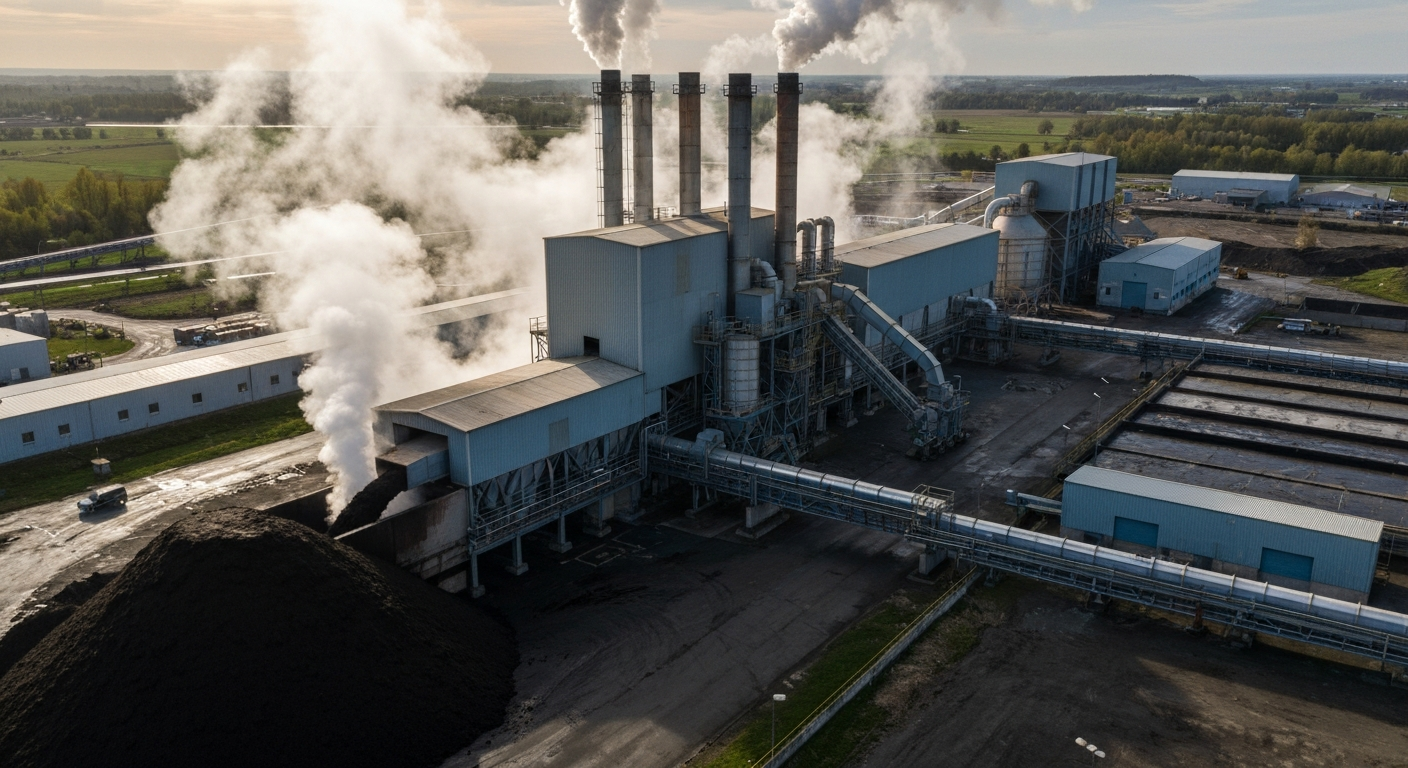
EPA regulations for sewage sludge land application in the U.S. include pollutant limits, pathogen and vector attraction reduction, management practices, monitoring, recordkeeping and reporting. India-specific reuse and disposal should be checked against applicable national, state pollution control and project-level requirements. The 2026 National Guidelines on Sewage Sludge Management from Jal Shakti describe a structured framework for safe handling, treatment, utilization and disposal of sewage sludge.
When Bio Sludge Should Not Be Treated as Reusable
Do not position dried bio sludge as fertilizer, fuel or construction input if any of these conditions are unresolved:
- Heavy metals are above accepted limits
- Pathogen reduction is not verified
- Sludge comes from mixed industrial sources without characterization
- High salt or toxic organics are present
- Odour remains uncontrolled
- Final moisture is unstable
- Local authority has not approved the reuse route
- The receiving industry has no acceptance specification
- Hazardous waste classification is possible
In these cases, the goal may be safer volume reduction and controlled disposal rather than value recovery.
For hazardous or high-risk waste streams, connect readers to CPCB hazardous waste disposal guidance.
Paddle Dryer vs Other Bio Sludge Drying Options
| Option | Best fit | Limitations |
|---|---|---|
| Sludge drying bed | Low-cost, low-speed drying where land is available | Weather and area dependent |
| Solar dryer | Municipal sludge, large area, suitable climate | Slower and climate sensitive |
| Belt dryer | Continuous drying with air-based system | Larger off-gas handling may be needed |
| Thin film dryer | Specific viscous or heat-transfer duties | Application-specific selection |
| Paddle dryer | Sticky cake, paste, sludge, indirect heat, compact layout | Needs correct feed and vapour handling design |
For comparison intent, add a contextual link to paddle dryer vs solar bed and thermal sludge drying system guide.
What Plant Teams Should Test Before Bio Sludge Drying
Before finalizing a dryer or reuse route, test the sludge properly.
Recommended inputs:
- Sludge source: STP, ETP, CETP or specific process
- Feed moisture percentage
- Daily sludge quantity
- Dewatering method used
- Sludge texture: slurry, paste, cake, sticky mass or granules
- Volatile solids and ash content
- Calorific value, if fuel use is planned
- pH and corrosive tendency
- Chloride, sulphate and salt load
- Heavy metals and regulated contaminants
- Pathogen indicators, if land application or composting is planned
- Required final moisture
- Available heating medium: steam, thermic fluid, hot water or other source
- Vapour handling requirement
- Final destination: disposal, co-processing, composting, fuel, bricks or storage
If the sludge is variable, a pilot trial is safer than assuming performance from one sample.
AS Engineers’ catalogue mentions a 50 kg/hr paddle dryer pilot trial machine for demonstrations and feasibility assessment.
Fit and No-Fit Guidance
| Condition | Paddle dryer fit? | Reason |
|---|---|---|
| Dewatered bio sludge cake needs lower moisture | Strong fit | Indirect drying can reduce moisture further |
| Sticky sludge creates handling problems | Strong fit | Paddles support mixing and movement |
| Plant has limited drying area | Strong fit | Compact system compared with beds |
| Final product needs controlled dryness | Strong fit | Thermal drying allows better moisture control |
| Sludge source changes every day | Conditional | Pilot testing and design margin needed |
| Sludge contains hazardous contaminants | Conditional | Drying helps volume, but does not remove hazard |
| Plant only needs basic thickening | Not first choice | Thickener/dewatering may be enough |
| Reuse route is not approved | Dryer may still help disposal | Value claim should not be made |
RFQ Checklist for Bio Sludge Dryer Selection
When I review a bio sludge drying requirement, I do not start only with TPD capacity. I first ask for the sludge source, feed moisture, target moisture, sludge behavior, heating medium and final disposal route. These inputs decide the dryer design.
Send these details before requesting a final quotation:
- Plant type: STP, ETP, CETP, food, pharma, textile, chemical or municipal
- Sludge generation per day
- Existing dewatering equipment
- Moisture before dryer
- Target moisture after dryer
- Operating hours per day
- Sludge bulk density
- Stickiness and lump behavior
- Available utilities
- Heating medium preference
- Space available
- Odour and vapour control requirement
- Pollution control requirement
- Final use or disposal plan
- Site location and installation constraints
For equipment-level buying, link users to paddle dryer manufacturer in India.
AS Engineers Support for Bio Sludge Drying
AS Engineers works in paddle dryer and sludge dryer systems for industrial and municipal sludge drying applications. The company’s source documents list paddle dryer, sludge dryer, centrifugal blower, pollution control equipment and turnkey solutions as part of the product ecosystem, with ISO 9001:2015 certification shown in the catalogue.
A complete bio sludge dryer system may include:
- Feeding system
- Paddle dryer
- Heating system
- Scavenging or vapour handling system
- Cyclone, scrubber or bag filter where needed
- Condenser or chimney arrangement depending on vapour route
- Screw conveyor, bagging system, silo or truck loading arrangement
- Service and OEM spare support
For a connected overview, use sludge dryer machine applications and sludge management guide.
FAQs
What is bio sludge?
Bio sludge is biological sludge produced during wastewater treatment. It is mainly made of microbial biomass, organic matter, water and solids separated from sewage or industrial wastewater. Its composition depends heavily on the wastewater source.
Can bio sludge be reused after drying?
Yes, but not automatically. Dried bio sludge may be considered for composting, fuel, cement, brick making or soil-related use only after testing for moisture, calorific value, contaminants, pathogens, heavy metals and local regulatory acceptance.
Why is drying important after dewatering?
Dewatering removes free water, but the sludge cake can still be wet, heavy and difficult to handle. Drying reduces moisture further, which can lower volume, improve storage, reduce transport burden and support downstream handling.
Is a paddle dryer suitable for sticky bio sludge?
A paddle dryer is often suitable for sticky sludge because it uses indirect heat transfer and mechanical agitation through paddles. Final suitability depends on feed moisture, stickiness, salts, organic content, throughput and vapour handling requirement.
What data is needed to select a bio sludge dryer?
The main inputs are sludge source, daily quantity, feed moisture, target final moisture, sludge behavior, existing dewatering method, heating medium, operating hours, MOC requirement, vapour handling need and final disposal or reuse route.
Conclusion
Bio sludge can become easier and more economical to manage when the plant treats it as an engineering problem, not only as a waste problem. Dewatering, stabilization, drying, testing and final-route planning must work together.
A paddle dryer can help reduce moisture, improve handling and support waste-to-value possibilities, but fertilizer, fuel, cement or brick use should never be promised without sludge analysis and regulatory review.
For bio sludge drying selection, share your sludge source, feed moisture, target moisture, daily quantity, heating medium and disposal or reuse plan with AS Engineers. The right system depends on the real sludge behavior at your plant.