A belt sludge dryer and a thin film sludge dryer can both reduce sludge moisture, but they solve different plant problems. A belt dryer is usually stronger when you have large sludge flow, enough floor space, and need gentle drying through hot air movement. A thin film dryer is usually stronger when space is limited, heat transfer must be faster, and the sludge can be spread as a controlled thin layer on a heated surface.
For industrial ETP sludge, do not choose only by machine name. Check sludge stickiness, inlet moisture, final moisture target, available utilities, exhaust treatment, maintenance skill, and disposal or reuse route before final selection.
Quick Answer: Which Dryer Should You Choose?
| Plant condition | Better starting point |
|---|---|
| Large municipal/STP sludge flow with enough building area | Belt sludge dryer |
| Compact layout and stable feed behavior | Thin film sludge dryer |
| Sticky, pasty, filter cake, or difficult industrial sludge | Also evaluate paddle dryer |
| Lower-temperature drying requirement | Belt dryer may fit better |
| Enclosed vapor handling and compact design priority | Thin film or paddle dryer may fit better |
| Plant has limited skilled maintenance support | Avoid high-complexity systems without service planning |
| Sludge quality changes frequently | Pilot testing becomes more important than brochure comparison |
The practical answer is not “belt dryer is best” or “thin film dryer is best.” The better dryer is the one that matches the actual sludge behavior and plant operating condition.
What Is a Belt Sludge Dryer?
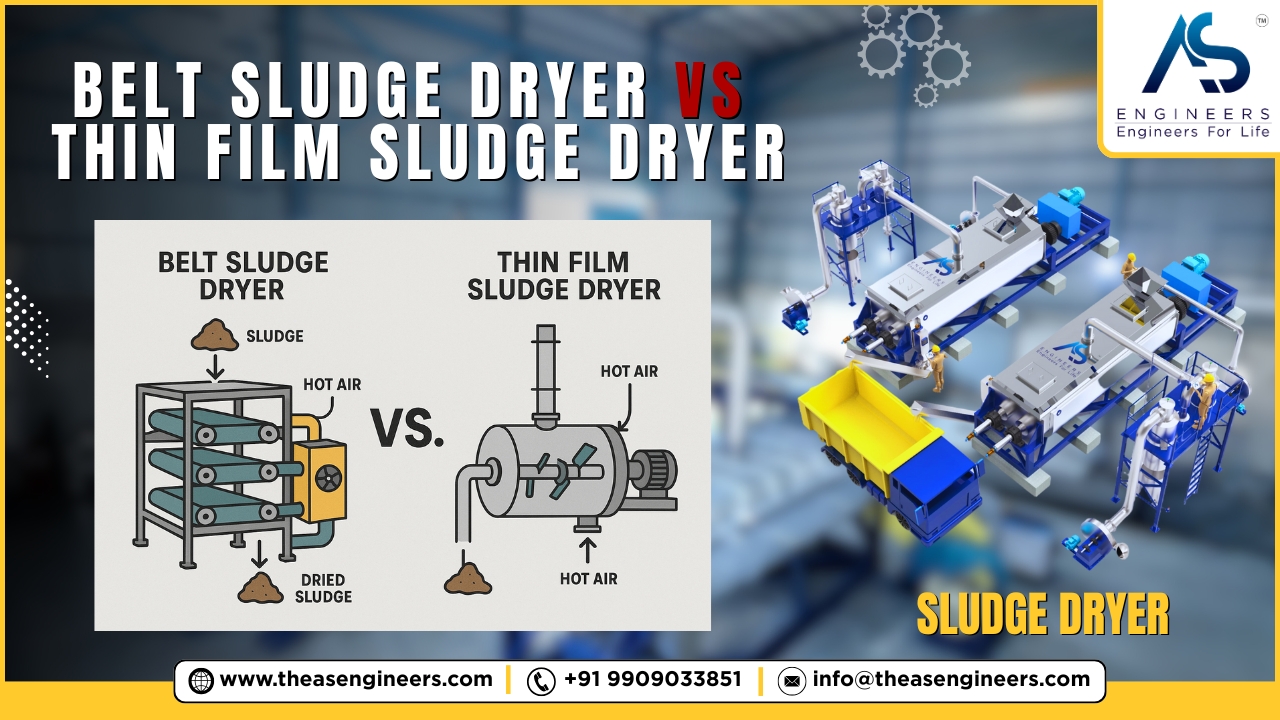
A belt sludge dryer uses a moving belt or conveyor system to carry dewatered sludge through one or more drying zones. Hot air passes through or across the sludge layer, evaporating moisture as the sludge moves forward.
This is mainly a convective drying approach. The drying air does much of the heat-transfer work, so the system normally requires air circulation, heating, exhaust handling, and odor-control planning. Belt dryers are common where the plant has enough space and where sludge can be distributed evenly over the belt.
A belt sludge dryer may be suitable for municipal sludge, sewage sludge, paper sludge, and other sludge streams that can be spread in a stable layer after dewatering.
What Is a Thin Film Sludge Dryer?
A thin film sludge dryer spreads sludge into a thin layer on a heated surface. A rotor, scraper, or blade system keeps the material moving across the heated wall so moisture can evaporate quickly.
This is mainly a conductive or indirect drying approach. Heat is transferred from a heated surface into the sludge layer instead of relying mainly on large volumes of hot drying air. Thin film dryers are often considered where the buyer wants compact design, faster heat transfer, better enclosure, and controlled residence time.
Thin film dryers can be useful for selected sludge and viscous material streams, but they are not automatically suitable for every ETP sludge. If the sludge has grit, fiber, heavy scaling tendency, sticky organic behavior, or frequent composition variation, the design needs careful validation.
Belt Sludge Dryer vs Thin Film Sludge Dryer Comparison
| Factor | Belt sludge dryer | Thin film sludge dryer |
|---|---|---|
| Main drying principle | Hot air dries sludge on a moving belt | Heated surface dries sludge as a thin layer |
| Heat transfer style | Mostly convective/direct air contact | Mostly conductive/indirect surface heating |
| Footprint | Usually larger | Usually more compact |
| Air handling | Higher air volume and exhaust treatment load | Lower air volume, but vapor handling still needed |
| Feed behavior | Needs sludge that can be spread evenly | Needs sludge that can form and move as a controlled thin film |
| Best-fit sludge | Dewatered sludge with stable spreading behavior | Pumpable, viscous, or controlled-feed sludge suitable for thin-layer drying |
| Maintenance focus | Belt, rollers, air filters, ducts, heat exchanger, spreading system | Rotor, scraper/blades, seals, heated surface, drive system |
| Operating sensitivity | Sensitive to uneven spreading and air distribution | Sensitive to fouling, scaling, scraper wear, and feed variation |
| Space suitability | Better where plant space is available | Better where footprint is constrained |
| Buyer risk | Large layout, odor/exhaust control, belt maintenance | Internal access, scraper/seal wear, feed consistency |
When a Belt Sludge Dryer Makes Sense
A belt sludge dryer can be a good fit when the plant has enough floor area and the sludge can be spread evenly after mechanical dewatering.
It may suit plants where the sludge is not extremely sticky, the feed rate is large and continuous, and the operating team prefers visible access to belts, rollers, and air-handling components.
Belt dryers can also be useful where the plant needs gentler drying. Because the material moves over a belt and is exposed to heated air, the process may be easier to tune for lower-temperature drying compared with some high-intensity drying systems.
However, the buyer must account for air volume. A belt dryer is not just a belt. It includes drying chamber, hot air circulation, heat source, exhaust ducting, odor control, dust/fines control, fire-risk controls where applicable, and material handling before and after drying.
When a Thin Film Sludge Dryer Makes Sense
A thin film sludge dryer can be a good fit when the plant needs compact thermal drying and the sludge can behave predictably inside a thin-layer drying system.
It may suit selected industrial sludge streams where indirect heating, controlled residence time, and enclosed vapor capture are important. Thin film drying can reduce the need for large hot-air flow compared with belt drying, but it requires disciplined feed control and maintenance planning.
The main caution is feed behavior. If sludge is abrasive, gritty, highly scaling, fibrous, or highly variable, the heated surface, rotor, scraper, and seals must be reviewed carefully. A thin film dryer can look compact on paper, but if cleaning and wear are frequent, operating reliability can suffer.
Why Industrial ETP Sludge Changes the Decision
ETP sludge from textile, chemical, pharma, dye, food, refinery, fertilizer, paper, metal, ceramic, and ZLD plants can behave very differently from municipal sludge.
Two plants may both say “ETP sludge,” but one sludge may be fibrous, another may be sticky, another may contain salts, another may have solvent odor, and another may contain abrasive solids. This is why dryer selection should start with sludge behavior, not only with dryer type.
Before choosing between belt and thin film drying, check:
- Feed moisture after filter press, centrifuge, screw press, or belt press
- Sludge stickiness and plastic phase behavior during heating
- Grit, sand, fiber, polymer, oil, salt, or chemical load
- Final moisture target for disposal, storage, incineration, co-processing, or reuse
- Whether vapors need scrubbing, condensation, or odor treatment
- Whether dried sludge will be bagged, conveyed, stored, or loaded into truck
- Whether the plant has steam, thermic fluid, hot water, gas, coal, briquette, LDO, electricity, or waste heat
- Whether the plant has space for ducting, cyclone, scrubber, bag filter, condenser, chimney, or product handling
For a broader view of thermal drying options, see our guide on thermal sludge drying systems and advanced sludge drying technologies.
Where Paddle Dryer Should Also Be Considered
In many industrial sludge applications, the real comparison should not stop at belt dryer vs thin film dryer. A paddle dryer should also be reviewed when the sludge is sticky, pasty, filter-cake-like, or difficult to spread evenly on a belt.
A paddle dryer uses indirect heat transfer through hollow shafts, paddles, and jacketed surfaces. The rotating paddles mix, shear, and move the sludge through the dryer while heat evaporates moisture. This design can be useful for wet cake, paste, sludge, slurry, granules, and powders when selected correctly.
A paddle dryer may be a practical option when:
- Sludge is too sticky for stable belt spreading
- Plant space is limited
- Lower off-gas volume is preferred
- Enclosed drying is important
- Dried output must be easier to convey or bag
- The buyer wants a continuous, compact, indirect drying system
- The plant needs integration with cyclone, scrubber, bag filter, condenser, screw conveyor, bagging system, silo, or truck loading
Read more about conductive paddle dryers for sludge treatment and how to choose a sludge paddle dryer before finalizing a dryer type.
Belt Dryer vs Thin Film Dryer vs Paddle Dryer
| Selection point | Belt dryer | Thin film dryer | Paddle dryer |
|---|---|---|---|
| Strongest fit | Large sludge flow with spreadable feed | Compact indirect drying for controlled feed | Sticky, pasty, wet cake, and difficult sludge |
| Heat transfer | Hot air / convection | Heated wall / conduction | Hollow shaft, paddles, jacket / conduction |
| Space need | Higher | Lower | Lower to moderate |
| Off-gas load | Higher | Lower than belt in many cases | Lower than air-heavy systems |
| Mechanical stress | Gentle | Higher scraping/shearing | Mixing and shearing |
| Maintenance focus | Belt and air system | Rotor, scrapers, seals | Shaft, paddles, seals, bearings, gearbox |
| Best buyer check | Can sludge spread evenly? | Can sludge form a stable film? | Can sludge be mixed, sheared, and discharged reliably? |
This table should be treated as a first-screening tool. Final dryer selection should be based on sludge testing and duty data.
Energy and Operating Cost: Be Careful With Generic Claims
Energy consumption is usually one of the largest operating factors in sludge drying, but it is risky to apply one universal number to every plant.
Actual energy use depends on:
- Initial moisture
- Final moisture target
- Bound moisture behavior
- Sludge temperature
- Heating medium
- Heat recovery
- Operating hours
- Dryer insulation
- Air or vapor handling
- Ambient conditions
- Feed consistency
- Operator control
Some third-party industry comparisons report lower thermal energy demand for thin film dryers compared with belt dryers in specific full-drying cases, but this should not be converted into guaranteed savings without a site calculation and trial data.
For Indian plants, also include electricity cost, fuel availability, steam or thermic-fluid system condition, manpower, spares, maintenance downtime, emission-control cost, and disposal cost after drying.
Environmental and EHS Considerations
Sludge drying is not only a mechanical decision. It is also an EHS and disposal-route decision.
A dryer can reduce moisture and improve handling, but it does not automatically make sludge safe for unrestricted reuse. Dried sludge may still need testing, authorization, and disposal through an approved route depending on sludge origin and composition.
For ETP sludge, especially chemical, dye, pharma, refinery, fertilizer, metal, and hazardous waste streams, verify:
- Hazardous or non-hazardous classification
- SPCB/GPCB/CPCB authorization requirements
- TSDF, co-processing, incineration, landfill, or reuse route
- Heavy metal, salt, solvent, oil, odor, and organic load
- Dust, vapor, and condensate handling
- Fire, explosion, and combustible dust risks where applicable
- Worker exposure during feeding, discharge, bagging, and cleaning
For related reading, see our guide on industrial sludge disposal and CPCB guidelines for hazardous waste disposal.
Common Mistakes Buyers Make
Choosing from brochure capacity only
Capacity is not enough. The same dryer capacity can perform differently with different sludge moisture, density, stickiness, and vapor behavior.
Ignoring sludge stickiness during the plastic phase
Many sludge streams pass through a sticky phase before becoming granular or powdery. If the dryer cannot handle this transition, buildup and discharge issues may start.
Comparing only capex
A lower equipment price can become expensive if fuel consumption, downtime, cleaning, operator load, or emission-control cost is high.
Forgetting vapor and odor treatment
Drying removes water, but the vapor stream may carry odor, fines, volatile compounds, or condensable material. The dryer must be reviewed with cyclone, scrubber, bag filter, condenser, ducting, ID fan, and chimney requirements.
Treating all ETP sludge as the same
Textile sludge, chemical sludge, pharma sludge, paper sludge, food sludge, and ZLD sludge should not be selected with one generic rule.
RFQ Checklist for Belt vs Thin Film Sludge Dryer Selection
Before asking for a quotation, prepare these inputs:
| RFQ input | Why it matters |
|---|---|
| Sludge source | ETP, STP, CETP, ZLD, paper, textile, chemical, pharma, food, refinery, etc. |
| Daily sludge quantity | Defines evaporation load and dryer size |
| Initial moisture | Decides water removal requirement |
| Final moisture target | Affects residence time and energy |
| Sludge form | Slurry, paste, cake, granule, powder |
| Stickiness during heating | Critical for belt spreading, thin film scraping, and paddle mixing |
| Bulk density | Affects volume, feed system, and discharge |
| Chemical composition | Impacts MOC, corrosion, odor, and disposal |
| Heating medium available | Steam, thermic fluid, hot water, gas, coal, LDO, electricity, briquette |
| Emission-control need | Cyclone, scrubber, bag filter, condenser, chimney |
| Product handling | Screw conveyor, bagging, silo, bucket elevator, truck loading |
| Space available | Determines layout practicality |
| Operating hours | Defines continuous or batch preference |
| Maintenance skill | Affects technology choice and service planning |
| Disposal or reuse route | Impacts target dryness and compliance needs |
For dewatering-stage planning before drying, also read sludge dewatering techniques and sludge dewatering machine guide.
Practical Selection Rule
Choose a belt sludge dryer when sludge can be spread evenly, space is available, high airflow treatment is acceptable, and the plant prefers accessible mechanical maintenance.
Choose a thin film sludge dryer when the plant needs a compact indirect system, sludge behavior is stable, and the team can manage rotor, scraper, seal, and surface maintenance.
Evaluate a paddle dryer when the sludge is sticky, pasty, filter-cake-like, difficult to spread, or when the plant wants compact indirect drying with integrated vapor and product handling.
The safest route is pilot testing or at least a detailed sludge-behavior review before final purchase.
Conclusion
Belt sludge dryer vs thin film sludge dryer is not a one-line comparison. A belt dryer can be practical for large sludge flow, spreadable feed, and plants with enough space. A thin film dryer can be practical for compact indirect drying with controlled feed behavior. For many industrial ETP sludge applications, a paddle dryer should also be evaluated because sludge stickiness, plastic-phase behavior, vapor handling, and discharge reliability can decide the success of the project.
Before finalizing any sludge dryer, share your feed moisture, final moisture target, daily quantity, sludge composition, heating medium, available space, and disposal route. AS Engineers can review the duty condition and guide the next selection step based on real plant requirements.
FAQs
What is the main difference between a belt sludge dryer and a thin film sludge dryer?
A belt sludge dryer dries sludge on a moving belt using hot air. A thin film sludge dryer spreads sludge as a thin layer on a heated surface and dries it through indirect heat transfer. Belt dryers need more air handling and space, while thin film dryers are usually more compact but more sensitive to feed behavior and internal maintenance.
Is a thin film sludge dryer always more energy efficient than a belt dryer?
Not always. Thin film dryers can have better heat-transfer efficiency in many controlled applications, but actual energy use depends on sludge moisture, final dryness, heat recovery, heating medium, feed consistency, insulation, vapor handling, and operating discipline. Do not accept generic savings claims without a site-specific calculation.
Which dryer is better for sticky ETP sludge?
For sticky ETP sludge, evaluate a paddle dryer along with belt and thin film options. Sticky sludge may be difficult to spread evenly on a belt and may foul heated surfaces in thin film systems. Paddle dryers can be suitable for sticky, pasty, and wet-cake materials when designed with correct MOC, heating medium, vapor handling, and discharge system.
Can dried sludge be reused after drying?
Drying reduces moisture and can make sludge easier to handle, transport, store, or process. It does not automatically make sludge safe or approved for reuse. Reuse depends on sludge composition, test results, local regulatory approval, and the selected route such as co-processing, fuel use, fertilizer, bricks, or disposal.
What data is required before selecting a sludge dryer?
At minimum, provide sludge source, daily quantity, initial moisture, final moisture target, bulk density, stickiness, chemical composition, heating medium, available space, operating hours, vapor-treatment need, and final disposal or reuse route. A pilot trial or material test is recommended for difficult sludge.