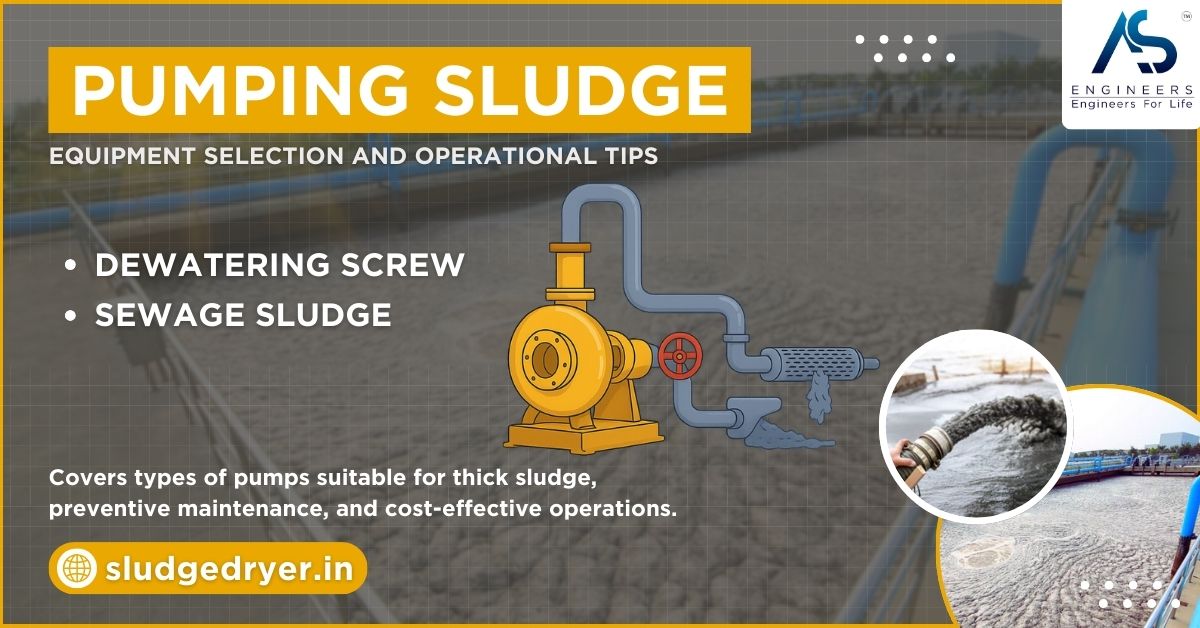
Pumping sludge is the controlled transfer of wet sludge, thickened sludge, or partially dewatered sludge from one process stage to another. The pump must be selected for solids, viscosity, grit, fibers, suction condition, pipe route, transfer distance, head, and downstream equipment. A pump that works for thin return activated sludge may fail quickly on thick ETP sludge, filter press cake, or sticky sludge going to drying.
In wastewater and industrial plants, sludge pumping is not only a pump purchase decision. It affects dewatering performance, storage reliability, tanker loading, operator safety, maintenance cost, and final sludge drying efficiency.
When I review a sludge pumping requirement, I do not start with motor HP alone. I first check sludge source, moisture level, solids behavior, particle size, grit load, transfer distance, suction condition, and the next process step. That one change prevents many wrong pump selections.
What is pumping sludge?
Pumping sludge means moving sludge through a pump, pipeline, hose, or feeding system after it is generated in an ETP, STP, CETP, clarifier, thickener, dewatering system, or sludge holding tank.
Sludge is harder to pump than clean water because it may contain:
- Suspended solids
- Fibers and rags
- Grit and sand
- Chemical precipitates
- Oil and grease
- Biological solids
- Variable moisture
- Air pockets or gas
- Corrosive or abrasive material
This is why a standard clean-water pump should not be selected blindly for sludge duty.
For a wider foundation on sludge types and behavior, refer to our guide on what sludge is and how it behaves in treatment systems.
Why sludge pumping fails in many plants
Most sludge pumping problems are not caused by the pump alone. They usually come from incomplete duty data, poor suction conditions, poor screening, wrong pipe sizing, excessive bends, high solids variation, or mismatch between the pump and downstream process.
Common site problems include:
| Problem | What usually causes it | Practical result |
|---|---|---|
| Frequent clogging | Fibers, rags, grit, oversized solids, poor screening | Pump stoppage and manual cleaning |
| Reduced flow | High viscosity, worn rotor/impeller, suction blockage, air entrainment | Sludge backs up in tank or pit |
| High power consumption | Wrong pump type, thick sludge, excessive head, mechanical drag | Motor overload or high electricity use |
| Seal failure | Abrasive grit, poor flushing, dry running, chemical attack | Leakage and repeated downtime |
| Pipeline choking | Settling solids, low velocity zones, dead legs, poor cleanout access | Unplanned shutdown |
| Inconsistent dryer feed | Sludge moisture variation, pump pulsation, poor upstream holding control | Dryer output becomes unstable |
A good sludge pumping system must be selected as a full transfer system, not just as a pump model.
Main types of sludge and their pumping behavior
Different sludge types need different handling logic.
| Sludge type | Pumping behavior | Selection caution |
|---|---|---|
| Primary sludge | Can contain grit, fibers, and settled solids | Needs screening, solids passage, and wear-resistant design |
| Waste activated sludge | Usually more pumpable but may foam or vary in concentration | Avoid shear and air entrainment where process stability matters |
| Thickened sludge | Higher viscosity and higher solids | Positive displacement pump may be more suitable than centrifugal |
| Digested sludge | More uniform, but may contain gas and corrosive compounds | Check sealing, venting, and material compatibility |
| Chemical ETP sludge | Can be abrasive, corrosive, sticky, or dense | MOC, seal type, and wear parts become important |
| Dewatered sludge cake | Often not pumpable through normal pumps | Screw conveyor, screw feeder, cake pump, or direct dryer feeding may be required |
For comparison between sludge sources, see primary sludge vs secondary sludge and STP sludge handling basics.
Where sludge pumping fits in the treatment line
Sludge pumping is used at multiple points in a plant:
- Clarifier sludge withdrawal
- Sludge transfer to holding tank
- Thickener feed and underflow transfer
- Dewatering machine feed
- Filter press, screw press, or centrifuge discharge handling
- Tanker loading
- Dryer feeding
- Sludge recirculation or return sludge pumping
- Sludge transfer to storage, disposal, or further treatment
In a complete sludge handling line, pumping should be coordinated with sludge dewatering techniques and the final sludge drying method. If the sludge is too wet, downstream drying cost increases. If it is too thick or sticky, normal pumping becomes unreliable.
Sludge pump types and where they fit
No single sludge pump is best for every application. The correct choice depends on sludge condition and duty.
| Pump type | Best-fit use | Strength | Limitation |
|---|---|---|---|
| Non-clog centrifugal pump | Thin sludge, wastewater sludge, low to moderate solids | High flow, simple operation | Performance drops with high viscosity and thick sludge |
| Submersible sludge pump | Pits, sumps, wet wells, temporary transfer | Compact and practical for submerged duty | Maintenance access can be harder |
| Progressive cavity pump | Thick sludge, controlled feed, dewatering feed | Steady flow and good handling of viscous sludge | Stator wear and dry-run risk |
| Rotary lobe pump | Sludge transfer with controlled flow | Reversible operation and accessible maintenance | Wear risk with abrasive sludge |
| Peristaltic hose pump | Abrasive or corrosive sludge, dosing-type transfer | Fluid contacts only hose | Hose replacement and pressure limitations must be considered |
| Air-operated diaphragm pump | Intermittent transfer, difficult fluids, remote areas | Can handle variable sludge and run dry better than many pumps | Pulsating flow and compressed air cost |
| Screw pump or cake pump | Very thick sludge or semi-solid cake | Better for high-solids movement | Not suitable for all layouts or long-distance transfer |
For a dedicated equipment-focused page, use our guide on sludge transfer pumps and sludge pumps in wastewater treatment.
Centrifugal pump or positive displacement pump?
The first major decision is whether the sludge behaves more like liquid or paste.
| Selection point | Centrifugal pump | Positive displacement pump |
|---|---|---|
| Thin sludge | Usually suitable | May be unnecessary |
| High-viscosity sludge | Often struggles | Usually stronger fit |
| Variable solids | Can lose performance | More stable if properly selected |
| Long transfer with pressure requirement | Needs careful curve review | Often better for controlled flow |
| Fibrous sludge | Needs non-clog design and screening | Needs rotor/clearance suitability |
| Dry-run tolerance | Usually poor | Depends on pump type |
| Energy efficiency | Good near correct operating point | Good when matched to duty |
| Maintenance focus | Impeller, casing, seal, bearing | Rotor, stator, lobes, hose, seals |
The important point is not “centrifugal vs positive displacement” in theory. The important point is actual sludge behavior at your site.
Inputs needed before selecting a sludge pump
Before selecting a pump for pumping sludge, collect these inputs:
| Input | Why it matters |
|---|---|
| Sludge source | Primary, secondary, chemical, biological, oily, digested, or mixed sludge behaves differently |
| Solids percentage or moisture | Controls viscosity and pumpability |
| Daily quantity | Helps size transfer duty and operating hours |
| Required flow rate | Prevents underfeeding or oversizing |
| Transfer distance | Affects friction loss and pump pressure requirement |
| Static lift | Determines head requirement |
| Pipe route | Bends, valves, vertical sections, and length affect resistance |
| Particle size and grit | Affects clogging and wear |
| Fiber/rag content | Affects impeller, rotor, and screening selection |
| pH and chemical nature | Affects MOC, elastomer, and seal compatibility |
| Temperature | Affects viscosity, elastomers, and safety |
| Downstream equipment | Dewatering machine, storage tank, tanker, or sludge dryer feed needs different flow behavior |
| Duty cycle | Continuous, batch, intermittent, or emergency duty affects motor and control selection |
A pump quotation without these inputs is usually incomplete.

Piping design matters as much as pump selection
Even a suitable pump can fail if the pipeline is poorly designed.
Good sludge piping design should:
- Avoid unnecessary bends and sharp direction changes
- Provide cleanout points at practical locations
- Avoid dead legs where sludge can settle
- Keep suction piping short and stable where possible
- Avoid air pockets and poor venting
- Use suitable pipe material for abrasion and corrosion
- Provide isolation valves and maintenance access
- Keep the line flushable where sludge dries or settles
- Avoid sudden reductions that create blockage points
For industrial plants, pumping sludge must also connect with the larger industrial sludge disposal plan, because the transfer system directly affects storage, loading, drying, and transport cost.
Pumping sludge to a dewatering system
Dewatering machines need controlled and stable feed. If the sludge pump sends inconsistent flow, the dewatering result becomes unstable.
Typical issues include:
- Too much flow, causing poor capture
- Too little flow, reducing dewatering efficiency
- Sudden solids variation
- Poor polymer mixing due to inconsistent feed
- Pump pulsation affecting belt press, screw press, or centrifuge operation
- Excessive shear changing sludge characteristics
For plants comparing dewatering options, read belt filter press vs screw press dewatering and how to choose sludge dewatering equipment.
Pumping sludge to a sludge dryer
Sludge dryer feed is different from normal wastewater transfer. The pump or feeder must deliver material in a form the dryer can accept consistently.
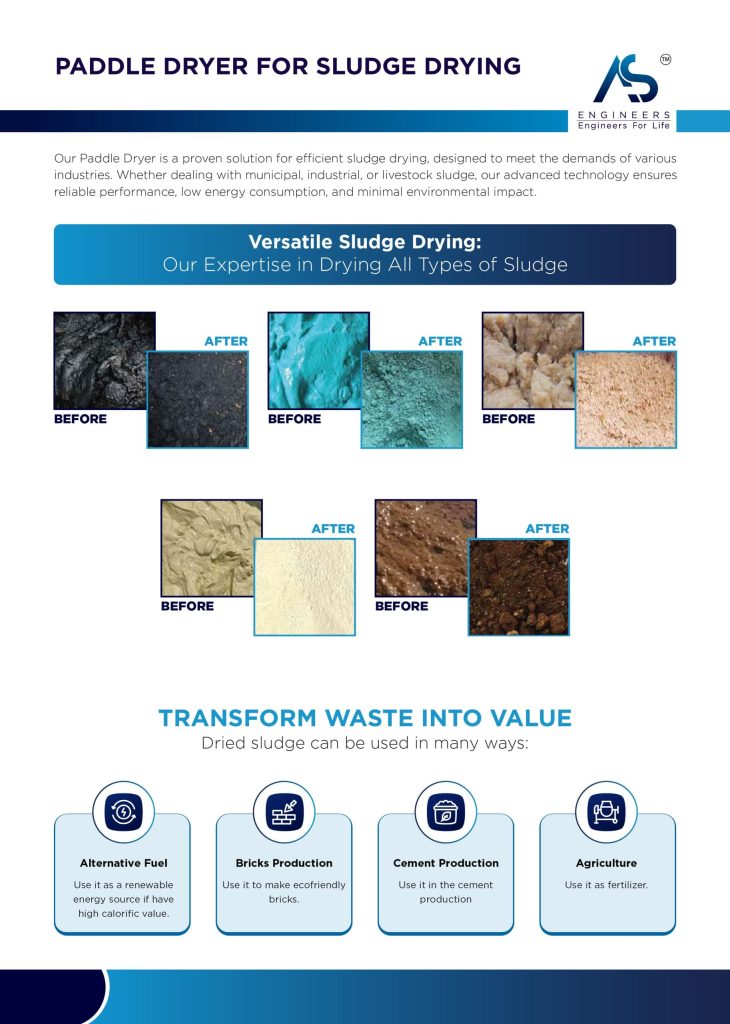
In many sludge drying lines, the feed system may include a sludge pump, screw feeder, belt conveyor, wet material silo, or another controlled feeding arrangement. AS Engineers’ paddle dryer configuration can include a feeding system, heating system, paddle dryer, scavenging system, pollution control equipment, solvent or vapour management, and product handling system.
This matters because the dryer does not only need “sludge.” It needs sludge at the right feed consistency, moisture range, handling behavior, and feed rate.
When a pump may work for dryer feeding
A sludge pump may be suitable when:
- Sludge is still wet enough to flow
- Solids are manageable for the selected pump
- Feed needs controlled transfer from tank to dryer inlet
- Sludge does not bridge or form hard lumps
- Suction and discharge conditions are stable
- Pump pulsation does not disturb downstream feed control
When a pump may not be the right choice
A normal sludge pump may not be suitable when:
- Sludge is already a stiff cake
- Material bridges in hopper
- Sludge contains large lumps, fibers, or foreign particles
- The line plugs after shutdown
- Material dries inside pipe
- Dryer needs metered screw feeding instead of pumped flow
For thermal drying selection, see our thermal sludge drying system guide and AS Engineers’ sludge dryer manufacturer page.
Practical sludge pumping selection table
| Site condition | Better selection direction |
|---|---|
| Thin sludge from clarifier | Non-clog centrifugal or submersible sludge pump |
| Thickened sludge to dewatering | Progressive cavity, rotary lobe, or suitable positive displacement pump |
| Abrasive chemical sludge | Wear-resistant MOC, suitable seal, and controlled velocity |
| Corrosive sludge | Compatible wetted parts, elastomer, and seal selection |
| Sludge with rags/fibers | Upstream screening, cutter/grinder where suitable, and non-clog design |
| Sludge to dryer feed | Match pump/feeder to moisture, consistency, and dryer inlet requirement |
| Intermittent transfer from pit | Submersible or AODD type may be considered depending on duty |
| High solids cake | Screw conveyor, screw feeder, or cake handling system may be better |
Maintenance checklist for sludge pumps
Sludge pump maintenance should be based on duty severity, not only calendar intervals.
Check these items regularly:
- Pump flow and discharge pressure trend
- Suction blockage or air entry
- Seal leakage
- Bearing temperature and noise
- Coupling alignment
- Vibration
- Motor current
- Stator, rotor, lobe, hose, or impeller wear
- Flush water or seal water condition
- Valve and cleanout condition
- Pipeline deposits
- Dry-run protection
- Level control and interlock function
- Spare wear parts availability
The U.S. Department of Energy’s pumping system guidance also highlights proper pump sizing, variable flow control, adjustable speed drives, and avoiding throttling or bypassing excess flow where applicable.
Troubleshooting common sludge pumping problems
| Symptom | Likely causes | What to check first |
|---|---|---|
| Pump runs but no flow | Suction blockage, air lock, wrong rotation, dry pit, high viscosity | Suction line, tank level, priming, rotation |
| Flow is lower than expected | Worn internals, clogged strainer, high solids, pipe blockage | Pump wear parts, suction screen, discharge line |
| Frequent clogging | Fibers, rags, lumps, poor screening | Bar screen, grinder, pump passage, cleanouts |
| High motor current | Thick sludge, high head, mechanical binding, wrong pump speed | Sludge consistency, pressure, coupling, bearings |
| Seal leakage | Abrasive grit, dry running, poor flushing, chemical attack | Seal face, flush line, MOC compatibility |
| High vibration | Cavitation, bearing issue, misalignment, foundation problem | Suction condition, bearing, coupling, base frame |
| Pipeline choking after shutdown | Sludge settling or drying inside line | Flushing arrangement, slope, drain points |
| Dryer feed variation | Inconsistent pump output, sludge moisture variation, poor hopper control | Feed tank mixing, pump speed, level control |
Energy efficiency in sludge pumping
Energy efficiency is important, but it should not be separated from reliability. A low-power pump that clogs every week is not efficient in real plant operation.
Practical energy checks include:
- Do not oversize the pump without reason
- Keep the pump near its suitable operating range
- Avoid unnecessary throttling where variable speed control is suitable
- Reduce avoidable pipe friction
- Avoid excessive bends and restrictions
- Use multiple pump arrangements where variable demand is high
- Review motor current trend after sludge characteristics change
- Recheck the system after plant expansion or sludge chemistry changes
For deeper industrial pump efficiency guidance, refer to the U.S. DOE guide on improving pumping system performance.
EHS and handling cautions
Pumping sludge can expose plant teams to splash, odor, pathogens, hazardous chemicals, slippery floors, confined spaces, and pressure release hazards. The right handling method depends on whether the sludge is municipal, industrial, hazardous, biological, oily, or chemically treated.
For municipal sewage sludge and biosolids, the EPA explains that treatment and disposal routes may include land application, landfilling, and incineration, depending on regulatory requirements and sludge quality. For India-specific sewage treatment references, the Ministry of Housing and Urban Affairs maintains the Manual on Sewerage and Sewage Treatment Systems.
Do not open sludge lines, pumps, or tanks without site safety procedure, isolation, depressurization, and PPE. For hazardous industrial sludge, follow your plant EHS procedure and applicable local regulatory requirements before any maintenance or transfer activity.
RFQ checklist for pumping sludge
Send these details before asking for a sludge pump or sludge transfer system quotation:
| RFQ input | Details to provide |
|---|---|
| Sludge type | ETP, STP, CETP, primary, secondary, chemical, biological, oily, digested, or mixed |
| Sludge quantity | m³/hr, kg/hr, or tons/day |
| Moisture or solids | Present moisture and expected variation |
| Temperature | Normal and maximum |
| pH and chemistry | Corrosive, alkaline, acidic, solvent-bearing, oily, or abrasive |
| Particle size | Grit, fibers, lumps, rags, stones, or foreign matter |
| Transfer distance | Horizontal and vertical distance |
| Static head | Suction and discharge elevation |
| Pipe route | Bends, valves, existing pipe diameter, and material |
| Duty cycle | Continuous, batch, intermittent, standby, or emergency |
| Downstream equipment | Thickener, dewatering machine, holding tank, tanker, sludge dryer, or bagging |
| Control requirement | Manual, VFD, level control, PLC, or interlocked operation |
| Site constraints | Space, access, maintenance clearance, available utilities |
| Required accessories | Strainer, grinder, cleanout, flushing, hose, valves, pressure gauge, flow meter |
| EHS requirement | Hazard class, PPE requirement, ventilation, odor control, spill control |
At AS Engineers, we review sludge handling as a process condition, not only an equipment enquiry. If your sludge is going to a dryer, share feed moisture, final moisture target, material behavior, daily throughput, heating medium, and vapour handling requirement along with pumping data.
Fit and no-fit guide
| Situation | Suitable approach |
|---|---|
| Wet sludge needs transfer from tank to dewatering | Select sludge pump based on solids, flow, and pressure |
| Thick sludge needs metered feed | Consider positive displacement pump with VFD control |
| Sludge is sticky cake after filter press | Consider screw conveyor or screw feeder instead of normal pump |
| Sludge contains abrasive grit | Use screening, grit control, wear-resistant parts, and maintenance access |
| Sludge contains fibers and rags | Improve upstream screening before blaming the pump |
| Pump line blocks after shutdown | Add flushing, cleanouts, slope review, or change transfer method |
| Sludge is going to paddle dryer | Match pump or feeder to dryer inlet behavior and moisture consistency |
FAQs
What is the best pump for pumping sludge?
There is no single best sludge pump for every plant. Thin sludge may work with a non-clog centrifugal or submersible pump, while thickened sludge often needs a progressive cavity, rotary lobe, peristaltic, or other positive displacement pump. Selection depends on solids, viscosity, grit, fiber content, transfer distance, head, and downstream equipment.
Why does a sludge pump clog frequently?
Frequent clogging usually happens because of rags, fibers, grit, oversized solids, poor screening, wrong pump passage, low velocity zones, or settled sludge in the pipeline. The first check should be sludge quality, suction condition, screening, cleanout points, and pipe route.
Can dewatered sludge be pumped?
Some partially dewatered sludge can be pumped if it still flows and the pump is selected for that duty. Very stiff filter press cake or sticky sludge may need a screw conveyor, screw feeder, cake pump, or direct feed arrangement instead of a normal sludge pump.
Is a sludge pump needed before a sludge dryer?
Sometimes yes, but not always. If sludge is wet and flowable, a sludge pump may be used to transfer it toward the dryer feed system. If sludge is thick, sticky, or cake-like, a screw feeder, conveyor, or hopper-based feeding system may be more reliable.
What details are needed for a sludge pumping quotation?
A proper quotation needs sludge type, quantity, moisture or solids content, transfer distance, head, pipe route, particle size, pH, temperature, abrasiveness, duty cycle, operating hours, and downstream equipment details. Without this data, pump selection can be unreliable.
Conclusion
Pumping sludge successfully depends on matching the pump, piping, controls, and maintenance plan to the actual sludge condition. A plant handling thin STP sludge does not need the same pump logic as a chemical ETP plant handling abrasive sludge or a drying plant feeding thick sludge into a paddle dryer.
The safest selection approach is to study the sludge first, then decide whether the duty needs a non-clog centrifugal pump, submersible sludge pump, progressive cavity pump, rotary lobe pump, peristaltic pump, diaphragm pump, screw feeder, or conveyor-based feed system.
For sludge drying projects, share your sludge source, daily quantity, moisture, solids behavior, dewatering method, transfer distance, and final drying requirement. AS Engineers can review the sludge handling and drying requirement together so the pumping system does not become the weak point before the dryer.