What Is Chemical Sludge and Why Does Treatment Matter?
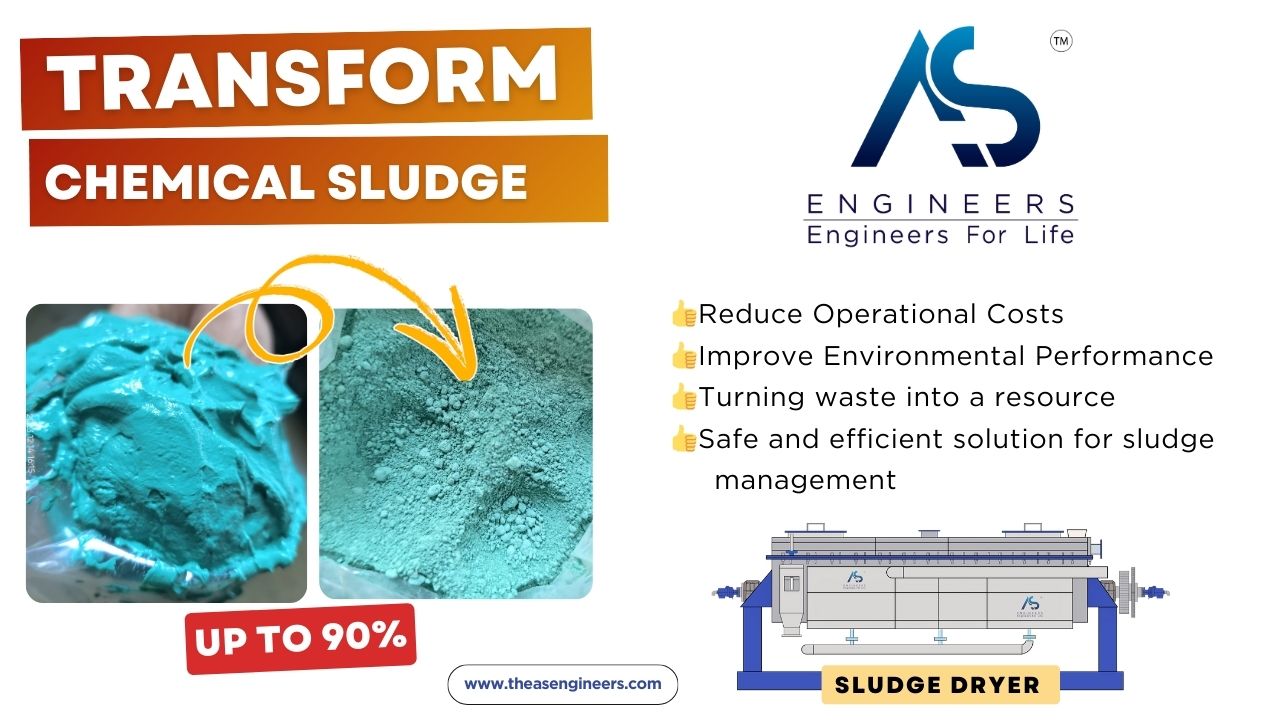
Chemical sludge treatment and reuse means testing, dewatering, drying, and routing chemical ETP sludge toward authorised disposal or approved recovery. The main goal is not only moisture removal. The real goal is to reduce handling risk, lower wet sludge volume, control vapours, and make the final material suitable for its legally accepted route.
Chemical sludge is generated when chemicals are used in an effluent treatment plant to neutralise pH, precipitate metals, coagulate suspended matter, or remove difficult pollutants from industrial wastewater. It is common in chemical, textile, dye, pharmaceutical, electroplating, paper, petrochemical, and specialty manufacturing plants.
On site, this sludge rarely behaves like simple mud. Some batches are lime-rich and granular. Some are sticky, acidic, solvent-bearing, or abrasive. In our shop-floor and commissioning checks, the first problem is usually not the dryer. It is inconsistent feed, poor sludge conditioning, or missing data on pH, chloride, ash, solvents, and inlet moisture.
Before selecting any industrial sludge management route, a plant should know what is inside the sludge. Drying helps reduce volume and improve handling, but it does not magically make hazardous material non-hazardous. That point matters for compliance and for buyer decision-making.
Is Chemical Sludge Hazardous or Reusable?
Chemical sludge can be hazardous, non-hazardous, recyclable, recoverable, or disposal-only depending on its composition and test results. The same dryer cannot decide the reuse route. Laboratory analysis, local rules, receiving facility acceptance, and end-use suitability decide whether dried sludge goes to TSDF, cement co-processing, incineration, brick use, or another approved route.
A practical assessment starts with pH, moisture, ash, calorific value, heavy metals, chlorides, sulphates, volatile matter, solvent traces, and leachability. In many jurisdictions, regulators treat waste as hazardous based on listed waste categories or hazardous characteristics such as ignitability, corrosivity, reactivity, and toxicity. India’s hazardous waste framework also uses authorisation, labelling, transport, manifest, and disposal obligations for applicable waste streams.
For a plant engineer, the safer rule is simple: do not plan reuse before testing. Reuse claims without analysis can create a bigger compliance problem than wet sludge disposal.
The hazardous sludge guide is useful when sludge contains heavy metals, solvents, toxic organics, or difficult industrial residues. If the sludge comes from a ZLD or high-TDS process, also review ZLD sludge handling because salts and crystals change drying behaviour.
How Does Chemical Sludge Treatment Work Before Drying?
Chemical sludge treatment normally follows thickening, conditioning, dewatering, drying, and final handling. Each stage should reduce water or improve handling without creating a new risk. Drying works best when the upstream sludge cake is consistent and the feed system can deliver it evenly into the dryer.
The common sequence is:
- Thickening: Reduces free water and increases solids before mechanical dewatering.
- Conditioning: Polymer, lime, or other conditioning support may improve cake formation.
- Dewatering: Filter press, belt press, screw press, or centrifuge converts slurry into sludge cake.
- Thermal drying: A sludge dryer removes additional bound and surface moisture.
- Discharge handling: Dried sludge is cooled, conveyed, bagged, stored, or sent for approved disposal or reuse.
A common buyer mistake is expecting the dryer to solve all upstream instability. If the filter press discharges one batch at 45% moisture and the next at 70% moisture, dryer load, residence time, vapour load, and discharge texture will shift. That is why sludge dewatering techniques should be reviewed before final dryer sizing.
For chemical sludge, I also check whether the material cakes on screw flights, bridges in hoppers, or forms hard lumps after partial drying. These small handling details decide whether the system runs smoothly or requires constant operator intervention.
Why Is Paddle Dryer Technology Suitable for Chemical Sludge Drying?
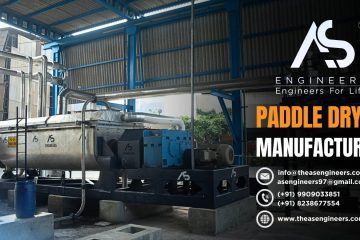
A paddle dryer is suitable for many chemical sludge drying applications because it uses indirect heat transfer, agitation, and continuous mixing inside an enclosed system. Heat is transferred through hollow shafts, paddles, and jacket surfaces instead of direct flame contact. This is useful when the sludge is sticky, paste-like, or vapour control is important.
AS Engineers’ paddle dryer for chemical industry applications are built around feed behaviour, moisture target, material of construction, heat source, vapour handling, and discharge condition. For difficult sludge, the dryer body is only one part of the system. Feeding, vapour treatment, condensate routing, pollution control, and product handling are equally important.
Chemical sludge often needs a different design mindset than municipal sludge. Solvent-bearing sludge may need enclosed vapour handling. Acidic or chloride-rich sludge may need upgraded wetted parts. Abrasive sludge may need hard-facing or careful paddle surface selection. Sticky sludge may need a feed arrangement that avoids hopper bridging.
For wider sludge dryer selection logic, use the sludge dryer guide and the paddle dryer configuration guide.
What Should Buyers Check Before Selecting a Chemical Sludge Dryer?
Buyers should check sludge composition, inlet moisture, daily generation, operating hours, target outlet moisture, vapour risk, corrosion risk, disposal route, available utilities, and maintenance access. A wrong selection can cause choking, high energy use, odour complaints, poor discharge, or non-acceptance by the receiving facility.
| Buyer Checkpoint | Why It Matters | Safe Selection Direction |
|---|---|---|
| Inlet moisture variation | Decides heat load and residence time | Needs testing |
| pH and chloride level | Affects corrosion risk | Application-specific MOC |
| Solvent or VOC possibility | Affects vapour handling design | Enclosed system may be required |
| Ash and inorganic content | Affects discharge texture | Depends on feed condition |
| Abrasive particles | Affects paddle and shaft wear | Hard-facing may be considered |
| Final disposal or reuse route | Decides target moisture and handling | Confirm with receiving facility |
| Utility availability | Steam, thermic fluid, electricity, fuel | Site-specific |
| Maintenance access | Reduces downtime during cleaning and inspection | Must be planned in layout |
A serious buyer should share sludge lab data before asking only for price. For chemical sludge, the lowest quoted machine can become expensive if it ignores vapour, corrosion, condensate, or discharge handling.
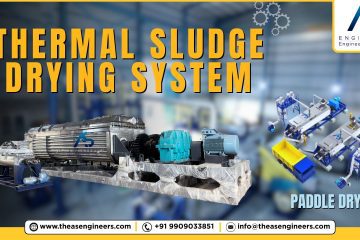
AS Engineers also provides paddle dryer services for system support, repair, retrofitment, and spare parts. For plants still comparing drying methods, the thermal sludge drying system guide explains where heat-based drying fits after dewatering.

Can Dried Chemical Sludge Be Reused?
Dried chemical sludge can be reused only when testing, composition, regulation, and the receiving user allow it. Drying improves handling and reduces moisture, but reuse depends on whether the dried material is safe and acceptable for a specific end use. Cement co-processing, controlled incineration, brick manufacturing, or other recovery routes must be evaluated case by case.
For waste-to-value planning, the most important questions are:
Does the dried sludge have useful calorific value?
Are heavy metals within the receiving facility’s limit?
Will salts, chlorine, sulphur, or ash create process problems?
Can the plant document the material quality consistently?
Does the local authority or buyer permit that route?
The sludge waste recycling guide is useful for understanding the broader recovery mindset. For disposal-route comparison, review land application vs incineration, but apply it carefully because chemical sludge is often more restricted than biological or municipal sludge.
In practical terms, drying usually helps even when reuse is not possible. Lower moisture means less transport burden, cleaner storage, easier loading, reduced odour, and better control over disposal logistics.
How Should Vapour, Odour, and Condensate Be Handled?
Chemical sludge drying should not be treated as only a moisture-removal task. Vapour, odour, fine particles, and condensate must be planned before commissioning. If the sludge contains solvents or volatile organics, the vapour stream may need condensation, scrubbing, filtration, or routing back to treatment.
AS Engineers’ sludge drying system approach includes heating, feeding, drying, scavenging, pollution control, solvent or vapour management, and product handling. Relevant equipment may include cyclone, scrubber, bag filter, ID fan, condenser, solvent tank, and discharge conveyor depending on the application.
This is where many projects fail during operation. The dryer may remove moisture, but if condensate has no return path, vapour ducting is undersized, or the scrubber is not considered during layout, the site team faces complaints after startup. For plants handling ETP and CETP sludge, the ETP sludge treatment guide and CETP sludge drying pages give useful context.
Where Does AS Engineers Fit in Chemical Sludge Treatment Projects?
AS Engineers supports chemical sludge drying through paddle dryer design, material selection, feed and discharge planning, vapour handling, trial support, and after-sales service. The company manufactures from GIDC Vatva, Ahmedabad, Gujarat, and brings 25+ years of drying and fluid mechanics experience.
According to AS Engineers’ internal product data, its paddle dryer can be configured with indirect steam heating, thermal oil heating, atmospheric operation, vacuum operation, or pressurised operation depending on process requirements. Available material options include CS, SS304, SS316, Duplex Steel, and other alloys based on sludge chemistry.
The buyer should not finalise a dryer from brochure data alone. For chemical sludge, a pilot trial is often the best way to see feed behaviour, sticking tendency, discharge form, vapour load, and achievable outlet moisture. AS Engineers offers a 50 kg/hr pilot trial option for evaluating performance before full-scale selection.
For deeper equipment reading, see chemical sludge drying with paddle dryers, sludge drying with paddle dryer technology, and paddle dryer pilot trial. For direct equipment evaluation, review the AS Engineers sludge dryer manufacturer page.
FAQs
1. What is chemical sludge treatment and reuse?
Chemical sludge treatment and reuse is the process of testing, thickening, dewatering, drying, and routing chemical ETP sludge toward approved disposal or recovery. Reuse is possible only when the dried sludge meets composition, safety, regulatory, and receiving-facility requirements. Drying improves handling, but testing decides the final route.
2. Does drying make chemical sludge non-hazardous?
No. Drying reduces moisture and volume, but it does not automatically remove hazardous classification. If the sludge contains regulated metals, solvents, toxic organics, corrosive compounds, or other hazardous characteristics, the dried output may still require authorised handling and disposal.
3. What moisture level should chemical sludge be dried to?
The target moisture depends on the disposal or reuse route. Some plants need a low-moisture granular discharge for transport and co-processing, while others only need enough drying to reduce disposal tonnage. The correct target should be confirmed through lab data, receiving facility requirements, and pilot testing.
4. Which dryer is suitable for sticky chemical sludge?
A paddle dryer is often suitable for sticky chemical sludge because the paddles mix, shear, and move the sludge while indirect heat removes moisture. However, suitability depends on feed consistency, solvent risk, corrosion level, abrasiveness, and discharge behaviour. A pilot trial is strongly recommended for difficult sludge.
5. Can chemical sludge be used in cement, bricks, or fuel?
It can be considered only after testing. Cement co-processing, brick use, and alternative fuel applications depend on calorific value, ash, chlorine, sulphur, metals, toxicity, and local approval. Dried sludge is easier to handle, but approval comes from compliance and receiving-facility acceptance, not from drying alone.
Closing
Chemical sludge is one of the highest-risk sludge streams in an industrial ETP because moisture, chemistry, vapour, corrosion, and disposal rules all affect the final decision. Before selecting a dryer, share your sludge composition, inlet moisture, daily generation, utility availability, and intended disposal or reuse route with the AS Engineers team through the AS Engineers contact page.