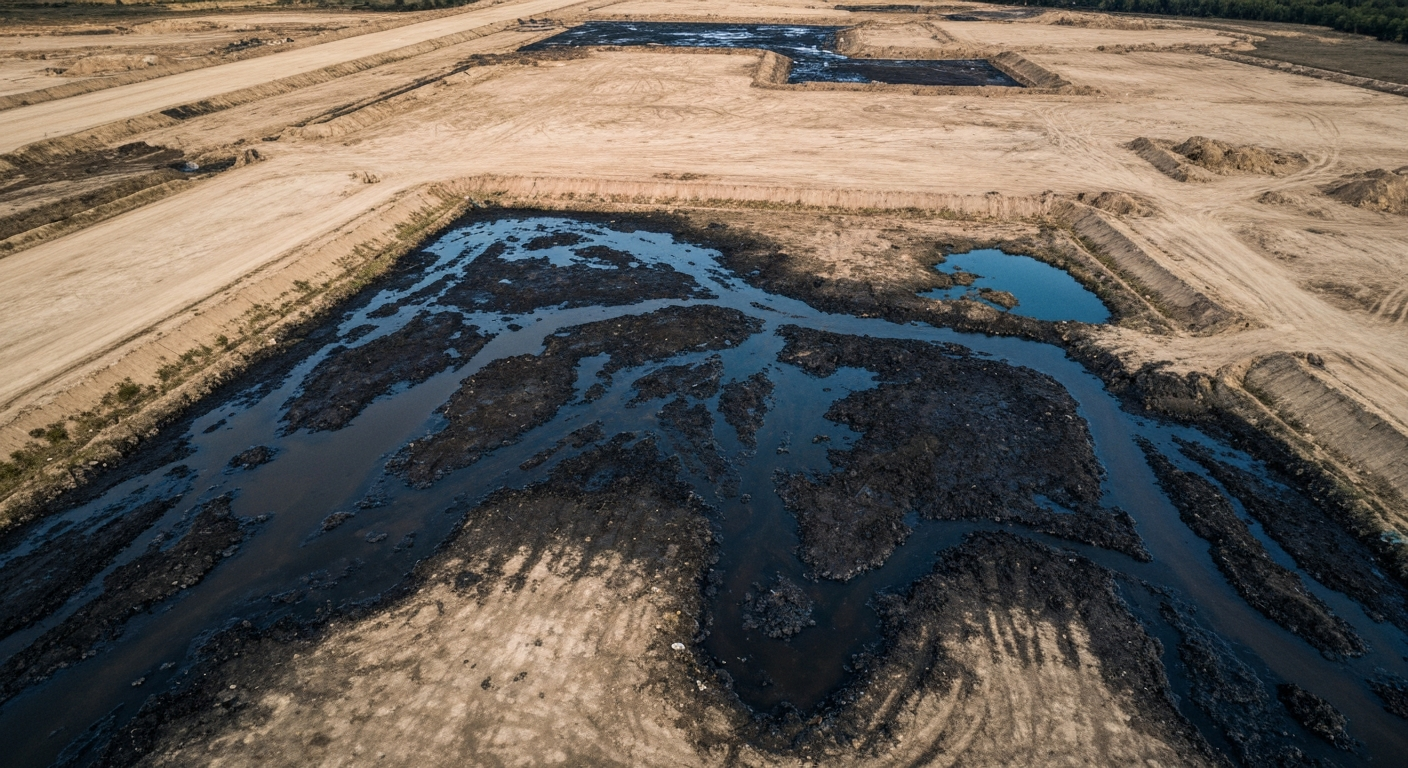
Landfilling wet sludge looks simple only on the invoice. The real cost is not just landfill or TSDF disposal. It includes water weight, extra truck trips, difficult handling, odour, storage space, leachate risk, testing, documentation, and long-term liability.
For ETP, STP, CETP, ZLD, chemical, textile, pharma, food, paper, dye, refinery, and municipal sludge, the first cost question should be simple: how much water are we paying to transport and dispose of?
At AS Engineers, when we review a sludge disposal problem, we do not start with the dryer size. We first check sludge quantity, inlet moisture, hazardous classification, current disposal route, distance to disposal site, fuel availability, final moisture target, and whether dried sludge has an approved reuse or disposal path.
Why wet sludge becomes expensive to landfill
Wet sludge is heavy because it contains a large amount of moisture. In many plants, this moisture becomes the silent cost driver. Every extra ton of water increases:
- transport weight
- number of truck trips
- handling time
- sludge pit storage requirement
- landfill or TSDF load
- leachate risk
- odour and hygiene issues
- documentation and monitoring effort
This is why wet sludge landfilling should not be evaluated only as “₹ per ton disposal.” The better question is: ₹ per ton of useful dry solids versus ₹ per ton of water being carried with the sludge.
For plants comparing dewatering, drying, and final disposal options, also read our industrial sludge disposal guide and sludge dewatering techniques guide.
The simple cost logic: moisture is the multiplier
If a plant sends wet sludge for landfill or TSDF disposal, most expenses increase with weight, volume, labour, and transport frequency.
| Cost driver | Why wet sludge increases it | What to check before deciding |
|---|---|---|
| Transport cost | More water means more weight and more trips | Daily sludge tonnage, truck capacity, distance, loading time |
| Landfill or TSDF fee | Disposal is often affected by weight and waste category | Approved vendor quote, hazardous/non-hazardous classification |
| Labour cost | Wet sludge is harder to pump, load, unload, and clean | Manpower per shift, loading equipment, pit cleaning frequency |
| Storage cost | Wet sludge occupies more pit or yard space | Available storage area, odour control, monsoon risk |
| Compliance cost | Testing, manifests, records, and disposal proof may be required | Sludge category, SPCB authorization, TSDF records |
| Environmental risk | Wet sludge can increase leachate, odour, and contamination concerns | Leachate control, covered storage, approved final route |
For hazardous and other wastes in India, CPCB lists the Hazardous and Other Wastes Rules and amendments, with SPCBs/PCCs having responsibilities across hazardous waste generation, handling, and disposal.
Obvious costs versus hidden costs
The obvious costs are easy to see. They appear in monthly bills.
The hidden costs usually appear later, after disposal becomes routine.
| Cost type | Visible cost | Hidden cost |
|---|---|---|
| Transport | Truck charges | Extra trips due to water weight, vehicle wear, loading delays |
| Disposal | Landfill or TSDF invoice | Rising future rates, rejection due to moisture or classification issue |
| Labour | Loading and unloading workers | Cleaning, odour complaints, spill handling, PPE, supervision |
| Storage | Sludge pit or temporary yard | Space blockage, monsoon overflow, hygiene risk |
| Compliance | Lab testing and paperwork | Wrong classification, missing records, non-approved route risk |
| Environmental | Disposal at external site | Long-term liability if handling or final disposal is questioned |
Wet sludge disposal becomes costly because the plant keeps paying for the same problem every month instead of reducing the load at source.
The AS Engineers disposal-load example
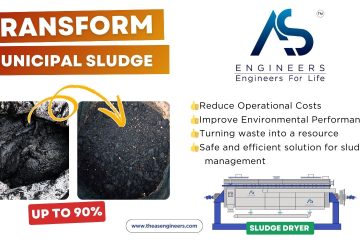
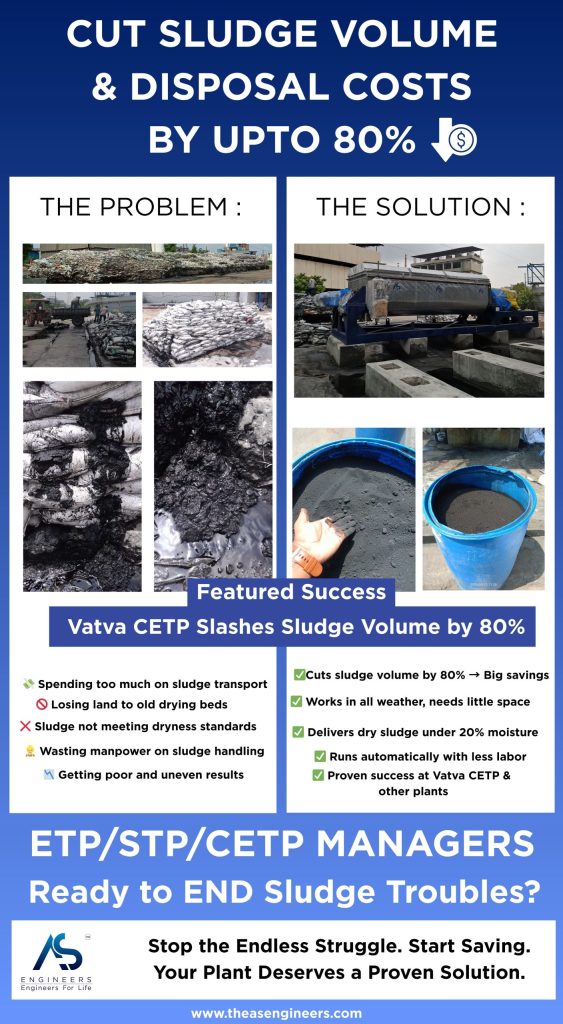
AS Engineers’ internal sludge drying model shows a practical example:
| Before drying | After drying |
|---|---|
| 10 ton/day wet sludge | 2 ton/day dried sludge |
| ₹1,00,000/day disposal cost at ₹10,000/ton | ₹20,000/day disposal cost at same disposal rate |
| High transport and space load | Lower disposal load and improved handling |
This example shows the disposal-load logic from AS Engineers’ catalogue material. Actual savings depend on sludge moisture, drying target, sludge chemistry, heating medium, plant operation, disposal vendor quote, and whether the dried output is approved for disposal, co-processing, or reuse.
This is why no responsible supplier should promise a fixed payback without testing the sludge and checking the disposal route.
Why landfilling wet sludge creates environmental risk
Landfilling wet sludge is not only a cost issue. It can also increase environmental management risk.
Wet sludge may contribute to:
- leachate generation
- odour nuisance
- poor site hygiene
- higher landfill space consumption
- methane and landfill gas concerns where organic waste decomposes
- runoff or spill risk during transport and unloading
- long-term monitoring burden at landfill sites
India’s Solid Waste Management Rules, 2026 further strengthen restrictions on landfilling and restrict landfills to non-recyclable, non-energy recoverable waste and inert material in the municipal solid waste context. The rules also prescribe higher landfill fees for local bodies sending unsegregated waste to sanitary landfills.
For industrial sludge, the route depends on laboratory testing, waste category, SPCB authorization, and the approved disposal or utilization pathway. Hazardous sludge must not be treated as ordinary landfill waste.
Wet sludge, dewatered sludge, and dried sludge
Plant teams often mix these three terms. They are different stages of moisture reduction.
| Form | Typical condition | Practical meaning |
|---|---|---|
| Wet sludge | Pumpable, slurry-like, very high moisture | Difficult to transport and expensive to landfill |
| Dewatered sludge cake | Semi-solid cake after filter press, screw press, centrifuge, or belt press | Better than wet sludge but may still carry high moisture |
| Dried sludge | Lower moisture after thermal drying | Easier handling, lower weight, better storage and potential for selected approved reuse routes |
Mechanical dewatering is usually the first step. Thermal drying is considered when dewatering alone does not reduce disposal burden enough, when TSDF or transport cost is high, or when the final route needs lower moisture.
For method selection, see our guide on top sludge treatment methods.
Where paddle drying helps
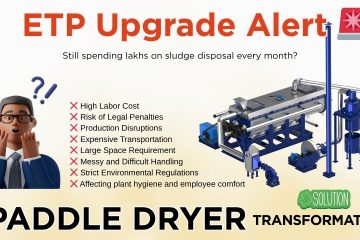
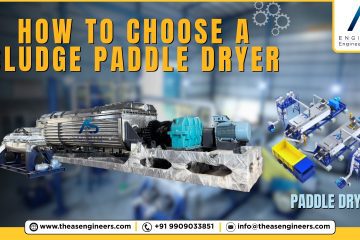
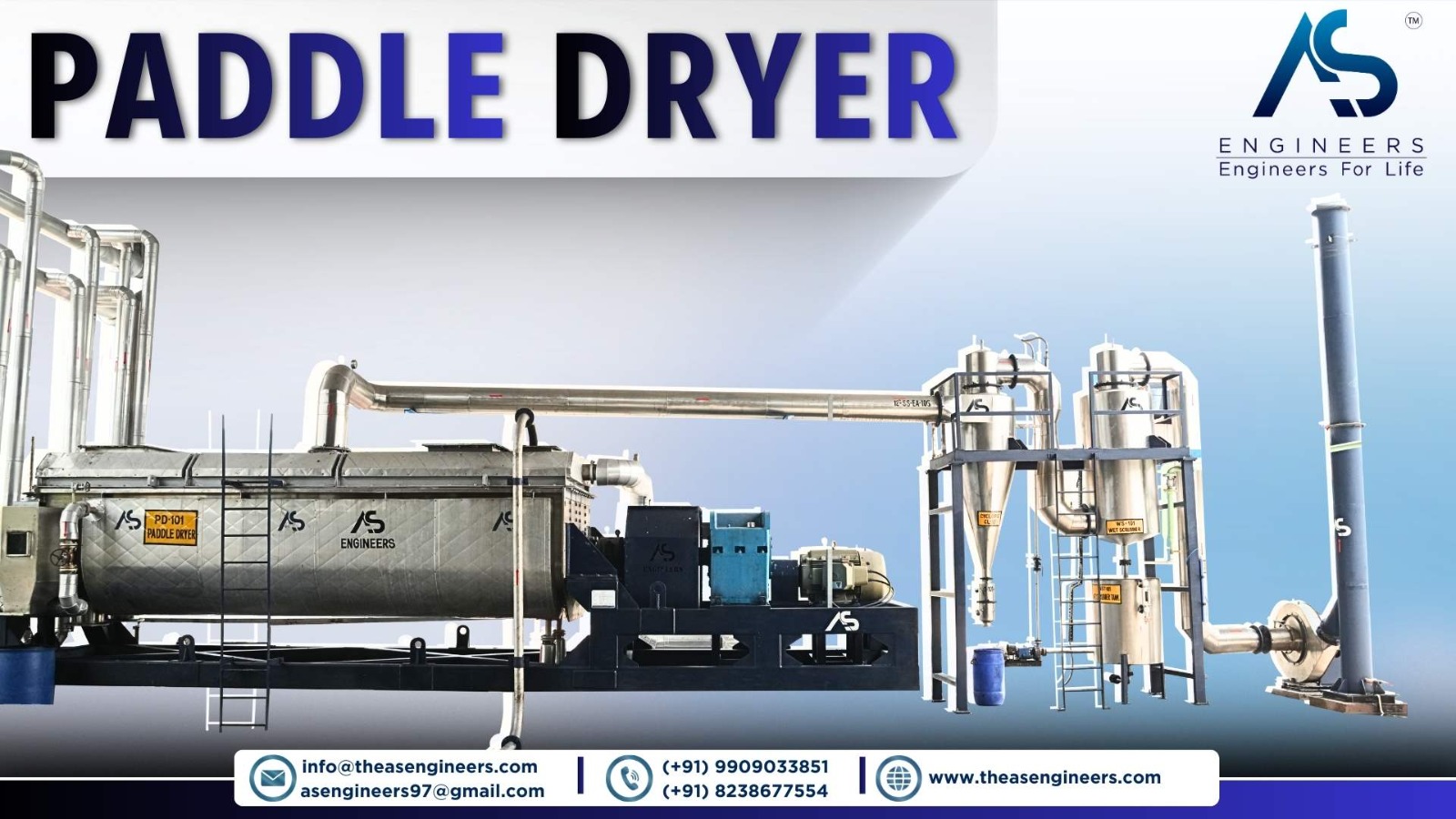
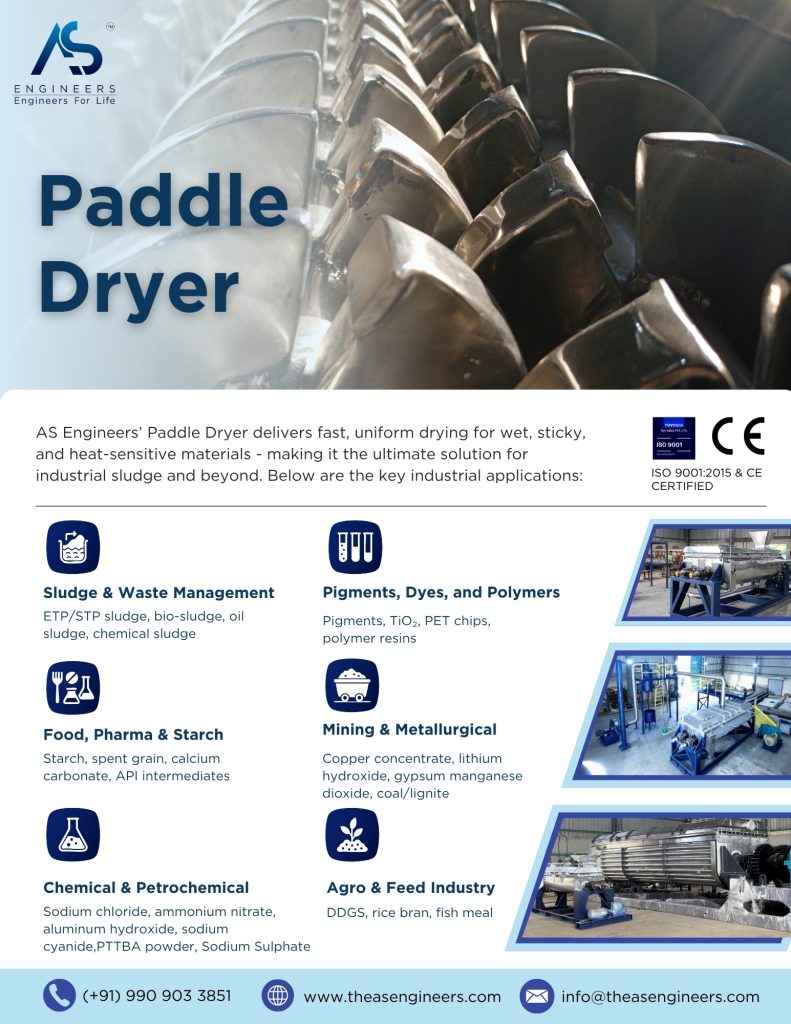
A paddle dryer helps reduce wet sludge disposal load by using indirect heat transfer through hollow shafts and jacketed surfaces. The sludge is continuously mixed and exposed to heated surfaces while moisture evaporates.
AS Engineers’ paddle dryer system can include feeding, heating, drying, scavenging, pollution control, solvent/vapour handling, and product handling sections. The paddle dryer process uses hollow shafts and jacket heat transfer, with configuration options such as standard dryer, dual zone dryer, and vacuum dryer depending on process requirement.
For sludge applications, this helps plant teams:
- reduce moisture before final disposal
- reduce transport weight
- improve sludge handling
- reduce storage burden
- prepare dried material for approved disposal or co-processing evaluation
- reduce dependency on frequent wet sludge lifting
AS Engineers’ catalogue also supports paddle dryer features such as indirect steam or thermal oil heating, feed handling for slurries/pastes/cakes/granules/powders, material options such as CS, SS304, SS316, duplex steel and other alloys, and enclosed processing with solvent recovery options where applicable.
For equipment selection, read our sludge dryer guide and paddle dryer manufacturer in India page.
Drying does not replace testing or compliance
This point is important.
A sludge dryer reduces moisture. It does not automatically remove heavy metals, salts, oil contamination, hazardous constituents, pathogens, or chemical risk. The final route still needs proper testing and approval.
Before deciding landfill, TSDF, co-processing, fertilizer route, brick route, or any reuse route, check:
- sludge source and process
- hazardous or non-hazardous classification
- pH and corrosivity
- heavy metals
- oil and grease
- chloride and salts
- ash content
- calorific value if co-processing is considered
- presence of solvents or flammable vapours
- final moisture target
- authorized receiver requirements
- SPCB/CPCB applicable conditions
CPCB’s co-processing guidelines state that utilization of hazardous and other wastes for co-processing or other use requires authorization from the State Pollution Control Board based on CPCB SOPs or guidelines.
When wet sludge landfilling is a bad economic choice
Wet sludge landfilling becomes a weak option when:
- sludge generation is daily and continuous
- moisture is high
- disposal site is far from the plant
- transport frequency is high
- TSDF or landfill charges are increasing
- sludge storage area is limited
- odour complaints are frequent
- monsoon handling becomes difficult
- sludge is rejected due to moisture or inconsistent condition
- the plant wants to explore co-processing or resource recovery
For many ETP and ZLD plants, drying is not only an environmental decision. It is a logistics and cost-control decision.
Also read industrial ETP volume reduction for a deeper look at how volume reduction affects daily plant economics.
When drying may not be the right first step
A sludge dryer should not be selected blindly. Drying may not be the best first step if:
- the sludge still has too much free water and needs better dewatering first
- daily sludge quantity is too low for thermal drying economics
- disposal cost is already low and nearby
- the plant has no steam, thermic fluid, fuel, or power support
- sludge contains unknown solvents or flammable vapours
- final disposal route does not benefit from lower moisture
- laboratory data is missing
- feed consistency is poor and no conditioning step is planned
In these cases, improve thickening, conditioning, screw press, filter press, centrifuge, or other dewatering steps before evaluating thermal drying.
Practical cost calculation for plant teams
Before asking for a sludge dryer quotation, prepare this table.
| Input | Why it matters |
|---|---|
| Wet sludge quantity per day | Determines dryer size and disposal load |
| Current moisture percentage | Shows how much water must be removed |
| Current disposal cost per ton | Baseline for savings calculation |
| Transport distance and truck capacity | Identifies logistics cost |
| Sludge source | ETP, STP, CETP, ZLD, chemical, pharma, textile, refinery, food |
| Hazardous classification | Decides legal route and handling requirement |
| Current dewatering equipment | Shows whether pre-drying improvement is needed |
| Target final moisture | Defines heat duty and dryer design |
| Fuel or heating medium | Steam, thermic fluid, hot water, gas, coal, briquette, electricity |
| Vapour handling need | Water vapour, solvent vapour, odour, fumes, fines |
| MOC requirement | Corrosion, abrasion, chloride, solvent, pH |
| Final route | TSDF, landfill, co-processing, cement, brick, fertilizer, internal use |
This data helps avoid oversized equipment, undersized vapour handling, wrong MOC, and unrealistic ROI claims.
RFQ checklist for sludge drying
When sending an RFQ to AS Engineers, include:
- sludge type and source
- daily generation in kg/day or ton/day
- inlet moisture and expected final moisture
- sludge temperature
- bulk density if available
- pH, chloride, oil/grease, heavy metals, ash, calorific value if tested
- hazardous/non-hazardous status
- current disposal route and cost
- available utilities
- space available for dryer and feeding system
- current dewatering method
- feeding behaviour: pumpable, sticky, lumpy, fibrous, sandy, oily, corrosive
- vapour and odour handling requirement
- required automation level
- product handling requirement after drying
For pricing logic, see our industrial sludge dryer machine price guide.
Common mistakes that increase wet sludge disposal cost
Paying disposal cost without moisture accounting
Many plants know the monthly disposal bill but not the moisture load. Without inlet moisture and dry solids data, cost analysis becomes guesswork.
Treating drying as a machine-only decision
A dryer is not only a shell and shaft. The system may need feeding, heating, vapour handling, pollution control, discharge conveying, bagging, and safety checks.
Ignoring final disposal route
If the dried sludge has no approved route, the project remains incomplete. Always confirm whether the target is landfill reduction, TSDF load reduction, co-processing, fuel use, cement route, brick route, composting, or authorized disposal.
Skipping sludge testing
Industrial sludge can vary by batch, process, chemical use, and ETP operation. Testing is necessary before selecting MOC, vapour handling, and final route.
Comparing only equipment price
The lowest machine price can become expensive if it causes choking, corrosion, high maintenance, poor drying, vapour issues, or difficult discharge.
Conclusion
The hidden cost of landfilling wet sludge is moisture. Water increases transport weight, landfill load, handling work, storage space, odour risk, leachate concern, and compliance effort.
For industrial plants, the correct approach is not simply “landfill or dryer.” The correct approach is:
- measure sludge quantity and moisture
- confirm sludge classification
- calculate current transport and disposal cost
- improve dewatering where needed
- check whether thermal drying can reduce final disposal load
- verify the approved final route
- size the sludge dryer based on real sludge data
If you are evaluating wet sludge landfilling cost, share your sludge quantity, moisture, current disposal cost, heating medium, sludge source, and final disposal route. AS Engineers can review the requirement and suggest a practical sludge drying configuration based on actual plant conditions.
Request a sludge dryer quotation
Frequently Asked Questions
What is the hidden cost of landfilling wet sludge?
The hidden cost of landfilling wet sludge is the cost of carrying and disposing of water. High moisture increases transport weight, truck trips, landfill or TSDF load, labour, storage space, odour control, documentation, and long-term environmental risk.
Does drying sludge make it non-hazardous?
No. Sludge drying reduces moisture. It does not automatically remove hazardous constituents, heavy metals, salts, oil, solvents, or chemical risk. The sludge must still be tested and sent to an approved disposal, TSDF, co-processing, or reuse route.
Is dewatering enough before landfill?
Dewatering may be enough for some plants if the disposal cost and moisture target are acceptable. Thermal drying is considered when dewatering cake is still too heavy, disposal cost is high, landfill/TSDF distance is long, or the final route requires lower moisture.
How does a paddle dryer reduce wet sludge disposal cost?
A paddle dryer reduces moisture using indirect heat transfer through hollow shafts and jacketed surfaces. Lower moisture can reduce sludge weight, improve handling, reduce transport frequency, and lower the quantity sent for final disposal, depending on sludge characteristics and final route.
What data is required before selecting a sludge dryer?
The main RFQ inputs are sludge quantity, inlet moisture, target moisture, sludge source, hazardous classification, chemical properties, current dewatering method, available heating medium, vapour handling need, MOC requirement, space, and final disposal or reuse route.