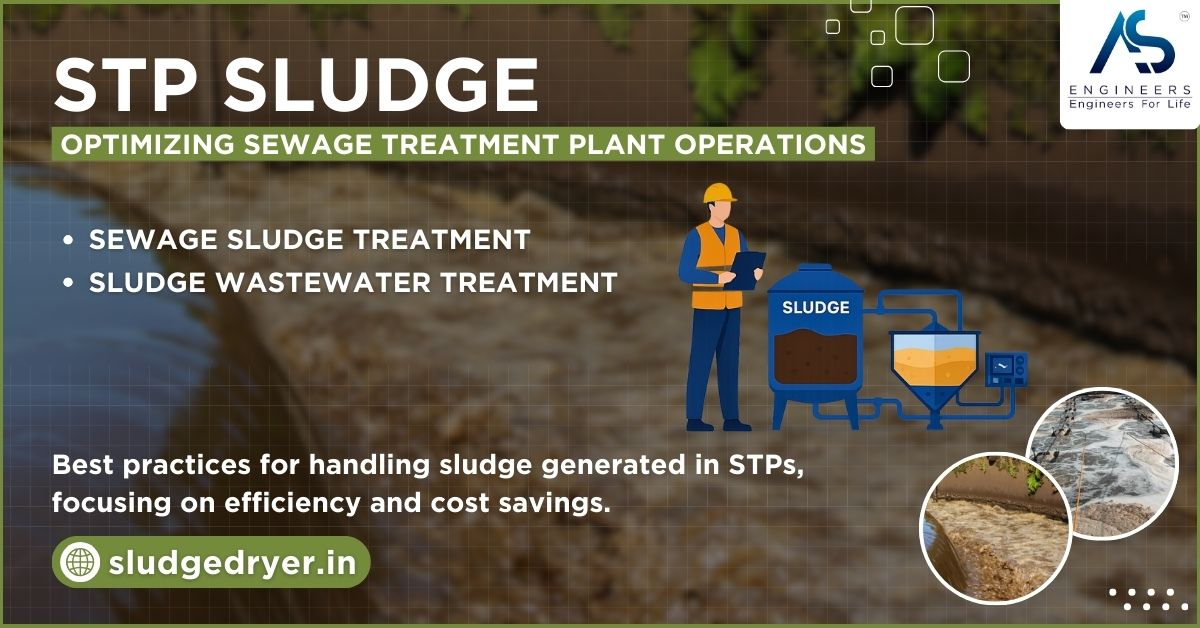
STP sludge is the semi-solid residue generated when a sewage treatment plant separates suspended solids, organic matter, grit, and excess biological biomass from wastewater. For plant teams, the real challenge is not only treatment. It is moisture, odour, storage space, transport weight, disposal route, and operating reliability.
A good STP sludge management plan connects testing, thickening, stabilization, dewatering, drying, vapour or percolate treatment, and approved disposal or reuse into one practical flow. Before selecting any sludge dryer, the plant should clearly know the sludge source, inlet moisture, daily wet cake quantity, final moisture target, and disposal or reuse plan.
For a broader process view, first review what an STP is and then connect that process to the sludge line explained below.
What is STP sludge?
STP sludge is the settled or separated solid material produced during sewage treatment. It may include organic solids, microbial biomass, grit, fats, fibres, inert matter, nutrients, and moisture. The exact composition depends on the sewage source, STP design, chemical dosing, biological treatment performance, and sludge withdrawal practice.
STP sludge is different from industrial ETP sludge. ETP sludge may contain process chemicals, metals, solvents, pigments, salts, or hazardous residues depending on the factory. STP sludge usually comes from domestic sewage or mixed wastewater, but it still needs testing before reuse, drying, co-processing, land application, or disposal.
For basic sludge terminology, refer to what is sludge.
Where STP sludge forms inside a sewage treatment plant
STP sludge is not one uniform material. Different sections of the sewage treatment plant generate different sludge streams.
| STP section | Sludge or residue produced | Main concern | Planning note |
|---|---|---|---|
| Screening and grit removal | Screenings, grit, rags, plastics, sand | Not suitable as normal sludge feed | Keep segregated from sludge dryer feed |
| Primary clarifier | Primary sludge | High settleable solids, organic load, odour risk | Usually easier to thicken than waste activated sludge |
| Aeration tank and secondary clarifier | Waste activated sludge or secondary sludge | High water content, biological solids, variable dewatering behaviour | Needs good sludge age and dewatering control |
| Tertiary or chemical treatment | Chemical or tertiary sludge | May contain coagulants, phosphorus, or other treatment chemicals | Test before selecting reuse or disposal route |
| Sludge holding tank | Mixed sludge | Septicity, odour, inconsistent feed | Avoid long storage without mixing and control |
A plant handling mixed primary and secondary sludge should not assume the same drying behaviour throughout the year. Monsoon dilution, variable inflow, chemical dosing, and sludge age can change the cake moisture and stickiness.
For a direct comparison, see primary sludge vs secondary sludge.
Correct STP sludge treatment sequence
A practical STP sludge line usually follows this sequence:
Sludge characterization → thickening → stabilization where required → conditioning → dewatering → drying if required → vapour or percolate treatment → approved disposal or reuse.
Each stage has a different job.
| Stage | Purpose | Common plant-side mistake |
|---|---|---|
| Characterization | Understand moisture, solids, pH, organics, ash, odour, and reuse/disposal risk | Selecting equipment without sludge analysis |
| Thickening | Reduce free water before dewatering | Sending very dilute sludge to dewatering or drying |
| Stabilization | Reduce biological activity and odour where required | Ignoring odour and pathogen risk |
| Conditioning | Improve dewatering using polymer, lime, or other conditioning method | Overdosing chemicals without checking downstream drying |
| Dewatering | Convert slurry into sludge cake | Treating dewatering as final volume reduction |
| Drying | Reduce remaining moisture and improve handling | Selecting dryer capacity without inlet and outlet moisture |
| Final handling | Bagging, silo, truck loading, reuse, co-processing, or disposal | Assuming dried sludge is automatically saleable |
For full plant context, connect this page with sludge treatment plant and sewage sludge treatment.
Dewatering and drying are not the same
Many STP buyers confuse dewatering with drying. This causes wrong equipment selection.
Dewatering removes free water mechanically. Drying removes additional moisture using evaporation or heat transfer. A sludge dryer normally comes after dewatering, not instead of dewatering.
| Point | Dewatering | Drying |
|---|---|---|
| Main purpose | Remove free water | Reduce remaining moisture further |
| Typical equipment | Screw press, centrifuge, belt press, filter press, drying bed | Paddle dryer, thermal dryer, solar dryer, disc dryer |
| Output | Wet sludge cake | Drier, lighter, easier-to-handle material |
| Energy requirement | Mainly mechanical | Thermal energy plus drives and auxiliaries |
| Best use | Reduce liquid load before final handling | Reduce disposal weight, volume, odour risk, and transport burden |
| Key limitation | Cake may still be heavy and wet | Needs proper heat source, vapour handling, and feed control |
For dewatering selection, refer to sludge dewatering techniques. For drying system design, see thermal sludge drying system.
When an STP sludge dryer makes sense
A sludge dryer becomes practical when the plant has already controlled basic sludge handling and still faces high disposal cost, high transport weight, limited storage space, odour complaints, or a need for more stable dried output.
A dryer usually makes sense when:
- The plant generates regular wet sludge cake after dewatering.
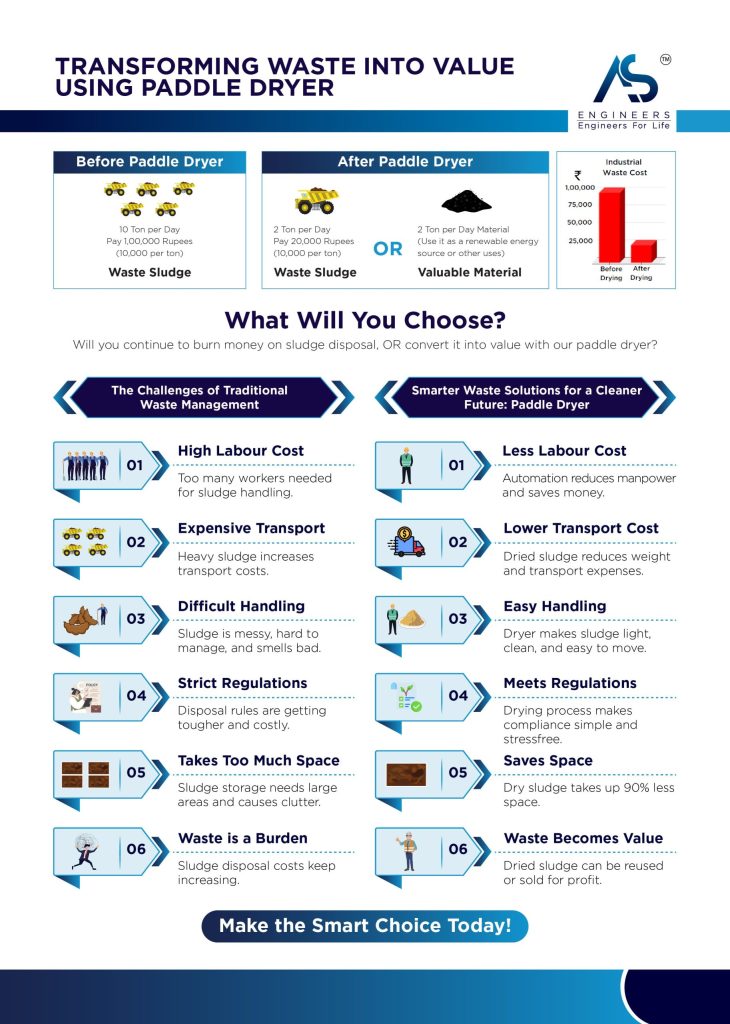
- Transport cost is high because the cake still contains significant moisture.
- Disposal vendors charge by weight or volume.
- Storage space is limited.
- The plant wants better handling before co-processing, incineration, brick use, cement route, or other approved reuse.
- The plant has available steam, thermic fluid, hot water, hot air, waste heat, or other suitable heat source.
- Vapour, odour, and fines can be handled through a properly designed exhaust and pollution-control line.
A dryer may not be the first priority when:
- Sludge quantity is very low.
- Sludge is still too dilute and not dewatered.
- Disposal cost is low and stable.
- There is no confirmed disposal or reuse route.
- The plant has no space, utilities, or vapour-treatment provision.
- Sludge composition is unknown or highly variable.
For low-cost and natural drying options, compare this with sludge drying bed and paddle dryer vs solar bed.
How an indirect paddle dryer supports STP sludge volume reduction
An indirect paddle dryer uses heat transfer through hollow shafts, jacketed surfaces, and heated paddles to evaporate moisture from sludge cake. In AS Engineers’ paddle dryer design approach, the system may include feed handling, fuel or heating medium, paddle dryer body, scavenging air, vapour handling, pollution-control equipment, and dried product handling.
For STP sludge, the main value is controlled drying in a compact, enclosed system. The sludge does not depend only on hot air contact. Heat is transferred indirectly through metal surfaces, while the paddles mix, shear, and move the material through the dryer.
Important design points include:
- Feed moisture and final moisture target
- Sludge stickiness during the plastic phase
- Heating medium, such as steam or thermic fluid
- MOC selection based on corrosion and sludge chemistry
- Vapour volume and odour handling
- Fines carryover control through cyclone, scrubber, or bag filter where required
- Product discharge through screw conveyor, bagging, silo, or truck loading
- Dryer speed, residence time, and torque requirement
- Cleaning and maintenance access
AS Engineers’ approved material list includes sewage treatment plant sludge and biosludge as paddle dryer applications. The company’s documents also describe pilot trial availability for application checking before full-scale selection. This is important because STP sludge can behave differently from one plant to another.
For paddle-style drying details, refer to paddle sludge dryer for effective sludge treatment.
STP sludge treatment and drying options compared
| Option | Good fit | Main limitation | Buyer check |
|---|---|---|---|
| Sludge drying bed | Small plants, low budget, available land, suitable climate | Slow, weather-dependent, odour and space issues | Check drying days, bed area, percolate treatment, manual handling |
| Mechanical dewatering | Most STPs before final disposal or drying | Cake may remain wet and heavy | Check polymer use, cake dryness, machine reliability |
| Indirect paddle dryer | Regular wet cake, high disposal cost, limited space, need for controlled drying | Needs heat source and vapour handling | Check moisture target, heating medium, feed behaviour, exhaust treatment |
| Anaerobic digestion plus dewatering | Larger biological plants where biogas recovery may be feasible | Higher process control and capital requirement | Check sludge quantity, volatile solids, retention time, gas handling |
| Composting or land application | Suitable tested sludge and approved route | Not suitable for every sludge or location | Check pathogen, metals, stability, odour, and local approvals |
| Co-processing, cement, bricks, fuel route | Dried material with suitable properties | Requires acceptance by end user and compliance route | Check calorific value, ash, moisture, chloride, sulphur, metals |
Do not select a final route only from a brochure claim. Confirm the sludge test report, site conditions, local consent requirements, and acceptance criteria of the disposal or reuse partner.
Regulatory and EHS checks before reuse or disposal
STP sludge handling should be reviewed with the plant’s consultant, EHS team, and local consent conditions. In India, treated sewage effluent standards and discharge permissions are influenced by CPCB, SPCB, PCC, and applicable MoEFCC notifications. The 2017 notified standards for STP treated effluent include parameters such as pH, BOD, TSS, and faecal coliform, and local authorities may prescribe stricter norms.
For drying beds, the Swachh Bharat Mission FSSM manual explains that water drains through gravel and sand while solids remain on top for drying, and the percolate requires further treatment before disposal or reuse. It also notes that bed area depends on loading depth, drying period, local climate, and the desired moisture content.
For STP sludge drying, this means the plant should not treat drying as a standalone environmental solution. The full line must include:
- Sludge testing
- Odour control
- Worker safety during handling
- Percolate or condensate management
- Vapour and fines treatment
- Safe storage of dried output
- Fire and dust-risk review where applicable
- Approved disposal, reuse, co-processing, or land application route
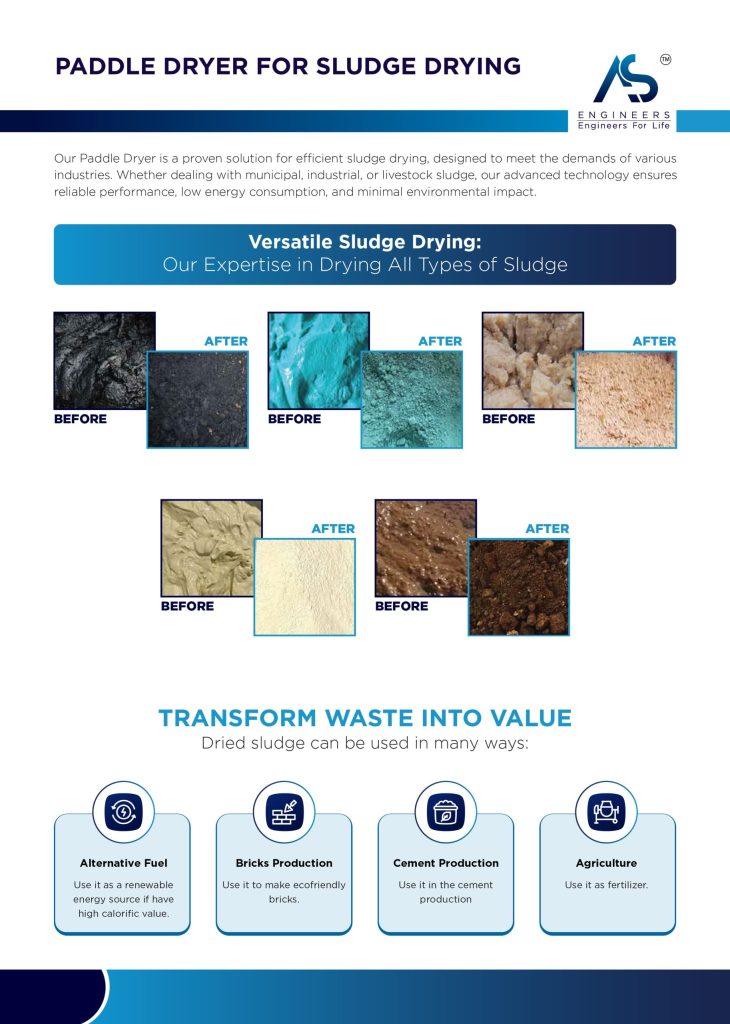
Dried sludge may be considered for agriculture, fuel, cement, bricks, or other routes only when the material quality, local rules, and receiver acceptance make that route valid.
For disposal-route comparison, see disposal of sludge: land application vs incineration.
RFQ checklist for STP sludge dryer selection
A good sludge dryer quotation cannot be prepared from “TPD capacity” alone. Share these inputs before asking for a dryer selection:
| RFQ input | Why it matters |
|---|---|
| Wet sludge quantity in kg/hr or TPD | Defines dryer size and operating hours |
| Current inlet moisture | Determines water evaporation load |
| Required final moisture | Determines residence time and heat duty |
| Sludge source | Municipal STP, township, hotel, institution, industrial park, or mixed stream |
| Sludge type | Primary, secondary, mixed, tertiary, digested, or waste activated sludge |
| Existing dewatering equipment | Screw press, filter press, centrifuge, belt press, drying bed |
| Sludge cake behaviour | Sticky, paste-like, fibrous, granular, abrasive, odorous, bridging tendency |
| Heating medium | Steam, thermic fluid, hot water, hot air, electricity, waste heat, or fuel-fired system |
| MOC expectation | CS, SS304, SS316, Duplex, or other alloy based on chemistry |
| Vapour treatment need | Condenser, cyclone, scrubber, bag filter, ID fan, chimney |
| Discharge method | Screw conveyor, bagging, silo, truck loading, or downstream process |
| Lab data | pH, ash, volatile solids, chloride, sulphur, metals, pathogen risk, calorific value if fuel route is planned |
| Site conditions | Space, layout, access, utility availability, automation requirement |
For feed transfer planning, refer to sludge transfer pumps and pumping sludge.
Common mistakes in STP sludge management
Selecting by motor HP or dryer size only
A dryer is not selected only by HP or shell size. Moisture load, sludge behaviour, heat source, vapour handling, and discharge plan matter more.
Ignoring sludge variability
STP sludge changes with inflow, season, sludge age, polymer dosing, and operator practice. A sample from one day may not represent the full year.
Sending dilute sludge directly to thermal drying
Drying should usually follow thickening and dewatering. Sending very wet sludge directly to a thermal dryer can increase operating cost and reduce system stability.
Mixing grit, rags, screenings, and sludge cake
Screenings and grit should be removed before the sludge line. They can damage pumps, conveyors, and dryer internals.
Assuming dried sludge is automatically valuable
Dried sludge may have reuse potential, but only when testing, approvals, and buyer acceptance support it.
Ignoring vapour and odour handling
Drying releases vapour and may carry fines or odour. Cyclone, scrubber, bag filter, condenser, ID fan, or chimney selection should be reviewed based on duty.
Not defining final moisture target
“Dry sludge” is not a specification. The plant should define the required outlet moisture range based on handling, storage, disposal, or reuse.
How AS Engineers reviews STP sludge dryer requirements
When I review an STP sludge drying requirement, I do not start with dryer capacity alone. I first ask for wet cake quantity, inlet moisture, final moisture target, dewatering method, heat source, sludge behaviour, and the disposal or reuse route. Without these inputs, the quotation becomes a guess.
At AS Engineers, the sludge drying review focuses on actual site duty. For STP sludge, the team may review the feed system, dryer configuration, heating medium, vapour handling, pollution-control arrangement, dried product handling, maintenance access, and pilot-trial requirement where needed.
A practical STP sludge dryer project should answer these questions before purchase:
- What is the daily sludge cake generation?
- What is the present cake moisture after dewatering?
- What final moisture is required for disposal, storage, reuse, or co-processing?
- What heat source is available at site?
- Is the sludge sticky, fibrous, abrasive, or odorous?
- How will vapour, fines, odour, condensate, or scrubber liquid be handled?
- How will dried sludge be stored, bagged, conveyed, loaded, or sent further?
For broader dryer comparison, refer to sludge dryers guide.
Conclusion
STP sludge management should not stop at “remove sludge from the clarifier.” The correct approach is to understand the sludge source, reduce free water through thickening and dewatering, decide whether thermal drying is justified, and confirm the final disposal or reuse route before investing in equipment.
For STP sludge dryer selection, share feed moisture, final moisture target, wet cake quantity, dewatering method, heat source, sludge analysis, disposal route, vapour-treatment need, and site layout. AS Engineers can review the duty conditions and suggest a drying configuration based on actual plant data.
FAQs
What is STP sludge?
STP sludge is the semi-solid residue produced when a sewage treatment plant separates solids, organic matter, grit, and biological biomass from wastewater. It may come from primary clarification, secondary biological treatment, tertiary treatment, or mixed sludge holding.
What is the best treatment method for STP sludge?
There is no single best method for every STP. A practical route usually includes characterization, thickening, stabilization where required, conditioning, mechanical dewatering, and then drying or approved disposal/reuse depending on moisture, quantity, odour, land availability, and cost.
Is a sludge dryer required after dewatering?
A sludge dryer is required only when dewatered sludge cake is still too wet, heavy, odorous, costly to transport, difficult to store, or unsuitable for the planned disposal or reuse route. Small plants with enough land may use drying beds, while larger or space-limited plants may evaluate mechanical dewatering plus thermal drying.
Can dried STP sludge be used as fertilizer, fuel, cement input, or brick material?
Dried STP sludge may be considered for these routes only after lab testing, regulatory review, and acceptance by the receiving party. The plant should check moisture, ash, volatile solids, pathogens, metals, chloride, sulphur, calorific value, odour, and local consent conditions before claiming reuse.
What data is needed for an STP sludge dryer quotation?
A useful RFQ should include wet cake quantity, inlet moisture, final moisture target, sludge source, sludge type, existing dewatering equipment, heating medium, sludge behaviour, MOC expectation, vapour-treatment need, discharge method, lab analysis, site layout, and operating hours.