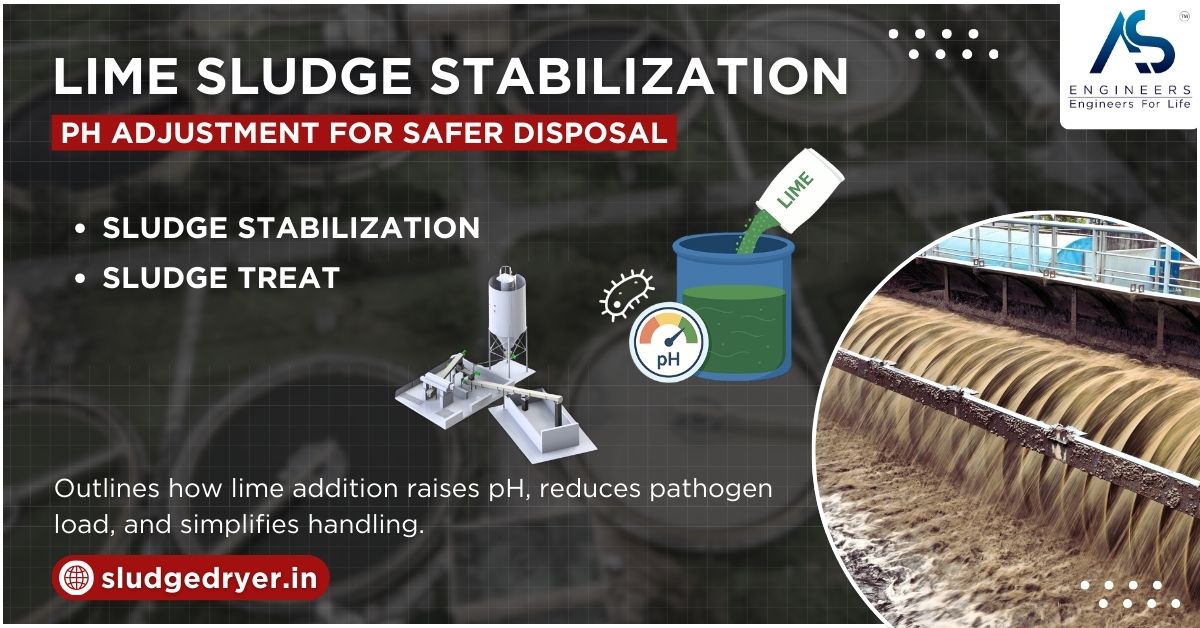
Lime sludge stabilization is the process of raising sludge pH with quicklime, hydrated lime, or another alkaline material so the sludge becomes easier and safer to handle before disposal, reuse review, dewatering, or drying. It can reduce odour, slow biological activity, support pathogen reduction in sewage sludge, and improve disposal documentation, but it does not automatically make every sludge non-hazardous or low-cost to dispose of.
For industrial ETP sludge, the correct approach is not “add lime and send it out.” The plant team should first check sludge chemistry, pH, moisture, metals, organic load, disposal route, TSDF requirement, and whether further dewatering or thermal drying is needed.
What lime sludge stabilization actually means
In plant language, “lime sludge stabilization” can mean two slightly different things.
| Term used on site | What it usually means | Why it matters |
|---|---|---|
| Lime sludge | Sludge generated from lime use in water treatment, softening, neutralization, or pH adjustment | It may already be alkaline, but it still needs characterization before disposal |
| Lime-stabilized sludge | Sludge treated with lime to raise pH and reduce biological instability | The process must be controlled through dosage, mixing, contact time, and pH verification |
| Alkaline sludge stabilization | Broader term for using alkaline materials to stabilize sludge | Used in sewage sludge, biosolids, and some industrial sludge treatment discussions |
| Lime-treated ETP sludge | Industrial effluent sludge treated with lime or neutralization chemicals | May still be hazardous depending on contaminants, metals, and process source |
A common mistake is treating pH as the only decision point. pH is important, but it is not the full disposal decision. Sludge may also contain heavy metals, salts, oils, solvents, chemicals, biological contaminants, or high moisture that affects transport and final disposal.
For a broader foundation, read the industrial sludge disposal guide before finalizing any disposal route.
Why pH adjustment is used in sludge stabilization
pH adjustment is used because many biological and chemical reactions in sludge are pH-sensitive. Raising sludge pH into a highly alkaline range can help suppress microbial activity, reduce odour generation, and improve biological stability in sewage-type sludge.
In the U.S. sewage biosolids context, EPA guidance notes that alkaline stabilization generally meets Class B requirements when the wastewater solids and alkaline material mixture is at pH 12 or above after 2 hours of contact. The U.S. federal Part 503 rule also lists lime stabilization as a process to significantly reduce pathogens when sufficient lime raises sewage sludge pH to 12 after two hours of contact.
For Indian industrial sludge, this should be treated as technical reference, not a direct compliance shortcut. ETP sludge must be assessed according to the plant’s Consent to Operate, SPCB direction, CPCB guidance, hazardous waste classification, TSDF acceptance criteria, and lab reports. The Government of India has confirmed that hazardous and other waste management is governed under HOWM Rules, 2016, with CPCB technical guidelines and SOPs for hazardous waste utilization and management.
Where lime stabilization helps and where it does not
Lime stabilization is useful when the main problem is biological instability, odour, acidic sludge, pathogen risk in sewage-type sludge, or pH correction before a defined disposal route.
It is not a complete solution when the main problem is moisture, bulk volume, transport cost, sticky cake handling, high disposal tonnage, or sludge that still needs drying before landfill, co-processing, incineration, or reuse review.
| Plant problem | Can lime stabilization help? | What else may be needed |
|---|---|---|
| Low pH sludge | Yes | Controlled lime dosing and pH verification |
| Odour from biological sludge | Often | Mixing, retention time, covered handling, drying if storage is long |
| Sewage sludge pathogen reduction | Yes, if process targets are met | Documented pH, time, temperature, and pathogen testing where required |
| High moisture sludge cake | Limited | Dewatering and/or sludge drying |
| Heavy sludge transport cost | Limited | Dewatering, thermal drying, or volume reduction planning |
| Hazardous ETP sludge | Not enough alone | Lab analysis, hazardous waste classification, TSDF/SPCB route |
| Reuse as soil amendment | Only if allowed | Pathogen, metals, contaminant, and local regulatory clearance |
| Sticky sludge handling | Sometimes | Conditioning, dewatering equipment selection, dryer feed testing |
This is where lime treatment and a sludge drying system should be planned together instead of separately.
Quicklime vs hydrated lime for sludge stabilization
Both quicklime and hydrated lime are used in alkaline stabilization, but they behave differently on site.
| Parameter | Quicklime | Hydrated lime |
|---|---|---|
| Chemical name | Calcium oxide | Calcium hydroxide |
| Reaction with moisture | Highly reactive and heat-generating | Already hydrated, generally easier to handle |
| pH increase | Fast | Effective but may need different dosage |
| Handling risk | Higher heat and dust risk | Dust risk still present, lower heat reaction |
| Typical use | Faster pH rise and solids increase | Controlled pH adjustment where easier handling is preferred |
| Site caution | Needs strict moisture control and SOP | Needs dust control, PPE, and dosing control |
The right choice depends on sludge moisture, site safety system, lime storage arrangement, mixing equipment, target pH, reaction time, operator skill, and disposal route. Do not select lime only by price per kg. The real cost comes from dosage, storage loss, mixing energy, safety control, dewatering impact, and disposal weight.
Practical lime sludge stabilization workflow
Characterize the sludge before dosing
Start with testing. At minimum, the plant should know:
- Current pH and alkalinity
- Moisture percentage and total solids
- Volatile solids or organic load where relevant
- Heavy metals and hazardous constituents
- Oil and grease if from refinery, machinery, paint, automotive, or process industries
- Pathogen indicators for sewage or biological sludge where relevant
- Chlorides, sulphates, salts, or process chemicals that may affect disposal
- Current disposal route and TSDF/landfill acceptance conditions
For ETP sludge, connect this step with the ETP sludge challenges and disposal guide so the stabilization plan matches the actual sludge source.
Define the treatment objective
Before adding lime, define the purpose clearly.
The objective may be pH correction, odour control, pathogen reduction, improved handling, reduced biological activity during storage, pre-treatment before dewatering, or conditioning before disposal. Each objective changes the required dosage, contact time, monitoring, and documentation.
Run lime demand testing
Lime demand depends on sludge composition, moisture, buffering capacity, and acid load. Jar testing or small batch testing is safer than using a fixed dosage copied from another plant.
A proper test should record:
| Test item | Why it matters |
|---|---|
| Lime type and dose | Confirms actual chemical requirement |
| pH rise curve | Shows how fast the sludge reaches target pH |
| pH after holding time | Checks whether pH drops after initial reaction |
| Temperature rise | Important when using quicklime |
| Mixing quality | Avoids untreated pockets inside sludge mass |
| Cake consistency | Shows whether dewatering or dryer feeding will improve or worsen |
| Odour change | Gives operational feedback, but not a substitute for lab testing |
Mix uniformly and verify contact time
Poor mixing is one of the most common failure points. Lime must contact the sludge mass uniformly. If the mixer creates dead zones, lumps, or dry pockets, part of the sludge may remain under-treated even when the average pH looks acceptable.
For sewage sludge stabilization, pH and contact time are key control points. For industrial sludge, pH logs are still useful, but they should be combined with contaminant testing and disposal documentation.
Dewater after stabilization where needed
Lime treatment may change cake structure. In some cases, it improves dewatering. In other cases, overdosing or poor mixing can create a difficult cake.
The dewatering stage may include filter press, belt filter press, screw press, centrifuge, or drying bed depending on sludge type and plant layout. For equipment selection, use this sludge dewatering equipment guide before finalizing the process.
Dry when moisture and disposal weight remain the real problem
Lime stabilization does not evaporate most of the water from sludge. It can increase solids content because lime adds dry material, but wet stabilized sludge can still be heavy, bulky, and expensive to transport.
Drying becomes important when the plant wants to reduce disposal tonnage, improve storage, reduce truck movement, prepare sludge for co-processing review, or make dried output easier to handle. A paddle dryer manufacturer in India can review whether the sludge is suitable for indirect thermal drying after stabilization or dewatering.
AS Engineers’ sludge drying approach is based on indirect heat transfer through hollow shafts and jacket heating, with paddle agitation for wet cakes, pastes, and sludge-type materials. The AS Engineers catalogue supports paddle dryer/sludge dryer capability, process flow, heating medium options, pollution-control integration, and product handling systems.
Where a paddle dryer fits after lime stabilization
A paddle dryer can be considered after lime stabilization and dewatering when the plant still has high moisture sludge cake and wants better volume reduction.
The typical sequence is:
Sludge generation → lime dosing or pH adjustment → stabilization hold time → dewatering → sludge dryer → dried sludge handling → disposal or reuse review
This sequence is not universal. Some plants dewater first and lime-stabilize the cake. Some stabilize liquid sludge first. Some skip lime treatment and use dewatering plus drying, depending on sludge type and regulatory route.
The selection should be based on sludge behavior, not only on the desire to reduce weight. For AS Engineers, the RFQ review should include feed moisture, final moisture target, sludge source, pH, lime dosage, abrasive content, stickiness, daily throughput, heating medium, vapour handling, MOC requirement, and final disposal route.
You can compare the financial side with the hidden cost of landfilling wet sludge because disposal cost is usually driven by wet tonnage, transport frequency, storage space, handling labour, and TSDF/landfill acceptance.
Key control points for safer disposal
| Control point | What to check | Why it matters |
|---|---|---|
| Sludge source | STP, ETP, CETP, paper, food, chemical, textile, refinery | Determines contaminant risk and disposal route |
| Initial pH | Acidic, neutral, or already alkaline | Sets lime demand and dosing logic |
| Lime type | Quicklime or hydrated lime | Affects heat, handling risk, and reaction rate |
| Mixing system | Tank mixer, pugmill, screw mixer, batch mixer | Controls uniformity |
| Contact time | Holding period after dosing | Supports stabilization objective |
| Final pH | Measured after mixing and holding | Confirms treatment condition |
| Moisture | Before and after dewatering/drying | Controls transport and disposal cost |
| Metals and hazardous constituents | Lab testing | Prevents false “safe disposal” assumptions |
| Documentation | pH logs, dosage, lab reports, manifests | Supports audit and disposal traceability |
| Final route | TSDF, landfill, co-processing, reuse review | Prevents mismatch between treatment and acceptance criteria |
For hazardous or regulated industrial sludge, also review CPCB guidelines for hazardous waste disposal and TSDF site standards before presenting disposal as “safe.”
Common mistakes in lime sludge stabilization
Treating pH 12 as a universal answer
pH 12 is important in many lime stabilization references for sewage sludge, but it is not a universal industrial disposal approval. ETP sludge may still contain hazardous constituents even after pH adjustment.
Skipping sludge characterization
Without pH, moisture, metals, organics, oil, salts, and source data, lime dosing is guesswork. A plant can over-dose lime, create handling issues, or still fail disposal acceptance.
Ignoring pH decay
Lime-treated sludge can lose alkalinity over time because of carbonation and buffering reactions. If the sludge is stored for long periods, pH should be checked again before movement or final disposal.
Forgetting that lime adds mass
Lime can stabilize sludge, but it also adds dry solids. If the main commercial problem is wet tonnage, the plant still needs dewatering or drying.
Poor dust and heat control
Quicklime can generate heat when it contacts moisture, and lime dust is caustic. Storage, dosing, ventilation, PPE, emergency wash facilities, and operator training must follow the plant’s safety SOP.
Assuming stabilization equals reuse
Reuse in agriculture, cement, bricks, or soil amendment depends on sludge composition, lab results, local rules, acceptance by end user, and regulatory approval. Stabilization is only one step in that decision.
RFQ checklist for lime-treated sludge drying
Share these details before asking for a sludge dryer quotation:
| RFQ input | Details to provide |
|---|---|
| Sludge source | STP, ETP, CETP, paper mill, food plant, textile, chemical, pharma, refinery, etc. |
| Lime treatment status | Untreated, lime-conditioned, lime-stabilized, neutralized, or mixed sludge |
| Lime type and dosage | Quicklime/hydrated lime and approximate kg per ton of sludge |
| Feed moisture | Moisture percentage after thickening/dewatering |
| Final moisture target | Required moisture after drying |
| Daily quantity | Tons/day or kg/hr |
| Sludge behaviour | Sticky, pasty, granular, abrasive, corrosive, fibrous, oily |
| pH range | Initial pH and pH after lime treatment |
| Contaminants | Metals, salts, oil, solvents, hazardous constituents if present |
| Heating medium | Steam, thermic fluid, hot water, or other site utilities |
| Vapour handling | Water vapour, odour, solvent trace, scrubber/condenser need |
| Disposal route | TSDF, landfill, co-processing, incineration, reuse review |
| Site constraints | Space, electrical load, feeding height, civil work, dust control |
For plant-side layout and dryer selection, AS Engineers can review sludge behavior, heating medium, feeding arrangement, vapour handling, pollution-control requirement, and product discharge arrangement. For direct equipment context, refer to AS Engineers’ sludge dryer manufacturer and paddle dryer pages.
When lime stabilization plus drying is a good fit
This route is worth evaluating when:
- Sludge has biological odour or instability before disposal
- pH correction is required before handling or transport
- Dewatered cake is still too wet or heavy
- Disposal cost is driven by wet tonnage
- Storage space is limited
- Trucks are moving too much water instead of solids
- TSDF or landfill acceptance requires better consistency
- The plant wants a more controlled sludge management chain
- Final reuse or co-processing is under technical review
It may not be the best route when the sludge is highly variable, contains unknown hazardous constituents, lacks lab reports, has explosive or solvent-rich vapour risk, or needs a legal compliance decision before treatment design. Those cases need SME, EHS, and regulatory review before equipment selection.
FAQs
What is lime sludge stabilization?
Lime sludge stabilization is a treatment method where lime or another alkaline material is mixed with sludge to raise pH, reduce biological activity, control odour, and make the sludge easier to handle before disposal, dewatering, drying, or reuse review.
What pH is required for lime sludge stabilization?
For sewage biosolids in U.S. EPA guidance, alkaline stabilization commonly references pH 12 or above after 2 hours of contact for Class B pathogen reduction. Some vector attraction reduction and Class A conditions require additional pH, time, temperature, and solids controls. For Indian industrial ETP sludge, always follow lab reports, SPCB/CPCB direction, TSDF criteria, and project-specific compliance requirements.
Does lime stabilization make sludge non-hazardous?
No. Lime stabilization can improve pH, odour, and biological stability, but it does not automatically remove hazardous metals, oils, salts, solvents, or other regulated contaminants. Hazardous status must be confirmed by lab testing and applicable rules.
Should sludge be dewatered before or after lime treatment?
Both arrangements are possible. Some plants dose lime into liquid or thickened sludge before dewatering. Others treat dewatered cake. The better route depends on mixing equipment, lime demand, moisture, cake behaviour, storage time, and disposal route.
Can lime-stabilized sludge be dried in a paddle dryer?
Yes, it can be evaluated for paddle drying if the sludge is suitable for indirect thermal drying. The dryer selection should check pH, moisture, lime content, abrasiveness, stickiness, corrosiveness, vapour handling, MOC, feed system, and final disposal target before design.
Conclusion
Lime sludge stabilization is useful for pH adjustment, odour control, biological stability, and safer handling, but it should not be treated as a one-step disposal solution. The correct plant-side decision is to combine sludge characterization, controlled lime dosing, pH verification, dewatering, drying review, and disposal documentation.
For many ETP and STP plants, the real cost problem is not only unstable sludge. It is wet sludge volume, transport frequency, storage space, and final disposal uncertainty. In those cases, lime stabilization may need to be followed by dewatering and a suitable sludge dryer.
If your plant is handling lime-treated sludge, share the sludge source, pH, lime dosage, feed moisture, final moisture target, daily quantity, lab report, and disposal route. AS Engineers can review the drying-side requirement and suggest a practical sludge drying configuration based on actual site conditions.